If you could be someone else for a day, who would you be, and why?
Birthdays. They creep up on you, don’t they? February the 27th. You blink, and suddenly you’re staring down the barrel of another year, wondering where the time scurried off to. People make a great fuss over a man’s birth date, especially when that man has had his name plastered on the covers of a few books. They want you to say something profound, to offer up some grand, sweeping summary of the human condition just because you managed to survive another trip around the sun.
But if I’m honest with you, when I sit back and take stock of it all, I don’t think about the books. I don’t think about the reviews, and God knows I try not to think about that Nobel Prize. That thing hung around my neck like a gilded albatross. Half the critics didn’t think I deserved it, and between you and me, I agreed with them. I told them as much.
No, on a day like this, my mind wanders back to the Salinas Valley. I can smell the damp earth after the first winter rain. I can see the mustard flowers painting the hills in a blinding, brilliant yellow, and the grey fog rolling in off the Pacific, blanketing the harbour. That dirt, that soil – that is where I come from. That’s what shaped me. I spent my life trying to put the flavour of that dust onto paper. I wrote about the farmhands, the fruit pickers, the dispossessed, the people who laboured until their hands bled just to earn a crust of bread. They called me a radical and a communist for The Grapes of Wrath. They burned the book in my own hometown. But I wasn’t trying to be a politician. I was just listening to the people. I was just watching.
Watching is a heavy business, though. You sit in a room by yourself, bleeding onto a typewriter, trying to make sense of the cruelties and the small, marvellous acts of kindness that men inflict upon one another. Sometimes, it’s enough to make you want to step right out of your own boots.
In fact, a fellow from the papers asked me a question once, trying to be clever, I suppose. He asked, “John, if you could be someone else for a day, who would you be, and why?”
I didn’t give him a straight answer at the time – I usually preferred to let the press stew – but I’ve thought about it since. It’s a strange notion. You’d think a writer would want to be Shakespeare, or perhaps a great statesman, or an explorer. But if I could shed this skin, just for twenty-four hours, I wouldn’t choose to be anyone famous. I’d choose to be my old friend, Ed Ricketts. You might know him as Doc from Cannery Row.
Why Ed? Because Ed possessed the most beautifully unfettered mind I have ever encountered. My mind is a writer’s mind; it’s always looking for a story, always searching for a beginning, a middle, and a tragic end. I look at a man and I can’t help but wonder about his flaws, his sins, the invisible weights dragging him down. It’s exhausting.
But Ed… Ed didn’t look at the world and ask why things were the way they were. He didn’t judge. He just looked at what was. He’d wade out into the tide pools near Asilomar Beach, up to his knees in the freezing water, and he’d stare down at a starfish or a hermit crab with a reverence most men reserve for God. He called it ‘is’ thinking. A crab wasn’t good or bad; it simply was.
If I could be Ed for just one day, I would love to experience that profound, peaceful clarity. I would love to look at a coastal town, or a group of drunks in a vacant lot, or a tide pool teeming with life, and feel no terrible compulsion to fix it, or moralise about it, or turn it into a damned metaphor. I’d just savour the quiet truth of it. I’d stand in the Pacific water, smell the kelp, and know that everything belongs exactly where it is. To understand the world without needing to conquer it with words – that would be a holiday, wouldn’t it?
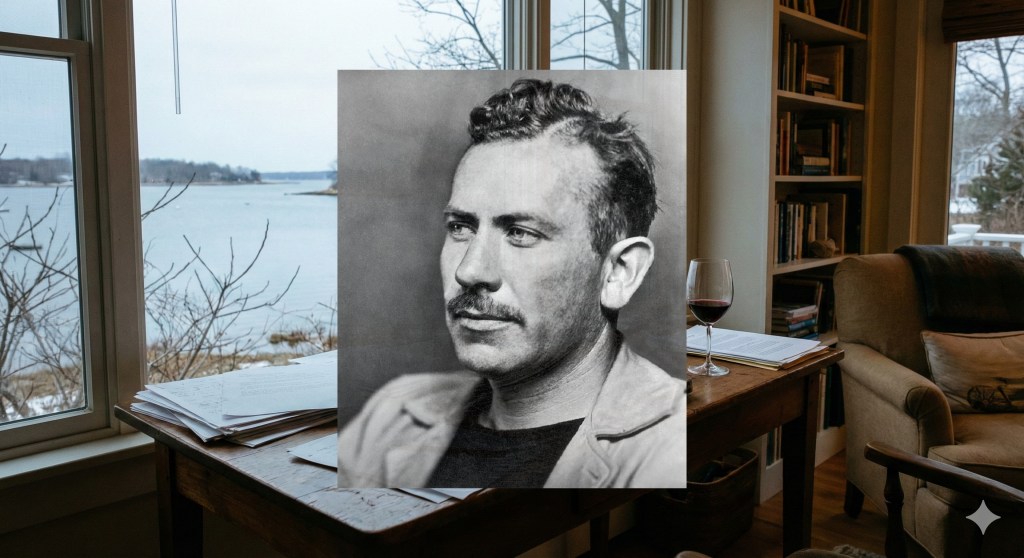
Ah, well. We are what we are. Ed is gone, and I am stuck with this pencil, this paper, and these eyes that can’t stop searching for the story. So, I suppose I’ll pour myself a glass of wine, look out the window, and get back to work. The tide is always coming in, and there is always something left to say.
Bob Lynn | © 2026 Vox Meditantis. All rights reserved.


 Vox Meditantis
Leave a reply to Steven S. Wallace Cancel reply