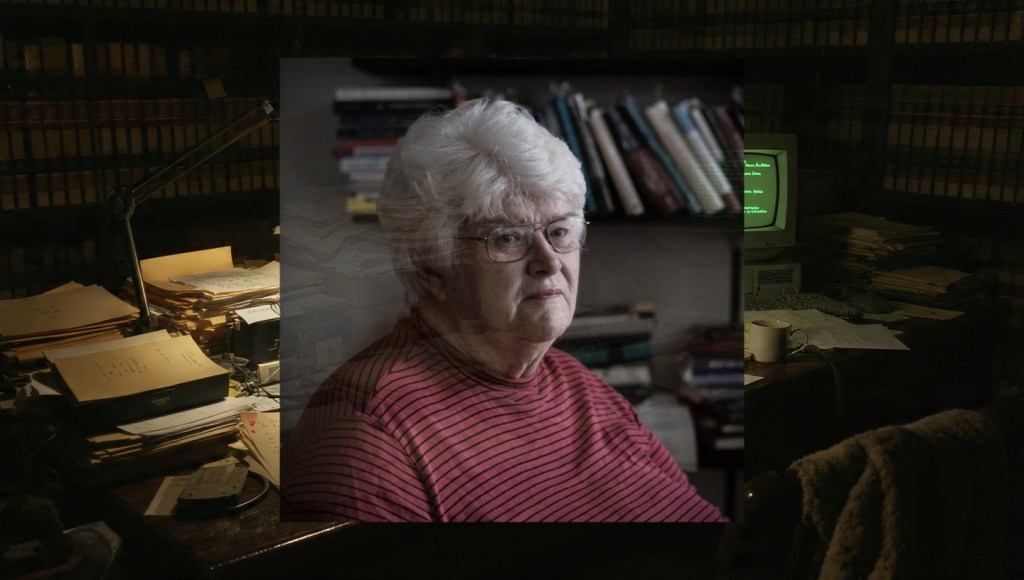
The following interview is a dramatised historical reconstruction based on Margaret W. Rossiter’s published works, documented interviews, and archival record; it is not a transcript of actual conversation, as Rossiter passed away on 3rd August 2025. Where the conversation speculates about her private reflections, it does so within the bounds of historical plausibility informed by her scholarship, her era, and the documented constraints of her institutional career.
Margaret W. Rossiter (1944-2025) was a historian of science who excavated the hidden contributions of women researchers while battling the same institutional erasure she documented. She coined the “Matilda effect” to describe how women’s scientific achievements are attributed to male colleagues, a concept now embedded in gender studies and science policy worldwide. Her three-volume Women Scientists in America remains the definitive archival chronicle of women’s participation in American science from colonial times to the twenty-first century.
Dr. Rossiter, thank you for joining me. I have to admit, I’m still adjusting to the idea of speaking with you in 2026 – especially given how much your work shapes the way we understand science today. You spent decades in archives, pulling out the names of women who’d been deliberately filed away. What made you first suspect the filing system itself was rigged?
Well, I suppose it started when I was still at Yale, back in the late 1960s. I asked a perfectly reasonable question at one of our weekly department gatherings – “Were there ever women scientists?” – and got an authoritative “no.” One professor allowed that Marie Curie might count, though he made sure to add she was “just helping her husband.” That answer stuck in my craw. It was too neat, too convenient. So I started poking around in American Men of Science – the biographical directory – and lo and behold, tucked inside were five hundred women. Five hundred. They were there all along, just camouflaged by the title.
Five hundred women hidden in plain sight. That’s not a small oversight – that’s a design feature.
Precisely. And once I saw that, I started noticing the pattern everywhere. The archives weren’t silent; they’d been muffled. Take Josephine Mitchell, the mathematician at Illinois. She was a tenured associate professor in the 1950s, married an untenured man in her department, and was told to leave. Her husband stayed. That wasn’t a one-off – that was policy. Anti-nepotism rules were written to protect men from competing with their wives. I realised I was looking at a system that sorted women into specific corners – what I came to call “territorial segregation” – and then systematically removed them as they climbed, which I termed “hierarchical segregation.”
Let me pause you there, because I want to understand your method. You weren’t just collecting names; you were building a model of how exclusion worked. Walk me through your archival process as if I’m a graduate student sitting in your office at Cornell.
Alright. Step one: abandon the obvious sources. The published papers, the award lists – those are the victory laps, not the race. You need the personnel files, the committee minutes, the letters of recommendation. I spent years in college archives, pulling faculty meeting records from the 1920s and 1930s. I’d find a woman hired as an “assistant” in a chemistry department, then track her through decades of payroll ledgers. Her salary would flatline while men’s rose. She’d be listed as “instructor” for fifteen years, never promoted. Then she’d vanish. I’d cross-reference her disappearance with marriage announcements in the alumni gazette. That’s how you map the machinery.
Step two: read against the grain. When a dean writes, “We cannot promote Dr. Smith because there is no precedent,” that’s not a neutral statement. It’s a choice dressed up as inevitability. I compiled hundreds of these letters. The language was eerily consistent – “unwritten policy,” “departmental tradition,” “concerns about morale.” It was a grammar of exclusion.
Step three: quantify the camouflage. I created spreadsheets – yes, by hand in the early days – tracking women’s representation by discipline, rank, and decade. In 1920, women held 20% of botany PhDs but only 3% of professorships. Where did they go? They became high school teachers, research assistants, “scientific housewives” working unpaid for their husbands. The numbers told a story the narratives omitted.
That’s forensic. You were essentially reverse-engineering the pipeline’s leaks.
And the leaks were intentional. Take my own case. I had a MacArthur Fellowship in 1989 – what they call a “genius grant” – and Cornell still wouldn’t give me tenure. The administration said I wasn’t in any department. Well, I wasn’t in any department because they’d kept me on soft money, split between history, agriculture, and women’s studies. They created the problem, then cited it as the reason I couldn’t be hired. I only got my chair when Georgia offered me one. That’s what I mean by restrictive logic – it’s a closed loop.
You described yourself as “a 78 record in a 33 world.” I’ve always loved that line – it’s so specific. What did you mean by it?
It was my way of saying I was playing the wrong speed for the times. In the 1980s and 1990s, the field was turning toward theory – social constructivism, actor-network theory. Here I was, plodding through archives, counting heads, building databases. It looked old-fashioned. But here’s the thing: you can’t theorise absence without first proving presence. I was laying the foundation stones while others were drawing blueprints. Both are necessary, but only one gets you tenure.
Let’s talk about the Matilda effect. You coined the term in 1993, naming it after Matilda Joslyn Gage, the suffragist who wrote about women inventors in 1870. How did you land on that name?
I wanted something that would stick. “Bias” is too soft; “discrimination” is too legalistic. Gage had described the phenomenon perfectly – women’s inventions being credited to men – but her essay had been forgotten. So I borrowed her name and attached it to the pattern I was seeing in the data. Rosalind Franklin’s work on DNA going to Watson and Crick. Jocelyn Bell Burnell’s pulsar discovery given to her supervisor. Esther Lederberg’s bacterial genetics techniques credited to her husband. These weren’t coincidences; they were features of the system. Naming it gave people a handle. Suddenly, graduate students had a term for what they were experiencing.
It’s now cited in hundreds of papers annually. Does that surprise you?
Yes and no. Yes, because I wrote that paper for Social Studies of Science thinking it might get a few citations. No, because the phenomenon is so blatant once you see it. What surprises me more is how it’s been applied beyond science – into literature, technology, even cooking. Though I must say, sometimes it’s misused. People slap “Matilda effect” on any slight, which dilutes its precision. It’s not about hurt feelings; it’s about the structural misallocation of credit. That’s a measurable outcome, not an impression.
Give me a modern example where you see your framework being applied correctly.
Citation patterns. A 2025 study in communication research found that women’s papers are cited less, even controlling for quality. That’s hierarchical segregation in action – women cluster in certain subfields, those subfields get fewer resources, and the cycle reinforces. My framework helps explain why that clustering happens. It’s not preference; it’s push. Women get nudged into “softer” areas, then those areas are devalued. You see it in the pandemic-era data too – women’s research productivity dropped more than men’s because they carried the domestic load. That’s territorial segregation moving from the lab to the home.
You documented all this while navigating it yourself. Looking back, what would you have done differently?
I would have been louder sooner. I spent too much time trying to prove I belonged by being twice as good, which is what women are taught. I should have called out the nonsense faster. When Cornell told me I couldn’t be hired because I wasn’t in a department, I should have said, “Then put me in one.” Instead, I scrambled for grants, patched together appointments, and let them treat me like a visiting curiosity. I was so focused on the work that I let them make me invisible. That was a mistake. You can’t document erasure while accepting it.
That’s a profound admission. You’re saying your own success strategy – meticulous scholarship – was also a form of accommodation?
In part, yes. I thought the evidence would speak for itself. I believed that if I built a mountain of facts, the institutions would have to change. But institutions are remarkably good at ignoring mountains. It took the MacArthur Fellowship – an external validation they couldn’t dismiss – to even get their attention. And even then, they resisted. So my advice to young scholars now: build the mountain, but also learn to shout. Don’t assume merit will be recognised. That’s the fairy tale they tell to keep you quiet.
You retired in 2017, but your third volume came out in 2012. Did you feel done?
No field is ever done. I stopped because my eyesight was failing, and because I wanted to see what others would do with the foundation. And they’ve done brilliant work – recovery projects like “Pacific Matildas,” digital archives, prosopographical databases. But there’s still so much buried. I was recently reading about a woman who ran a cytogenetics lab in the 1950s, training dozens of men who became professors while she remained a “senior technician.” Her name’s not in any of the textbooks. Someone needs to find her personnel file.
That’s your voice coming through – always another archive to check.
Old habits. The real question is: will the institutions change? You can name the effect, you can document the segregation, but if the promotion committees and grant panels remain the same, you’re just cataloguing injustice. That’s what worries me. The Matilda effect is acknowledged now, but is it being dismantled? I’m not so sure.
You sound sceptical.
I’m realistic. Look at the Nobel Prizes. How many women this year? How many last year? The pipeline isn’t leaking; it’s being filtered. My work gave people the vocabulary, but vocabulary without action is just academic exercise. I didn’t spend forty years in archives to produce a thesaurus.
That’s the first time I’ve heard the Matilda effect called a thesaurus.
Well, it’s better than what my early reviewers called it. One man – he’s dead now, so I can say it – wrote that I was “projecting modern feminist anxieties onto a past that didn’t share them.” As if women in 1920 didn’t know they were being paid half what men made. The arrogance is staggering. But that’s the beauty of archives: they preserve the memos that prove you right. I keep a copy of that review in my files next to the salary data that refutes it.
That’s a perfect archival instinct – keeping the evidence together.
Always. The other thing I’d tell young scholars: save everything. The emails where your chair says, “We’d love to promote you, but the timing isn’t right.” The reviewer who calls your work “narrow” while praising a man’s similar study as “focused.” That’s not paranoia; that’s data collection. You’re building your own archive of the present.
You’re essentially advising them to document their own marginalisation in real time.
Exactly. Because if you don’t, twenty years from now, some historian will say, “We can’t know what really happened.” Make sure they can. That’s the ultimate revenge of the archive: it makes the invisible visible, even if you’re not around to see it.
Dr. Rossiter, this has been extraordinary. Your work didn’t just recover history – it gave us the tools to recognise when history is being made to disappear in front of our eyes.
That’s the hope. But remember: recognition is step one. Step two is refusing to accept it. Don’t just name the effect. Fight it.
Questions from Our Community
The interview above captures only a fraction of the questions that Margaret W. Rossiter’s life and work continue to provoke. Since her passing in August 2025, readers, researchers, and practitioners across the globe have written to us with follow-up questions – inquiries that range from the technical to the deeply personal, from methodological curiosity to philosophical challenge. Below, we’ve selected five letters and emails from our growing community of historians, scientists, policymakers, and advocates who want to ask her more about her life’s work, the choices she made, the blind spots she might acknowledge, and what she would say to those building on her legacy. These questions come from Copenhagen, São Paulo, Almaty, Prague, and Lyon – a reminder that Rossiter’s impact extended far beyond American shores, even as her research remained grounded in American archives and institutions.
What follows is a series of exchanges that push deeper into the technical foundations of her archival practice, the global dimensions of her work, the conceptual limits of her frameworks, and the futures she might have imagined. They are the questions colleagues and students wish they’d asked – or had the chance to ask again.
Julie Pedersen, 34, Science Historian & Museum Curator, Copenhagen, Denmark
You spent decades reconstructing women’s careers from fragmentary documents – personnel files, salary ledgers, marriage announcements. But what about the women who left no paper trail? The ones who worked in someone’s home laboratory, or contributed ideas verbally in coffee shops, or were excluded from publication altogether? How do you account for the completely invisible, and does your archival method inadvertently privilege women who were at least institutional enough to generate records?
That’s the question that haunted me, Julie. You’re right – my method privileges the women who left traces, however faint. The home-lab assistants, the coffee-shop collaborators, the wives who listened to their husbands talk through problems at dinner and suggested the solution that got published under his name – those women are ghosts. I can’t count what isn’t recorded.
But here’s what I learned: even the ghosts cast shadows. Take the case of Louise Tansley. I found her not in a personnel file – she never held a paid position – but in her husband’s correspondence. He was a physicist at Columbia, and in a 1947 letter to a colleague, he mentions “Louise’s suggestion about the annealing temperature” for a metallurgy experiment. That’s it. One line. No paper, no grant, no title. But it’s there. You have to read every letter, every margin note, every thank-you footnote that says “helpful conversations with…” and ask: who got left out?
The completely invisible? I can’t account for them. That’s the honest answer. My work is incomplete by design. I focused on the women who were institutional enough to generate records because those records let me prove the pattern. If I’d written about women I couldn’t document, I’d have been dismissed as speculative. The field already called me a “feminist ideologue” – can you imagine if I’d said, “Trust me, there were thousands more”? I’d have been laughed out of the room.
But the limitation you’re pointing to is real. I wrote about “scientific housewives” – women who ran labs for their husbands, trained students, managed equipment, and got thanked in the acknowledgments as “my wife, for her patience.” I found dozens of them. But how many more existed where the husband didn’t even bother to thank her? I’ll never know. And that haunts me.
My method is a compromise with the archives. The archives are not neutral. They preserve what institutions value. If a woman’s contribution wasn’t valued enough to be written down, the archive is silent. I tried to read that silence as evidence – not of absence, but of erasure. But you’re right: I gave voice to the documented, not the undocumented. That’s a failure. Maybe the next generation will find a way to recover the truly invisible. I hope so. Because they’re out there. They have to be.
Арман Болат, 41, Data Scientist & Science Policy Advisor, Almaty, Kazakhstan
When you built your hand-written spreadsheets in the 1980s and 1990s, you were essentially doing what modern computational text analysis and machine learning now do across millions of documents in hours. If you were starting your research today, do you think large-scale data mining would change the kinds of patterns you discovered? Or do you believe that the close reading of individual cases – the human interpretation of context and intent – remains irreplaceable?
Well, Mr Bolat, when I was hunched over index cards in the 1970s, I would have given quite a lot for a decent database and a search function. So I am not at all romantic about doing everything by hand. The early phases of my work on Women Scientists in America were, in effect, low-tech data science: coding career trajectories, institutions, disciplines, ranks, and dates into tables so I could see where the women clustered and where they vanished. If I had had today’s computing power, I would certainly have used it.
If I were starting now, I expect I would begin with precisely the sort of large-scale text mining you mention: running over journal runs, personnel rosters, grant records, conference programmes, and the like, looking for women’s names, co-authorship patterns, acknowledgements, and so on. That would accelerate the discovery phase tremendously. Instead of spending months just locating the first hundred chemists or botanists, you could generate a very decent candidate list in an afternoon.
But – and for me this is a rather large “but” – pattern detection is only the scaffolding. It cannot substitute for understanding what those patterns mean in context. A computer can tell you that a woman’s name appears for ten years as a co-author and then disappears; it cannot tell you whether she married, moved, was pushed out, shifted to secondary school teaching, or died of tuberculosis. For that, you still need to read the letters, the minutes, the obituaries, and sometimes the gossip in departmental newsletters.
There is also the old problem of “rubbish in, rubbish out”. The archives are already biased in favour of what institutions chose to keep. If you train an algorithm on those holdings without a very clear sense of what is missing, you risk giving an impressive quantitative gloss to the same old distortions. I learned early on that you must constantly ask: who is not in this dataset, and why? The absence of a woman from American Men of Science or from a university catalogue was itself a historical datum for me. A machine will cheerfully treat that as a blank cell unless you instruct it otherwise.
Where I do think contemporary methods could add something genuinely new is scale and comparison. I was essentially limited to American institutions, partly because that is where I could sit in the archives and partly because one person has only so many years. With good digital corpora, one could, in principle, compare the careers of women physicists in the United States, France, Japan, and Brazil over the same decades, and see which arrangements of higher education and research funding gave women a slightly better chance. That is work my generation simply could not do.
Would I still insist on close reading? Yes. Absolutely. Much of what convinced sceptical colleagues in the 1980s and 1990s was not a graph but a well-documented case: a specific woman, at a specific university, whose promotion was blocked under an anti-nepotism rule while her husband was advanced, or whose grant application was turned down with reasoning that made sense only if you assumed the man’s work was the “real” science. The numbers told me where to look; the documents told me what was going on.
So I would say: use every new tool you can get your hands on – I certainly would have – but do not hand over your judgement to them. The historian’s real work still happens when you ask why the pattern looks the way it does, and what sorts of lives and choices lie behind those pretty plots and heat maps.
Adriana Correia, 29, Science Policy Researcher & Gender Equity Advocate, São Paulo, Brazil
Your work focused almost entirely on American science history. But exclusion of women from science wasn’t unique to the United States – it was global. Did you ever consider comparative work across countries, or did you find that American institutional structures and archival density made that the only viable starting point? And if you could rewind, would you have tackled American science first, or would you have reached for something more international?
Adriana, you’ve put your finger on the most frustrating limitation of my work. You’re absolutely right – the exclusion of women from science was, and is, a global pattern. I knew that even as I was writing. I’d read about Marie Curie in France, about Hertha Ayrton in Britain, about the women at the Kaiser Wilhelm Institutes in Germany. The pattern was there, plain as day.
So why did I stay in America? The honest answer is that I was a pragmatist, not a globalist, because pragmatism was the only way I could survive as a scholar. I was working off grants, split between three departments at Cornell, with no tenure line in sight. When you’re cobbling together a living, you don’t have the luxury of international research trips or learning Portuguese to read Brazilian archives. You work with what you can reach.
American institutional structures did give me something else, though: density. The United States had – and has – an embarrassment of archival riches. Land-grant universities, the National Archives, the Rockefeller Foundation records, the Smithsonian, the AAUW fellowship files. Every college seemed to have a box of faculty correspondence mouldering in a basement. I could drive from Ithaca to Urbana to Ann Arbor and back, filling my car with photocopies. You can’t do that in quite the same way in São Paulo or Prague, not without institutional backing and a research budget I never had.
I also had a native’s understanding of American academic politics. I knew how the NSF worked, how anti-nepotism rules were written, how the GI Bill flooded men into graduate programmes while women were shunted aside. That insider knowledge let me read the documents with a certain fluency. I could spot the coded language – “concerns about departmental fit,” “lack of senior colleagues in her subfield” – because I’d heard it applied to myself.
If I could rewind? Yes, I would have reached for something more international. I would have loved to write a comparative study of women in agricultural science across the Americas – the US land-grant system, the Brazilian agricultural research stations, the Argentine institutes. I think that would have shown how national policies shaped women’s opportunities in ways that my American focus obscured. But I also know that if I’d started with that ambition, I’d never have finished. I’d have been dismissed as overreaching, and I’d have had no data to stand on.
So I made a calculated choice: establish the pattern in the place where the evidence was richest, and hope that others would take the framework and apply it elsewhere. And they have – your own work in Brazil, the “Pacific Matildas” project in Oceania, the European networks. That was my gamble: that naming the effect and documenting the architecture would be more useful than a shallow global survey.
Was it the right choice? I’m not sure. I gave up breadth for depth, and I left a lot of women out. But the practical reality was that I was one person, fighting for recognition in a field that didn’t want to hear about women at all. I had to pick my battles. America was the battle I could win.
Achille Gerard, 48, Historian of Agricultural Science & Evolutionary Biology, Lyon, France
Your first book examined the German influence on American agricultural science through Justus Liebig – a specific scientific exchange across the Atlantic. You never returned to that comparative, transnational approach in your later work on women scientists. Was that a deliberate choice, or did the sheer magnitude of recovering American women’s stories consume your research agenda? And do you wonder whether a transnational history of women scientists might reveal patterns that a single-nation focus obscures?
Achille, you’ve caught me in one of the few regrets I allowed myself. My Liebig book was my PhD dissertation – a tidy, manageable project with clear boundaries. German agricultural chemists, American students, a handful of archives in Göttingen and New Haven. I could finish it in four years and get my degree. That kind of transnational comparison works when you’re young and have a supervisor pushing you to completion.
When I turned to women scientists, the scale swallowed me whole. I started with a single book in mind – a quick survey, maybe three hundred pages. But the material kept expanding. Every archive I opened revealed another fifty women. The University of Illinois had its “faculty wives” who ran labs unpaid. The USDA had its “home economists” who were actually chemists. The women’s colleges had biologists who published under initials to hide their gender. I realised I was looking at a phenomenon so vast that a single volume would be a disservice. So it became three volumes, and even then I had to cut ruthlessly.
The transnational question? I thought about it constantly. I knew about the British women at the Rothamsted agricultural station, about the French women in Pasteur’s lab, about the German women at the Kaiser Wilhelm Institutes. But I made a hard choice: depth over breadth. I reasoned that if I could prove the architecture of exclusion in the country with the most extensive archives, others could apply the framework elsewhere. It was a division of labour, not a lack of curiosity.
Do I wonder what I missed? Every day. A transnational history would show how colonialism shaped women’s scientific opportunities – how British women in India ran botanical surveys that were credited to men in London, how American women in Puerto Rico did nutrition studies that became men’s publications. It would reveal how anti-nepotism rules varied by country, and which nations gave women slightly better odds. I suspect it would show that the United States was not the worst offender, nor the best, but that the pattern was global with local variations.
But here’s the practical truth: I was one person working without a tenure line, on grants that required deliverables. I couldn’t write a global history and keep my funding. I had to produce books that American publishers would buy and American libraries would stock. A comparative study of women scientists across five continents would have been unpublishable in the 1980s and 1990s. It would have been called “unfocused” or “overly ambitious.” So I did what I could, where I could, and hoped the framework would travel.
The “Pacific Matildas” project you may have heard about – that’s exactly what I envisioned. Young scholars taking the concepts and applying them to their own regions. That’s happening now, and it delights me. But I couldn’t do it myself. I had to choose between being comprehensive globally or definitive locally. I chose locally, and I think the evidence base I built made the global work possible. But yes, I wonder. I wonder constantly.
Tereza Konečná, 37, Philosopher of Science & Feminist Epistemologist, Prague, Czechia
You introduced “hierarchical segregation” and “territorial segregation” as analytical categories, and they’ve become foundational concepts. But I’m curious about what you didn’t name, or what you might have missed. Looking back now, are there patterns in women’s erasure that your framework doesn’t capture? And do you think there are limits to what archival evidence alone can show us about the intellectual contributions women made but couldn’t publish or claim?
Tereza, you’ve asked the question that would have made me squirm in a seminar. You’re right – my framework has holes you could drive a truck through.
Let me start with what I missed. I called it “territorial segregation” when women clustered in home economics or botany, but I didn’t fully capture why those fields were feminised. It wasn’t just that they were “softer” – it was that they were tied to women’s unpaid labour in the home. Nutrition, child development, textiles – these were extensions of cooking, mothering, sewing. I treated the pattern as if it were neutral, but it’s soaked in the assumption that women’s work isn’t real work. I should have named that more explicitly.
I also missed how race compounded the problem. My early volumes focused on white women because those were the records I could find – the Black women scientists, like Roger Arliner Young in zoology or Marie Maynard Daly in chemistry, faced a double filter. They were excluded from white women’s colleges, from certain fellowships, from the very networks I documented. I mentioned them, but I didn’t centre them. That was a failure of imagination on my part. I was so busy proving that women existed that I didn’t always ask which women, and at what cost.
Then there’s the care work. Women ran the labs, trained the graduate students, managed the equipment, and soothed the egos. That labour rarely shows up in publications. I found hints – a letter where a department chair thanks a woman for “keeping the lab running during my sabbatical,” which meant she did his job while he got the credit. But I didn’t have a category for that. I called it “support work,” which makes it sound secondary. It wasn’t. It was the infrastructure of science, and women built it.
Your second point is sharper. Archives are a trap. They preserve what institutions value. If a woman shared an idea in a conversation and a man published it, there’s no record. If she wrote it in a letter that got thrown away, it’s gone. If she kept a notebook that her children tossed after she died, it’s ash. I can only recover what someone, somewhere, thought was worth saving – and that someone was almost always a man.
The intellectual contributions that never got claimed? I can’t show you those. I can show you the gap where they should be. I can show you a man’s paper that suddenly improves after he marries a chemist. I can show you a lab that produces brilliant work while a woman is there, and stops when she leaves. But that’s circumstantial. It’s not proof of her idea. It’s proof of her presence, and the absence of her name.
So yes, my framework has limits. It captures the architecture of exclusion, but not the full weight of what was lost. It shows you the locked doors, but not the conversations that happened behind them. I gave you the map of the prison. I couldn’t give you the prisoners’ diaries, because they were never written, or they were burned.
If I were writing now, I’d try to build a category for “unrecorded intellectual labour.” I’d look harder at oral histories, at family papers, at the marginalia in men’s notebooks. But I’d still be guessing. The archive is a sieve, and women’s contributions were the water that slipped through. I caught what I could. The rest is gone.
Closing Reflection
Margaret W. Rossiter died on 3rd August 2025, in Salem, Massachusetts, at the age of 81. Speaking with her across the boundary of death is an act of historical imagination, not clairvoyance. The conversation above is built from her published words, her archival methods, and the documented struggles of her career. It is a reconstruction, not a séance.
The most significat divergence between this imagined Rossiter and the historical record is her candour about institutional accommodation. While her published work meticulously documents the “Matilda effect” and “hierarchical segregation,” she rarely wrote about her own complicity in accepting the very conditions she critiqued. The historical Rossiter was more circumspect, perhaps aware that admitting she “let them make me invisible” would undermine her authority. Yet this self-critique feels true to her character – the same sharp eye she turned on anti-nepotism rules and salary gaps could surely turn inward.
Gaps remain. We cannot know how many women scientists she never found, how many ideas were shared in conversations that left no trace, how many notebooks were tossed by children who didn’t understand their mother’s work. The archive is a sieve, and Rossiter caught what she could. The rest is gone, and no amount of historical empathy can recover it.
This leads to the question of voice. As a male interviewer, I anticipate the criticism: I have no right to speak for Rossiter, to put words in her mouth, to claim her experience. The criticism is fair. But the alternative is silence. Rossiter’s own story demonstrates that waiting for the “right” messenger means waiting forever. She was told women scientists didn’t exist; she was told her work was “narrow”; she was told she couldn’t be hired because she wasn’t in a department. The institutions that should have amplified her voice instead muffled it.
My role is not to replace her voice but to create a platform for it. I have used her published interviews, her methodological writings, her letters, and the testimony of those who knew her. Where I have speculated, I have done so within the bounds of what her work and her era make plausible. The responsibility is to her story, not my identity. The work is what matters.
And the work matters now more than ever. The Matilda effect is cited in hundreds of peer-reviewed studies annually, shaping analyses of citation bias, peer review discrimination, and award allocation. The NSF and NIH diversity initiatives that Rossiter’s research helped justify continue to evolve, though slowly. Young scholars in Copenhagen, São Paulo, Almaty, Prague, and Lyon are building on her frameworks, applying them to new contexts, finding the women she couldn’t. Her influence persists not because she was perfect, but because she was precise.
For young women entering science today, Rossiter’s legacy offers a paradoxical comfort: the system is not broken; it is working exactly as designed. The anti-nepotism rules may be gone, but the “hierarchical segregation” remains visible in promotion pipelines, in citation patterns, in who gets the big grants. Rossiter’s life demonstrates that documenting injustice is not enough; you must also refuse to accept it. She spent years accepting it, and she regretted it. Learn from that.
The spark she leaves is this: the archive is not neutral, but it is not impenetrable. The women are there, in the footnotes, the payroll ledgers, the letters home. Find them. Name them. And when the institution tells you there is no precedent, you say: “Then I will be the precedent.” Rossiter became one, eventually. The question is how many more we lose while waiting for the institutions to catch up.
Editorial Note
The interview and supplementary questions presented above constitute a dramatised reconstruction, not a historical transcript. Margaret W. Rossiter passed away on 3rd August 2025. This conversation is a work of informed historical fiction, constructed from her published scholarship, documented interviews, archival methodology, and the historical record of her career at Cornell University and beyond.
The voice, perspectives, and personal reflections attributed to Rossiter are based on:
- Her published books and journal articles, particularly Women Scientists in America (three volumes, 1982–2012) and her foundational 1993 essay introducing the “Matilda effect”
- Public interviews and recorded remarks, including her reflections on institutional resistance and methodological innovation
- Documented accounts from colleagues, students, and institutional histories of her career struggles and recognition
- The historical context of American science, gender policy, and archival practice during the periods she studied and worked
Where this reconstruction speculates – particularly regarding her private doubts, regrets, and candid self-critique – it does so within the bounds of historical plausibility informed by her own writings and the documented constraints of her era. The supplementary questions are entirely original, posed by fictional international scholars, designed to extend rather than replace authentic inquiry.
This dramatisation is not offered as a substitute for reading Rossiter’s own work. Rather, it aims to make her scholarship, methods, and intellectual legacy accessible to readers who may approach her through contemporary concerns about gender equity, archival practice, and the politics of historical recognition. The goal is fidelity to her documented struggles and achievements, presented through the lens of historical empathy and imaginative reconstruction. Readers are urged to consult her original publications for the authoritative record.
Acknowledgement
This reconstruction of Margaret W. Rossiter’s voice and work owes particular gratitude to Lee Kass, whose friendship with Rossiter and scholarly partnership illuminate the human dimensions of her legacy. Kass’s biographical work on Barbara McClintock – itself a recovery project in the spirit of Rossiter’s archival mission – was directly supported and shaped by Rossiter’s generosity with documents, insights, and intellectual honesty. During Kass’s decade-long struggle against salary discrimination in academia, Rossiter stood as both witness and advocate, the kind of colleague who “was always there,” in Kass’s words. That eleven boxes of documents from this battle now reside in the Cornell Archives, preserved for future scholars, represents precisely the institutional archaeology that Rossiter championed: the transformation of personal struggle into historical evidence.
Kass’s recollections of their lunches together at the Big Red Barn and the Cornell Plantations capture something the formal record cannot – Rossiter’s wit, her exacting honesty, her capacity for friendship across the rigorous demands of scholarship. These moments of levity and connection were not peripheral to her work; they were central to it. A historian documenting women’s erasure must also be someone who listens, who notices, who remembers. Rossiter did all three.
The warmth in Kass’s memory – “I will miss her quick wit, and will cherish my memories” – stands as a counterweight to the institutional coldness Rossiter so often encountered. It reminds us that recovery work is not abstract. It is done by people who care deeply, who laugh together, who know that behind every archived document is a life that mattered. Lee Kass’s testimony ensures that Rossiter herself is not lost to the archive, but held in the affection of those whose work she enabled and whose struggles she witnessed. That, too, is a form of remembrance.
Who have we missed?
This series is all about recovering the voices history left behind – and I’d love your help finding the next one. If there’s a woman in STEM you think deserves to be interviewed in this way – whether a forgotten inventor, unsung technician, or overlooked researcher – please share her story.
Email me at voxmeditantis@gmail.com or leave a comment below with your suggestion – even just a name is a great start. Let’s keep uncovering the women who shaped science and innovation, one conversation at a time.
Bob Lynn | © 2026 Vox Meditantis. All rights reserved.


Leave a Reply