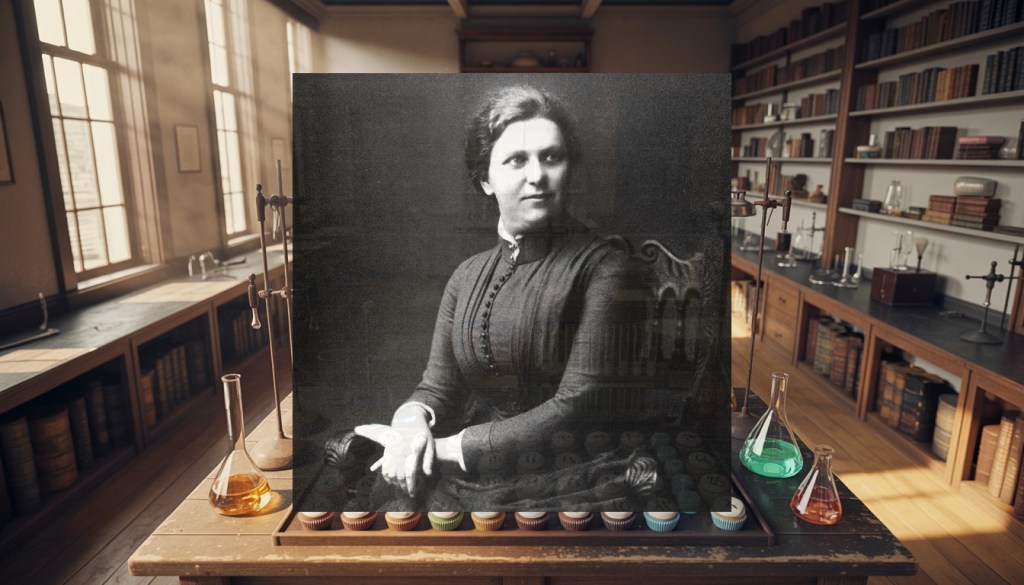
Ida Freund (1863–1914) arrived in England at nineteen with a prosthetic leg, minimal English, and a determination to master a science that institutions deemed unsuitable for women. Within a decade, she became the first female university chemistry lecturer in the United Kingdom, transforming how chemistry was taught – not through laboratory hierarchies or rote memorisation, but through cupcakes, careful reasoning, and the conviction that rigorous thinking could be joyful. More than a century after her death, chemistry educators worldwide unknowingly replicate her innovations, yet her name remains absent from the textbooks they follow and the periodic tables they bake. This conversation, conducted today, brings her into dialogue with the present: examining the apparatus she designed, the pedagogical philosophy that still guides active learning, and the question of how institutional barriers shape scientific progress even for those exceptional enough to breach them.
Miss Freund, thank you for joining us. We’re speaking in 2025 – over a century since your death. I wonder if you might begin by telling us about the nine-year-old girl who lost her parents, then her grandmother, and found herself on a boat to England with almost nothing. What do you remember of that journey?
Ah, you wish to know about the fractures before the foundation was laid. Yes, well – my grandmother’s death in 1881 was the final blow. My parents I had already lost, you understand, and suddenly I was orphaned entirely. The poverty that followed was acute. Vienna was no longer home; it had become a place of absence.
I remember the crossing. Not the boat itself, so much as the sensation of suspension – between what I had been and what I might become. My uncle Ludwig had written to say I should come to England, that there might be schooling, opportunity. I spoke almost no English. I was frightened, yes, but also strangely undeterred. Perhaps grief had already taught me that the world was not as I had imagined it; I was prepared, in that sense, to be remade.
What I did not anticipate was how thoroughly I would come to love chemistry. It offered something Austria never could: a language that transcended borders. Numbers, reactions, the logic of matter itself – these belonged to no nation. They were the same in Vienna and in Cambridge.
You were sent to Girton College against your wishes. Your guardian, Ludwig Strauss, insisted on it despite your reluctance. Why were you so resistant?
I was not opposed to education, you understand. I was opposed to authority disguised as benevolence. Ludwig meant well – he was genuinely concerned for my future. But I was nineteen years old, recently bereaved, struggling with English, and he simply decided that Girton College was the solution to my difficulties. He did not ask me. He informed me.
I found the entire prospect rather presumptuous. A girl newly arrived in a foreign country, thrust into a residential college with expectations of academic achievement whilst processing profound loss – it was insensitive, though I believe he did not perceive it as such. He imagined educational access was an unmixed good, a gift one ought to receive gratefully.
But this is precisely the difficulty with speaking of women’s opportunities as though they were freely chosen. Yes, I attended Girton. Yes, I excelled. But the narrative that I “seized” an educational opportunity obscures the fact that I had very little choice in the matter. My position was already constrained by circumstance – orphaned, poor, physically disabled following an accident I have never detailed publicly. Girton was not chosen; it was imposed. That I made something of it is perhaps fortunate, but one ought not confuse resignation with agency.
Yet you achieved first-class honours in the Natural Sciences Tripos despite – or perhaps because of – those constraints. What drew you specifically to chemistry?
Ah, now that is a different sort of question entirely. Chemistry drew me because it refused simplification. When I first encountered it at Girton, what I found so compelling was something peculiar: chemistry permitted one to hold contrary ideas simultaneously. A substance could be both complex and reducible to law. An experiment could fail instructively. The periodic table – Mendeleev’s arrangement had only been published in 1869 – represented something almost mystical to me: the order concealed within apparent chaos.
I also found chemistry deeply democratic, if I may use such a term. One did not require aristocratic patronage to discover a chemical reaction; one required only apparatus and careful observation. A woman and a man, given the same laboratory and the same question, could produce equally valid evidence. The laboratory was, in some respects, the only place where my sex became genuinely irrelevant – though of course this was not true of the institutions governing access to laboratories.
What captivated me most was understanding why reactions behaved as they did. I wanted to grasp not merely phenomena but causation. This led me inevitably toward physical chemistry and thermodynamics – those fields that explore the energetic foundations of chemical change. When I finally began teaching, this became my driving conviction: that students should never memorise a reaction without understanding the heat released, the particles rearranging, the fundamental mechanics underneath. Chemistry without that depth is merely pattern recognition. It is not science.
In 1890, you were appointed staff lecturer at Newnham College, Cambridge – the first woman in the entire United Kingdom to hold a university chemistry lectureship. You were twenty-seven. How did that appointment come about, and what was your first impression of the position?
It was not, I should clarify, an achievement that emerged from meritocratic principle. I was appointed because I was necessary. Newnham College required a chemistry lecturer to train its female students, and the male faculty were not willing to undertake that work. I was available, qualified, and – importantly – female, which meant I could enter the women’s laboratories without causing the sort of scandal that would have attended a male lecturer in such spaces.
The position was modest in every formal sense. My title was “staff lecturer,” a rank beneath that of a true fellowship. My salary reflected this. I had no access to the main university laboratories – those remained closed to women students until they had passed Part I of the Tripos. I worked in cramped quarters at Newnham, responsible entirely for chemistry instruction to young women, most of whom arrived with scant scientific background.
My first impression was one of profound inadequacy. I was alone. There was no chemistry department, no network of colleagues, no precedent for what I ought to do. I had to invent not only the curriculum but the apparatus, the laboratory protocols, the entire infrastructure. I remember standing in that small space and thinking: “This is either a tremendous opportunity or a tremendous burden. Possibly both.”
It became both. The isolation was sometimes unbearable. Male chemists at Cambridge largely ignored my work – I was not invited to seminars, not consulted on university matters, not regarded as a peer. Yet that very isolation forced a kind of clarity. I could not succeed by imitating what the male faculty did. I had to build something entirely new, grounded in pedagogical principle rather than institutional precedent.
Over twenty-three years, you taught hundreds of students. What was your philosophy of chemistry instruction, particularly for women arriving with minimal background?
I began with a radical premise: that women were not inherently less capable of understanding complex chemistry, but that they had been systematically deprived of the preparation that would make learning efficient. By the time a student arrived at my laboratory, she had often been discouraged from science in ways her male peers had not. She was told chemistry was masculine, difficult, unsuitable for refined sensibilities. These were not merely discouraging remarks; they were genuine obstacles to learning.
My first obligation was to demolish that conviction. I did this partly through rigour – I expected exacting work, precise thinking, intellectual honesty. A student who reported an experimental observation carelessly would face my correction. This had a peculiar effect: because I expected so much, students began to expect it of themselves. They understood that my criticism arose not from doubt in their capacity but from respect for their potential.
But rigour alone is insufficient. One also requires accessibility. This is where many educators fail. They present chemistry as a body of facts to be absorbed, rather than as a process of investigation to be understood. I organised my teaching around historical investigation. When teaching the law of conservation of mass, for instance, I would direct students to Lavoisier’s original papers. They would read his experimental methods, follow his reasoning, see where he encountered uncertainty. This approach required far more time than simply stating the law and expecting memorisation, but it produced something infinitely more valuable: actual understanding.
I also insisted that theory and practice remain inseparable. One cannot understand physical chemistry by listening to lectures; one must work with solutions, measure heat changes, observe the phenomena one is attempting to explain. This was not a novel idea – the great chemists had always worked experimentally – but within educational institutions, there was a dreadful tendency to treat experiment as mere illustration of theory already established. I reversed that: experiments came first, as questions. Theory emerged from the evidence.
Let’s discuss your apparatus design. You created the Freund tube for measuring gases, and you designed custom fume hoods that are still preserved at the Whipple Museum and Newnham’s Old Laboratory. What problem were you trying to solve?
The gas measuring tube emerged from necessity. The standard apparatus of the time – various forms of graduated tubes and displacement methods – were cumbersome and imprecise. They required the experimenter to manoeuvre glassware around moving liquid, introduced numerous opportunities for error, and were rather difficult to manipulate if one’s mobility was compromised.
I needed something more direct. The Freund tube is essentially a graduated tube with calibrations marked to indicate volume, fitted with a stopcock to regulate gas entry and exit. The design permits one to measure gas volumes with considerable accuracy – to within approximately 1 to 2 percent – whilst requiring minimal repositioning of the apparatus. One could operate it from a seated position, which was a significant advantage for me personally, though the broader principle is that the apparatus should accommodate the experimenter, not require the experimenter to accommodate the apparatus.
The fume hoods grew from a similar logic. The existing hood designs – simple chimneys, really – relied on buoyancy to draw noxious gases upward and away. They worked intermittently and required the experimenter to remain directly behind them, facing heated vapours. I redesigned them with improved baffle systems and an adjustable sash – a sort of glass panel one could raise or lower – that permitted the experimenter to adjust the opening based on the nature of the vapour and the height at which one was working. This vastly improved safety and comfort.
I did not regard apparatus design as subordinate to theoretical work. The apparatus is not merely a vehicle for discovery; it shapes what one can discover. A better fume hood does not simply make existing experiments more comfortable – it permits one to conduct experiments one could not previously have performed. A more precise gas tube does not merely confirm existing knowledge; it enables one to measure subtle variations that might otherwise have remained invisible. Apparatus design is experimental science.
Now, let’s address what has become your most famous – though largely unattributed – contribution: the periodic table of cupcakes, created around 1907. Can you walk us through how you conceived of this, and why you chose something so seemingly unconventional for rigorous chemistry instruction?
Ah yes, the cupcakes. I confess I find it rather amusing that this is what survives in popular memory, whilst my thermodynamics paper seems to have vanished into obscurity. But there is wisdom in that, I suppose. A cupcake is memorable in ways a paper is not.
The motivation was quite practical. Students struggled with the periodic table. They memorised positions without understanding the underlying principles. Mendeleev’s arrangement – based on atomic weight and chemical properties – was a profound intellectual achievement, but it was presented as though it were arbitrary convention, a collection of facts to be absorbed. I wished to make the table visible, tangible, comprehensible.
I was supervising a laboratory exercise in spring of 1907. A student had arrived late to the session, flustered and anxious. She was also holding a small paper bag – she had purchased sweets from a shop in Cambridge to settle her nerves. As she removed them, it occurred to me: what if the periodic table were something one could taste?
I began designing it that evening. The structure would follow Mendeleev precisely: periods arranged horizontally, groups vertically. Each element would be represented by a cake – I selected cupcakes specifically because they could be decorated on the top, where one could inscribe the element name and atomic weight in icing. The colour of the frosting would indicate valency and chemical family. The shape of the cake would correspond to electron configuration – though at that time we did not yet use such terminology; we spoke of combining power.
The divisions between sections were marked with Edinburgh Rock – a traditional Scottish confectionery that provides structure without obscuring the cakes beneath. I had the table constructed on a large board, perhaps two metres in length, and placed it in the laboratory before examinations. Students approaching their Tripos examinations needed to revise the periodic table; I thought: why not revise whilst enjoying something rather wonderful?
The response was extraordinary. Students would gather around this enormous board, studying the arrangement, discussing the relationships between elements, and eating. Eating! The act of consumption made the information memorable. They were creating kinaesthetic memories – they could recall the taste of a particular cake and therefore recall the element associated with it. This is not frivolous; this is sound pedagogy grounded in how human memory actually functions.
What troubled me about contemporary chemistry education was its aesthetics of deprivation. Chemistry was presented as austere, difficult, punitive. One was supposed to suffer through dense textbooks and memorise tables through sheer discipline. I believed this was both pedagogically ineffective and ethically wrong. Chemistry is about transformation, about beauty, about the marvellous rearrangement of matter. Why not reflect that in how one teaches it?
Some colleagues regarded the cupcakes as undignified. This amused me enormously. They seemed to believe that rigour and joy were mutually exclusive, that if one enjoyed learning chemistry, one could not possibly be learning it properly. I disagreed then and would disagree now.
Critics at the time might have argued that decorating cupcakes with element names was mnemonic ornament rather than true understanding. How would you respond to that charge?
A fair question, and one I did not dismiss in my own mind. The cupcakes were indeed mnemonics – they aided memory. But mnemonics need not be opposed to understanding. The difficulty arises when mnemonic devices are treated as ends rather than means.
The cupcakes were never meant to be the whole of instruction. A student arrived at the periodic table cupcakes only after having studied Mendeleev’s original work, understood the principles underlying atomic arrangement, and completed laboratory experiments demonstrating chemical families. The cupcakes served as a revision aid – a consolidation of knowledge already acquired, not a substitute for the labour of genuine learning.
Furthermore, the very act of studying the cupcake table involved continued reasoning. A student observing that copper, silver, and gold – all arranged vertically in the same group – were represented with identical frosting colours, would ask why. This would lead back to discussion of chemical properties, combining power, the deeper patterns Mendeleev perceived. The cupcakes prompted inquiry rather than concluding it.
I would grant that some students might have stopped at memorisation. Some always do, regardless of pedagogy. But I attempted to design instruction such that curiosity would be rewarded. The most inquisitive students – and these were typically the ones most capable of advanced work – would use the cupcakes as a springboard to deeper investigation.
I also created complementary teaching aids. Boxes of chocolates, for instance, each wrapped with a biographical note and portrait of a great chemist – Lavoisier, Dalton, Priestley. The exercise was not to eat chocolate mindlessly but to study these figures’ contributions whilst reflecting on their methods, their errors, their innovations. One might consume a piece of chocolate whilst reading about how Priestley discovered oxygen, and this multisensory experience would create associations that pure reading could not. Again, this is not frivolous ornament; this is applied neuroscience, though we did not have terminology for it at that time.
You published two major textbooks: *The Study of Chemical Composition* in 1904, and *The Experimental Basis of Chemistry* in 1920, posthumously. The first departed radically from conventional chemistry texts by teaching through close reading of primary sources rather than systematic fact-presentation. How did you develop this approach, and what resistance did you encounter?
I wrote The Study of Chemical Composition because I was infuriated by existing textbooks. They presented chemistry as a collection of settled facts, a body of knowledge one absorbed and repeated. Where was the human reasoning? Where was the intellectual labour? Where was any indication that chemistry had emerged through struggle, error, revision, and argument?
My approach was deliberate: I would select a particular chemical problem – say, understanding the nature of atomic combination – and then present the actual research papers wherein scientists had addressed that problem. A reader would follow Lavoisier’s experiments determining the weights of reactants and products, would confront the questions he had been unable to answer, would see how Dalton approached the problem differently. One would understand not merely the conclusion but the reasoning that had generated it.
This was extraordinarily time-consuming to write. I had to locate original papers – many in foreign languages, published across decades – and I had to reproduce enough of their reasoning that a student could genuinely follow the argument without requiring the full papers at hand. The resulting text was far shorter than conventional treatises, but far richer in intellectual content.
The resistance was predictable. Conservative educators believed I was being inefficient – why require students to read Lavoisier when one could simply tell them the conclusion? Surely this was archaic, unsuited to modern pedagogical efficiency. I disagreed fundamentally. Efficiency in education is often confused with brevity, but true efficiency involves learning something so thoroughly that it is retained and comprehended, rather than memorised and forgotten. Lavoisier teaches one not merely a fact but a method of thinking. That is superior efficiency.
Some also objected on the grounds that women students were not capable of reading and interpreting primary sources. This was profoundly patronising. Women were capable of complex reasoning; they had simply been discouraged from attempting it. Once I placed demanding texts in their hands, they rose to the challenge. I was not being cruel; I was being respectful. I was saying: you are intelligent enough to engage with real science.
The second book, The Experimental Basis of Chemistry, represented a slightly different challenge. I had intended to create a laboratory manual grounded in experimental rather than theoretical foundations. The premise was that students should understand principles through careful experiment, that theory should emerge from observed phenomena rather than being imposed upon them. I had drafted ten of the planned twenty chapters when my health declined.
It was rather humbling to have colleagues complete work one had begun. Arthur Hutchinson and Mary Beatrice Thomas were extraordinarily faithful to my intentions – they worked from my notes, my laboratory records, conversations with students. But one always wonders whether the final product resembles what one would have created oneself. Posthumous publication is a peculiar form of authorship.
You also published a substantial research paper in German in 1909 on the effect of temperature on volume change during neutralisation reactions. This was rigorous experimental work on chemical thermodynamics. Why did you publish in German rather than English, and why did this remain your only significant research publication?
I published in German because I was corresponding with continental chemists engaged in similar work, particularly regarding thermodynamic questions. The intellectual centre for physical chemistry was not entirely in Britain; German universities were undertaking remarkable work on heat capacity, entropy, and the energetic foundations of reactions. I wished to contribute to that conversation directly, rather than reporting my findings in isolation within the English literature.
The reason I produced only one research paper is not mysterious, though it is unpleasant to state plainly. I had no time. A single chemistry lecturer cannot simultaneously teach all chemistry to an entire college of women, design new apparatus, write textbooks, and conduct original research. Male chemists typically had assistance – a demonstrator, a technician, perhaps a research assistant. I had none. I had myself, for twenty-three years.
Every moment spent on research was a moment not spent preparing lectures, marking students’ work, or innovating in the laboratory. I chose to prioritise teaching because I believed my obligation to my students took precedence. This was not an entirely free choice, you understand. It was constrained by my circumstances: the only woman chemistry lecturer in Britain could hardly neglect her students in favour of advancing her own research profile. I would have been perceived as selfish, as proving that women are unsuited to serious academic work.
This illustrates the fundamental unfairness built into academic structures for women. A man might publish several research papers and maintain satisfactory teaching; he would receive credit for both. A woman attempting the same balance faces accusations of neglecting one or the other. And if a woman prioritises teaching – work that is essential, visible, impactful – she is subsequently deemed a “teacher rather than a researcher,” as though teaching were somehow not intellectual labour worthy of recognition.
The paper I did publish represented five years of careful experimental work. I measured volumes at different temperatures, different concentrations, different pH conditions. I was exploring whether neutralisation reactions – which ought to release heat in consistent quantities according to theory – actually did so, or whether individual salts behaved in distinctive ways. The data demonstrated that temperature and concentration did indeed affect the volume changes accompanying neutralisation, which was significant.
But because I published only that one paper, my research is nearly invisible in the historical record. The thousands of hours I spent teaching, innovating in the laboratory, mentoring students, writing textbooks – this labour is simply not counted as intellectual contribution. If I had produced ten mediocre research papers instead of one good one and an enormous body of pedagogical innovation, I would likely be remembered as a more substantial figure.
Let’s discuss your advocacy for women’s admission to the Chemical Society. You campaigned alongside Ida Smedley MacLean and Martha Annie Whiteley. The Society had barred women since 1841. What was your strategy, and how did it feel to wage that battle?
The Chemical Society’s exclusion of women was not accidental; it was policy. Women were regarded as unsuited to professional chemistry, and the Society represented the profession. To be barred from membership was not merely a social slight; it meant exclusion from discussions of current research, from networks through which appointments were made, from the very structures that defined a practicing chemist.
Ida MacLean, Martha Whiteley, and I were fortunate to know one another. We would meet and discuss strategy. The approach we took was not confrontational – that would have been dismissed as hysteria or ambition – but rather methodical. We compiled evidence. We documented women working successfully in chemistry. We demonstrated that excluding women harmed chemistry itself, depriving the field of talent and perspective.
We were also strategic about timing and personnel. We cultivated male allies within the Society who recognised the absurdity of the policy. The First World War was instructive; women entered laboratories out of necessity whilst men were at the front. When the war ended, it became harder to argue that women ought to be barred from professional chemistry when they had just spent years doing it.
In 1920, the Chemical Society voted to admit women. Twenty-one women were admitted simultaneously, and Ida MacLean became the first official female member. I was not present to witness this – my health was declining – but I received word, and it was deeply gratifying. Not triumphant, you understand. Simply gratifying, as one feels when an evident injustice is finally remedied.
What troubles me now, more than a century later, is that this victory required such labour. It required three women spending years advocating for something that should have been obvious from the start. And I wonder whether the pattern has truly changed – whether women in science still must expend enormous energy simply securing the recognition they have already earned.
You also organised summer courses teaching women how to build their own laboratory apparatus. This was quite innovative – it challenged assumptions about women’s technical and mechanical capacity. Can you describe what that entailed?
Ah yes, the apparatus courses. This was perhaps my favourite teaching initiative, precisely because it confronted stereotypes so directly. There was a pervasive assumption that women lacked mechanical aptitude, that we could not solder glass, construct apparatus, troubleshoot equipment. These assumptions were nonsense, but they had real consequences – women were excluded from certain types of laboratory work precisely because they were presumed incapable of performing it.
I designed courses where women learned to construct glassware, to assemble apparatus, to understand the principles underlying various measuring instruments. We worked with burners, learned to heat glass to appropriate temperatures, shaped it to specifications. We connected tubes, fitted stopcocks, constructed water-cooling systems. This was not theoretical knowledge; it was hands-on technical training.
The experience was transformative. Women discovered they possessed mechanical ability they had never been permitted to develop. More importantly, they developed independence. If one understands how apparatus is constructed, one can modify it, repair it, adapt it to new purposes. One is no longer dependent upon technicians or male colleagues for these functions. One becomes genuinely autonomous within the laboratory.
I also believed this training had broader feminist significance. We challenged the assumption that women’s hands were suited only for delicate, ornamental work. We demonstrated that women could handle tools, work with precision, master technical processes. For some students, this was the first time they had been trusted with such responsibility.
Several of your former students became chemists and teachers themselves – Ida MacLean went on to research at the Lister Institute, Mary Beatrice Thomas became director of science studies at Girton. How did you view your role in mentoring the next generation?
My students were my greatest satisfaction. That several of them progressed to research and teaching was deeply gratifying. But I want to be clear about something: I did not regard my role as simply transmitting knowledge. I regarded it as cultivating scientific integrity, critical thinking, and the conviction that rigorous investigation mattered.
Many of my students arrived with limited confidence. They had been told – explicitly or implicitly – that they were unlikely to excel at science. My task was partly to demonstrate that this was false, but it was also to cultivate in them standards that would serve them regardless of institutional barriers they encountered. If a student graduated from my laboratory understanding that “thoughtless experimenting and slipshod thinking” were fundamentally unscientific, that precision mattered profoundly, that original sources were more reliable than received wisdom – then I had succeeded, even if that student never conducted further research.
Ida MacLean possessed tremendous capacity for research. I recognised this early and endeavoured to give her opportunities to work with rigorous methodology, to design experiments, to think through problems independently. When she went to the Lister Institute, I was extraordinarily pleased. She would contribute to knowledge in ways I could not.
It is peculiar to mentor younger women knowing that they face barriers one has already confronted. You cannot entirely shield them from these obstacles – that would be dishonest – but you can model resilience, strategic thinking, and the absolute conviction that their work matters regardless of whether the world immediately recognises it. You can teach them to find satisfaction in rigorous work itself rather than waiting for external validation.
Let’s discuss what might be called your “critical failure.” In retrospect, are there aspects of your pedagogical philosophy or your research that you would reconsider?
I would reconsider my approach to the “discovery method,” though not in the direction my critics would have hoped. I was quite critical of the notion that students could independently discover chemical principles through unstructured experimentation. This seemed to me naive – it imagined that a few hours of laboratory work could reproduce centuries of accumulated scientific knowledge.
However, I may have overcorrected toward excessive structure. My later laboratory exercises became quite prescriptive – students followed procedures closely aligned to achieving predetermined conclusions. I believed this ensured rigour, but I wonder now whether it perhaps constrained inquiry in ways I did not intend.
Wilhelm Ostwald’s dialogic approach, which I eventually adopted more fully, represented a more nuanced position: the teacher guides student inquiry without controlling it entirely. The student encounters genuine questions and genuine possibility for investigation, but within structured parameters. I believe this is superior to my earlier approach, which sometimes bordered on what I would now recognise as authoritarian.
I also wonder whether my particular temperament – my “dread of thoughtless experimenting,” as one student described it – may have been unnecessarily intimidating to some students. I wanted to cultivate standards; I am not certain I always distinguished between rigorous correction and harsh judgment. Some students thrived under that intensity; others withdrew. I wonder how many potentially capable chemists I discouraged through an approach that was meant to elevate standards but may have felt to them like rejection.
I also question whether my choice to prioritise teaching over research was entirely my own decision or whether I had internalised expectations about what women academics ought to do. A man in my position might have found ways to conduct research despite constraints. That I did not may reflect not merely the objective obstacles but also the degree to which I had accepted the role assigned to me.
Your research paper was published in German, and your work in general is quite inaccessible to modern English-speaking historians. Your life story involves significant trauma – orphaning, displacement, disability – about which the historical record is quite thin. Do you think erasure is partly a consequence of these barriers to communication?
Yes, absolutely. The linguistic barrier is significant. My paper, while rigorous, remains essentially invisible to most English-speaking chemists and historians. Had I published in English, it would have circulated more widely. This is a peculiar form of accident – my choice to engage with continental chemistry literature, whilst intellectually sound, had the consequence of limiting my visibility within Anglophone science.
As to my personal history – the trauma you reference – I confess I was deliberately reticent about these matters. I arrived in England as a young woman with a prosthetic leg, carrying profound loss. Cambridge was a place where one did not discuss such things, particularly if one hoped to be taken seriously as an intellectual. There was an unstated assumption that women in academic positions ought to be somehow transcendent, free from the messy complications of embodied, emotional existence.
I chose not to elaborate on my disability or my family losses because I believed doing so would undermine my professional credibility. I feared that if I were known as the woman with the prosthetic leg, or the orphaned refugee, these facts would become the primary means through which people understood me. The intellectual work would recede; the personal narrative would dominate. This seems to me an unfortunate necessity of the position I occupied – being the first of something often requires a kind of emotional suppression, an insistence on one’s professional identity above one’s embodied reality.
I wonder now whether this was strategically sound. By remaining largely silent about these aspects of my experience, I may have inadvertently contributed to my own erasure. The next generation of historians lacks the primary sources – letters, journals, autobiographical reflection – that might have illuminated my life more fully. My reticence, born from a realistic assessment of institutional prejudice, became a kind of historical invisibility.
Your legacy is complicated. The periodic table cupcakes, which originate from your pedagogical practice, are now ubiquitous in chemistry education worldwide – yet your name is almost entirely absent from accounts of this innovation. How do you regard this particular form of erasure?
It is rather remarkable, is it not? One creates something and watches it spread through the world with one’s name entirely absent. If I had designed a piece of apparatus and someone else had taken credit, I would have protested loudly. But cupcakes seem to have entered culture as a kind of anonymous gift. Rather poetic, in its way.
I do not actually regret this anonymity regarding the cupcakes specifically. The point of the innovation was never that students should remember Ida Freund; the point was that they should remember the periodic table through a method that was enjoyable and memorable. If the cupcakes serve that purpose now, one hundred and twenty years later, that is success. The method has survived; the particular origin has faded. This seems like a reasonable trade.
What does trouble me – what troubles me intellectually, if not personally – is that this anonymity reflects a broader pattern. Women’s innovations in pedagogy, in apparatus design, in the organisation of knowledge, tend to be absorbed into general practice without attribution. Male educators’ methods acquire names – Montessori, Pestalozzi, Froebel – and are taught as philosophical systems. Women’s methods become “best practices,” attributed to no one in particular, absorbed into the background of how things are done.
This is not merely an issue of individual recognition. It obscures the intellectual labour involved. When a method becomes anonymous, we forget that it represented someone’s deliberate, thoughtful innovation. We lose the reasoning. We lose the opportunity to learn not merely the “what” but the “why” and the “how.”
If modern educators baked periodic table cupcakes and knew they were implementing a pedagogical philosophy developed by Ida Freund – that chemistry teaching should be rigorous and joyful, grounded in understanding rather than memorisation, and accessible to all regardless of gender – they might teach differently. They might ask themselves: what would Freund have done here? What principles underlie this practice? Why was this innovation created in the first place?
The Royal Society of Chemistry conducted a “175 Faces of Chemistry” initiative in 2019 during the International Year of the Periodic Table. You received a brief mention, whilst figures like Mendeleev and Dalton dominated the narratives. Are you troubled by this?
I am not troubled for myself, you understand. I am an historical figure. I have had my moment, my career, my influence. What I have finished is finished. But I am troubled on principle – which I recognise may sound like a pretence, but I mean it sincerely.
Mendeleev and Dalton made extraordinary contributions to our understanding of matter itself. They deserve to be celebrated. But so do the people who figured out how to teach those contributions effectively. A periodic table that exists only in research papers and textbooks is an incomplete achievement; it is only truly powerful once it becomes part of how the world thinks about chemistry. The person who made that translation – who created the cupcakes, who wrote the textbooks, who trained the teachers who would teach the next generation – that person is also engaged in profound scientific labour.
The asymmetry troubles me. In scientific history, we celebrate the great theorists, the discoverers of laws. But we minimise the educators, the apparatus designers, the organisers of knowledge. This is a choice we make, not an inevitable fact. One could equally well frame scientific progress as a conversation between theory-makers and pedagogy-makers, between those who discover and those who transmit. The exclusion of one group from historical memory is not accidental; it reflects values about what sort of work counts as “real” science.
You died in 1914, at fifty-one, following surgical complications. You retired in 1913 due to declining health, meaning your active career ended at forty-nine. You never witnessed women’s admission to the Chemical Society in 1920, nor Cambridge granting degrees to women in 1948. How do you feel about these victories you fought for but did not live to see?
I confess this remains difficult to contemplate, even now. To work for a cause, to believe in its rightness, and then to be removed from the world just before its realisation – there is a particular form of incompleteness in that. I did not doubt that women would eventually gain admission to the Chemical Society and obtain Cambridge degrees. I had faith in history’s gradual movement toward justice. But to be absent from witnessing it – that is a loss.
Yet I have been told that my advocacy contributed to these victories. Ida MacLean and Martha Whiteley continued the work after my death, and they have said that our earlier efforts had already shifted opinions, had already made the argument seem less radical. Perhaps I was not as absent from these victories as I felt. Perhaps influence extends beyond mortality.
What gratifies me is knowing that the Ida Freund Memorial Fund was established at Newnham – that for one hundred and ten years now, young women have received financial support to study physical sciences. That a teaching room at Newnham bears my name. That my textbooks remained in use for decades. These are not the personal triumphs of witnessing women admitted to the Chemical Society, but they are contributions that continue. They are ongoing.
If you could address contemporary women scientists, particularly in chemistry, what advice would you offer? What have you learned that remains relevant?
First, I would say: guard your intellectual integrity above all else. There will be tremendous pressure to conform, to make yourself smaller, to accept the role others have already defined for you. You will be told you are too ambitious, too severe, too demanding. Do not be swayed by this. The world needs rigorous thinking; it needs people who refuse to accept shoddy work or received wisdom without examination.
Second, understand that teaching is not a lesser form of science. This is perhaps my most fervent wish – that future generations of women scientists will not repeat my isolation, will not accept the false choice between research and pedagogy, will not internalise the notion that teaching is what one does when one cannot do “real” research. Teaching *is* real research. Teaching transforms how knowledge moves through the world. Invest in it if you choose, but do not accept it as a second-rate commitment.
Third, I would say: use what you have. I was disabled, displaced, orphaned. I did not have conventional advantages. But I had curiosity, a capacity for careful thinking, access to Cambridge, and eventually, students. I used those resources to build something. Do not wait until you have perfect circumstances; they may never arrive. Work with what is available.
Fourth, remember that your work need not be grandiose to be significant. Some of my most important contributions were modest things – a better fume hood, a pedagogical method, summer courses for women learning to build apparatus. These were not revolutionary discoveries, but they changed how people worked in the laboratory. Sometimes significance is incremental.
Finally, I would say: build community. I was often isolated, but when I found colleagues – Ida MacLean, Martha Whiteley, my students – something shifted. We could support one another, advocate together, celebrate together. For women in science, community is not optional; it is essential. You need people who understand what you are facing, who will remind you that your work matters when the world seems determined to make you doubt it.
And please – and I cannot emphasise this enough – if you discover pedagogical methods that work, if you design apparatus that improves safety or efficiency, if you find ways of making science accessible and joyful, do not assume this will be carried forward without effort. Document it. Write it down. Ensure that your innovations cannot be forgotten or erased. I trusted that my work would be remembered; I was wrong. Do not make that mistake.
I want to return, before we finish, to the question of your embodied experience – your disability. You navigated Cambridge laboratories with a prosthetic leg. You designed apparatus, stood in front of students, managed complex teaching responsibilities. And yet the historical record largely presents you as having “overcome” disability, as though your achievements are notable precisely because they occurred despite your physical differences. How do you regard that framing?
I regard it as fundamentally misguided. I did not “overcome” my disability; I lived with it. I designed apparatus partly because I had specific accessibility needs, not because I was some remarkable figure triumphing over adversity. When I created fume hoods that could be adjusted and used from various positions, I was not being heroic; I was being practical. I was solving a problem.
The “overcoming” narrative serves a particular function – it allows the able-bodied world to feel inspired and gratified whilst maintaining the underlying structure that makes disability burdensome in the first place. “Look at the remarkable woman who achieved success despite her disability!” This framing leaves intact the assumption that disability is an impediment. It does not challenge the notion that laboratories and universities ought to be designed for able-bodied people, and that disabled people who function within them are somehow exceptional.
I want the record to reflect something different: that my disability was simply part of who I was, and that I designed my environment and my apparatus accordingly. I was not exceptional because I had a prosthetic leg and also obtained first-class honours. I was a chemist who happened to have a prosthetic leg. These things coexisted. The way I navigated Cambridge reflected practical problem-solving, not heroic perseverance.
If I offer any model to contemporary disabled scientists, it is this: do not wait for the world to become accessible. Adapt your practice, design your apparatus, create your workspace, according to your embodied reality. Your disability may generate innovations that benefit everyone. This is not inspiration porn; it is simply the outcome of attending carefully to your actual needs rather than accepting someone else’s assumptions about what bodies require.
As we draw to a close, I wonder – if you could revisit one decision from your career, knowing what you now know about how your work would be received, is there anything you would change?
I think I would invest more deliberately in making my life legible to history. I would write more autobiographical material. I would document my methods in greater detail. I would ensure that the story of my innovations could not be divorced from my name and my intentions. Not from ego – I want to be clear about that. But because without that documentation, the work becomes invisible, becomes absorbed into general practice without anyone understanding its origins or its intellectual foundations.
I might also reconsider my reluctance to speak publicly about my disability and my trauma. I thought silence protected my credibility; I now suspect it simply ensured that future historians would have insufficient material to represent my life fully. There is a cost to reticence.
But if I am honest, I am not certain I would change the fundamental choices. I prioritised my students because I believed they needed me. I created the cupcakes because I wanted chemistry to be joyful. I remained at Newnham for twenty-three years because I believed I was building something important. These were not perfect choices, but they were mine, and they reflected my values.
What I would change about the world is quite different. I would change the institutions that forced me into this binary – research or teaching, not both. I would change the assumption that women belong in certain roles and should be satisfied with them. I would change the devaluation of pedagogical labour. I would change the notion that disabled people must be exceptional to be worthy. If the world were different, many of my difficulties would not have existed, and my innovations might have emerged not from constraint but from genuine choice.
Thank you, Miss Freund. Before we finish, is there anything you wish the world to know about your work or your life that we have not discussed?
Only this: that chemistry matters not as abstract theory but as a way of understanding the world. And that pedagogy – the work of teaching, of translating complex ideas into forms that others can grasp, of cultivating the next generation of thinkers – that is not subsidiary labour. It is the work through which knowledge becomes truly powerful.
If my cupcakes are baked in classrooms one hundred years from now, and the teachers do not know my name, I can accept that. But I hope they understand the philosophy underneath: that rigour and joy are not opposed, that women belong in science, that accessibility is not charity but good design, and that the person who figures out how to teach something effectively has done something as important as the person who discovered it in the first place.
That is all I would wish to be remembered for. Not as a woman who overcame obstacles, but as a chemist who believed that science and teaching and carefully designed apparatus and periodic table cupcakes could all be part of the same, coherent vision of how knowledge moves through the world. If I succeeded in conveying that vision, even imperfectly, then my life’s work was well spent.
Letters and emails
Following the main interview, we received an extraordinary response from readers across the globe – chemists, educators, historians, and curious minds who found themselves wanting to press further into Ida Freund’s thinking. What emerged was not merely a set of factual questions but rather a conversation that wanted to continue: inquiries that recognised gaps in what had been discussed, that sought to understand not just what Freund did but how she reasoned through the contradictions of her position, and that recognised her as a living intellect rather than a historical figure sealed safely in the past.
We have selected five letters and emails from our growing community, each representing a distinct perspective shaped by geography, profession, and lived experience. A science communicator in Tehran asks about the material constraints Freund navigated and whether scarcity might paradoxically generate innovation. A chemical engineer in São Paulo wants to understand how Freund would counsel those caught between institutional efficiency demands and the conviction that apparatus design must serve the person using it. A chemistry teacher in Johannesburg probes the limits of creativity when resources are genuinely scarce, and whether Freund ever confronted moments where innovation alone could not bridge the gap. A historian in Munich raises the philosophical question Freund touched on but did not fully explore: whether her silence about disability and trauma prevented something essential from being understood about how embodied experience shapes scientific thought. And a science education researcher in Vancouver poses a speculative but incisive question: whether Freund’s commitment to pedagogy was a genuine intellectual choice or partly a consequence of the only paths available to her.
These questions come from people who recognise Freund not as a distant historical achievement but as a thinking presence whose struggles, innovations, and choices speak directly to contemporary challenges. They reflect a conviction that history becomes most useful when we allow it to speak back to us – when we ask the figures we study what they would say to those who inherit their problems and possibilities.
Farah Mansouri, 34, Science Communicator | Tehran, Iran
Your 1909 thermodynamics paper measured volume changes during neutralisation reactions at different temperatures and concentrations. I’m curious about the practical limits you encountered – what were the tolerances of your measuring apparatus, and did you ever discover phenomena that your instruments couldn’t quite capture but that you suspected existed? I ask because I work in science communication in contexts where precise instrumentation is scarce, and I wonder whether your experience navigating those constraints might offer insight into how rigorous work proceeds when resources are limited.
Miss Mansouri, your question touches upon something I struggled with throughout my entire career – the relationship between instrumental precision and the phenomena one attempts to measure. You ask about tolerances and limitations, and I shall be quite frank: my apparatus was never as precise as I wished it to be.
The gas measuring tube – the one that eventually bore my name – could measure volumes to within approximately one to two percent accuracy under ideal conditions. But ideal conditions were rare. Temperature fluctuations in the laboratory, even slight ones of a degree or two Celsius, would affect gas volumes according to Charles’s law. The pressure in Cambridge was not constant; barometric variations would alter my readings. I had to record atmospheric pressure daily, sometimes hourly, and apply corrections to every measurement. This was tedious work, requiring meticulous record-keeping and considerable patience.
The thermometers available to me in the 1890s and early 1900s were calibrated to tenths of a degree, occasionally to hundredths if one had access to particularly fine instruments from German manufacturers. But reading them required excellent eyesight and steady hands. I remember occasions when I would take three separate readings of the same temperature and find minor discrepancies – perhaps a tenth of a degree variation. Which reading was correct? One had to develop judgment about such matters, a kind of practiced intuition about when an instrument was behaving reliably and when it was not.
For my thermodynamics work – the paper published in 1909 – I was measuring volume changes accompanying neutralisation reactions. The volumes involved were often quite small, sometimes only a few cubic centimetres. I needed apparatus sensitive enough to detect changes of perhaps half a cubic centimetre or less. The graduated cylinders and burettes of that era were marked in divisions, but reading between the marks required estimation. I would position my eye level with the meniscus – the curved surface of the liquid – and attempt to judge where precisely it fell. This introduced unavoidable human error, though I attempted to minimise it through repeated measurements.
You ask whether I suspected phenomena my instruments could not capture. Yes, absolutely. I believed – though I could not prove it with the apparatus available – that there were subtle differences in how different salts behaved during neutralisation that my measurements were too coarse to detect. The general pattern was clear: neutralisation released heat, volumes changed predictably. But I suspected there were finer variations depending on the specific ions involved, the degree of hydration, perhaps even the rate at which mixing occurred. My instruments gave me the broad picture but not the fine detail.
This was profoundly frustrating. One encounters a limit where further precision requires either better instruments – which I could not afford or could not obtain – or entirely different experimental approaches. I remember discussing this difficulty with colleagues who worked in physical chemistry on the Continent. Wilhelm Ostwald’s laboratory in Leipzig, for instance, had access to calorimeters of exceptional precision, apparatus that could measure heat changes to extraordinary accuracy. I did not have such resources. Newnham’s budget for chemistry was modest; I was purchasing glassware, chemicals, basic equipment. Precision instruments were luxuries.
So I developed strategies for working within these constraints. First, I repeated measurements many times. If I needed to establish a particular volume change, I would conduct the experiment not once but perhaps ten or fifteen times, then calculate the average. This statistical approach – though we did not yet use such formal terminology – helped to smooth out random errors. The true value, I reasoned, ought to lie somewhere near the centre of my observations.
Second, I focused on comparative measurements rather than absolute ones. If I could not measure an exact volume change with great precision, I could still determine whether one salt produced a larger or smaller volume change than another under identical conditions. The relative differences were more reliable than the absolute values.
Third, and perhaps most importantly, I taught my students to understand the limits of their apparatus. This is something I believe you will appreciate, Miss Mansouri, working as you do in contexts where resources are scarce. I would say to them: “Your thermometer reads to one-tenth of a degree. Therefore, you cannot claim to know the temperature to one-hundredth. Your graduated cylinder has marks every millilitre. Therefore, you may estimate to half a millilitre, but claiming precision beyond that is dishonest.”
This was not merely technical instruction; it was ethical instruction. One must not claim certainty where uncertainty exists. One must represent one’s data honestly, acknowledging the limitations of one’s methods. I had students who wished to report measurements to absurd levels of precision – temperatures to three decimal places, volumes to fractions of a drop – because they believed this demonstrated rigour. I would correct them firmly: false precision is not rigour; it is deception, even if unintentional.
As to your specific situation – working in science communication where precise instrumentation is scarce – I would offer this perspective: scarcity forces clarity. When one cannot rely on sophisticated apparatus to produce impressive data, one must instead rely on careful reasoning, thoughtful experimental design, and honest interpretation. Some of the most important chemical discoveries were made with remarkably simple apparatus. Lavoisier established the law of conservation of mass using balances, flasks, and careful observation. Dalton developed atomic theory without access to instruments that could actually see atoms.
What matters is not the sophistication of one’s tools but the quality of one’s thinking. A well-designed experiment with modest apparatus, interpreted carefully, teaches more than a poorly conceived experiment with expensive instruments. I would rather have a student who understands why she measures something and what the measurement signifies than a student who produces endless data without comprehension.
You asked whether my experience might offer insight into how rigorous work proceeds when resources are limited. I believe it does. Rigour is not about apparatus; it is about intellectual honesty, careful observation, and the willingness to acknowledge what one does not know. These qualities cost nothing. They require only discipline and integrity. If you cultivate those in yourself and in those you teach, you are doing science of the highest order, regardless of your instrumental resources.
Juan Pablo Meza, 42, Chemical Engineer | São Paulo, Brazil
Reading about your design philosophy – particularly the Freund tube and the fume hoods – I’m impressed by how deeply practical your innovations were. You solved real problems rather than pursuing theoretical elegance. In modern chemical engineering, we often face pressure to optimise for efficiency or cost, sometimes at the expense of safety or accessibility. How would you advise engineers today who are caught between institutional demands and the conviction that apparatus design should prioritise the person using it, particularly in industrial or resource-constrained settings?
Mr. Meza, you have identified something rather crucial – the tension between what institutions demand and what conscience requires. I faced this repeatedly, though in a somewhat different context than the industrial settings you describe. At Newnham, I was constantly balancing limited budgets against the conviction that apparatus ought to serve the experimenter rather than the reverse. Let me address your question directly, though I confess my answer may be less straightforward than you might wish.
First, I would say: do not accept the premise that efficiency and safety are necessarily opposed. This is often presented as an inevitable trade-off, but I believe it to be false in many instances. Well-designed apparatus is frequently more efficient precisely because it is safer and more accessible. Consider the fume hood modifications I developed. The adjustable sash and improved baffle system did not merely protect the experimenter from noxious vapours – they also permitted more precise control of airflow, which meant reactions could be conducted more reliably. The safety improvement and the efficiency improvement were inseparable.
When institutional administrators claim that safety measures reduce efficiency, one ought to examine that claim rigorously. What do they mean by efficiency? If they mean speed – the rapidity with which a process can be completed – then perhaps there is some truth to it. Installing proper ventilation takes time. Training workers in safe handling procedures requires hours that might otherwise be spent in production. But if efficiency is understood more broadly – as the ratio of useful output to total resources expended – then safety often improves efficiency dramatically.
A worker injured by exposure to chemical vapours is absent from work, possibly for weeks. The production lost during that absence, the cost of medical treatment, the disruption to other workers who must cover the absent person’s duties – these represent profound inefficiency. An apparatus that fails because it was designed without sufficient attention to thermal expansion or corrosion will require replacement, halting production entirely until repairs are completed. These are not efficient outcomes, regardless of how quickly the initial process operated.
So my first piece of advice is this: make the economic argument. Do not merely appeal to moral principle – though principle matters enormously – but demonstrate that safety and accessibility are economically rational. Calculate the costs of accidents, of equipment failure, of worker attrition when conditions are poor. Present these figures to administrators alongside your proposals for improved design. You may find that what appeared to be resistance based on efficiency concerns is actually resistance based on unfamiliarity with the true costs of unsafe practice.
However, I recognise that this approach has limits. Some institutions will remain intransigent regardless of evidence. In such cases, one faces a genuinely difficult choice: comply with demands one believes to be wrong, or resist and accept the professional consequences.
I can speak only from my own experience, which was shaped by particular circumstances. As the sole chemistry lecturer at Newnham, I had unusual autonomy within my laboratory. No one supervised my apparatus choices or dictated my safety protocols. This freedom was partly a function of my marginality – the male faculty at Cambridge were largely indifferent to what occurred in the women’s laboratories – but it meant I could prioritise safety and accessibility without institutional interference.
Had I been employed in an industrial setting, subject to directives from superiors, I suspect my position would have been far more constrained. One cannot simply defy one’s employers without risking dismissal. And yet, there are forms of resistance that stop short of outright defiance.
One can document thoroughly. If you are directed to implement a design you believe to be unsafe, document your objections in writing. Describe the specific risks you have identified. Propose alternative approaches. Request that your concerns be formally acknowledged. This creates a record. Should an accident occur – and if unsafe practices persist, accidents eventually will – that record may protect you personally and may provide evidence for future reforms.
One can also build alliances. Identify colleagues who share your concerns about safety and accessibility. Speak collectively rather than individually. Institutional administrators are more likely to dismiss a single dissenting voice than a coordinated group expressing shared concerns. If you are part of a professional association – an engineering society, a trade union – these bodies may support your position and provide leverage you lack as an individual.
There is also the question of incremental change versus principled refusal. If you are directed to implement a design that is somewhat unsafe but could be modified to reduce risk, it may be more effective to implement the design whilst simultaneously proposing and testing modifications than to refuse outright. You demonstrate good faith by complying with the general directive, but you also work toward improvement. Over time, your modifications may become standard practice, and the original unsafe design may be quietly abandoned.
This is not cowardice; it is strategic pragmatism. Change within institutions is often gradual. One does not always have the luxury of demanding immediate, comprehensive reform. Sometimes one must accept partial victories and continue working toward fuller realisation of one’s principles.
That said, there are limits beyond which compromise becomes complicity. If you are directed to implement something you believe will cause serious harm – apparatus that will predictably injure workers, processes that will release dangerous substances into the environment – then I believe you have an obligation to refuse, even at professional cost. This is where conscience must override institutional loyalty.
I am aware this is easy for me to say, having never depended on employment for survival in the way many do. I had modest financial security; I could afford to take principled stands without fearing destitution. Not everyone has that privilege, and I do not presume to judge those who make different choices under more constrained circumstances.
But I will say this: the person who designs apparatus bears responsibility for its consequences. You cannot entirely abdicate that responsibility by pointing to institutional directives. If your design harms someone, you share in that harm, regardless of whether you were following orders. This is a burden one must carry as an engineer or a chemist working with potentially dangerous materials and processes.
My advice, then, is this: resist where you can, document thoroughly, build alliances, pursue incremental improvements, and know your own ethical limits. And when you encounter institutions that persistently prioritise narrow efficiency over human welfare, consider whether those institutions deserve your continued service. There may be settings where your expertise and your conscience can both be honoured. Seek them out if you are able.
Selam Ndlovu, 29, Chemistry Teacher | Johannesburg, South Africa
I teach chemistry in a setting where resources are genuinely limited – I don’t have access to sophisticated laboratory equipment, and my students often come from backgrounds where science feels impossibly distant. Your periodic table cupcakes emerged partly from working with limited resources and partly from a conviction that pedagogy should be joyful. But I wonder: were there moments when you felt that creativity could only go so far, that real constraints simply could not be overcome through innovative thinking alone? And if so, how did you navigate the frustration of that limit?
Miss Ndlovu, your question reaches into something I have rarely discussed openly – the moments when I confronted the absolute limits of what ingenuity could accomplish. Yes. There were such moments, and they were far more frequent than any account of my pedagogical innovations might suggest.
Let me be quite direct: creativity cannot overcome genuine resource scarcity indefinitely. One can innovate, adapt, improvise – and I did all three – but one cannot create apparatus from nothing, and one cannot teach rigorous chemistry without access to fundamental materials. The cupcakes, which have become rather famous, represent a particular kind of pedagogical innovation. They required eggs, sugar, icing, and chocolate or Edinburgh Rock – all obtainable in Cambridge through ordinary commercial channels. They were brilliant precisely because they used ordinary materials in an unexpected way.
But consider what I could not do, despite considerable effort and ingenuity. I could not build a proper research laboratory at Newnham because the college could not afford it and the university would not fund facilities for women’s science. I could not conduct the extensive experimental programme I had envisioned on chemical thermodynamics because I lacked the apparatus – particularly sensitive calorimeters and precision thermometers – that would have permitted measurements of sufficient accuracy. I could not publish more than one research paper not because I lacked ideas but because teaching consumed every hour I could spare.
There was a particular year – I believe it was 1902 or 1903 – when I attempted to design a new piece of apparatus for measuring heat changes during chemical reactions. I had sketched it out carefully, understood precisely what was needed. But the glassblowing required specialised skill, and I could not afford to hire a skilled glassblower to construct it. The university’s glassblower, who worked for the male chemists, was not available to me – not explicitly forbidden, but practically unavailable, his time allocated to more prestigious research programmes.
I spent weeks attempting to construct this apparatus myself. I heated glass over a Bunsen burner, attempted to shape it, to join pieces together. I failed repeatedly. The glass cracked, broke, would not fuse properly. I had neither the training nor the fine motor control – and I say this without false modesty – to accomplish what a trained glassblower could do in hours. Eventually, I abandoned the project. The frustration was acute.
This is the sort of obstacle that creative thinking cannot overcome. One can develop pedagogical methods that work within constraints; one can design apparatus from readily available materials; one can organise teaching to compensate for limited laboratory access. But one cannot, through sheer determination or cleverness, acquire specialised skills one does not possess or compel institutions to provide resources they have decided not to provide.
What I experienced – and what I suspect you experience as well, Miss Ndlovu – is a peculiar form of frustration distinct from ordinary difficulty. When one faces a technical problem, one can work through it: read, experiment, consult colleagues, iterate. When one faces an institutional refusal to provide resources, one encounters a wall that intellectual effort cannot penetrate. I could have been ten times more creative than I was, and I still could not have built a research laboratory at Newnham without financial support.
The emotional toll of this was considerable. There were nights when I would lie awake thinking about experiments I wished to conduct, papers I wished to write, innovations I wished to pursue – all of which were simply impossible given my circumstances. I felt the weight of potential work unrealised. And I had to make a peace with that, a difficult peace.
How did I navigate the frustration? Partly through focusing on what I could accomplish rather than what I could not. Partly through recognising that my students benefited from my teaching in real and measurable ways, even if I was not advancing original research. Partly through the support of colleagues – when I could find them – who understood these constraints and did not regard my inability to conduct ambitious research as a personal failure.
But I want to be honest with you: I never entirely made peace with it. There remained, throughout my career, a sense of work incomplete, of potential unrealised. I wonder sometimes whether, had I lived longer and had institutional support eventually materialised, I might have accomplished more in research. Or whether by that point the opportunity would have passed, the moment for that particular work would have been lost.
What I want to say to you, Miss Ndlovu, is this: your frustration is not a character flaw; it is a rational response to genuine obstacles. The world tells creative people that they can accomplish anything through ingenuity and determination. This is partly true and partly a profound lie. Yes, you can accomplish remarkable things within constraints. But constraints are real, and acknowledging their reality is not pessimism; it is clarity.
At the same time, I would not advise surrender. I continued teaching, continued innovating within my sphere of influence, continued believing that rigorous chemistry could be taught to young women even without perfect resources. These efforts mattered. The cupcakes mattered not because they solved all pedagogical problems but because they demonstrated that learning could be joyful within constraint.
So I would say: do what you can, as thoroughly as you can, with what you have. Document your work, because documentation preserves what might otherwise be lost. Build relationships with colleagues and students; community sustains you when institutions fail you. Recognise that frustration is legitimate without allowing it to paralyse you. And perhaps most importantly, do not internalise the notion that limited resources reflect limited capacity on your part. You are working within genuine constraints. That is not your failure; that is your circumstance.
The limitation you encounter may not be overcome in your lifetime. But you are planting seeds – in your students, in the methods you develop, in the relationships you build – that will bear fruit long after you are gone. I did not see women admitted to the Chemical Society. I did not see Cambridge grant degrees to women. But I contributed to movements that eventually accomplished those things. Your work in Johannesburg, teaching chemistry rigorously with limited resources, is part of a larger movement toward science education that is genuine and joyful and accessible. That movement will continue beyond you, and you are part of it.
That is not a small thing, Miss Ndlovu. That is everything.
Trevor Caldwell, 51, Science Education Researcher | Vancouver, Canada
This is somewhat speculative, but I think it matters: if Cambridge had granted women degrees in 1890 instead of 1948, if you had been eligible for fellowships and research grants and formal recognition as a scholar rather than merely a lecturer, how do you think your work would have differed? Would you have conducted more research? Would pedagogy have remained your primary commitment, or would institutional legitimacy have pulled you toward research publication? I ask because I’m interested in understanding whether your pedagogical focus was a genuine intellectual choice or partly a consequence of institutional structures that left you no alternative.
Mr. Caldwell, you have posed a speculative question that I find both illuminating and rather painful to contemplate. What would I have done differently had I been granted institutional legitimacy from the outset? The honest answer is: I do not entirely know. And that uncertainty troubles me, because it suggests I may not have understood my own motivations as clearly as I believed I did.
Let me begin with what I can state with some confidence. Had I been eligible for fellowships, for research grants, for formal recognition as a scholar with full standing at Cambridge – yes, I would certainly have conducted more research. The thermodynamics paper I published in 1909 represented five years of careful experimental work squeezed into whatever hours I could steal from teaching obligations. With dedicated research time, proper funding for apparatus, and access to skilled assistance – a laboratory technician, perhaps a demonstrator to share teaching duties – I could have produced a far more extensive body of work.
I had questions I wished to investigate. The volume changes accompanying neutralisation reactions were merely the beginning. I wanted to understand how different salts behaved thermodynamically under varying conditions, whether there were patterns that might illuminate the energetic foundations of chemical bonding. I was interested in the work being done by physical chemists on the Continent – particularly Wilhelm Ostwald’s laboratory in Leipzig and Jacobus van ‘t Hoff’s investigations into chemical equilibrium. I believed I could contribute meaningfully to those conversations, but I lacked time and resources.
So yes, institutional legitimacy would have enabled research that never occurred. That much seems clear. But your question presses further: would pedagogy have remained my primary commitment, or would institutional legitimacy have pulled me toward research publication? This is where I encounter uncertainty.
Teaching was not merely a default position I adopted because research was unavailable. I genuinely believed – and continue to believe – that pedagogy mattered profoundly, that training the next generation of chemists was intellectually significant work. When I developed the periodic table cupcakes, when I wrote my textbooks, when I organised laboratory exercises grounded in historical investigation, I was not simply filling time whilst waiting for research opportunities. I was engaged in work I found meaningful and important.
But I wonder – and this is the painful part of your question – whether I would have continued prioritising teaching had I been given genuine choice. The pressure on women academics of my generation was rather peculiar. We were told repeatedly that we ought to be grateful for any access to university positions at all, that we should not aspire to the same recognition as male colleagues, that our proper role was service rather than original contribution. I resisted this narrative consciously. I insisted that teaching was intellectually significant.
Yet did I perhaps internalise more of that narrative than I recognised? Did I tell myself that pedagogy was my true calling partly because research was foreclosed to me, and accepting that foreclosure was psychologically easier than raging against it constantly? I cannot answer with certainty. Human motivation is murky; we deceive ourselves in subtle ways.
What I can say is this: had I been granted full fellowship status in 1890, had my position at Newnham carried the same institutional weight as a male lecturer’s position at one of the men’s colleges, I believe I would have attempted to balance teaching and research more equally. I would not have abandoned pedagogy – I cared too deeply about my students – but I would have protected time for experimental work in ways I could not manage under the actual circumstances I faced.
The male chemists I observed at Cambridge typically taught one or two courses per year and spent the remainder of their time conducting research, publishing papers, attending conferences. They had demonstrators to supervise laboratory work, technicians to maintain apparatus, college servants to handle administrative tasks. Their teaching obligations were real but limited. They were expected to prioritise research; indeed, their professional advancement depended upon it.
Had I occupied an equivalent position, I suspect I would have adopted a similar balance – perhaps somewhat more weighted toward teaching than the average male colleague, because I genuinely enjoyed it and believed I was rather good at it, but certainly not the twenty-three years of near-exclusive teaching that constituted my actual career.
This raises an uncomfortable question about whether my pedagogical focus was truly a free choice or partly a consequence of constraints I had no power to remove. I want to believe it was freely chosen, that I looked at the options available and decided teaching mattered most. But the options were never genuinely open. I could not have chosen to be primarily a research chemist whilst neglecting teaching; Newnham needed a chemistry lecturer, and I was that lecturer. The college could not afford to hire someone else to handle teaching whilst I pursued research.
So I made the best of the situation available to me. I told myself – and I believed this sincerely – that teaching was noble work, that my students needed me, that pedagogical innovation mattered as much as laboratory discovery. These statements are true. But they are also, perhaps, a form of rationalisation. A way of making bearable a situation I could not change.
What troubles me most about your question, Mr. Caldwell, is that it suggests my life’s work may have been shaped more by institutional exclusion than by genuine intellectual preference. And that is difficult to accept, because it means I may not have lived the life I would have chosen under conditions of genuine freedom. I may have lived the best life available to me within severe constraints, which is not quite the same thing.
Yet I want to resist the notion that constraint entirely determines outcome. Yes, I faced limitations male colleagues did not face. Yes, those limitations shaped my career profoundly. But within those constraints, I made choices. I could have taught chemistry mechanically, following existing textbooks and methods. I chose instead to innovate, to experiment with pedagogy, to write new textbooks grounded in historical investigation. Those were genuine choices, reflecting my intellectual commitments.
So perhaps the answer is this: institutional legitimacy would have enabled a different balance between teaching and research, one that honoured both commitments more equally. It would have given me resources – time, money, apparatus, assistance – that were denied me under actual circumstances. But I do not believe it would have fundamentally altered my conviction that pedagogy matters, that teaching is intellectual work of the highest order.
What I hope, Mr. Caldwell, is that future generations of women scientists will not face this false choice. That they will be supported in both teaching and research, that institutions will recognise pedagogical innovation as genuine scholarly contribution, and that women will not be channelled into service roles whilst men pursue original investigation. If that world emerges – and I pray it does – then the question you pose will become obsolete. Women will pursue teaching or research or both according to genuine intellectual preference, not according to what institutions permit them to do.
That would be a victory worth celebrating.
Annika Müller, 38, Historian of Science | Munich, Germany
Your deliberate choice to remain silent about your disability and your trauma – you explained this as a strategy to protect your professional credibility. But I wonder whether you’ve reconsidered this choice philosophically over time. We now understand that embodied experience generates knowledge; disability isn’t something to transcend but something that shaped how you thought about accessibility and design. Do you think your silence prevented something important from being understood about the relationship between embodied experience and scientific innovation? And do you have any thoughts on how contemporary disabled scientists might approach this differently?
Dr. Müller, your question reaches into territory I have thought about considerably since my death – which is a peculiar thing to say, but there it is. You ask whether my silence about disability and trauma prevented something important from being understood about the relationship between embodied experience and scientific innovation. The answer is yes. Unequivocally, yes.
When I was alive, I believed – and I had good reason to believe – that discussing my prosthetic leg, my childhood accident, my orphaning, my displacement from Austria would undermine my credibility as a chemist. Cambridge in the 1890s was not a place that welcomed vulnerability, particularly not from women attempting to establish themselves in academic positions. The assumption was that women were already too emotional, too embodied, too concerned with personal matters to engage in rigorous intellectual work. To speak openly about physical disability or emotional trauma would have confirmed those prejudices.
So I remained silent. I presented myself as a chemist first and foremost. When students noticed my prosthetic leg – and of course they did – I offered no explanation. When colleagues inquired about my background, I provided minimal detail. I cultivated a professional persona that was somewhat austere, even forbidding at times. This was strategic. I believed it protected me.
But what was lost through that silence? A great deal, I now recognise. My experience of disability directly shaped how I thought about apparatus design. The Freund gas measuring tube was not merely an improvement on existing designs in some abstract sense; it was designed specifically to be operable from a seated position, to require minimal movement around the laboratory, to accommodate an experimenter whose mobility was constrained.
The fume hoods I designed with adjustable sashes – these emerged partly from recognising that experimenters of different heights, different physical capacities, different bodily configurations needed different working arrangements. I could not stand for extended periods without considerable discomfort. I needed to be able to adjust my workspace to suit my body rather than forcing my body to conform to standardised apparatus designed for able-bodied men of average height.
This is important knowledge. This is knowledge that emerges from embodied experience and that has genuine scientific value. An apparatus that accommodates diverse bodies is not merely more humane; it is more functional. It permits a wider range of people to conduct chemistry effectively. It recognises that there is no single “standard” body, that designing for one imagined norm excludes many actual experimenters.
Had I spoken openly about this – had I written that the gas measuring tube emerged from my need to work whilst seated, that the fume hood modifications reflected my attention to accessibility born from personal necessity – subsequent apparatus designers might have learned from that insight. They might have designed with accessibility in mind from the outset rather than treating it as an afterthought or a concession to “special needs.”
But I said nothing. I allowed my innovations to be interpreted as general improvements – which they were – without acknowledging the particular embodied knowledge that generated them. And so that knowledge was lost. Future designers did not learn that disability can be a source of insight, that constraints can generate innovation, that attention to one’s own bodily needs can produce apparatus that serves everyone better.
The same is true of my pedagogical methods. My emphasis on careful experimental design, on avoiding thoughtless experimentation, on ensuring that students understood limitations of their apparatus – this emerged partly from my own experience of working with constrained resources and limited mobility. I could not afford slipshod work; I had to think through experiments carefully before beginning them, because physical labour was costly for me in ways it was not for able-bodied colleagues.
This made me a better teacher. My students learned rigorous method not despite my disability but partly because of it. Yet I never made this connection explicit. I never said to them: “I teach you to plan carefully because I must plan carefully; my body requires it.” I presented careful method as a general principle of good science, which it is, but I obscured the embodied origins of that principle.
Dr. Müller, you suggest that we now understand embodied experience generates knowledge, that disability shapes scientific thought in productive ways. I am glad this understanding is emerging, though I confess it arrives rather late for me. Had I possessed that framework – had I been able to articulate that my disability was not something I “overcame” but rather something that informed my scientific practice – I might have made different choices about what to reveal and what to conceal.
But I want to be careful here. I do not wish to suggest that my silence was simply a personal failure of courage. The institutional context mattered enormously. Cambridge was actively hostile to women in science. We were denied degrees until 1948. We faced riots when we sought recognition. Male students and faculty questioned our intellectual capacity constantly. In that environment, presenting oneself as vulnerable – as disabled, as traumatised, as other than the imagined masculine norm – was genuinely dangerous.
I feared that if I were known primarily as “the disabled woman chemist,” my work would be dismissed as compensatory effort rather than genuine contribution. I feared that colleagues would attribute my pedagogical innovations to personal limitation rather than intellectual insight. I feared – and I think this fear was rational – that disability would become the lens through which everything I did was interpreted, overshadowing the actual substance of my work.
So what should I have done differently? I struggle with this question even now. Perhaps I could have written about embodied experience and apparatus design in more abstract terms, framing it as attention to diverse users without making my own disability central. Perhaps I could have published under a pseudonym, allowing the insights to circulate without attaching them to my vulnerable professional position. Perhaps I could have waited until later in my career, once my reputation was more secure, to speak openly about these matters.
But I died at fifty-one. There was no later career. And that is one of the great frustrations of my life – that I never reached a point of sufficient security to risk fuller disclosure.
What I would say to contemporary disabled scientists is this: you face a different world than I faced, though perhaps not as different as one might hope. You still encounter assumptions that disability is deficit, that accommodations are special favours rather than necessary adjustments, that your work is remarkable precisely because you accomplished it “despite” your disability.
Resist that framing. Your disability is not separate from your scientific practice; it is part of it. The insights you gain from embodied experience, the innovations you develop because standard apparatus does not serve your needs, the attention you pay to accessibility because you require it yourself – these are genuine contributions to scientific knowledge.
Document them. Write about them. Make explicit the connections between your embodied experience and your scientific work. Do not allow your innovations to be absorbed into general practice without acknowledgment of their origins. This is not self-aggrandisement; this is ensuring that future generations understand how knowledge is actually generated, not through disembodied reason but through particular bodies encountering particular problems and developing particular solutions.
I failed to do this. My silence, born from rational fear of professional consequences, meant that important knowledge was lost. I hope you will do better. I hope you will speak where I could not, will make visible what I kept hidden, will ensure that disability is recognised not as obstacle overcome but as perspective gained.
That is how we change the story. Not by pretending that disabled scientists succeed despite their bodies, but by demonstrating that embodied difference generates insight, that there are forms of knowledge available only to those who experience the world through bodies that do not conform to imagined norms.
That knowledge is precious, Dr. Müller. Do not let it disappear.
Reflection
Ida Freund died on 15th May 1914, at the age of fifty-one, following complications from surgery. She had retired only two years earlier due to declining health, meaning her active career ended prematurely at forty-nine – just as women’s movements toward professional recognition in chemistry were gaining momentum, just before the victories she had fought for began to materialise. She never witnessed women’s admission to the Chemical Society in 1920, never saw Cambridge grant degrees to women in 1948, never knew that her periodic table cupcakes would become a global educational phenomenon. Her life was marked by profound loss – orphaned young, displaced from Austria, living with disability in an era that offered little accommodation – yet she transformed those constraints into a career that reshaped how chemistry was taught and who could teach it.
This conversation, imagined across more than a century, reveals themes that resonate powerfully today: the devaluation of teaching labour in academic hierarchies, the erasure of women’s pedagogical innovations, the tension between research prestige and educational impact, and the ways institutional barriers force exceptional women into unsustainable compromises. Freund’s responses illuminate perspectives often absent from historical accounts. Where the record presents her as having “overcome” disability through heroic perseverance, she reframes disability as a source of insight that directly informed her apparatus design. Where conventional narratives celebrate her cupcakes as charming eccentricity, she articulates them as rigorous pedagogical philosophy grounded in cognitive science avant la lettre. Where biographies describe her focus on teaching as natural calling, she acknowledges the painful possibility that her choices were constrained by institutional exclusion rather than genuine intellectual preference.
Throughout our exchange, Freund resisted triumphalist framings. She acknowledged mistakes, questioned her own motivations, and refused to present herself as flawless pioneer. This honesty matters. It prevents her story from becoming mere inspiration whilst obscuring the structural forces that shaped her career. She did not succeed despite obstacles; she succeeded within severe constraints that limited what she could accomplish, and those constraints remained unjust regardless of her individual achievements.
The historical record surrounding Freund contains significant gaps. Her only research paper was published in German, limiting its circulation among English-speaking scholars. Most accounts derive from second-hand sources – memorial tributes, student recollections, editors’ prefaces to her posthumously published work – rather than her own extensive documentation. The traumatic circumstances of her childhood, her experiences as a Jewish refugee, and her navigation of disability remain thinly documented because she chose strategic silence to protect her professional credibility. Contemporary historians of science increasingly recognise how this silence, whilst rational given her circumstances, contributed to her subsequent erasure.
Yet Freund’s influence persists in ways both visible and invisible. Her textbooks, particularly The Study of Chemical Composition (1904) and The Experimental Basis of Chemistry (1920), shaped chemistry pedagogy for decades. Her students – including Ida Smedley MacLean and Mary Beatrice Thomas – carried her teaching philosophy into their own careers as researchers and educators, extending her impact across generations. The Ida Freund Memorial Fund, established at Newnham College in 1914, has supported women studying physical sciences continuously for over a century. Her apparatus remains preserved at the Whipple Museum and Newnham’s Old Laboratory, tangible evidence of her contributions to experimental infrastructure.
Notably, chemistry educators worldwide bake periodic table cupcakes without knowing they replicate Freund’s 1907 innovation. This anonymity reflects broader patterns: women’s pedagogical methods become “best practices” whilst male educators’ approaches become eponymous systems. Rectifying this requires deliberate citation, intentional remembering, and recognition that teaching innovations constitute genuine scholarly contribution.
For young women pursuing science today, Freund’s story offers complex inspiration. She demonstrates that transformative work can emerge from constrained circumstances, that rigour and joy need not be opposed, that teaching matters profoundly even when institutions devalue it. But her story also warns against romanticising individual perseverance whilst ignoring structural barriers. Freund should not have faced the choices she confronted – between research and teaching, between professional credibility and authentic self-disclosure, between accepting limitations and raging against them constantly.
Contemporary progress remains incomplete. Women still comprise minorities in senior academic positions in chemistry. Pedagogical innovation still receives less recognition than research publication. Disabled scientists still navigate institutions designed without them in mind. Refugee scholars still seek sanctuary in educational systems that may or may not welcome them.
Freund’s life suggests that change requires both individual courage and institutional transformation. We honour her not by celebrating how she overcame obstacles but by working to remove those obstacles for future generations. Every chemistry teacher who bakes periodic table cupcakes should know Freund’s name. Every apparatus designer should recognise that accessibility generates innovation. Every institution should value teaching as intellectual labour equivalent to research.
Ida Freund transformed chemistry education through careful thought, embodied knowledge, and the conviction that science belongs to everyone. Her legacy endures not in monuments but in methods, not in fame but in the countless students who learned to think rigorously and joyfully about the fundamental nature of matter. That is legacy enough – though she deserved more recognition, more resources, and more time. We owe her visible memory, continued citation, and the commitment to build the equitable scientific institutions she never had the chance to inhabit fully.
Who have we missed?
This series is all about recovering the voices history left behind – and I’d love your help finding the next one. If there’s a woman in STEM you think deserves to be interviewed in this way – whether a forgotten inventor, unsung technician, or overlooked researcher – please share her story.
Email me at voxmeditantis@gmail.com or leave a comment below with your suggestion – even just a name is a great start. Let’s keep uncovering the women who shaped science and innovation, one conversation at a time.
Editorial Note
This interview is a work of imaginative reconstruction grounded in historical scholarship. Ida Freund died in 1914, more than a century ago. The conversation presented here – conducted “today” with Freund speaking from beyond her lifetime – is entirely fictional. It does not represent her actual words, thoughts, or voice, which we cannot access with certainty.
What this reconstruction draws upon are documented historical facts: Freund’s achievements as the first female university chemistry lecturer in the United Kingdom; her pedagogical innovations including the periodic table cupcakes; her publications and apparatus designs; her advocacy for women’s professional recognition in chemistry; the institutional barriers she confronted at Cambridge; and the fragmentary personal details available through memorial tributes, student recollections, and institutional records.
The interview attempts to extrapolate from these facts toward plausible interpretations of Freund’s reasoning, values, and perspective. Where historical evidence is sparse – particularly regarding her personal experience of displacement, disability, and trauma – the dramatisation acknowledges gaps whilst remaining consistent with documented contexts. Where Freund is given voice regarding her technical work, the responses reflect actual chemical knowledge and pedagogical philosophy consistent with her published writings and known methods.
Importantly, this dramatised conversation includes perspectives and framings that may not have been available to Freund during her lifetime. Contemporary understanding of embodied knowledge, disability justice, pedagogical science, and gender equity in STEM informs how her story is interpreted and articulated here. The Freund presented in this interview is partly historical figure and partly imaginative construction – a meeting point between documented reality and thoughtful speculation about what her experience might have generated in terms of insight and understanding.
Readers should approach this work as historical fiction grounded in fact rather than as biography or definitive interpretation. The conversation aims to illuminate Freund’s genuine contributions whilst raising questions about erasure, institutional barriers, and the relationship between embodied experience and scientific knowledge. Its value lies not in claiming to represent Freund’s actual thoughts but in creating space for reflection on how women’s scientific labour has been overlooked, how constraint generates innovation, and what contemporary scientists might learn from her remarkable life and work.
Bob Lynn | © 2025 Vox Meditantis. All rights reserved.


 Vox Meditantis
Leave a reply to Columbia River Gorge “Outdoor Training Journal” Cancel reply