What’s the coolest thing you’ve ever found (and kept)?
Thursday, 13th November 2025
The question arrived with the first proper November rain, the kind that commits rather than flirts – steady against the harbour windows, making the Delaware look like charcoal rubbed with the side of a thumb. What’s the coolest thing you’ve ever found (and kept)? sat at the top of the screen like a party game that had wandered into group therapy by mistake, cheerfully unaware of the company it was keeping.
My first, entirely unedited thought was: the chipped shell on the sill. Not exactly the stuff of treasure-hunt documentaries; no dramatic provenance, no auction-house drama, just an imperfect piece of calcium carbonated into something quietly insistent. But my thumb found it, as it always does, without looking – that old habit of checking, the way one might check a pulse – and the prompt answered itself before my mind could reach for something more impressive.
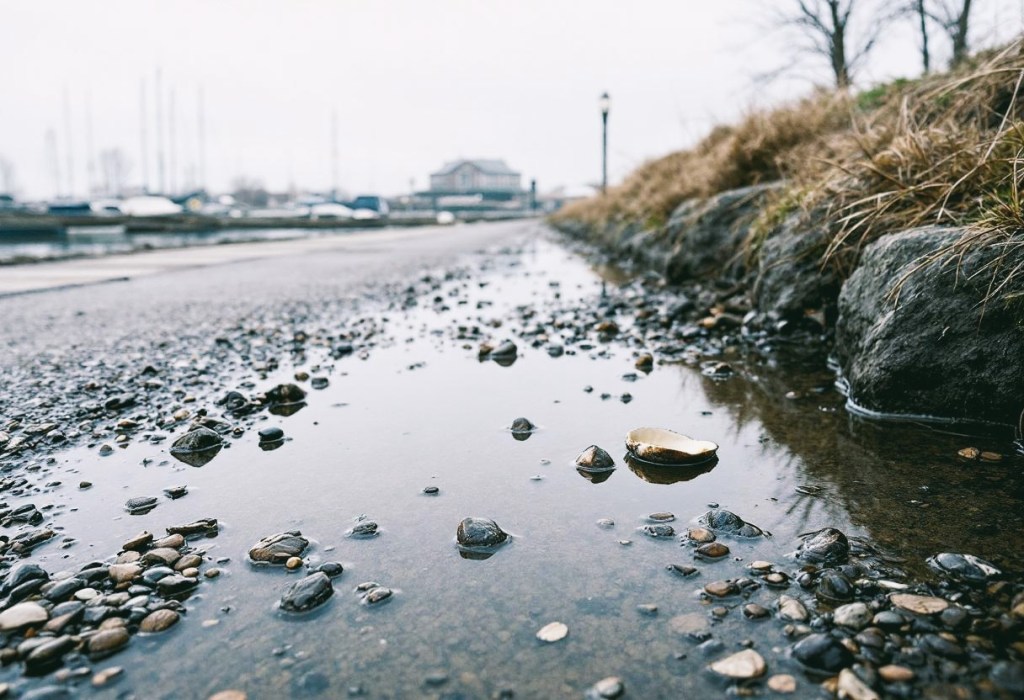
The shell turned up on an otherwise ordinary morning walk about ten years ago, on the strip of pebbled shoreline just beyond where the proper paths give up and the river begins insisting on its own terms. I remember the light – grey but honest, the sort of sky that doesn’t pretend it will brighten later – and the particular texture of the day ahead: a double session with a grieving father, a supervision group likely to be more confession than consultation, a waiting room already overbooked. I was doing what I always did then, and still often do: walking briskly enough to call it exercise, thinking quickly enough to call it preparation, telling myself I was “clearing my head” whilst in fact filling it with rehearsals of what I might need to say.
The shell was sitting upside down in a small pool left by the tide, half-buried in silt, looking for all the world like unremarkable litter. If anything drew my eye, it was the chip – a neat crescent missing from one side, as if something with more force than finesse had taken a substantial bite. I almost walked past; psychiatrists are not short of metaphors about damage, and there are only so many objects one can rescue before one’s flat begins to resemble an installation on unprocessed attachment.
But something about the way it sat there – wrong way up, slightly off-centre, refusing to pretend it was whole – made me stop. I bent, turned it over in my palm, and saw that the inside still held its sheen, that quiet mother-of-pearl iridescence that looks like light trying to remember itself. The outside: abraded, scratched, unapologetically ordinary. The inside: unexpectedly luminous, as though nothing the tide had done had quite managed to reach it.
Cool is a strange word for someone of my generation to use without irony – it still carries faint echoes of jukeboxes and leather jackets, the sort of thing Mother would have pronounced with delighted emphasis in her Nevada days. If I translate it into something more clinically adjacent, the coolest thing I’ve ever found and kept is probably any object that manages to be truthful without being theatrical. The shell passes that test.
For the first few months it lived in my coat pocket, alongside a rotation of bus tickets and folded index cards with questions for supervision – a small, gritty reminder that one could be both visibly damaged and still quietly intact in places the world didn’t see. On days when a session left me doubting my usefulness, my fingers would find it the way a child finds a worry stone, tracing the rough edge and the smooth, remembering that broken is a description, not a verdict. Eventually it migrated to the office – to the sill of the harbour-facing window in the consulting room, where it has sat through more weather and more stories than either of us could reasonably have anticipated.
Patients notice it more often than you’d think. Children reach for it first, of course; they are connoisseurs of small, interesting objects and have fewer qualms about touching what isn’t obviously labelled a toy. Adults usually comment only when the silence has grown safely companionable – That shell’s seen some things, hasn’t it? or I like that it’s not perfect, which is the sort of projection textbooks warn about and real life quietly depends on.
At some point, entirely without conscious decision, the shell became part of the rooms architecture of care. It sits beside the stack of well-thumbed novels and the neat row of seashells I euphemistically call grounding tokens when really they’re just things Ive collected on morning walks to remind myself that the harbour exists even when the work threatens to become its own universe. It has listened, in its own inanimate fashion, to disclosures about shame and desire, fury and boredom, unspectacular grief that never makes headlines but rearranges a life all the same.
Every so often someone will ask whether they can have it. The first time, a teenager who’d finally survived a year she hadn’t been entirely sure she wanted to see the end of cradled it in her palm and said, half-joking, I think I need this more than you do. My instinct was to say yes; one is always trying, perhaps too hard, to offer something tangible. But my whole body resisted, in that honest way bodies sometimes do when the mind is still dithering, and what came out instead was How about we find you your own?
So we did. One Saturday after the river clean-up – gloves, bin bags, Kevin’s practical charm stitching strangers into something like community – I took her and a few others down to the same stretch of not-quite-path where the tide does as it pleases. We walked slowly, eyes down, looking for objects that had no intention of being metaphorical and would almost certainly become so the moment we picked them up. She chose a fragment of blue glass, smoothed to safety by years of abrasion, the colour of certain August evenings. Someone else pocketed a rusted washer, someone a small piece of driftwood that looked like a question mark.
I kept my shell. Not because it was objectively better than their finds – it wasn’t – but because it had become, by then, a kind of quiet colleague. It has seen me through more than one dark October, more than one Monday when showing up felt like an act of faith rather than confidence. It has listened to my own private admissions in the half-hour between the last patient and the walk to Marcuss for restorative tea – that I’m afraid of being ordinary, that competence sometimes feels like elaborate avoidance, that intimacy terrifies me precisely because it can’t be timetabled or supervised.
When I started the watercolour class on Harbour Street – wrong brushes, appropriate humility – the shell came with me one evening, tucked into the pocket of a coat that still smelled faintly of lemon and stock from the risotto I’d made the night before. The instructor, paint on her sleeve and kindness in her cadence, suggested we bring something familiar to draw so our hands could worry less about subject and more about seeing. I set the shell on the table and tried, with mixed success, to translate its particular combination of battered and luminous onto paper. The result looked more like a collapsed meringue than a sea relic, but the exercise did what it needed to do: it forced me to really look at it, rather than merely reach for it in passing.
Up close, the coolness of the thing revealed itself in layers thinner than paint. There’s the obvious narrative, of course – survival, inner beauty, all the tidy storylines advertisers adore – but what struck me that evening was more prosaic. This shell existed perfectly well before I found it, and would have continued existing had I walked on. My finding it didn’t rescue it; it simply brought it into a different kind of use. Now it lives a double life – ex-home to whatever small creature once rented it, current collaborator in the work of helping humans remember they’re allowed to be both damaged and worthy of care.
The older I get – fifty-eight now, which still sounds like something that should belong to other people – the more persuaded I am that the coolest finds are rarely the ones with monetary value. They’re the things that end up quietly re-scripting how you move through your own life: a mentor’s letter you keep in a desk drawer for decades, a recipe card that turns feeding people into sacrament, a shell that teaches you, one thumb-press at a time, that wholeness was never the entry requirement.
I sometimes imagine the scene from the outside: a woman in a restored Victorian near the harbour, reputedly competent, with degrees on the wall and a waiting list that troubles her conscience, using a chipped shell as a kind of secular rosary. It would be easy to mock, if one were in the mood, all that symbolism perched on a windowsill. But the older I grow, the less interested I am in being unmockable and the more committed I am to being honest.
So here is the honest answer to the deceptively playful prompt. The coolest thing I’ve ever found and kept is a small, imperfect shell from the edge of the Delaware – not because it’s rare, but because it has spent a decade reminding me that survival rarely looks pristine, that beauty is often a matter of angle and light, and that sometimes the most useful objects in a room are the ones that sit quietly by the window, doing nothing more flashy than being there, consistently, while people try to become less afraid of themselves. Which, when I think about it, is not a bad job description for a life either.
Catherine
Bob Lynn | © 2025 Vox Meditantis. All rights reserved.


 Vox Meditantis
Leave a comment