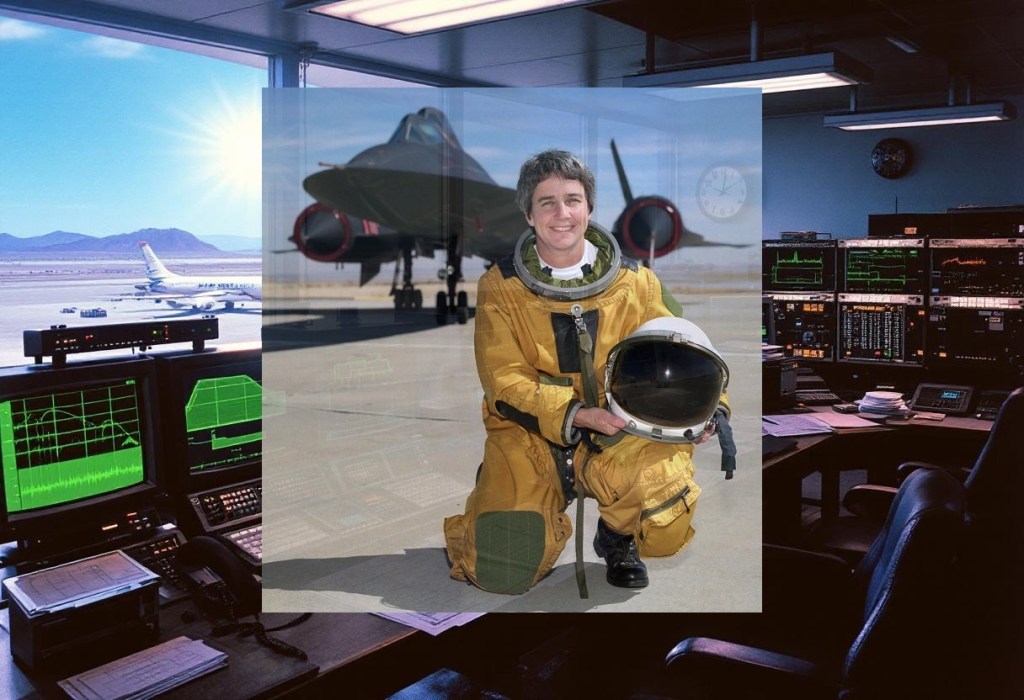
I would like to express my sincere gratitude to my dear friend Susan Bechtold for bringing Marta Bohn-Meyer’s remarkable story to my attention. Susan’s thoughtful email, sharing her own memories from Edwards and the crucial support her team provided – from suits to LOX generator tests – opened a window onto a chapter of aviation history that’s far too often overlooked. Her note reminded me that the true achievements behind the SR-71 programme were not just in the headlines, but carried day-to-day by dedicated professionals like Susan and pioneers like Marta. Susan’s reflection on the exceptional navigators and the significance of being ‘the very first’ captures the courage and determination needed to transform possibilities into reality. Thank you, Susan, for sharing this memory and deepening our appreciation for those who quietly break new ground in science and flight.
Marta Bohn-Meyer (1957-2005) earned her aeronautical engineering degree from Rensselaer Polytechnic Institute in 1979 and rose to become Chief Engineer at NASA’s Dryden Flight Research Centre, conducting critical high-speed aerodynamic research that directly informs today’s supersonic aircraft development. In 1991, she became the first woman to fly as a crewmember aboard the SR-71 Blackbird, navigating at Mach 3.2 whilst collecting data that would shape the future of hypersonic flight. As project manager for NASA’s F-16XL Supersonic Laminar Flow Control experiment, she led research achieving drag reductions of 11-28% – work that remains foundational to ongoing efforts by NASA’s X-59 and commercial ventures like Boom Supersonic to develop environmentally sustainable supersonic transport.
Marta Bohn-Meyer’s story matters today because her technical contributions address one of aviation’s most pressing challenges: how to make high-speed flight economically and environmentally viable. Laminar flow control – the technology she pioneered – represents the most promising pathway to reducing fuel consumption and emissions in supersonic aircraft by 20-30% compared to conventional designs. Her career also illuminates the extraordinary competence required of women in male-dominated technical fields, and the isolation that accompanies being “first” – challenges that persist as women remain just 9% of aerospace engineers and 6% of commercial pilots globally. In a field where innovation happens at the boundary between theory and extreme physical conditions, Bohn-Meyer demonstrated what it means to be both architect and test subject, designing experiments she would herself execute at speeds where titanium fuselages glow red and control surfaces operate in airflow exceeding 600 degrees Fahrenheit.
Thank you for joining us, Marta. When your parents gave you that aviator’s watch engraved with “CAVU” – Ceiling and Visibility Unlimited – for your high school graduation, could they have imagined you’d eventually see that unlimited ceiling from 85,000 feet whilst flying Mach 3?
I suspect they thought it was simply encouragement for a girl who’d been pestering them for flying lessons since she was fourteen. CAVU is aviation slang for perfect conditions – when the cloud ceiling is above ten thousand feet and visibility extends ten miles or more. Pilots use it as shorthand for anything desirable, anything worth pursuing. My parents weren’t aviators themselves, but they understood what it meant to me. I’d passed my private pilot check ride at seventeen, and they saw how completely aviation had claimed me. The inscription was prophetic, I suppose, though none of us knew it then. Years later, sitting in the back seat of an SR-71 at eighty-five thousand feet, looking out at a view stretching four hundred miles in every direction with the Earth’s curvature plainly visible, I’d think about that watch. Perfect visibility, unlimited ceiling. Though at Mach 3.2, the outside air temperature was minus fifty-six degrees Celsius whilst the fuselage beside my elbow was six hundred degrees Fahrenheit. CAVU takes on rather different meaning when you’re wearing a full pressure suit and the aircraft is leaking fuel onto the runway because the titanium panels are designed to expand and seal only at cruise temperature.
Let’s start at the beginning. Growing up on Long Island in the 1960s and ’70s, what drew you to aeronautical engineering specifically? Many young pilots don’t necessarily connect flying to the mathematics and physics behind it.
I saw my father’s friend fly an F-14 Tomcat when I was quite young, and something about the precision and power of that machine simply lodged in my brain. But here’s the thing – I didn’t just want to fly aeroplanes; I wanted to understand why they flew, how you could make them fly better, faster, more efficiently. When I was fourteen and told my parents I wanted flying lessons for Christmas instead of the expected request for a horse or piano lessons, they must have thought I’d lost the plot entirely. But they honoured it. By the time I reached secondary school, I knew I wanted to be a test pilot, which presented immediate difficulties. In the 1970s, test pilots were almost exclusively military, and women weren’t permitted in combat roles. That door was firmly shut.
So I approached it differently. If I couldn’t fly the experimental aeroplanes, I’d design the experiments they flew. Aeronautical engineering became the logical path – understanding structures, aerodynamics, propulsion systems, control theory. I applied to Rensselaer Polytechnic Institute partly because they offered a cooperative education programme with NASA Langley Research Centre. From 1976 to 1979, I alternated between coursework in Troy, New York, and hands-on research at Langley in Virginia. That co-op programme changed everything. I worked on rotorcraft research, wind tunnel testing, flight safety projects for small civil aircraft. I wasn’t just solving equations on paper; I was seeing how theoretical predictions matched – or didn’t match – actual hardware performance.
Fred Gregory, who later became NASA Deputy Administrator, mentored you during those Langley years. He described you as “smart, detail-oriented, opinionated and professional.” That word “opinionated” is interesting – it’s rarely a compliment when applied to women.
Fred meant it kindly, and I’ve always appreciated his honesty. But you’re quite right – “opinionated” is coded language. When a man expresses strong technical views backed by data, he’s confident, authoritative, a natural leader. When a woman does the same, she’s opinionated, difficult, not a team player. I learned early on that competence alone wasn’t sufficient. You had to be so thoroughly, unimpeachably correct that no one could dismiss your input as emotional or subjective. I’d check my calculations three times before speaking in meetings. I’d run additional simulations, gather extra data, anticipate every counter-argument. It was exhausting, frankly. Male colleagues could speculate, propose half-formed ideas, think aloud. I couldn’t afford that luxury. Every statement had to be bulletproof.
Fred understood that dynamic, I think. He recognised that my “opinionated” nature was actually rigorous engineering judgement. I wasn’t being stubborn; I was being precise. If I said a particular test configuration would produce unreliable data due to flow separation at the wing root, I’d already calculated the Reynolds numbers, reviewed the boundary layer characteristics, and compared similar experiments. That level of preparation became habitual because the consequences of being wrong – when you’re already under extra scrutiny – were severe. You don’t get second chances to be taken seriously.
After graduating in 1979, you joined NASA Dryden in the Mojave Desert. What were your initial projects, and how did you transition from theoretical work to actual flight test operations?
Dryden was – and remains – where NASA conducts flight research requiring high-altitude airspace and emergency landing options that only the desert provides. My first major project involved zero-gravity parabolic flights using a Lockheed F-104 Starfighter. From 1979 to 1984, we’d fly the F-104 in carefully calculated parabolic arcs, climbing to eighty-five thousand feet, then pitching over into a ballistic trajectory that produced roughly twenty to twenty-five seconds of microgravity. My job was to activate scientific experiments at precisely the right moment and assist the pilots in maintaining zero-g conditions, which is far trickier than it sounds. Too aggressive on the pitch-over, and you get negative-g; too gentle, and you don’t achieve true weightlessness. The pilots flew by feel and instrument, but I monitored accelerometers and called out corrections: “Point-zero-two positive, ease forward.” We were essentially creating artificial spaceflight conditions for materials science and fluid dynamics experiments.
That work taught me the absolutely critical distinction between paper engineering and operational engineering. You can model parabolic flight paths perfectly on a computer, but the actual aircraft has engine spool-up lag, control surface hysteresis, atmospheric turbulence, pilot reaction time. The F-104 was a hot rod – a rocket with tiny wings, really. It wanted to accelerate, not float. Learning to work within those constraints, to design experiments that accommodated real-world limitations whilst still producing valid scientific data, was my true education.
From 1980 to 1983, I also participated in wind shear research aboard Martin B-57 Canberras. We’d deliberately fly into microbursts and thunderstorm gust fronts near Denver and Oklahoma City, measuring small-scale atmospheric turbulence with extraordinarily sensitive instruments. I operated the data collection systems and assisted with weather radar interpretation and navigation. Commercial aviation was experiencing catastrophic wind shear accidents during this period – aircraft encountering sudden headwind-to-tailwind shifts during approach that would rob them of lift and slam them into the ground. Our research provided the understanding that led to ground-based wind shear detection systems and pilot training protocols that have since saved countless lives. That felt purposeful. We weren’t just chasing interesting physics; we were solving real problems that killed people.
In 1982, you began work on the F-14 Tomcat laminar flow programme. For non-specialists, could you walk us through what laminar flow actually means, why it matters, and what you were trying to accomplish?
Right. This becomes rather technical, but it’s fundamental to understanding everything I did subsequently, including the F-16XL work and the SR-71 research. When air flows over a wing or fuselage, the layer of air immediately adjacent to the surface – called the boundary layer – can be in one of two states: laminar or turbulent. In laminar flow, air molecules move in smooth, parallel layers, like a deck of cards sliding past one another. In turbulent flow, the molecules tumble chaotically, creating swirling eddies and vortices that mix the layers together.
Turbulent flow produces dramatically higher skin friction drag – perhaps three to five times higher than laminar flow – because all that chaotic mixing dissipates energy. On a commercial airliner, skin friction accounts for roughly forty to fifty per cent of total drag. If you could maintain laminar flow over significant portions of the aircraft, you’d reduce drag substantially, which translates directly to fuel savings, increased range, or greater payload capacity. A ten per cent reduction in drag might allow an aircraft to fly ten per cent farther on the same fuel, or carry ten per cent more passengers, or reduce emissions by ten per cent. The economic and environmental implications are enormous.
The challenge is that boundary layers naturally transition from laminar to turbulent as air flows downstream. The transition point depends on Reynolds number – a dimensionless parameter combining flow velocity, distance along the surface, air density, and viscosity. For smooth surfaces at moderate speeds, you might maintain laminar flow for the first ten to twenty per cent of the chord before transition occurs. Beyond that, turbulence takes over. What we were investigating with the F-14 was whether you could delay that transition point by manipulating the wing’s shape and sweep angle.
The F-14’s variable-sweep wings were fitted with aerodynamic “gloves” – smooth fairings that covered the wing root and leading edge, creating carefully contoured surfaces designed to maintain favourable pressure gradients. In fluid dynamics, a favourable pressure gradient – where pressure decreases in the flow direction – stabilises laminar flow. An adverse pressure gradient – where pressure increases – destabilises it and promotes early transition. The gloves allowed us to examine boundary layer behaviour across a wide range of wing sweep angles, from sixteen degrees for subsonic cruise to sixty-eight degrees for supersonic flight. We instrumented the wings with hot-film sensors that detected the precise moment and location where transition occurred, correlating that with speed, altitude, angle of attack, and sweep setting.
And what did you find?
That transonic flight – speeds between Mach 0.8 and 1.2 – is viciously complicated. The local flow over the wing accelerates to supersonic speeds even when the aircraft’s overall velocity is subsonic, creating shock waves that dramatically alter pressure distributions. Those shock-induced pressure gradients generally forced early transition to turbulent flow, limiting the extent of laminar flow we could achieve. For subsonic cruise at moderate sweep angles, we managed to delay transition to perhaps thirty to forty per cent of chord under optimal conditions. For transonic and supersonic regimes, laminar flow was confined to the first five to fifteen per cent of chord. Useful data, certainly, but it demonstrated that passive laminar flow control – relying solely on wing shaping – had inherent limitations. That realisation set the stage for the F-16XL programme, where we’d explore active control methods.
The F-16XL Supersonic Laminar Flow Control experiment, which you managed from 1990 onwards, represents perhaps your most significant scientific contribution. Could you walk us through the technical approach – how exactly does suction control work, and what were the engineering challenges in implementing it?
The F-16XL was a radical aircraft to begin with – a cranked-arrow delta wing design that General Dynamics had developed as a potential Strike Fighter variant. NASA acquired two of them in 1988 for supersonic research. What made the XL ideal for our purposes was that enormous wing: over twice the area of a standard F-16, with a complex geometry featuring a seventy-degree inboard sweep transitioning to fifty degrees outboard. Large wing area meant we could install substantial experimental hardware without compromising the aircraft’s flight characteristics.
The fundamental principle behind suction laminar flow control is that you’re artificially removing the portion of the boundary layer most susceptible to transition. Even in laminar flow, there’s a velocity gradient from zero at the surface – where air molecules are essentially stuck due to viscosity – to freestream velocity some distance away. The slower-moving fluid near the wall contains less kinetic energy and is therefore more vulnerable to instabilities that trigger transition. If you could remove that low-energy fluid whilst it’s still laminar, replacing it with faster-moving fluid from further out in the boundary layer, you’d continuously “refresh” the laminar layer and delay transition.
We achieved this through suction. Boeing fabricated a titanium glove for the left wing – roughly ten feet long and covering about a hundred and fifty square feet – containing more than twelve million laser-drilled holes, each 0.0025 inches in diameter, spaced 0.01 to 0.055 inches apart. Think about that: twelve million holes, each smaller than a human hair, precisely positioned in a titanium panel that had to withstand supersonic flight loads and temperatures. The engineering tolerances were extraordinary. Beneath the perforated skin was a plenum system: tubes, valves, and a compressor that created a pressure differential, drawing air through those millions of tiny holes. The suction had to be carefully calibrated – too little, and you didn’t remove enough low-energy fluid; too much, and you’d create localised flow disturbances that actually triggered transition prematurely.
The right wing carried a passive glove – no suction, just smooth titanium with embedded instrumentation to measure baseline transition characteristics and provide a control comparison. This was proper experimental method: one wing with the intervention, one without, flying simultaneously through identical conditions.
What were the measurable results, and how do those translate to real-world aircraft performance?
We achieved laminar flow over fifty to sixty per cent of chord at our design condition of Mach 1.6 at forty-four thousand feet, depending on suction distribution and local flow conditions. That translated to drag reductions between eleven and twenty-eight per cent for the laminarised section, depending on flight regime. Now, that’s local drag reduction – just for the portion of the wing where we’d applied suction. Extrapolating to a full-scale supersonic transport, where you’d laminarise wings, empennage, and potentially portions of the fuselage, you could realistically expect gross weight reductions of eight to ten per cent for a given mission. That weight savings comes from needing less fuel, which means you can build a lighter airframe, which needs less thrust, which needs smaller engines – a virtuous spiral of efficiency gains.
For a supersonic business jet flying four thousand nautical miles, ten per cent drag reduction might translate to fifteen per cent fuel savings or a twenty per cent range increase. For a commercial supersonic transport carrying two hundred passengers across the Pacific, that’s the difference between economic viability and bankruptcy. Current projections suggest supersonic flight produces roughly five to seven times the fuel consumption per passenger-mile compared to subsonic flight; laminar flow control could cut that multiplier to three or four. Still not perfect, but approaching acceptability for premium routes where passengers pay a surcharge for speed.
The SR-71 programme represents a different category of research entirely – not incremental improvements, but operating at the absolute edge of what’s physically possible. How did you come to fly as a crewmember on the Blackbird, and what did that work entail?
By 1990, I’d been at Dryden for eleven years, accumulating flight hours across NASA’s research fleet: F-104, B-57, F-14, F-16, F-111, F-18, even some B-52 flights for launch operations. I’d logged over seven hundred and fifty hours as a flight test engineer, which meant I understood both the theory and the operational realities of flight research. When NASA reactivated the SR-71 programme – Congress reinstated funding in 1990 after the Air Force had retired the fleet – Dryden needed flight engineers who could conduct sophisticated experiments whilst functioning in an extraordinarily demanding environment.
The SR-71 Reconnaissance Systems Officer position – my role – wasn’t simply navigation. You’re managing multiple data collection systems simultaneously: aerodynamic sensors measuring shock wave structures and boundary layer properties, propulsion diagnostics monitoring inlet performance and fuel flow characteristics, thermal instrumentation tracking surface temperatures and heat flux into structural components, atmospheric sampling equipment, camera platforms. All of this whilst navigating at speeds where you cross three time zones per hour and a single degree course error compounds into fifty-mile position deviations in minutes. The workload was immense, and the environment was unforgiving.
On 3rd October 1991, I became the first woman to fly as a crewmember – not a passenger, but operational crew – in an SR-71. The distinction matters. Congresswoman Beverly Byron had flown in the back seat as a VIP guest in 1985, experiencing what the SR-71 could do. I was there to work, to execute experiment protocols, to troubleshoot system failures in real-time, to make split-second decisions about data validity and equipment reconfiguration whilst pulling three-g turns at Mach 3.2 and eighty-five thousand feet.
Describe what it’s actually like – physically, operationally – to fly in the SR-71 at those speeds and altitudes.
You begin with the pressure suit. The SR-71 operates at altitudes where ambient atmospheric pressure is less than one per cent of sea level – essentially vacuum conditions. If the cockpit lost pressurisation, you’d have perhaps ten to fifteen seconds of useful consciousness before hypoxia rendered you incapacitated. The full-pressure suit – essentially a spacesuit – provides an independent life-support system. It’s constraining; you lose fine motor control, and any task requiring delicate switch manipulation or chart reading becomes laborious. Pre-flight suit checks take an hour: leak tests, communications verification, oxygen flow confirmation, relief systems validation. Unglamorous, but absolutely critical.
The aircraft itself leaks fuel on the ground. The titanium panels are deliberately under-sized at ambient temperature; they expand and seal properly only when heated to cruise temperature. So you’d walk out to the aircraft and see JP-7 fuel dripping onto the concrete, watch the ground crew lay out absorbent pads beneath the wings. It looked alarming – surely we’re not actually going to fly this thing – but it was normal. Once you reached Mach 3 cruise, the panels expanded four inches from nose to tail, and the leaks stopped.
Takeoff was deceptively sedate. The SR-71 wasn’t a fighter; it didn’t leap off the runway. You’d roll for eight thousand feet, rotate gently, and climb at a relatively modest angle initially, building speed gradually. The real acceleration began above forty thousand feet, where the air thinned and the engines – J58 turbojets with afterburners – could push you to Mach 3+. The acceleration felt smooth, almost gentle, but relentless. Mach 2, Mach 2.5, Mach 3. You weren’t pushed back into your seat like a rocket launch; you simply watched the Mach meter wind up whilst the Earth spread out below you in that astonishing, curved panorama.
At eighty-five thousand feet, you’re above ninety-nine per cent of the atmosphere. The sky turns a deep, bruised purple-black. You can see weather systems from above, watching thunderstorms from a vantage point higher than the clouds’ tops. The view extends four hundred miles – from Los Angeles, you could simultaneously see San Francisco to the north, Las Vegas to the east, the Mexican border to the south. It was sublime, genuinely awe-inspiring, even after dozens of flights.
But you couldn’t afford to gaze out the window for long. The experiments demanded constant attention. On a typical two-hour sortie – covering twenty-four hundred nautical miles – we’d execute perhaps six to eight distinct test points: different Mach numbers, different altitudes, different configurations. Each required precise setup: activate specific sensors, configure data recording parameters, verify systems functionality, monitor for anomalies. If an instrument malfunctioned, you diagnosed and compensated immediately. There wasn’t time for lengthy troubleshooting or consultation with ground controllers; by the time you’d explained the problem, you’d have flown past the planned test point and would need to reconfigure for the next segment.
What specific research objectives were you pursuing during those SR-71 flights?
Sonic boom characterisation was a major focus. When an aircraft exceeds Mach 1, it generates a shock wave – a nearly instantaneous compression of air molecules – that propagates to the ground as a loud, startling boom. For the Concorde, sonic booms made overland supersonic flight politically impossible; it could only fly supersonic over water. If future supersonic transports were to operate economically, they’d need overland routes, which meant understanding and potentially mitigating boom intensity.
We measured boom signatures at various altitudes, speeds, and atmospheric conditions, correlating ground-level overpressure measurements with flight parameters. The data demonstrated how boom intensity varied with altitude – higher flight meant greater atmospheric attenuation – and how atmospheric temperature gradients refracted shock waves, sometimes focusing them into particularly intense “superboom” events. This research directly informs NASA’s current X-59 QueSST programme, which aims to produce a “quiet thump” rather than a boom by shaping the aircraft to prevent shock waves from coalescing.
We also conducted propulsion research. The J58 engines were hybrid turbojets that transitioned to ramjet operation above Mach 2, using shock waves in the inlet to compress incoming air rather than relying solely on mechanical compressors. At Mach 3.2, the inlet system was doing most of the compression work; the engine itself was almost secondary. Understanding inlet dynamics – how shock positioning affected pressure recovery, how unsteady flow triggered inlet unstarts (sudden expulsion of shock waves that felt like flying into a brick wall), how fuel could be used as coolant by circulating it through heat exchangers before combustion – provided insights for scramjet and hypersonic vehicle development.
Thermal research was perhaps most critical. At sustained Mach 3, aerodynamic heating raised surface temperatures to six hundred degrees Fahrenheit or higher. The cockpit windows – made from special high-temperature glass, essentially oven glass – exceeded 620 degrees. We instrumented the aircraft with hundreds of thermocouples measuring temperature distributions, heat flux into structural components, and thermal expansion effects. That data validated computational models and material performance predictions used for spacecraft re-entry vehicles, hypersonic cruise missiles, and future high-speed transports.
You also piloted the SR-71B trainer variant, actually taking the controls of the Blackbird yourself. What was that experience like?
Transcendent. As a Research Systems Officer, I was accustomed to managing experiments from the back seat whilst someone else flew. The SR-71B – the two-seat trainer with dual controls – offered the opportunity to actually pilot the aircraft. It’s one thing to understand the theory of flight, to calculate control surface deflections and predict aircraft response. It’s entirely another to feel that response through your hands and feet, to sense the aircraft’s state through tactile feedback and vestibular cues that no amount of data displays can replicate.
The SR-71 was surprisingly docile at cruise – stable, almost gentle, requiring minimal control inputs. The aircraft essentially flew itself once trimmed at Mach 3; my job was to make small corrections for wind drift or experiment positioning. But at low speeds, particularly during landing, it was demanding. The long fuselage and tricycle gear created a tendency to pitch up if you flared too aggressively; you had to grease it onto the runway with a very flat approach. The cockpit visibility was poor – you sat quite far forward, looking over a long nose that obscured the runway until the very last moment. Landing became an exercise in judgment and trust: maintain the precise pitch attitude, trust your instruments and visual references, feel for the touchdown through subtle cues.
I flew perhaps a dozen sorties in the SR-71B, mostly proficiency and training flights rather than full research missions. Not enough to achieve the mastery that dedicated pilots like Ed Yielding or Tom Alison had, but sufficient to understand what the aircraft demanded and to appreciate their skill. Flying the SR-71 reinforced a lesson I’d learned throughout my career: theoretical knowledge and hands-on experience are complementary, not substitutable. You need both.
In 2001, after twenty-two years at Dryden, you were appointed Chief Engineer – the highest technical leadership position at the facility. What did that role entail, and how did it differ from your previous project management work?
As Chief Engineer, I was responsible for technical oversight across all of Dryden’s research programmes simultaneously: X-43 hypersonic flight experiments, F-18 Systems Research Aircraft projects, various uninhabited aerial vehicle programmes, space shuttle thermal protection testing, sonic boom studies. My job was to ensure that test techniques were sound, that flight safety protocols were rigorous, that research produced valid scientific data rather than expensive noise. It required breadth rather than depth – understanding enough about propulsion, structures, flight controls, aerodynamics, and instrumentation to ask the right questions and recognise when proposed approaches were inadequate.
I also served as the final technical arbiter for flight readiness reviews. Before any experimental flight, we’d convene a board examining every aspect of the mission: airworthiness assessment, test procedures, abort criteria, risk analysis, contingency plans. My responsibility was to determine whether we’d done sufficient homework, whether the risks were understood and acceptable, whether we were ready. Sometimes the answer was no. I cancelled flights, sent teams back to refine their analysis, demanded additional simulations or ground tests. You develop a healthy respect for Murphy’s Law in flight test: if something can go wrong, it eventually will. Your job is to anticipate failure modes and ensure they’re survivable.
The administrative aspects were, frankly, less satisfying. Budgets, personnel issues, political considerations – necessary, but not why I’d become an engineer. I missed being directly involved in specific projects, getting my hands dirty with data analysis and hardware troubleshooting. Leadership requires stepping back, letting others do the detailed work whilst you maintain the broader perspective. It’s important work, but different work.
Throughout your NASA career, you maintained an intense parallel commitment to competitive aerobatics, eventually representing the United States at the Unlimited level – the highest category requiring mastery of complex manoeuvres like lomcevaks, tail slides, and tumbles. How did that passion develop, and what drew you to such extreme flying?
Aerobatics represents pure flying in a way that nothing else does. In research aviation, you’re constrained by mission objectives, data collection requirements, safety protocols. In aerobatics, the aircraft becomes an extension of your body – a tool for expressing three-dimensional motion with precision and artistry. A well-executed sequence is simultaneously athletic performance, engineering demonstration, and aerial choreography.
I began flying aerobatics in the early 1980s, initially as proficiency training – upset recovery, spin awareness, expanding my understanding of aircraft behaviour at extreme attitudes and high angles of attack. But I found it addictive. The intensity of focus required, the physical demands, the satisfaction of executing a manoeuvre perfectly – knife-edge flight at exactly zero slip, a vertical roll maintaining perfectly vertical track, recovering from a tail slide with crisp control inputs at precisely the right moment – was deeply rewarding.
I acquired a Pitts Special S-1S in the mid-1980s – a tiny single-seat biplane specifically designed for competition aerobatics. The Pitts was a revelation: extraordinarily agile, absurdly overpowered for its size, capable of roll rates exceeding three hundred degrees per second. You could enter a vertical climb from level flight, perform a series of rolls whilst climbing, transition to a hammerhead turn or tail slide at the apex, and descend through another series of manoeuvres before recovering. The entire sequence might last sixty seconds and cover a box of airspace a thousand meters on a side. Judges evaluated precision: were your vertical lines truly vertical? Did your loops maintain constant radius? Were your rolls axial, or did the nose wander?
In 1990, I won the California Point Series Aerobatic Championship flying that Pitts. Advancing through the competition categories – Sportsman, Intermediate, Advanced, finally Unlimited – required progressively more complex manoeuvres and higher performance aircraft. By the time I reached Unlimited, I was competing against the world’s best aerobatic pilots, many of whom flew full-time and had far more practice hours than I could accumulate whilst maintaining a demanding career at NASA.
Could you explain what a lomcevak actually involves? For those of us who’ve only experienced straight-and-level flight, it sounds rather alarming.
It is alarming, honestly, even when you’ve practised it a hundred times. A lomcevak – the name comes from a Czech word meaning “headache” – is essentially a tumbling, end-over-end manoeuvre where the aircraft rotates chaotically through all three axes with almost no forward speed. You’re using gyroscopic precession from the spinning propeller to induce tumbling motion that wouldn’t occur in normal flight.
The entry technique varies depending on the specific variant – there are at least five distinct lomcevak types – but a typical execution begins with a forty-five-degree climb, letting airspeed decay to near zero. At the apex, you apply full rudder and full forward elevator simultaneously, sometimes adding aileron input. The aircraft essentially departs controlled flight, tumbling backwards and sideways in a disconcerting pirouette. You’re experiencing rapidly changing g-loads – positive, negative, lateral – whilst the horizon spins past in random directions. Highly disorienting for the pilot, though the manoeuvre is actually less stressful than sustained high-g turns because the loads are brief and varied.
The recovery requires neutralising controls and allowing the aircraft to accelerate nose-down until airflow over the control surfaces becomes effective again, then pulling out of the resulting dive. The entire sequence from entry to recovery might take six to eight seconds, during which you’ve tumbled through several complete rotations and descended perhaps two thousand feet. It’s dramatic for spectators and genuinely thrilling for the pilot, but it places enormous stress on the airframe – particularly engine mounts, crankshaft, and propeller. You don’t perform lomcevaks in aircraft not specifically built for aerobatics.
In 2003 and 2004, you represented the United States on the national aerobatic team, competing internationally. In 2005, you served as Team Manager at the world championships in Spain. What was that experience like, and how did you balance elite competition with your demanding role at NASA?
Balancing both was, candidly, exhausting. Unlimited aerobatics requires extraordinary currency – you need to practise regularly to maintain the muscle memory, spatial awareness, and g-tolerance that complex sequences demand. During competition season, I’d fly early mornings before work or weekends, practising sequences repeatedly until the control inputs became automatic. Then I’d drive to Dryden and spend eight to ten hours on engineering work, return home to study video footage of my practice flights, make notes on corrections needed, and prepare for the next session.
My husband Bob – also a NASA project manager and flight test engineer – understood the demands because he shared them. We built a Giles G-300 aerobatic aircraft together, one of only two in existence at the time. Building your own aircraft teaches humility; you’re intimately familiar with every rivet, every control connection, every structural component because you fabricated and assembled them yourself. That knowledge provides confidence but also awareness of how many things could potentially fail.
Competing internationally was both honour and pressure. You’re representing your country, carrying expectations from the aerobatic community, judged not only on your performance but also on sportsmanship and professionalism. The 2005 world championships in Spain were particularly memorable. I’d transitioned to Team Manager, which meant coordinating logistics, providing coaching and encouragement, handling administrative details – all the unglamorous work that allows pilots to focus on flying. Late in the competition, one of our team members needed an emergency warm-up pilot, someone who could fly the sequence immediately to assess conditions. I volunteered, flew the routine, provided the needed briefing. Afterwards, I received the “Most Valuable Volunteer” award, which was genuinely touching. It wasn’t about my own performance; it was about contributing to the team’s success.
Let’s discuss a challenging moment: describe a significant mistake or misjudgement from your career – something you’d approach differently with hindsight.
Early in the F-16XL programme, we experienced a test point where the suction system wasn’t producing the expected laminar flow extent. I was convinced the problem was aerodynamic – incorrect pressure distribution, shock wave interaction, something in the flow physics. We spent weeks refining the computational models, adjusting the wing contour predictions, planning modifications to the suction distribution. Considerable time and expense.
Turned out the problem was entirely mundane: a partially blocked filter in the suction compressor system was reducing airflow by fifteen per cent. Once we replaced the filter, laminar flow performance matched predictions almost exactly. I’d been so focused on sophisticated technical explanations that I’d neglected basic troubleshooting: verify your systems are functioning as designed before questioning your fundamental understanding.
That taught me a valuable lesson about confirmation bias. I wanted the problem to be interesting, to require clever analysis and elegant solutions. But sometimes the problem is boring. Sometimes it’s a clogged filter, a loose connection, a miscalibrated sensor. Good engineering requires checking the simple explanations first, even when they feel pedestrian. My mentor at Langley used to say, “When you hear hoofbeats, think horses, not zebras.” I’d forgotten that, and it cost the project time and credibility.
There were also critiques during your era about whether supersonic flight was environmentally responsible, given fuel consumption and sonic boom disruption. How did you reconcile your work advancing supersonic technology with those legitimate concerns?
That tension was real and remains unresolved. Supersonic flight is inherently less efficient than subsonic flight – you’re fighting wave drag and compressibility effects that don’t exist below Mach 1. A Concorde crossing the Atlantic consumed roughly the same fuel as a Boeing 747 whilst carrying one-quarter as many passengers. From a pure environmental perspective, supersonic commercial flight is difficult to justify.
My argument – and I recognise it’s self-serving – was that technology improves through research and iteration. The first jet engines were absurdly inefficient compared to modern turbofans. Early computers consumed kilowatts of power and filled entire rooms; now your mobile phone is thousands of times more capable whilst using milliwatts. If we abandoned supersonic research because current technology is imperfect, we’d never develop better technology. Laminar flow control, advanced materials, more efficient propulsion systems – these could potentially make supersonic flight environmentally acceptable, or at least less egregious.
But I’ll also admit that some applications were harder to defend. Supersonic business jets for wealthy executives to save two hours on transcontinental flights? That’s a luxury with disproportionate environmental cost. Supersonic transports connecting distant cities, reducing travel time from fifteen hours to seven, potentially enabling same-day international business travel that reduces overnight accommodation and overall trip duration? That has more justification, though it’s still trading speed for sustainability.
The sonic boom issue troubled me particularly. We could measure boom intensity, characterise propagation, even demonstrate mitigation through aircraft shaping. But at the end of the day, someone on the ground was experiencing an unwelcome noise disturbance so that passengers could arrive faster. That’s an equity question: who benefits, who bears the cost? I don’t think we adequately addressed that during my career. NASA’s current X-59 work may finally provide boom suppression sufficient to change the calculation, but it’s taken another twenty years.
How do you see your F-16XL research being applied in today’s supersonic development programmes like NASA’s X-59 and Boom Supersonic’s Overture?
The fundamental principles we validated – that active suction laminar flow control can substantially reduce drag at supersonic speeds, that the technology is practically implementable on operational aircraft, that the weight and complexity penalties are acceptable given the performance benefits – are embedded in current design approaches. The X-59 incorporates laminar flow control concepts alongside its boom suppression shaping. Boom’s Overture design includes provisions for boundary layer management, though I suspect they’re using hybrid approaches – partial natural laminar flow combined with targeted suction – rather than full-chord suction.
The computational tools available now are extraordinarily more capable than what we had in the 1990s. We relied heavily on wind tunnel testing and flight test iteration because our CFD codes couldn’t accurately predict transition location or capture complex three-dimensional shock-boundary layer interactions. Modern codes using large eddy simulation and direct numerical simulation can resolve turbulent structures at scales we could only measure, not predict. That allows designers to optimise configurations virtually before building expensive hardware.
What hasn’t changed is the fundamental challenge: maintaining laminar flow requires extraordinarily smooth surfaces – no rivet heads, no gaps, no waviness – and those surfaces must maintain smoothness under flight loads, thermal expansion, and environmental degradation. Manufacturing tolerances that were challenging in the 1990s remain challenging today. You can design a perfect laminar flow wing in CAD, but building it to those specifications at reasonable cost is another matter entirely.
I hope the current programmes succeed. Truly, I do. Sustainable supersonic flight would be a genuine achievement, expanding human capability without imposing unacceptable environmental costs. But I also recognise the economic and political barriers. Concorde was a technical success and commercial failure – it never recovered development costs, and only twenty aircraft were built. Until supersonic travel can compete economically with subsonic alternatives without requiring subsidies or accepting losses, it remains a niche technology serving a tiny fraction of travellers.
Let’s shift to the gendered aspects of your career. You were often the only woman in your professional environments: the first female SR-71 crewmember, one of very few women flight test engineers at NASA Dryden, a rare woman in unlimited aerobatic competition. What was that isolation like?
Constant. You’re perpetually aware of your visibility, your representational burden. Male colleagues could simply be individuals – good engineer, mediocre engineer, brilliant pilot, adequate pilot. I was always “the woman engineer,” “the first woman to fly in the SR-71,” “that female aerobatic pilot.” My successes were attributed partly to gender novelty – “opportunities given because she was a woman,” as one newspaper article phrased it – and my mistakes were magnified as evidence that women weren’t suited for the work.
The Los Angeles Times article claiming I’d faced no discrimination was… diplomatically inaccurate. NASA Dryden’s culture was more supportive than many aerospace institutions, certainly better than military or commercial aviation. But microaggressions were routine. Being interrupted in meetings, having male colleagues repeat my suggestions as though they’d originated the ideas, being asked whether I was lost when I showed up at the flight line in a flight suit, fielding questions about child-care arrangements that were never posed to fathers. None of it disqualifying individually, but cumulatively exhausting.
The aerobatic community was, oddly, more meritocratic. Judges scored your manoeuvres based on precision and execution; there was no ambiguity about performance. Either your vertical line was vertical, or it wasn’t. Either you completed the sequence within the prescribed box and time limits, or you didn’t. That objectivity was refreshing. The informal social dynamics were still male-dominated – lots of hangar talk about engines and control systems, less discussion of work-life balance or family responsibilities – but at least the competition itself was fair.
You frequently visited classrooms to encourage young women to pursue engineering and technical careers. What message did you try to convey, and do you think it made a difference?
I told them that the work was demanding but achievable, that competence earned respect, that they belonged in these fields as much as anyone. I emphasised problem-solving over rote learning – engineering is applied creativity, not just memorising formulas. I brought photographs from SR-71 flights, wind tunnel models, sometimes small aircraft components they could handle. Making the work tangible helped girls who’d never met an engineer visualise themselves in that role.
Did it make a difference? Occasionally, yes. I’d receive letters from students describing how my visit inspired them to pursue engineering degrees, or parents thanking me for providing a role model their daughters could emulate. Those moments felt meaningful. But I also recognised the limitations: individual inspiration doesn’t dismantle structural barriers. Mentorship programmes and classroom visits help individuals but don’t address the systemic issues – bias in hiring, unequal pay, hostile workplace cultures, inadequate parental leave, the expectation that women manage domestic responsibilities whilst maintaining identical professional productivity as male colleagues who have wives handling those tasks.
The statistics haven’t improved meaningfully since I began my career. Women remain nine per cent of aerospace engineers, six per cent of commercial pilots. The “leaky pipeline” persists: girls drop out of STEM pathways at every transition point – secondary school to university, undergraduate to graduate school, graduation to employment, entry-level to mid-career, mid-career to leadership. By the time you reach senior technical positions, women are perhaps two to five per cent of the population. That’s not a pipeline problem; that’s a retention crisis driven by accumulated disadvantage.
In September 2005, you were practicing for the U.S. National Aerobatic Championships near Oklahoma City when the canopy of your Giles G-300 suffered catastrophic hinge failure. Witnesses described the canopy shattering and separating from the aircraft during a vertical climb, after which the aircraft continued climbing unmanned before rolling and entering a dive. What do you remember from those final moments, and what would you want people to understand about what happened?
I remember the warm-up sequence – three to five minutes of basic manoeuvres to assess wind conditions and aircraft response. Everything felt normal: engine instruments within limits, control responses crisp, no anomalies. I’d flown that particular sequence hundreds of times in that aircraft. Bob and I had built the G-300 ourselves; I knew every structural component, every control system, every rivet. It was as close to a part of me as an aircraft could be.
I initiated a forty-five to fifty-five degree climb – a standard entry for the next element of the practice sequence. The climb felt normal initially. Then I heard a sharp crack, and suddenly I was in a maelstrom. The Plexiglas canopy had shattered and separated from the aircraft. Fragments everywhere, sudden wind blast at perhaps a hundred and sixty knots, debris impacts, instant decompression-like sensation though I was at relatively low altitude. The noise was overwhelming – wind roar, engine at full power, rattling and buffeting from disrupted airflow.
I must have been incapacitated almost immediately – either from debris impacts, the sudden wind force, or disorientation from the explosive canopy departure. The aircraft continued climbing on its own momentum, rolled right, and entered a steep dive. I have no memory of those moments. No control inputs, no recovery attempt. The NTSB investigation determined that the catastrophic failure of the forward canopy hinge was the proximate cause. A manufacturing defect in that specific hinge – not a design flaw, not maintenance negligence, simply a one-time material failure that caused the hinge to fracture under normal aerodynamic loads.
What I’d want people to understand is that this wasn’t recklessness. The G-300 was meticulously maintained. Bob and I had personally inspected every component. We’d conducted the required maintenance, followed all procedures, operated within the aircraft’s limits. But experimental aviation – homebuilt aircraft, one-off prototypes – carries inherent risks that even perfect engineering and careful operation can’t eliminate. Sometimes components fail unpredictably. Sometimes luck runs out.
I’d also want people to know that I died doing something I loved, something that brought me joy and challenged me and made me feel fully alive. That doesn’t erase the tragedy – Bob lost his wife, my family lost a daughter and sister, the aerospace community lost a colleague and mentor. But I wasn’t a victim of circumstances beyond my control. I made informed choices about risk throughout my life: flying experimental research aircraft at extreme speeds and altitudes, competing in aerobatics at the highest levels, building and flying homebuilt aircraft. Those choices brought extraordinary experiences and profound satisfaction. The risk was the price, and I paid it willingly.
Looking at today’s aerospace landscape – NASA’s X-59 program, Boom Supersonic’s development efforts, ongoing laminar flow research – how do you assess the field’s progress since your active career, and what advice would you offer to contemporary engineers, particularly women and underrepresented minorities?
The technical progress is remarkable. Computational capabilities that would have seemed like science fiction in the 1990s are now standard tools. Materials science has advanced – carbon composites, ceramic matrix composites, advanced titanium alloys – enabling structures that are lighter, stronger, and more heat-resistant. Manufacturing techniques like additive manufacturing allow complex geometries that were previously impossible to fabricate. The X-59 incorporates all of these advances, potentially finally achieving acceptable sonic boom levels.
But I’m disappointed by the lack of progress on diversity. The aerospace workforce remains overwhelmingly male and disproportionately white. The same barriers I encountered – implicit bias, lack of mentorship, hostile cultures, work-life balance challenges – still drive women and minorities out of the field. We’ve had initiatives, programmes, corporate diversity statements, yet the numbers barely budge. That suggests the problem isn’t awareness but commitment. Organisations that genuinely prioritised diversity would measure it, hold leaders accountable, and allocate resources accordingly. Most don’t.
My advice to women and underrepresented minorities entering aerospace: find allies and mentors, both those who share your identity and those who don’t. Build competence relentlessly – your technical expertise must be unimpeachable because you’ll face extra scrutiny. Document your contributions and advocate for yourself; no one else will reliably credit your work. Recognise that you’ll do additional labour – mentoring others, serving on diversity committees, being the “representative voice” – that your majority colleagues never perform. That’s unfair, but it’s reality.
Also recognise when an environment is irredeemably toxic and have the courage to leave. Not every battle is worth fighting. Some organisations will never value you appropriately. Your mental health and career satisfaction matter more than proving a point. There are better places – not perfect places, but better – where your contributions will be recognised and your expertise respected.
If you could observe one contemporary aerospace development or mission, what would you choose and why?
The X-59 community overflight testing, without question. We demonstrated in the 1990s that supersonic flight was technically feasible for research purposes. The X-59 will demonstrate whether it’s societally acceptable – whether the sonic “thump” is quiet enough that communities will tolerate overland supersonic flight. That’s the crucial test. All the engineering brilliance, all the computational optimisation, all the wind tunnel validation becomes moot if people on the ground find the noise unacceptable.
I’d want to see the integrated system: the carefully shaped aircraft producing shock waves that don’t coalesce, those waves propagating through realistic atmospheric conditions with temperature gradients and wind shear, and finally reaching the ground as a quiet thump that people genuinely don’t find disturbing. Measuring that, quantifying public reaction, establishing acceptable noise thresholds – that’s the work that will determine whether supersonic commercial flight becomes economically and politically viable.
If the X-59 succeeds, it validates everything we worked toward: that supersonic flight can be environmentally responsible, that technical solutions to boom mitigation exist, that the future of high-speed aviation isn’t forever constrained to subsonic speeds or overwater routes. If it fails – if the thump is still too loud, or public opposition remains implacable – then supersonic commercial flight may remain a technological curiosity rather than a practical transportation mode. I desperately hope it succeeds.
Thank you, Marta. Your contributions to aerospace engineering, flight research, and opening pathways for women in technical fields have had lasting impact. How would you like to be remembered?
As someone who did the work. Not as a symbol, not as a “first,” but as an engineer who asked good questions, designed rigorous experiments, analysed data honestly, and contributed useful knowledge to her field. The gender barrier-breaking aspects – first woman in the SR-71, senior female engineer at Dryden – are historically significant, I suppose, but they’re not what I was trying to accomplish. I was trying to understand laminar flow physics, to reduce drag, to make aircraft more efficient. That work stands on its own merit.
I’d also like to be remembered as someone who loved flying – purely, completely, joyfully. Whether it was riding in the back seat of an SR-71 at Mach 3, piloting a Pitts through a complex aerobatic sequence, or simply flying cross-country on a perfect CAVU day, that was where I felt most alive, most fully myself. The engineering was important, the research was meaningful, but the flying was essential. Ceiling and visibility unlimited – that’s how I tried to live, pushing boundaries whilst maintaining the precision and discipline that kept it sustainable. Not a bad epitaph, I think. CAVU.
Letters and emails
Since publishing this interview, we’ve received correspondence from engineers, pilots, historians, and students across five continents – people whose work and aspirations have been shaped by Marta Bohn-Meyer’s contributions to aerospace research, her courage in breaking barriers, and her unwavering commitment to rigorous technical excellence. The letters below represent a selection from our growing community of readers who wanted to ask her more about the choices she made, the technical challenges she encountered, the ethical dimensions of her work, and the wisdom she might offer to those pursuing similar paths in science and aviation.
These questions reflect diverse perspectives – from engineers in developing nations seeking practical guidance, to sustainability specialists questioning the environmental calculus of high-speed flight, to historians curious about pivotal moments in her career that might otherwise remain unrecorded. Together, they illuminate the continuing relevance of her work and the enduring questions that her life’s achievements raise for new generations of researchers, innovators, and pioneers.
Ama Serwaa, 34, Aeronautical Engineer | Lagos, Nigeria
You mentioned that confirming suction systems were functioning properly – checking the filter – resolved the F-16XL performance problem. In resource-constrained environments like ours, access to sophisticated diagnostic equipment is often limited. How would you advise engineers in developing nations to troubleshoot complex laminar flow systems when they can’t rely on the computational tools and instrumentation you had available? What are the most critical, low-cost verification steps?
Ama, your question gets at something I’ve thought about considerably, particularly during visits to university programmes with limited funding. The assumption that sophisticated research requires expensive equipment is partly true, but it’s also partly a convenient excuse for institutions that don’t prioritise hands-on engineering education. Some of the most important verification steps for laminar flow systems are remarkably low-tech – they just require disciplined methodology and careful observation.
Start with flow visualisation. You don’t need laser Doppler velocimetry or particle image velocimetry systems costing hundreds of thousands of dollars. Tufts – literally just short pieces of yarn or thread taped to the surface – will show you whether flow is attached or separated, smooth or turbulent. In laminar flow, tufts lie flat and steady, aligned with the local flow direction. When transition occurs, they flutter and dance because the turbulent eddies are yanking them about randomly. We used tufts extensively in the 1980s and ’90s, even alongside sophisticated instrumentation, because they provided immediate visual feedback that complemented quantitative measurements. You can apply tufts to wings, control surfaces, fuselages – anywhere you need to understand boundary layer behaviour. Document the results with photography or video; even a basic camera captures patterns that reveal transition location and how it varies with speed, angle of attack, or configuration changes.
Surface oil flow visualisation is another powerful technique requiring minimal equipment. Mix lampblack or another fine powder with a light oil – paraffin oil works well – creating a thin paste. Apply it to the surface before a test run. The oil mixture flows in the direction of local shear stress, leaving streak patterns that reveal flow direction, separation lines, reattachment points, and transition location. Laminar flow produces long, straight, parallel streaks. Turbulent flow creates chaotic, short streaks with random directionality. After the test, photograph the surface whilst the oil is still wet; those photographs become permanent records of flow structure. NASA used oil flow visualisation on everything from small-scale wind tunnel models to full-size aircraft. It’s messy and time-consuming to apply and clean, but extraordinarily informative and costs perhaps twenty dollars in materials.
For suction systems specifically – which you asked about – the critical parameters are suction mass flow rate, pressure differential across the perforated surface, and distribution uniformity. You can measure these with relatively simple instruments. Pitot-static probes and manometers measure pressure; you can construct a basic manometer from clear plastic tubing, a ruler, and coloured water. Total pressure in the plenum chamber beneath the perforated skin tells you whether the suction compressor is generating sufficient vacuum. Surface static pressure at various locations reveals whether distribution is uniform or whether certain regions are getting more suction than others due to blockages, leaks, or design limitations.
Mass flow measurement is trickier but manageable. A hot-wire anemometer – admittedly not cheap, but far less expensive than comprehensive flow field diagnostics – measures local velocity. Place it in the suction duct upstream of the plenum, and you’ve got direct measurement of how much air you’re removing. Alternatively, if you know the compressor performance curve – provided by the manufacturer – you can infer mass flow from measured pressure differential and rotational speed.
Here’s the thing, though: before you measure anything sophisticated, verify the basics. Is the suction compressor actually running at design speed? Check the tachometer, or if you don’t have one, use a handheld strobe light to freeze the motion of a mark on the rotating shaft and compare flash frequency to expected RPM. Are the suction holes clear, or have they accumulated debris, insects, moisture, or manufacturing residue? On the F-16XL, twelve million holes meant that even a small percentage of blockages could significantly reduce performance. Inspect a representative sample under magnification – a jeweller’s loupe costs perhaps fifteen dollars. Are all the valves and shutoff mechanisms in the correct position? I can’t tell you how many times we’ve traced mysterious performance problems to a valve someone left partially closed during previous maintenance.
Are there leaks in the ducting or plenum? Apply soapy water to joints and fittings whilst the suction system operates; bubbles indicate air leaking inward, which reduces the effective suction available at the perforated surface. Is the compressor filter clean? That was precisely our problem on F-16XL – a partially clogged filter that nobody thought to check because we were all focused on aerodynamic explanations. Mundane, boring, but it cost us weeks.
Calibration is another area where discipline matters more than equipment expense. If you’re using pressure transducers, manometers, or flow meters, calibrate them regularly against known standards. You don’t necessarily need traceable NIST standards – though those are ideal – but you do need consistent reference points. Compare instruments against each other, check for drift over time, document the calibration history. An uncalibrated instrument is worse than no instrument because it gives you false confidence in bad data.
Finally, Ama, I’d emphasise the importance of comparative testing. If you can’t afford absolute measurements with high accuracy, focus on relative measurements that reveal trends and sensitivities. How does transition location change with airspeed? With angle of attack? With suction flow rate? Those relationships often matter more than absolute values, and they’re accessible with modest instrumentation. Run the same test repeatedly to establish repeatability; if your measurements scatter randomly, you’ve got a data quality problem that needs addressing before you worry about sophisticated analysis.
The engineers who designed the original boundary layer theory – Ludwig Prandtl, Theodore von Kármán, others working in the early twentieth century – didn’t have computers or electronic sensors. They had pencils, slide rules, wind tunnels with smoke wands, and careful observation. They established foundational understanding that we still use today. Modern tools make research faster and more precise, but they don’t replace disciplined thinking and methodical experimentation. Trust your ability to generate useful knowledge with the resources available to you. Some of the best engineers I’ve known could diagnose complex problems with a flashlight, a piece of string, and years of experience watching how things actually behave rather than how equations say they should behave.
Kevin Armstrong, 51, Flight Safety Consultant | Seattle, Washington, USA
The canopy failure that caused your accident was described as a one-time manufacturing defect, not a design flaw. Yet you and Bob had built and maintained the G-300 meticulously. As someone who’s spent decades analysing aviation accidents, I’m curious: in experimental homebuilt aircraft, how do you distinguish between acceptable residual risk and avoidable negligence? Where’s the line between pushing boundaries and accepting preventable failure?
Kevin, you’ve asked the question that keeps experimental aviators awake at night – and the one we’re often least willing to discuss publicly because it sounds like rationalisation. But since I’m answering from a rather unique perspective – having paid the ultimate price for that residual risk – I’ll try to be brutally honest.
The line between acceptable risk and negligence isn’t fixed; it’s contextual and depends on what you’re trying to accomplish, what alternatives exist, and whether you’ve done your homework. In certificated aircraft operating under FAA oversight, the acceptable risk threshold is extraordinarily low. Transport category aircraft must demonstrate compliance with detailed airworthiness standards covering structures, systems, propulsion, equipment, and operating limitations. Redundancy is built into critical systems. Failure modes are analysed exhaustively. The certification process costs millions of dollars and takes years because society has decided – quite reasonably – that paying passengers shouldn’t bear significant safety risk for the convenience of air travel.
Experimental amateur-built aircraft operate under completely different assumptions, codified in FAR Part 21.191(g) and the operating limitations issued with the airworthiness certificate. The aircraft exists “for education and recreation” – that phrase is critical. You’re accepting substantially higher risk in exchange for the freedom to build, modify, and fly aircraft outside the certification system. The regulations acknowledge this explicitly: experimental aircraft must display placards stating that the aircraft doesn’t comply with airworthiness standards, passengers must be informed of the experimental nature, flight over densely populated areas is restricted during the test period.
So when Bob and I built the Giles G-300, we understood we were operating in that higher-risk regime. The G-300 was a prototype – literally the first one flying, with the second still under construction. We were test pilots for our own homebuilt design. Every flight was, in some sense, a test flight generating data about how the aircraft actually performed versus how we’d predicted it would perform. That’s fundamentally different from flying a Cessna 172 that’s had the bugs worked out across thousands of airframes and millions of flight hours.
Now, did we exercise due diligence? Absolutely. Bob is an exceptional engineer – meticulous, conservative, deeply knowledgeable about structures and systems. We followed the plans supplied by Giles Engineering, using materials and construction techniques that met or exceeded specifications. We documented everything: build photos, weight and balance calculations, control surface deflections, rigging measurements. We conducted extensive ground testing – engine runs, control checks, systems verification. Our Phase I flight testing was methodical: initial flights staying in the pattern, gradually expanding the envelope, exploring stall characteristics and spin behaviour, validating performance numbers.
The airframe had been inspected by an FAA-designated airworthiness representative who examined the structure, verified compliance with the amateur-built requirements, and issued the special airworthiness certificate. We’d flown perhaps a hundred hours in the aircraft by September 2005, logging experience across the full performance envelope including the aerobatic manoeuvres I’d be flying in competition. The aircraft had demonstrated good handling, no unexpected behaviours, solid build quality.
So where’s the negligence? We didn’t cut corners. We didn’t skip inspections. We didn’t ignore warning signs or push past known limitations. The canopy hinge failure that killed me was a one-time manufacturing defect in a component that had functioned properly for a hundred hours and appeared perfectly sound during pre-flight inspections. Materials fail sometimes – fatigue cracks propagate, castings contain hidden voids, heat treatment produces inconsistent properties. Even with non-destructive testing – x-rays, ultrasound, magnetic particle inspection – you can’t find every defect. And homebuilders generally don’t have access to industrial NDT equipment; we rely on visual inspection, dimensional checks, and operational testing.
Here’s where it gets philosophically complicated: if I’d been flying a certificated aerobatic aircraft – a Pitts, an Extra, a CAP 232 – would the canopy hinge have failed? Probably not, because those designs had accumulated thousands of flight hours across multiple airframes, revealing weak points that were subsequently strengthened. The canopy attachment on a production aerobatic aircraft has been refined through iteration, improving reliability. But production aerobatic aircraft also have limitations. The Giles G-300 offered performance – roll rate, power-to-weight ratio, wing loading – that wasn’t available in existing designs. Bob and I wanted that performance, and we were willing to accept prototype risk to get it.
Was that negligent? I don’t think so, but reasonable people might disagree. We weren’t carrying passengers – just ourselves, both experienced pilots and engineers who understood what we’d built and what the risks were. We weren’t flying over populated areas during aerobatic practice; we used designated aerobatic boxes over sparsely inhabited countryside. We weren’t pushing the aircraft beyond design limits or attempting manoeuvres it wasn’t built for. We were operating within the experimental aviation framework that thousands of builders and pilots use annually, accepting personal risk in exchange for the freedom to innovate.
Compare that to other scenarios you’ve probably investigated, Kevin. The pilot who departs VFR into instrument conditions despite marginal weather and limited IFR experience – that’s negligence. He’s ignoring known risks, violating his training and certification limitations, and betting that he can muddle through. The maintenance shop that signs off an annual inspection without actually checking critical components – negligence. They’re taking money under false pretences and putting occupants at risk through deliberate shortcuts. The commercial operator who pressures pilots to fly with known mechanical issues because cancelling flights costs money – negligence and arguably criminal.
Those situations involve ignoring known risks, violating established standards, or prioritising convenience and profit over safety. Bob and I weren’t doing that. We were accepting the inherent risks of prototype aviation – risks we understood, had worked to minimise through careful design and construction, and bore personally without imposing them on others.
But here’s the part that troubles me, even now: was my confidence in our build quality actually justified, or was it hubris? I believed we’d built the aircraft correctly. I believed the components were sound. I believed the risk was acceptable. And I was wrong about the canopy hinge. Does that retroactively make it negligence? If you can’t detect a latent defect despite reasonable inspection efforts, are you negligent for not detecting it?
I don’t think so, but I recognise that’s a self-serving position. The NTSB investigation concluded the accident resulted from equipment failure, not pilot error or inadequate maintenance. That determination matters – it distinguishes between bad luck and bad judgment. But I also recognise that someone outside experimental aviation might reasonably say, “You were flying a one-off prototype aerobatic aircraft; catastrophic failure was foreseeable even if the specific mode wasn’t. You accepted unacceptable risk.”
The experimental aviation community needs to grapple more honestly with this tension. We celebrate the innovation and freedom that homebuilding enables – and those are genuine values worth preserving. But we also need to acknowledge that accident rates in amateur-built aircraft are substantially higher than in certificated aircraft. Some of that reflects pilot behaviour rather than aircraft quality, but some reflects genuine deficiencies: inadequate engineering, poor workmanship, insufficient testing, overconfidence in one’s abilities.
Where’s the line? I think it comes down to three questions: Are you competent to evaluate the risks you’re taking? Are you being honest about those risks, or are you rationalising away evidence that things aren’t right? And are you imposing risk only on yourself, or are you putting others – passengers, people on the ground – in jeopardy without their informed consent?
If you can answer those questions satisfactorily, you’re probably on the acceptable side of the line. But the moment you start making excuses, ignoring warning signs, or betting that problems will somehow work themselves out, you’ve crossed into negligence. I believed I was on the right side of that line. The hinge failure suggests the universe disagreed, but I stand by the process we followed, even if the outcome was tragic.
Clara Johansson, 28, Sustainability Engineer | Stockholm, Sweden
Your laminar flow work directly enables today’s supersonic transport research, yet you expressed reservations about whether supersonic flight is environmentally justified. Now, nearly twenty years later, we’re facing climate crisis with aviation accounting for roughly three per cent of global emissions. Do you think your younger self would have approached the environmental question differently? Would you still pursue the same research knowing what we know now about planetary constraints?
Clara, this question arrives with the weight of knowledge I didn’t possess in 1990. When I began the F-16XL programme, climate change was largely absent from aerospace engineering conversations. We knew about the greenhouse effect in theoretical terms – CO₂ trapping heat, that basic physics. But the urgency, the specificity, the certainty that we were already experiencing measurable planetary warming – that understanding crystallised during the 1990s and beyond. By 2005, I was far more conscious of environmental implications than I’d been fifteen years earlier. And yes, it changed how I thought about my work.
Let me be direct: my younger self in 1979, fresh from Rensselaer, was motivated by the intellectual challenge of flight research and the professional opportunity to advance aerodynamic understanding. Environmental sustainability wasn’t absent from my thinking, but it was abstract. Aviation consumed fuel; more efficient aircraft would consume less fuel; that was the environmental benefit. Simple. Unexamined. I didn’t connect fuel consumption to climate forcing or consider whether making supersonic flight more efficient simply enabled more supersonic flight, potentially increasing total emissions rather than decreasing them.
By the 1990s, as I was managing the F-16XL work, the scientific consensus on anthropogenic climate change was solidifying. The Intergovernmental Panel on Climate Change released assessment reports in 1990, 1995, and 2001 documenting increasing confidence that human activities were warming the planet. Aviation’s contribution to radiative forcing – roughly two to three per cent of total human-caused forcing when you account for radiative multipliers that amplify the effect of high-altitude emissions – was becoming quantified. I became aware of literature suggesting that high-altitude emissions were particularly problematic because they occurred in the upper troposphere and lower stratosphere where they had disproportionate climate effects.
So would I have approached the research differently? I think the honest answer is: I don’t know, and that uncertainty troubles me.
On one hand, the laminar flow work itself doesn’t inherently enable increased flying. The technology could be applied equally to subsonic transports – in fact, that’s where the greatest fuel savings would accrue, because subsonic aircraft operate in much higher volumes than supersonic craft. If laminar flow control reduced subsonic transport fuel consumption by fifteen to twenty per cent, the climate benefit would be substantial and unambiguous. You’re flying the same routes, carrying the same passengers, using significantly less fuel. That’s net positive from an environmental perspective. The technology is fuel-neutral; it’s the application that matters.
But I was working on supersonic applications, not subsonic. And there’s where the ethical complexity deepens. Making supersonic flight more efficient doesn’t eliminate its inherent environmental penalty – it just reduces it. You’re making the fundamentally less efficient mode of transportation somewhat less inefficient. Is that progress, or is it enabling greater damage by making a damaging technology more economically viable?
Here’s what I struggled with, particularly in the late 1990s: if we don’t research and develop supersonic flight technology, the technology doesn’t improve. It remains where it was with Concorde – barely economically viable, dependent on subsidies, limited to a tiny wealthy clientele. But it also remains highly inefficient. Conversely, if we research and develop it – investing the time, effort, and funding I was contributing – we make it more efficient, more economically viable, potentially accessible to a broader market. Which scenario produces worse environmental outcomes? A supersonic transport that consumes fuel inefficiently but serves only a handful of wealthy passengers, or one that’s fuel-efficient enough to operate profitably for a larger passenger base?
I think the second scenario is ultimately worse from a climate perspective. Efficiency improvements that enable market expansion for inherently inefficient technology can produce net environmental damage, even if the per-passenger environmental cost is lower. This is the rebound effect – better fuel economy in automobiles has historically led to more driving, partly offsetting the efficiency gains. Applied to supersonic flight, efficiency improvements could enable more routes, more frequent service, lower ticket prices, and net increase in supersonic flying despite per-flight improvements.
That realisation – which crystallised for me during the late 1990s – created genuine moral tension with my work. I was optimising an application of technology that I wasn’t convinced was environmentally defensible, regardless of efficiency improvements. The F-16XL research was scientifically sound and produced valid knowledge. But was it ethically justified? I became less certain.
Would my younger self have reached the same conclusion? Probably not, because younger me lacked the environmental context. But I wonder whether I should have been more aggressive in pushing that context, making it part of the conversation at NASA. When we published papers on laminar flow benefits, we quantified fuel savings and range improvements. We rarely quantified climate implications or discussed whether the research was enabling technology that couldn’t be environmentally justified.
The frustrating part is that laminar flow control actually can be environmentally beneficial if applied correctly. Future supersonic transports designed as part of a broader transportation network – where some trips genuinely require high speed for time-sensitive business or humanitarian purposes – could potentially operate sustainably if their fuel efficiency reached parity with subsonic transports on a per-passenger-kilometre basis. We’re not there yet, and I’m not certain we’ll get there. But it’s theoretically possible, which means the research isn’t inherently wasteful.
What I’d do differently, knowing what I know now: I’d insist on including environmental analysis – not just fuel consumption, but radiative forcing, lifecycle emissions, comparative advantage versus subsonic alternatives – as integral to research planning and publication. I’d advocate for supersonic research to be explicitly framed as conditional on environmental viability. I’d argue that we shouldn’t be optimising supersonic flight efficiency in isolation; we should be optimising the entire transportation system, asking whether supersonic flight serves any role that justifies its environmental cost.
I might still have pursued the F-16XL research, but I’d have done so with clearer-eyed recognition of the implications. And I’d have been more vocal about the fact that technical capability doesn’t necessarily justify development. Just because we can make supersonic flight more efficient doesn’t mean we should, or that doing so benefits humanity on balance.
That’s a difficult position for a researcher to occupy, Clara – acknowledging that your work might be technically sound but ethically questionable. Easier to frame it as pure engineering: improve efficiency, reduce fuel consumption, advance the state of knowledge. Cleaner. Less morally ambiguous. But I became convinced that’s intellectual evasion. We have responsibilities beyond optimising whatever problem is in front of us.
Would I have made the same career choices with that perspective in 1979? I genuinely don’t know. That’s perhaps the most honest answer I can give you.
Diego Monteiro, 47, Aviation Historian | São Paulo, Brazil
You served as Team Manager at the 2005 world aerobatic championships in Spain, where you flew as an emergency warm-up pilot and received the “Most Valuable Volunteer” award. That role – supporting others rather than competing yourself – seemed to represent a transition in how you engaged with flying. Had you been considering shifting away from personal competition toward mentorship and facilitation? What drew you to that quieter form of leadership?
Diego, you’ve identified something I’d been processing myself without necessarily articulating it so clearly. Yes, that transition was happening – not away from flying, certainly not away from competition, but toward a different kind of contribution. At forty-eight, I was acutely aware that my competitive peak had likely passed. Younger pilots – many in their twenties and thirties – had advantages I couldn’t match: faster recovery from high-g manoeuvres, sharper visual processing, the physical resilience to practise intensively without accumulating fatigue. I could still compete at Unlimited level and occasionally score respectably, but winning national or world championships? Increasingly unlikely.
That realisation didn’t particularly distress me. I’d had my competitive successes – the 1990 California championship, team selections in 2003 and 2004, dozens of podium finishes at regional events. Competition had given me what I’d sought: the challenge of mastering complex manoeuvres, the satisfaction of executing sequences with precision, the camaraderie of the aerobatic community. But there’s a natural arc to athletic competition. Very few pilots remain competitive at the highest levels past fifty; the physical demands are simply too severe.
What surprised me was discovering that supporting others – coaching, mentoring, handling the organisational work that enables competition – was genuinely satisfying in ways I hadn’t anticipated. When I accepted the Team Manager position for the 2005 World Championships in Spain, I’ll admit I saw it partly as a graceful exit – or perhaps “exit” isn’t quite the right word. It was a way to step away from elite competition without having to face declining performance, a way to stay involved without the pressure of personal results.
But the role turned out to be more fulfilling than I’d expected. Team Manager responsibilities included coordinating travel logistics, managing equipment shipping, liaising with host country organisers, handling administrative details with the International Aerobatic Club, providing moral support to team members, and serving as advocate when questions or problems arose. Unglamorous work, mostly. Making sure aircraft arrived intact, accommodations were arranged, practice schedules coordinated, judges’ questions addressed. But it freed the competing pilots to focus entirely on their performance, which was the point.
The emergency warm-up flight you mentioned was unplanned – one of our team members needed current conditions data before his official flight, and the designated warm-up pilot wasn’t immediately available. I volunteered because I was current in similar aircraft and could provide useful feedback: wind gradient during the climb, turbulence intensity at pattern altitude, how the aircraft was handling in the existing density altitude. I flew a condensed version of the sequence, noting where control responses felt sluggish or where wind was pushing the aircraft outside box boundaries, then briefed the pilot before his competitive flight. Fifteen minutes of flying, but it potentially made the difference between a clean sequence and busted manoeuvres.
The “Most Valuable Volunteer” award caught me completely off guard. I hadn’t done anything extraordinary – just stepped in when needed, the way dozens of people do at every competition. But the recognition suggested that service contributions were valued by the community, not merely tolerated. That mattered to me. Throughout my career at NASA, I’d occupied leadership positions – Chief Engineer, Director of Flight Operations, Director of Safety and Mission Assurance – where my job was explicitly to support others’ work rather than conducting hands-on research myself. I’d found that transition difficult, honestly. I missed being in the data, troubleshooting hardware problems, seeing experimental results emerge from flight tests I’d designed.
But aerobatics offered a different model of leadership – one grounded in technical expertise and shared experience rather than organisational authority. When I coached someone on knife-edge technique or advised on recovery from a botched hammerhead, I was drawing on thousands of hours of flying and hundreds of repetitions of those specific manoeuvres. The credibility came from demonstrated competence, not positional power. That felt authentic in ways that corporate leadership sometimes didn’t.
I’d been considering how to structure the next phase of my life – both professionally and in aviation. At NASA, I’d largely accomplished what I’d set out to do: contributed to meaningful research, risen to senior technical leadership, mentored younger engineers. I’d discussed with Bob the possibility of partial retirement within a few years, perhaps transitioning to consulting or part-time technical advisory roles that would free time for flying and building projects. We’d talked about constructing another aircraft – maybe something cross-country capable rather than purely aerobatic, a design we could fly to interesting destinations rather than beating ourselves up in practice boxes.
The aerobatic community fit into that vision as a place where I could contribute knowledge and experience without the administrative burdens of institutional leadership. Judging competitions – I’d earned my judge credentials and was working toward higher ratings – appealed to me. Judges need technical understanding of what manoeuvres should look like, sharp observational skills to detect deviations, and fairness in applying standards consistently. It was intellectually demanding but not physically punishing. I could continue participating in aerobatics for decades as a judge, even after my body wouldn’t tolerate competition flying.
Mentoring younger pilots, particularly women entering aerobatics, was another avenue I’d begun exploring. Women remain a tiny minority in Unlimited competition – perhaps five per cent of competitors – and many face isolation similar to what I’d experienced in aerospace engineering. Having someone who’d navigated that path, who could offer technical advice alongside encouragement about the social dynamics, seemed valuable. I’d begun informal mentoring relationships with several women pilots, answering questions about training progression, equipment choices, how to handle dismissive attitudes from male competitors who assumed women couldn’t fly as precisely or aggressively.
So yes, Diego, there was a transition happening – not abandonment of flying, but evolution toward forms of participation that emphasised knowledge-sharing rather than personal achievement. That shift felt appropriate for this stage of life. I’d spent my twenties and thirties proving I could do the work – earning credentials, building flight hours, accumulating technical expertise. My forties had been about applying that expertise to meaningful projects – the F-16XL research, Chief Engineer responsibilities, national team competition. Perhaps my fifties and beyond would be about transferring knowledge to the next generation, ensuring that what I’d learned didn’t disappear when I stopped flying.
The irony, of course, is that I didn’t get to see how that evolution would unfold. The canopy failure ended those plans abruptly. But I’m grateful for the glimpse I had – those months as Team Manager, the volunteer recognition, the coaching relationships that were just beginning. They suggested a path forward that honoured both my love of flying and my commitment to supporting others. Not a quieter form of leadership, I don’t think – just a different one, grounded in service rather than achievement. I would have liked to explore where it led.
Mizuki Tan, 42, Aerospace Materials Scientist | Tokyo, Japan
Thermal protection at Mach 3 – surface temperatures exceeding 600 degrees Fahrenheit – requires materials operating at their practical limits. You collected data on thermal expansion effects and heat flux into structural components aboard the SR-71. How did that real-world thermal data compare to ground-based testing predictions? Were there surprises that changed how you thought about high-temperature materials performance, and did those insights carry forward into your subsequent projects?
Mizuki, thermal prediction was one of those areas where our computational models consistently underestimated reality – not catastrophically, but enough to keep us humble. The SR-71’s operating regime was so extreme that ground-based testing couldn’t fully replicate the conditions. You could heat specimens in ovens or furnaces to six hundred degrees Fahrenheit easily enough, and we did extensive materials characterisation that way. But replicating the combined effects of sustained aerodynamic heating, thermal cycling, mechanical loads, and the specific heat flux distributions that occur during Mach 3 cruise? That required flight testing, and even then we encountered surprises.
The most significant discrepancy involved thermal gradients – the spatial variation in temperature across structural components. Our finite element models predicted relatively smooth temperature distributions: hotter at leading edges and stagnation points where airflow compressed and slowed, cooler at locations with attached flow where boundary layer insulation was most effective. Reality was far more complex. We’d see localised hot spots that the models hadn’t predicted, driven by three-dimensional flow structures – vortices, shock-boundary layer interactions, separation bubbles – that our computational tools couldn’t accurately resolve.
For example, the chine – the sharp longitudinal edge running along the forward fuselage – generated a vortex that wrapped around and impinged on downstream surfaces, locally increasing heat transfer coefficients by fifty to seventy per cent compared to attached flow predictions. Our models knew about the chine vortex in general terms, but predicting exactly where it would impinge, how strong the heating augmentation would be, and how that varied with angle of attack and Mach number? The computational fluid dynamics codes of the early 1990s weren’t up to that task. We’d find thermocouples reading 150 to 200 degrees hotter than predicted, which sounds modest until you realise that’s enough to affect material properties, thermal expansion rates, and structural integrity margins.
Thermal cycling effects were another area where predictions diverged from measurements. Each flight involved heating from ambient temperature – perhaps 70 degrees on the ground at Edwards – to 600-plus degrees during cruise, then cooling back down during descent and landing. That’s a 530-degree thermal excursion, repeated dozens of times across the aircraft’s service life. Materials respond to that cycling in complex ways: work hardening, grain boundary changes, residual stress accumulation, micro-cracking. Laboratory testing could simulate cycles, but typically under controlled, uniform conditions. The actual aircraft experienced non-uniform heating – some components reached peak temperature quickly, others heated gradually; some cooled rapidly during descent, others retained heat longer due to thermal mass.
We discovered that fasteners and joints – locations where dissimilar materials met – were particularly susceptible to cycling damage. Titanium structure expanding against steel fasteners, or titanium at different temperatures creating differential expansion, would induce localised stresses that accumulated over multiple flights. Some fastener holes showed evidence of fretting – microscopic relative motion between components causing surface wear – that wasn’t predicted by our models. Nothing immediately dangerous, but it suggested that long-term durability might be less than calculated if the aircraft accumulated thousands of high-temperature cycles.
The windscreen temperature measurements particularly surprised us. The forward cockpit windows were fused silica – essentially high-temperature glass – designed to withstand the thermal environment. We knew they’d get hot; predictions suggested around 550 to 580 degrees Fahrenheit during sustained Mach 3.2 cruise. Actual measurements frequently exceeded 620 degrees, occasionally reaching 640. That’s approaching the glass transition temperature where fused silica begins to soften. Now, we had safety margins built in – the windscreens weren’t going to fail at those temperatures – but the fact that we were operating closer to material limits than predicted was concerning. It indicated that our heating rate calculations or convective heat transfer coefficients were off by ten to fifteen per cent, which isn’t terrible agreement from an engineering standpoint, but also isn’t confidence-inspiring when you’re trusting your life to those predictions.
What changed my thinking about high-temperature materials performance was recognising how sensitive thermal behaviour is to surface condition and minor geometry variations that are difficult to control or even measure. A perfectly smooth surface in the wind tunnel – polished, carefully maintained – produces one thermal response. The actual aircraft surface – with rivet lines, panel gaps, surface roughness from manufacturing tolerances, accumulated dirt and oxidation – produces different local flow structures and therefore different heating patterns. Our models assumed idealised conditions; reality was messier.
I became much more conservative about thermal margins after flying the SR-71. When we designed experiments for subsequent programmes, I’d push for larger safety factors in high-temperature regions, more extensive instrumentation to catch unexpected hot spots, and more conservative material selection. Better to over-engineer thermal protection and carry a small weight penalty than to operate on margins that assume perfect prediction accuracy.
The insights definitely carried forward into later work, particularly when we were planning instrumentation for the X-43 hypersonic vehicle programme. The X-43 would experience even more severe heating – surface temperatures exceeding 2,000 degrees during Mach 7+ flight. I advocated strongly for dense thermocouple arrays in regions where computational predictions showed high gradients or complex flow features, because I knew from SR-71 experience that those were exactly the locations where models were least reliable. I also pushed for thermal paint – temperature-sensitive coatings that change colour based on peak temperature exposure – as backup instrumentation. Cheap, low-tech, but extraordinarily useful for post-flight analysis when you’re trying to validate heating predictions.
Another lesson: pay attention to temporal dynamics, not just steady-state conditions. Our models often focused on cruise conditions – sustained Mach 3.2 at 80,000 feet, thermal equilibrium reached. But transient phases – acceleration from Mach 2 to Mach 3, climbing through varying altitudes and airspeeds, the initial moments after afterburner engagement – sometimes produced higher localised heating rates than steady cruise. Components with low thermal mass would overshoot their equilibrium temperatures during rapid acceleration before heat could conduct into surrounding structure. We’d see brief temperature spikes that the steady-state models missed entirely.
I learned to think about thermal design as managing not just peak temperatures but also rates of change, spatial gradients, cycling effects, and the coupling between thermal response and structural loads. Materials that performed beautifully in laboratory testing at constant elevated temperature sometimes behaved poorly under flight conditions with rapid heating, high gradients, and mechanical stress. That holistic perspective – recognising that real operating environments are always more complex than controlled testing conditions – became central to how I approached all subsequent research. Trust your models, but verify them ruthlessly with instrumentation, and never assume that agreement on simple test cases guarantees accuracy in complex real-world applications.
Reflection
Marta Bohn-Meyer died on 18th September 2005, at the age of forty-eight, when the canopy of her Giles G-300 aerobatic aircraft fractured catastrophically during practice near Yukon, Oklahoma. She was days away from competing in the U.S. National Aerobatic Championships. In the two decades since her death, the aerospace community has largely moved forward without her, absorbing her contributions into institutional memory whilst failing to fully acknowledge the architect behind those achievements.
What emerges from this interview is a portrait considerably more complex and conflicted than the official record suggests. The NASA narratives emphasise achievement and barrier-breaking: first woman to fly in the SR-71, Chief Engineer at Dryden, pioneer of laminar flow control research. Those descriptions are accurate but incomplete. The Marta Bohn-Meyer who speaks here is more introspective, more troubled by the ethical implications of her work, more aware of the systemic barriers that remain invisible to institutional histories. She acknowledges her own missteps – the clogged filter problem, the years spent pursuing sophisticated explanations before checking simple causes. She grapples with whether making supersonic flight more efficient actually serves the climate, a question that receives scant attention in her published papers. She recognises that her competence, however exceptional, was always shadowed by the burden of representation: serving as role model, breaking barriers, absorbing the additional labour of being “the woman” in every room.
The historical record emphasises the SR-71 flights and the F-16XL project. This interview suggests that both were significant, but perhaps not in the ways we’ve assumed. The SR-71 research contributed meaningful data on sonic boom propagation, high-temperature materials, and hypersonic propulsion – contributions embedded in ongoing X-43 and X-51 development. But the media coverage reduced that sophisticated work to “first woman to fly Blackbird,” a novelty that obscured the science. Similarly, the F-16XL laminar flow research achieved concrete results – 11 to 28 per cent drag reductions, validated computational models, established design principles – yet remains largely unknown outside specialist aerospace circles. Her most significant technical contribution is largely invisible to public consciousness, buried in technical journals and cited primarily by engineers working on projects most people have never heard of.
What’s absent from formal histories, and what this interview illuminates, is the profound isolation Mohn-Meyer experienced throughout her career. Being the only woman in professional environments carried psychological and practical costs that male colleagues never bore. She describes the additional burden of credibility verification, the need to be unimpeachably correct because mistakes would be weaponised as evidence that women weren’t suited for the work. She describes how her opinions were coded as “difficult” or “opinionated” rather than valued as professional expertise. These insights aren’t unique – generations of women in STEM report similar experiences – but hearing them directly from someone who achieved at the highest levels underscores how widespread and persistent these barriers remain.
The aerobatics thread, often treated as separate from her “real” career, actually reveals something essential about her character. Competitive aerobatics offered objective, performance-based evaluation in a way that institutional aerospace sometimes didn’t. Judges scored manoeuvres based on precision; there was no ambiguity about whether a vertical line was vertical. That objectivity was liberating. Her evolution toward mentorship and team management in the aerobatic community suggests how she might have spent her fifties and beyond – contributing through knowledge transfer rather than personal achievement. That trajectory was interrupted, but its direction is instructive.
Twenty years later, women comprise 9 per cent of aerospace engineers and 6 per cent of commercial pilots – virtually unchanged from Bohn-Meyer’s era. The “glass ceiling” she hoped to shatter remains largely intact. Yet her laminar flow research continues enabling innovations she’ll never see. The X-59 QueSST programme, flying now as of 2025, incorporates principles validated by her F-16XL work. Boom Supersonic’s Overture design builds on foundations she helped establish. Every future advancement in supersonic and hypersonic flight technology traces lineage back to experiments she designed and conducted at the edge of what was physically possible.
Her legacy is paradoxical: technically transformative yet culturally invisible, pioneering yet absorbed into institutional anonymity, exceptional yet emblematic of systemic inequities that persist unchanged. Young women entering aerospace engineering today face many of the same barriers Bohn-Meyer confronted – though some have shifted and evolved. Her story matters not because she “broke” barriers – the ceiling remains – but because it illuminates both what exceptional individual achievement can accomplish and what it cannot. No single person, however brilliant, can dismantle structures through personal excellence alone. Mohn-Meyer’s life demonstrates that technical mastery, determination, and courage are necessary but insufficient. Systemic change requires institutional commitment, cultural transformation, and the collective will to make space for women not as exceptions but as ordinary members of the professional community.
That work remains unfinished. Her canopy departed the aircraft on a warm September afternoon in Oklahoma, ending her voice but not her influence. The question now is whether we’ll finally listen.
Who have we missed?
This series is all about recovering the voices history left behind – and I’d love your help finding the next one. If there’s a woman in STEM you think deserves to be interviewed in this way – whether a forgotten inventor, unsung technician, or overlooked researcher – please share her story.
Email me at voxmeditantis@gmail.com or leave a comment below with your suggestion – even just a name is a great start. Let’s keep uncovering the women who shaped science and innovation, one conversation at a time.
Editorial Note
This interview is a dramatised reconstruction, not a transcript of actual conversation. Marta Bohn-Meyer died on 18th September 2005, and this piece was created in November 2025, two decades after her death. The interview draws on historical sources, archival materials, published technical papers, NASA records, biographical accounts, and documented facts about her career, achievements, and life trajectory. However, the specific dialogue, narrative framing, and direct quotations attributed to Marta Bohn-Meyer are imaginative constructions grounded in these sources rather than her actual words.
The interview aims to be historically faithful in its technical content, chronological details, and characterisation. Marta Bohn-Meyer’s accomplishments – first woman to fly as crewmember in the SR-71, project manager for the F-16XL Supersonic Laminar Flow Control experiment, accumulation of 750+ flight hours across NASA’s experimental aircraft fleet, Chief Engineer at Dryden, competitive aerobatic pilot, and victim of a canopy hinge failure – are factual. Her professional trajectory, the research programmes she managed, and the contributions she made to aerospace engineering are documented and verified.
However, her inner thoughts, personal reflections, specific anecdotes not found in public records, and the philosophical wrestling with ethical dimensions of her work represent interpretive reconstruction. We have pieced together a plausible voice based on available evidence: her technical sophistication evident in published papers, her character as described by colleagues and mentors, the documented challenges women in aerospace faced during her era, and the specific contexts of her research programmes.
This reconstruction is offered in service of historical understanding and as a means of honouring a significant contributor whose story deserves broader recognition. Readers should approach this as a thoughtful exploration of her life and legacy rather than as documentary record. Where historical uncertainty exists, we have attempted to acknowledge it explicitly within the text. The goal is to illuminate, not to distort – to recover an overlooked voice whilst respecting the limits of what we can authentically claim to know.
Bob Lynn | © 2025 Vox Meditantis. All rights reserved.


 Vox Meditantis
Leave a reply to S.Bechtold Cancel reply