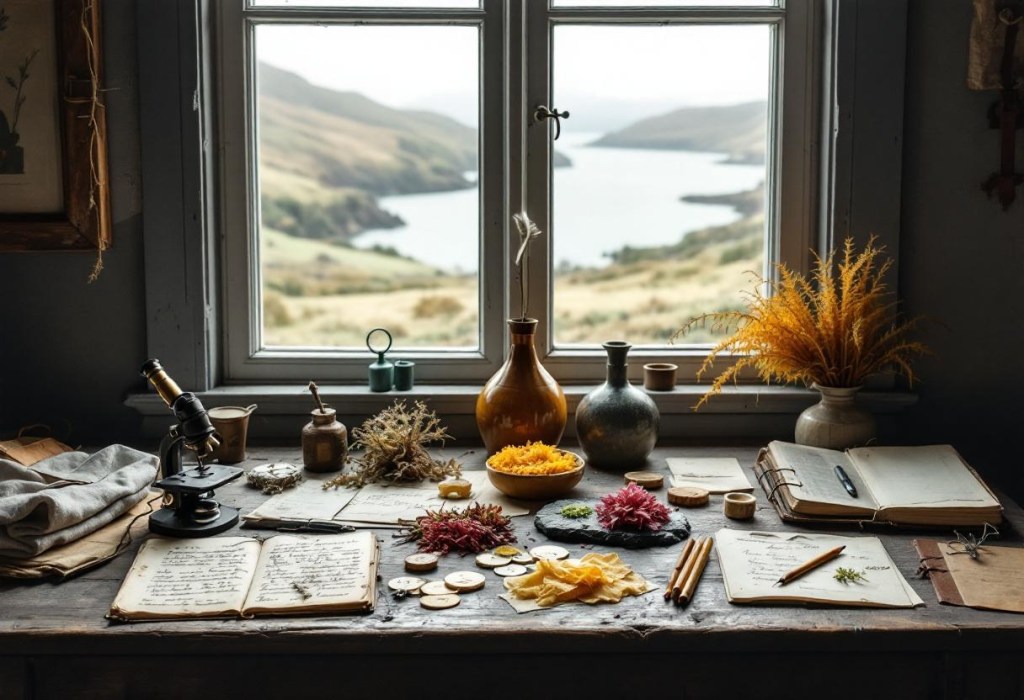
Ellen Hutchins (1785–1815) was Ireland’s first female botanist and a pioneering taxonomist whose eight years of fieldwork transformed understanding of Britain’s cryptogamic flora – those humble, often overlooked non-flowering plants that reward the patient observer with extraordinary complexity. Working from her sickbed in remote Ballylickey, County Cork, she discovered at least twenty species new to science, compiled a comprehensive flora of over one thousand plants, and produced exquisitely detailed watercolour illustrations that became essential references for the leading botanists of her time. Her greatest scientific triumph came in 1808 when she found reproductive structures on Velvet Horn seaweed, resolving a question that had troubled naturalists for decades about whether certain seaweeds were plants or animals. Though she died at twenty-nine, before she could claim full authorship of her discoveries, her legacy persists in the specimens housed in herbaria worldwide and in the species still bearing her name – silent reminders that her eye, patience, and mind were among the finest of her generation.
Good evening, Miss Hutchins. It’s a remarkable privilege to speak with you, particularly because your story has been largely absent from the historical record until quite recently. Before we discuss your scientific work, I wonder if you might tell our readers something of your early life – what drew a young woman in Cork to scrutinise moss and seaweed so intently that you became known among Britain’s leading botanists by the time you were five-and-twenty?
That is a generous question, though I confess the path was neither inevitable nor clearly marked. I was born into a family of modest means but considerable curiosity. My father, Abraham Hutchins, died when I was still young, leaving my mother in difficult circumstances. I became her steadfast companion – her eyes and hands, you might say, as her own health declined. But within that constraint lay freedom of a peculiar sort.
I grew up in a landscape of extraordinary botanical richness. West Cork is not fashionable, not known to the learned societies of Dublin or London, but for a person who looks – truly looks – it rewards the gaze lavishly. The rocky coasts, the mountain streams, the bogland – all of it teeming with plants that few naturalists had ever examined carefully. I began as most young ladies do, I suppose, with an interest in flowers and the simple pleasures of drawing. But the moment I encountered the marine algae, I was undone. These plants seemed to me infinitely more puzzling than any rose or foxglove. They demanded something more rigorous of the mind.
I had access to books – my family was educated, even if we lacked the fashionable connections. I read William Hudson’s Flora Anglica, and I was fortunate enough to meet through correspondence a number of working botanists who were willing to engage with questions from an unknown young woman in Cork. That openness – their willingness to answer queries, to consider my observations – made all the difference. Science, I discovered, could happen in a cottage by post and by careful looking, not only in lecture halls.
You mention your mother’s illness and your role as caregiver. How did you manage the physical demands of fieldwork – the mountain excursions, the coastal collecting – whilst also serving as her primary attendant?
One learns to compress existence, you might say. My brother too was unwell, paralysed and requiring constant care. There were periods when I was too weak myself to leave the house – my own constitution has never been robust – but weakness is educating in its own way. It teaches economy of motion, precision of purpose. When you are uncertain whether you will have strength for a full day’s work, you do not waste it on idle wandering.
I rose early, always. Three o’clock in the morning was not uncommon when I wished to reach particular mountain locations where certain plants grew. The cold and the dark were irrelevant. The plants were there, and the work needed doing. My mother understood the importance of the work, even as she required my presence. We negotiated a rhythm – careful management of domestic duties interspersed with periods of field collection.
The nearest rocky shore was a vigorous walk away, manageable even on days when my energy was uncertain. The seaweeds, you understand, demanded to be gathered at particular times – certain fronds only reveal their fructifications during specific seasons and states of tide. One cannot collect seaweed conveniently. It collects on its own schedule. But there was also something restorative in it. The work itself seemed to generate energy, paradoxical as that sounds.
You mention fructifications. That word will be unfamiliar to many readers. Can you explain what these structures are, why they mattered so intensely to botanists in your era, and why your discovery of them on the Velvet Horn was considered so significant?
A necessary question, for this is truly the heart of my work. Fructifications – the reproductive organs of plants – are how botanists classify and understand what they are observing. In flowering plants, it is simple enough: one sees the flower, the fruit, and knows with certainty that one is examining a plant organism. But the non-flowering plants – the cryptogams – these were far more obscure.
Most seaweeds, when examined carefully, showed no obvious reproductive structures. One might study a specimen for hours, turn it over in every light, and observe nothing that resembled what one expected of reproduction. Some naturalists proposed that seaweeds must be sponges, or some intermediate form between plant and animal. Others suggested they were merely fragments of larger organisms. The absence of visible fructifications created genuine doubt about their botanical status.
The solution required several things: first, an intimate familiarity with the plant itself – handling it repeatedly, understanding its growth patterns and seasonal changes. Second, careful observation with magnification. I possessed a simple microscope, nothing elaborate, but sufficient for the work. Third, patience approaching the fanatical. One might examine fifty specimens before finding one at precisely the right developmental stage.
When I finally located Velvet Horn specimens bearing fructifications in July of 1808, the structures were visible – though small and requiring magnification to appreciate fully – distributed across the fronds. I was able to sketch them and describe them in detail to Mr. Dawson Turner, the foremost specialist in British seaweeds. His publication of my findings settled what had been an open question: these were indeed plants, properly classified, with reproductive capacities matching their botanical status.
It seems a small thing now, perhaps, but it meant something. It meant that the plants I had been collecting and drawing and studying were what I believed them to be. It meant that observation, persistence, and care could resolve what learned men had debated inconclusively.
You compiled a flora of over one thousand species in West Cork – a catalogue that would be a lifetime achievement for any botanist, and you accomplished it between roughly 1805 and 1813, working from home, without institutional support or formal training. Walk us through what that process entailed. How did you approach such an ambitious survey?
I approached it as one approaches anything of magnitude – methodically and in recognition of my own limitations. I could not cover every square mile of Cork myself. But I could establish a comprehensive understanding of what grew in the locations I could reach, and I could solicit specimens and observations from trusted individuals in other areas of the county.
The first requirement was a reliable system of classification. I adopted the Linnaean system because it was the language in which naturalists communicated, the coin of the realm, so to speak. Every specimen required careful notation: location found, habitat details, condition, date of collection, notable features. I kept extensive field notes – no botanical observation was too minor to record. The colour of the substrate, the proximity to freshwater, whether the plant grew in exposed or sheltered conditions, its abundance or rarity – these details matter.
I pressed and dried specimens for preservation in herbaria, a tedious but crucial process. Paper must be changed frequently to prevent mildew. The specimens must be arranged logically for future consultation. My own dried specimens remain distributed across several collections now, I understand – Dublin, London, Edinburgh, Kew. At the time, I sent them where they would be most useful to working botanists.
But the core of the work was observation and illustration. I produced hundreds of watercolour drawings, and these were not mere decorations. They represented my detailed understanding of each plant’s structure: the arrangement of fructifications, the precise form of the fronds or leaves, the colour at different seasons of maturity. An accurate drawing captured information that words alone could not convey. When Mr. Turner or Mr. Hooker needed to describe a species for publication, they consulted my drawings.
I used a particular technique, developing skills in cross-hatching and fine line work that required considerable practice. The watercolours were applied with precision – one cannot correct them the way one might with pencil sketches. An error is permanent. This demanded not only artistic ability but the kind of patient observation that merges art and science into a single labour.
The catalogue itself represented sorting and organising all of this – over one thousand entries, each documented, each understood. How many professional botanists have completed such a work?
Let me press you on this: historians have noted that you produced these materials – the illustrations, the catalogue, the field observations – yet you never published under your own name. Your drawings were engraved and published in Turner’s Fuci and Hooker’s British Jungermanniae, but the author credit went to them. How did you understand that arrangement at the time? Did it seem unjust, or was it simply the accepted convention?
Both, I think, though I was perhaps not fully aware of how completely the injustice was embedded in the structure itself. Convention is a powerful thing. It shapes what seems possible, what seems natural, what seems possible to question.
When I worked with Mr. Turner, he was extraordinarily generous. He acknowledged my role as collector, illustrator, and observer. My name appeared in his publications. He praised my work in terms I did not expect. Yet when the authoritative description of a species appeared in print, it bore his name as the author. He had written the formal description, integrated it into the taxonomic literature, claimed the authority of interpretation. This seemed entirely proper to me at the time. He was a man of science with access to publication. I was a woman working from home in an isolated location. The roles seemed natural enough.
But here is what I now understand more clearly: the entire system was constructed to render a particular kind of labour – my labour – invisible in the formal record. I collected, I identified, I illustrated, I described my observations in detail. Yet the person who repackaged my discoveries in Latin prose, who situated them within the broader literature, who had the institutional authority to make them official – that person received historical credit. Over time, my role became merely the mechanical supply of raw materials. The intellectual work became his alone.
Was it unjust? The question assumes I could have chosen differently. But publishing under one’s own name as a woman in 1810 was not a choice available to me. The Linnean Society would not receive papers from women. The scientific journals would not publish my work under my own authorship. What would I have published, and where? The structure did not permit it.
So I accepted the arrangement that was available. But I would counsel younger women: understand the structure. Know what it costs you. Work within it if you must, but do not mistake necessity for justice.
Speaking of illustration – I’m fascinated by your technique, and I want to understand the level of scientific precision required. You weren’t simply making pretty pictures. Walk me through one specific example. How would you approach illustrating, say, a newly discovered lichen or liverwort?
Yes, precisely. Beauty and precision are not opposed in this work; they are united. A drawing that is merely decorative is useless to science. A drawing that attempts accuracy without aesthetic coherence is often equally useless, because a confused image confuses understanding.
Take a liverwort – I have studied many of them. The first step is careful observation of the living plant, if possible, or the freshly pressed specimen. I would examine it with magnification, noting the overall shape and size, the arrangement of leaves or leaf-like structures, any distinctive characteristics. I would sketch preliminary drawings, rough ones, establishing the proportions.
Then I would focus on the details that matter for classification: the shape and arrangement of the cellular structures visible under magnification, the form of the reproductive organs, the margin patterns. These require magnified drawing, often on a larger scale than the plant itself to show detail adequately. I would use a simple system of line work to indicate cellular structure – the cross-hatching I mentioned, carefully controlled to suggest texture and form without being arbitrary.
For the watercolour, I worked from these preliminary sketches and from fresh or recently dried specimens. Watercolour is challenging because the pigment must be applied with confidence – hesitation shows. I developed a limited palette: some ochres and earth tones, a few greens, blacks for detail work. I applied colour carefully, layer upon layer sometimes, to achieve the depth and variation one sees in living material. A lichen is not a uniform colour. Studying it carefully, one sees subtle gradations, slight variations in tone that indicate the texture and form.
Critical to all this was accuracy of measurement and proportion. I used simple tools – a lens, rulers, compasses – but applied them with rigour. When I drew a specimen at a particular magnification, I noted that magnification. When I drew it at actual size alongside a magnified version, both were geometrically proportional. A botanist who received my drawing could trust it as a guide to the actual structure of the plant.
The work demanded perhaps six to ten hours per specimen for a fully realised illustration, more if the specimen was particularly complex or if I wished to show multiple developmental stages. I often produced several drawings of the same species to show variations or seasonal changes.
That’s extraordinary precision – effectively you were creating visual data that others could rely on for taxonomic work. But you were doing this alone, without assistants, without institutional support. How did you acquire the basic tools? And did you have any failures or limitations you had to work around?
My microscope was modest by any standard. Cost me money I could ill afford, and I purchased it years into my work. For the first years, I relied entirely on what magnification I could achieve with simple hand lenses. This limited what I could observe, but it also trained the eye to a kind of careful looking that perhaps served me well.
The other tools – pencils, paper, watercolour pigments – I acquired piecemeal, often of quite ordinary quality. I learned to husband my materials carefully. Paper was expensive, and so I developed the habit of cross-writing my letters to collectors – writing sideways across already-completed correspondence to reduce the volume of paper my recipients needed to handle or store. It was economical and, I suppose, a small protest against the cost of knowledge.
As for failures, they were numerous. I made identification errors that I only discovered later. I produced drawings that, upon reflection, were clumsy or inaccurate. There were specimens so delicate that they arrived destroyed after posting, forcing me to develop new methods of packing and preservation. I learned that certain watercolour techniques rendered colours that faded or changed over time. One revises one’s understanding as the work progresses.
I recall a particular frustration with a rare seaweed specimen. The fructifications were so minute, so difficult to render in visual form, that I produced three separate drawings attempting to capture them accurately. The third attempt satisfied me, but the labour was considerable. At times I despaired of ever capturing what I saw clearly enough to communicate it effectively.
The most significant limitation was my own health. There were periods – weeks sometimes, occasionally months – when I was too weak to hold a pencil or to undertake fieldwork. These gaps in my productivity frustrated me enormously. I had plans, observations I wished to pursue, but my body would not cooperate. I learned to accept these interruptions without allowing them to paralyse the work entirely. When strength returned, I resumed.
You mention your health as an ongoing constraint, but I’m curious about something that might sound impertinent. Your greatest productivity, your most celebrated discoveries, occurred precisely during years when you were chronically ill. How do you account for that? Was there something about the nature of your work – the concentration required, perhaps, or the discipline – that somehow compensated for physical weakness?
That is not impertinent. It is the question that most interests me when I reflect on these years.
I think the work itself was restorative in ways that are difficult to explain to someone who has not experienced chronic illness. Physical weakness and fatigue create a peculiar clarity sometimes. When one cannot waste energy, one becomes extraordinarily attentive to what matters. Trivial concerns fall away. One’s concentration narrows and deepens.
There was something almost meditative in the detailed observation required by my work. To examine a specimen of lichen or moss with sufficient care to understand its structure, to render it accurately, to identify it correctly – this required a kind of sustained attention that was incompatible with the anxious preoccupation that often accompanies illness. For hours at a time, studying under magnification, sketching, annotating, I was absorbed into the work itself. The physical discomfort receded. The fatigue seemed less relevant.
I also think there was an element of purpose that transcended physical circumstance. I understood myself to be doing something of genuine importance. That understanding sustained me across many difficult days. The work felt urgent in a way that made bodily complaint seem less significant.
There is also, I confess, an element of stubbornness. I was determined that my illness would not prevent me from pursuing the sea plants with all my might. It became, perhaps, a point of pride or defiance – proof that one’s mind and one’s capacity for meaningful labour were not bound by what one’s body could easily accomplish. I would work on days when I felt too weak for ordinary household tasks, because the work mattered more than comfort.
Whether this was wisdom or merely the determination of a young woman who did not fully grasp the cost of such persistence, I cannot say with certainty now. But I do not regret it.
You said something just then – “pursue the sea plants with all my might.” That phrasing suggests something beyond scholarly interest. It suggests passion, even obsession. Tell me about that drive. What was it about these particular plants – these overlooked, difficult organisms – that claimed you so completely?
There is a kind of beauty in difficulty, you see. The flowering plants – the roses and the foxgloves – they announce themselves. They are designed to be seen, to attract notice and admiration. But the cryptogams, these plants that reproduce without flowers, without obvious fructifications, without the conventional markers of botanical status – they require one to look more carefully, to think more rigorously, to understand them on their own terms rather than through inherited assumptions.
When one truly attends to these plants, one discovers an architecture of extraordinary complexity. Look at a moss under magnification. The cellular structure, the precise arrangement, the delicate protonema – this is engineering on a microscopic scale, and it is elegant. A lichen, formed from the collaboration of fungus and algae, represents a kind of negotiated partnership that speaks to something profound about how life organises itself.
And the seaweeds – these I found simply magnificent. The variety of form, colour, and structure across different species, each adapted to particular conditions of shore and tide. I spent hours collecting along the coast, seeking specimens at different seasons, watching how they responded to environmental change. There is a kind of conversation happening in the marine environment, a complexity that most people never perceive because they do not look carefully.
I think I was also drawn to these plants precisely because they were overlooked. There was so much unknown territory. The liverworts of West Cork had barely been catalogued. The lichens were poorly understood. When one worked with these organisms, one was not merely rehearsing what others had already established. One was genuinely discovering something new, adding to human knowledge. That sense of authentic discovery, of participating in the expansion of understanding, was intoxicating.
And there was something satisfying about precision in the face of obscurity. Others might think these plants dull or uninteresting. But I knew their secrets. I had seen their structures under magnification, drawn them with accuracy, understood how they related to broader taxonomic families. That knowledge was mine, and it was solid. I could not be patronised about what I did not know, because I knew these plants with a depth that few others possessed.
I want to talk about the social recognition you received – the rather extraordinary fact that species were named in your honour. Multiple taxonomists chose to designate various lichens, mosses, and liverworts as hutchinsiae or variations thereof. How did you experience that? Did it feel like recognition of your work, or did it also highlight, in some way, the fact that you could not author these descriptions yourself?
Both, again. Always both.
When I first learned that Mr. Mackay intended to name a liverwort after me, I felt a profound honour. The Linnaean system of nomenclature is the language in which we speak across time and across borders. A plant bearing one’s name in that system is a form of immortality, recognition that will persist as long as botanists practise their art. I was moved by it, genuinely.
But – and here is the complication – I also recognised what it represented. My name affixed to a plant I had discovered but could not formally describe or publish. My identity preserved in a kind of secondary status. The plant would carry my name, yet the original description would bear another man’s authorship. Generations of botanists would encounter Ulota hutchinsiae or Jubula hutchinsiae without ever knowing who Ellen Hutchins was or what she had contributed. My name would become a curiosity, a footnote, rather than a clear attribution of intellectual labour.
I sometimes think of it as a kind of gilded obscurity. The honour is genuine, but it also masks a structural injustice. It is possible to say, “Yes, she discovered this plant, and see, it bears her name,” whilst simultaneously maintaining that she never truly participated in science in the authoritative way. The species-naming becomes a gesture of consolation, a way of acknowledging women’s contributions within the very system that prevented those contributions from being fully recognised.
And yet I would not refuse the honour. It is something, at least. It is more than most women of my era received. It is a form of visibility, even if limited.
Let’s talk about your correspondences with the leading botanists of your time. You maintained productive exchanges with Dawson Turner, William Jackson Hooker, James Townsend Mackay of Trinity College Dublin. How did those relationships function? Were you treated as a peer, or always as something else – valuable, perhaps, but fundamentally distinct in status?
Mr. Turner was remarkably respectful. He asked genuine questions about my observations. He took my identifications seriously. When I sent him specimens, he examined them carefully and often confirmed or sometimes gently corrected my classifications. He welcomed disagreement if I could justify it. These are the hallmarks of a truly collegial exchange, I think. He did not accord me the full status that he would extend to a male colleague working at an institution, but within the structure that existed, he treated me with considerable regard.
Mr. Hooker was similar. He was interested in my work on the bryophytes – the mosses and liverworts – and he consulted with me about particular specimens and observations. He published my illustrations in his British Jungermanniae, which was profoundly gratifying. Yet the work remained framed as his publication, featuring his descriptions and his taxonomic authority. My role was acknowledged but subordinated.
Mr. Mackay at Trinity was perhaps the closest to a mentor figure. He took genuine interest in my development as a botanist. He did not treat me merely as a source of specimens but engaged with me about the intellectual questions that preoccupied him. He was responsible for several of the species named in my honour. Yet even he could not have sponsored me into any formal scientific role. Trinity College, where he held his position, would not admit women as students. The Linnean Society would not accept me as a member. The structures of science were simply closed.
What I appreciated about these men was their willingness to work around the constraints. They found ways to collaborate despite the institutional barriers. They recognised and praised my contributions publicly when they could. But they were also men operating within a system that benefited them and limited me. Their openness did not extend to challenging that system fundamentally.
There’s an irony here worth exploring. The very thing that made you productive – your isolation in West Cork – also ensured that you remained largely invisible to the broader scientific community. You never attended meetings of scientific societies. You never gave lectures. You existed only through the mail and through the specimens you sent. Was that tragic, or did it perhaps afford you certain freedoms?
You probe at an interesting tension.
The isolation was certainly a limitation. I would have benefited, no doubt, from access to larger herbaria, from the opportunity to consult directly with specialists about particular specimens, from the intellectual stimulation of scientific society. There were questions I pursued that might have been resolved more quickly with access to the institutional resources of Dublin or London. The absence of those resources meant I worked with greater uncertainty, occasionally reaching conclusions that later revision proved incomplete.
Yet there were also unexpected advantages. Because I existed only through correspondence and specimens, I was not subject to the daily social scrutiny that would have attended a woman working visibly within an institution. I could not be dismissed on the basis of my appearance or my demeanour or my failure to perform appropriate femininity. I was judged, primarily, on the quality of my work. The plants I sent, the drawings I produced, the identifications I provided – these spoke for themselves.
There was also a kind of freedom in working without the expectation of constant social performance. I did not need to apologise for my intensity, to moderate my enthusiasm, to make my ambition palatable to those around me. I could pursue the sea plants with the singular focus that the work demanded, without needing to convince anyone else that it was a suitable pursuit for a woman.
The isolation also meant that I was less vulnerable to certain kinds of dismissal. I could not be prevented from attending meetings I never expected to attend. No one could refuse me entry to institutions I had no occasion to visit. My invisibility was painful, but it was also protective in its way. It allowed me to work.
I want to return to something you mentioned earlier – the moment of genuine uncertainty about seaweeds and their botanical status. This is actually a fascinating case study in how science progresses. There was legitimate debate among naturalists about whether seaweeds were plants or possibly animals or something intermediate. Your 1808 discovery seemed to settle it. But was it truly so conclusive? Did everyone simply accept your finding?
No, I give myself more credit than perhaps is entirely warranted. The discovery of reproductive structures on Velvet Horn was significant evidence, but it was not, by itself, conclusive of anything. What it did was provide concrete data that could not easily be dismissed.
There remained naturalists – some quite eminent – who continued to harbour doubts. Some argued that what I had identified might be parasitic organisms rather than the reproductive organs of the seaweed itself. Others questioned whether microscopic observation could be entirely trusted, whether the magnified images might deceive the eye. One learns quickly in scientific work that a single piece of evidence, no matter how compelling, does not settle old debates instantaneously.
But the accumulation of evidence matters. As other collectors found similar structures on other species of seaweed, as the descriptions were published and disseminated, the weight of evidence shifted. The question gradually moved from genuine controversy to settled science. My contribution was one piece of that broader process. It was important but not solitary.
I think this is a valuable lesson for workers in science: one’s own discoveries are always embedded in a larger context of inquiry. One is not solving problems in isolation but adding to accumulated understanding. It is humbling, in a way, but also liberating. It means the pressure on any single finding is reduced. The work of many people, over time, clarifies what is true.
You’ve been remarkably candid about the limitations and frustrations of your situation. But I wonder if you’ve also been too generous, occasionally, in accepting constraints that might have been challenged. You mention several times that women could not publish under their own names, could not join scientific societies. These were rules, yes, but rules created by people. Did you ever consider challenging them?
I was twenty-five years old, living in a remote part of Ireland, dependent on family members and on the willingness of established naturalists to take my work seriously. I was chronically ill. I was caregiving for my mother and my brother. I had no independent income, no education beyond what I could acquire through reading and correspondence, no access to the institutions that conferred scientific authority.
When one is in such a position, the question of challenging systemic rules feels, I confess, rather abstract. Challenge them how? Write letters to the Linnean Society demanding they reconsider? I was not unaware of the injustice. But the mechanisms by which one might address that injustice seemed entirely beyond my reach.
I think perhaps I accepted the constraints with less resistance than a person with greater resources and fewer immediate pressures might have done. If I had been born into wealth, or had better health, or had been male, or had lived in London rather than Cork, perhaps I would have fought more openly against the system. As it was, I worked within what was available.
But here is what I would say to younger women: do not mistake pragmatic acceptance of constraints for endorsement of their justice. I did what I could with what I had. But the system itself was wrong. Work around it if you must, but recognise it for what it is.
You died at twenty-nine. Your productive botanical work spanned roughly eight years. Had you lived – had your health held – what would you have done with your work? Would you have attempted to publish under your own name, despite the obstacles? Would you have tried to access institutional roles, or would you have continued as you were?
I do not know. I had not resolved that question. I had dreams, certainly. I hoped that my work might eventually find a form that did not require the intermediation of male colleagues. I wondered about producing illustrated works that would bear my own name and authority. The model was limited – there were few examples of women working in this way – but it seemed theoretically possible.
I also understood that my knowledge was deepening. My identifications were becoming more reliable. My understanding of relationships between species within families was growing more sophisticated. I thought perhaps that if I could extend my work to other regions of Ireland, or to other collecting sites, I might build a reputation sufficiently established that the structural barriers might flex slightly. It was perhaps naive, but I believed in the power of demonstrated competence.
I would never have been satisfied to remain invisible. That much I know. Whether I would have been willing to risk the social consequences of demanding fuller recognition, I cannot say with certainty. But I would have tried to push against the constraints in some form, more openly than I managed.
That uncertainty itself is part of what I grieve about my interrupted life. I did not arrive at my own answers about how to be a woman scientist in a scientific world designed to exclude women. I was still negotiating that question when I ran out of time.
Your story has experienced remarkable recovery in recent decades. Plaques have been erected. Festivals celebrate your work. University College Cork now publicly acknowledges you as Ireland’s first female botanist. How do you regard that recovery? Does it feel like justice, or is it something more complicated?
I am grateful for it, genuinely. It matters that people know my name again, that they understand what I accomplished. It matters that young women studying botany in Ireland learn that a woman of exceptional talent and determination pursued this work centuries ago. That is not nothing.
But I also recognise what recovery looks like from the vantage point of two centuries later. The plaques are tributes to someone long deceased. The festivals commemorate rather than include. The public recognition comes after the fact, when I cannot benefit from it professionally. It is, in some sense, the historical equivalent of the species-naming – honour rendered to the dead whilst the living conditions that prevented that honour from existing during life remain substantially unaltered.
I wonder about the women working in science now, even in 2025. I have been told that women scientists, particularly those with caregiving responsibilities or chronic illnesses, continue to face barriers not entirely dissimilar to what I encountered. The barriers are different in form – there are more pathways into science now, thank goodness – but the fundamental issue persists: a scientific world structured in ways that assumes its practitioners have a particular kind of life, without dependents, without illness, without other claims on their time or energy.
The recovery of my story is valuable, I think, primarily if it illuminates that ongoing issue. It is not simply a tribute to the past. It is a warning about the present.
A final question. If you could speak to women scientists today – particularly those working in fields that remain male-dominated, or those struggling to balance competing demands, or those feeling invisible or undervalued – what would you tell them?
I would tell them that the work itself is real, regardless of whether the world recognises it immediately. The knowledge you acquire, the discoveries you make, the problems you solve – these matter intrinsically. They do not become more real or more valuable because someone in authority acknowledges them. That is worth holding onto on difficult days.
I would also tell them that the structural barriers are not personal failures. If you find yourself navigating a system that seems designed to undervalue or exclude you, the problem is with the system, not with you. Work within it if you must. Circumvent it if you can. But do not internalise its judgments about your worth.
And I would tell them to document everything – your methods, your observations, your techniques, your failures as well as your successes. More than institutions or patronage or public recognition, what persists is the careful record of work. The specimens in herbaria, the illustrations in archives, the detailed notes about process – these become the conversation that reaches forward through time. Tend to that record. It is a form of legacy that no one can take from you.
Finally, I would tell them to pursue whatever engages their mind with all their might. The seaweeds claimed me because they were genuinely fascinating, infinitely complex, endlessly rewarding to study carefully. That engagement sustained me through the difficult years. Find what draws you like that. Chase it with intensity. The recognition, when it comes, will be secondary to the satisfaction of the work itself.
Letters and emails
Following the publication of our primary interview, we received correspondence from botanists, archivists, conservators, and researchers across the globe – each offering thoughtful questions that extended and complicated the conversation in productive ways. These letters arrived from practitioners working in fields that Ellen Hutchins helped pioneer, individuals navigating their own challenges within scientific work, and people whose lives and labour are shaped by the legacies of women like her.
Rather than compress these questions into a conventional Q&A format, we present them here as they were written: as letters and emails from a genuinely international community of scientific practitioners. Each contributor brings their own expertise, geographical perspective, and intellectual curiosity to bear on Ellen’s story. Together, they form a kind of conversation across continents and centuries – contemporary voices engaging with the woman who, two hundred years ago, pursued the sea plants with all her might from a cottage in West Cork.
What emerges is not a definitive set of answers, but rather an invitation to think alongside Ellen Hutchins about the practical, philosophical, and ethical dimensions of scientific work; about the weight of documentation and discovery; about the relationship between constraint and creativity; and about what we owe to those who came before whilst building something new.
Mila Kovalenko | 34 | Botanical Conservator & Archival Specialist | Prague, Czech Republic
You mentioned that your specimens ended up distributed across herbaria in Dublin, London, Edinburgh, Kew, Helsinki, and New York – fragmenting the complete picture of your work. As someone who now works with historical plant collections, I’m struck by how that geographic scattering simultaneously preserved your specimens from being lost entirely, but also made your contributions harder to trace as a coherent body of work. If you could redesign how scientific collections were managed and shared in your era, knowing what you know now about how institutions would evolve, what would you have done differently? And do you think the modern digital herbaria – where images of specimens from multiple institutions can now be viewed together online – finally achieve what you couldn’t accomplish with letters and postal parcels?
Miss Kovalenko, you have identified a tension that troubled me even at the time, though I did not possess the language or perspective to articulate it as clearly as you do now. The scattering of specimens was both inevitable and, in a peculiar way, strategic – though I cannot claim I foresaw all the consequences.
When I sent specimens to Mr. Dawson Turner in Yarmouth, or to Dr. Taylor in Dublin, or to Mr. Hooker when he was collecting materials for his publications, I understood that I was relinquishing physical possession of plants I had collected with considerable effort. A specimen posted cannot be recalled. Once it leaves one’s hands, it enters a circulation governed by the recipient’s purposes, connections, and eventual disposition of their own collections. I had no control over where my specimens would ultimately reside after the death of the men to whom I sent them.
But here is what I did understand: a specimen kept solely in my possession in Ballylickey was, in practical terms, invisible to science. It might as well not exist. The value of a specimen lies in its availability for examination by those who possess the expertise and comparative materials to situate it properly within the broader taxonomic literature. I could identify a lichen or liverwort with reasonable confidence, but I could not definitively confirm its relationship to species described from Scotland or Sweden or the Alps without access to specimens from those locations. The specialists – Mr. Turner, Dr. Hooker, Mr. Mackay – possessed such comparative collections. My specimens gained meaning by entering those contexts.
So the scattering was not accidental neglect but rather the consequence of a deliberate strategy: send specimens where they will be most useful to working botanists. If Mr. Turner needed particular seaweeds for his Fuci, I sent them. If Dr. Taylor required liverworts for his studies, I dispatched what I could spare. The distribution across multiple collections meant that my work became embedded in the authoritative references of the period. That seemed, at the time, like the highest purpose my plants could serve.
What I did not fully anticipate was the erasure that would follow. The specimens themselves were preserved – carefully mounted, annotated, filed into herbaria that would endure for centuries. But the narrative coherence of my work as a unified body of botanical investigation was lost. Each herbarium held fragments. No single institution possessed enough material to reconstruct the scope or ambition of what I had attempted. Future botanists might encounter a specimen labelled “E. Hutchins, Ballylickey, 1809” and have no notion that it represented one piece of a comprehensive flora, one element of eight years of concentrated fieldwork across West Cork’s varied habitats.
If I could redesign the system, knowing what institutions would become, I would have retained duplicate specimens more aggressively. Not merely one or two for my personal reference, but proper duplicates of everything significant that I collected. These I would have deposited together in a single location – Trinity College Dublin, perhaps, given Mr. Mackay’s position there and my Irish identity. A coherent collection, properly catalogued, bearing my name not merely as collector but as the architect of the survey itself. This would have required more resources than I possessed – more paper for pressing, more storage space, more funds for the materials of preservation. But it would have created a material record that could not be so easily fragmented or forgotten.
The difficulty, of course, is that such a deposit would have required institutional recognition I did not have. Trinity did not admit women. I held no formal position. What authority did I possess to demand that my collection be kept together, be catalogued under my direction, be preserved as a unified body of work? The institutions that might have housed such a collection were precisely the institutions from which I was excluded.
As for your digital herbaria – this concept astonishes me and, I confess, moves me deeply. That images of specimens from Dublin and London and Edinburgh and New York might be brought together in a single viewing space, accessible to any botanist anywhere, represents precisely what I attempted to accomplish through correspondence but could only achieve imperfectly. My letters to Mr. Turner often included detailed descriptions of specimens precisely because I could not assume he had seen comparable materials. We were forever trying to describe to one another what we were seeing, knowing that words and even drawings were imperfect substitutes for the actual plant in hand.
If such technology had existed in my time, the nature of botanical collaboration would have been transformed entirely. I could have examined Mr. Turner’s specimens from Norfolk to compare with my Cork materials without either of us posting anything. I could have consulted Dr. Hooker’s reference collections whilst making my own identifications. The delay, the uncertainty, the dependence on others’ willingness to describe what they were observing – all of this would have been obviated.
But I wonder whether something might also be lost. The correspondence itself forced a particular kind of precision. When one cannot show another person the actual specimen, one must describe it with extraordinary care. Every detail matters. The discipline of that description – learning to articulate exactly what makes a particular lichen distinctive, what subtle feature distinguishes one moss from a closely related species – this was educating in ways that immediate visual access might not require. We learned to see more carefully because we had to communicate what we saw through language alone.
Still, I would not refuse the technology on grounds of preserving difficulty. The work was hard enough without adding unnecessary obstacles. If digital access to distributed collections can restore the narrative coherence that physical scattering destroyed, then it accomplishes something I could not: it makes my work visible again as a unified contribution rather than as isolated fragments attributed to a collector whose larger purposes have been forgotten.
What I hope is that such technology serves not merely to aggregate specimens but to restore context – to help contemporary botanists understand not just what I found, but how I worked, what questions animated my collecting, what understanding of West Cork’s botanical geography I was building through years of careful observation. The specimens are data, yes. But they are also evidence of a mind at work, making decisions about what mattered and why. That is what I hope your digital herbaria can recover.
Felipe Andrade | 41 | Field Ecologist & Biodiversity Surveyor | Montevideo, Uruguay
You compiled a flora of over one thousand species in West Cork, which is genuinely remarkable for the era. But I’m curious about the methodological challenge that probably nobody asks about: how did you decide what not to include? When you’re working in an unexplored region, the temptation must be to catalogue everything, but there are practical limits – time, paper, illustrations. How did you prioritise? Did you focus on rarity, on covering different habitats, on the species most likely to be scientifically interesting? And did your choices about what to record versus what to leave out ever come back to haunt you – species you later wished you’d documented more thoroughly?
Mr. Andrade, you ask the question that keeps a collector awake at night. The decision about what to omit is far more agonising than the decision about what to include, precisely because one can never be entirely certain whether the plant passed over might prove, upon later examination, to be something extraordinary.
I began with a principle that seemed sensible at the outset: I would catalogue everything I could identify with reasonable confidence, prioritising species that were either rare, unusually well-developed specimens suitable for preservation, or representative of habitat types across West Cork. This sounds orderly enough in the telling, but the practice was considerably messier.
The common plants – the ubiquitous mosses that carpeted every stone wall, the abundant seaweeds that appeared on every shore – these I documented but did not collect in great quantities. I reasoned that such plants were already well-known to botanists, that specimens existed in sufficient numbers elsewhere, and that my resources were better directed toward the unusual, the uncertain, the plants that might extend the known range of a species or represent something not yet described. This was, I think, a defensible choice. But it meant that my flora represented a particular view of West Cork’s vegetation – emphasising the distinctive rather than the typical.
I was especially drawn to the cryptogams, as you know, and this shaped my priorities considerably. The flowering plants of West Cork were tolerably well-understood by reference to the standard floras – Hudson’s work, Withering’s arrangement, the various county catalogues that were beginning to appear. I could walk through a meadow and identify the grasses and the wildflowers with fair confidence, and I knew that such identifications added little to botanical knowledge unless the plant was growing in an unexpected location or exhibited some unusual characteristic.
But the cryptogams – the mosses, liverworts, lichens, algae – these were far less completely catalogued. For many species, the descriptions in the literature were inadequate or contradictory. The illustrations, when they existed at all, were often too crude to permit certain identification. Here was territory where careful work might genuinely contribute something new. So I directed my energies disproportionately toward these difficult, overlooked organisms. This meant that my flora, whilst comprehensive in its treatment of cryptogams, was perhaps less thorough in its coverage of flowering plants than a more conventional botanist might have produced.
Time was always the constraining factor. There were seasons when particular plants could be collected – seaweeds bearing fructifications, mosses in their fruiting state, alpine species accessible only during brief summer months when the mountain paths were passable. I had to make rapid decisions in the field: is this specimen worth the effort of collection, preservation, and documentation? Or is my time better spent searching for something rarer?
I developed a kind of triage approach, though I did not have that word for it then. Plants were sorted mentally into categories: certainly common, probably common but worth a single specimen for reference, uncertain and therefore requiring collection, and obviously rare or unusual and demanding immediate attention. This sorting happened almost instantaneously after years of practice. I could glance at a rock face covered in lichens and know within moments which specimens warranted closer examination.
But here is where regret enters. There were plants I dismissed as common that I later discovered were not common at all in that particular location, or that exhibited characteristics I had failed to notice during my initial observation. I recall a lichen growing on coastal rocks that I passed over repeatedly, assuming it to be a well-known species, only to realise during a later visit that its substrate preference and association with particular algae suggested it might be something distinct. By the time I returned to collect it properly, the rocks had been disturbed by winter storms, and I never found that particular population again.
There were also practical constraints that forced exclusions I did not choose voluntarily. Paper for pressing specimens was expensive and not unlimited. I could not collect every interesting moss I encountered because I simply did not have sufficient materials to preserve them all properly. This meant making painful choices: collect this specimen that might be unusual, or that other specimen that is certainly unusual but requires more careful handling? I often chose the latter, reasoning that the uncertain could wait for another season whilst the certainly valuable should be secured immediately.
Illustration presented even sharper limitations. I could collect and press dozens of specimens in a day, but I could produce perhaps one detailed watercolour illustration per week, accounting for the time required for observation, preliminary sketching, and the final painting. This meant that the vast majority of my collections were never illustrated. I had to select which species most urgently required visual documentation – usually those that were poorly illustrated in existing works, or those whose diagnostic features were particularly difficult to capture in words alone.
I prioritised illustrations of species I suspected might be new to science, or new to Ireland, or whose fructifications I had been fortunate enough to observe. The Velvet Horn seaweed received multiple illustrations because the reproductive structures were so significant and so poorly documented elsewhere. But there were hundreds of other collections that merited illustration and never received it, simply because time and energy were finite.
Looking back, I wonder whether I should have been more methodical about documenting the common species. A complete flora ought to include the abundant alongside the rare, the typical alongside the exceptional. By focusing so heavily on the unusual, I perhaps created a distorted picture of West Cork’s actual vegetation – a catalogue of curiosities rather than a true representation of what grew there. Future botanists consulting my work might come away thinking West Cork was populated primarily by rare lichens and unusual liverworts, when in fact the dominant plants were the same grasses and sedges and common mosses that grew throughout Ireland.
Yet I cannot entirely regret my choices. The common plants would have been documented eventually by others. The rare and difficult organisms might not have been recorded at all had I not pursued them. In that sense, my prioritisation served the larger purpose of botanical knowledge, even if it produced a flora that was comprehensive in some domains and selective in others.
What haunts me most are not the species I consciously chose to omit, but the species I failed to recognise as significant during my brief window of active work. There were plants I saw, noted casually, and moved past, not understanding that I was observing something that would later be recognised as rare or scientifically important. Those losses – of opportunity, of attention, of understanding – those I cannot recover. They represent the inevitable limitations of working alone, without the collaborative checking and cross-reference that institutional botany provides.
If I could offer guidance to someone undertaking similar survey work: document the common alongside the rare, even if briefly. Future workers will thank you for the baseline. But do not let comprehensiveness paralyse action. Better to catalogue one thousand species thoughtfully than to attempt three thousand and accomplish none well. And when you must choose what to omit, choose consciously, noting what you have passed over and why. That record of exclusion is itself valuable data.
Esinam Owusu | 28 | Lichenologist & Women in Science Advocate | Accra, Ghana
What stands out to me about your story is that you were essentially doing what we’d now call foundational biodiversity survey work – the kind of careful, place-based documentation that conservation biology desperately needs but often struggles to fund or prioritise. Yet you were doing it not because an institution commissioned you, but because the work seemed urgent and necessary to you personally. I wonder: did you ever feel the weight of that responsibility – the sense that you were the only person who could document these plants before they might be lost or overlooked? How did you reconcile that sense of individual responsibility with the isolation of working alone, without peers checking your work or sharing the burden?
Miss Owusu, you have touched upon something I did not speak of often during my lifetime, though it weighed upon me considerably. Yes, I felt that responsibility acutely – the awareness that I might be the only person who would ever look carefully at certain plants in West Cork, who would note their presence and habits, who would create a record that might matter to future naturalists. That sense of solitary obligation was both sustaining and oppressive.
West Cork in my time was not merely remote – it was botanically unexplored in any rigorous sense. Travellers passed through occasionally and noted the dramatic coastal scenery or the poverty of the inhabitants, but few stopped to examine the vegetation with scientific attention. The standard floras of Britain and Ireland were compiled primarily from observations in more accessible regions – the areas surrounding Dublin, the well-travelled routes through England and Scotland. Our western peninsulas, our mountain bogs, our wave-battered shores – these were marginal to the geographical imaginations of naturalists working in cities.
I understood, with increasing clarity as my work progressed, that if I did not document what grew here, it might go unrecorded for decades. There was no queue of botanists waiting to survey Bantry Bay. There was no institutional programme of exploration that would eventually reach West Cork. There was only me, and the question of whether I would do the work or whether it would remain undone.
This created a peculiar urgency. When I found a population of unusual lichens growing on a particular outcrop, I could not assume that anyone else would find them. When I observed seaweeds in specific states of fructification, I understood that the opportunity might not recur – that storm damage, seasonal variation, or simple chance might mean that particular observation was singular. I felt, at times, like a witness to something that would otherwise pass unobserved and therefore, in some sense, uncounted.
The weight of that responsibility manifested in several ways. First, it made me meticulous almost to the point of paralysis. I questioned every identification, every observation, every decision about how to describe what I was seeing. Without peers to consult immediately, without the ability to show a specimen to a colleague and say, “What do you make of this?”, I carried the full burden of accuracy myself. If I misidentified a plant, if I described it incorrectly, if I attributed characteristics to it that belonged to some other species, that error would enter the record and might mislead future workers. The thought troubled my sleep more than once.
Second, it made me possessive of my time in ways that must have seemed unreasonable to those around me. When my mother required my attendance, when household duties claimed hours that I might have spent in the field, I chafed against the constraint with an intensity that perhaps seems disproportionate. But I understood that my opportunity to complete this work was limited – by my health, by my domestic obligations, by my circumstances generally. Every lost day felt like a permanent forfeiture of knowledge that would now never be recorded.
Third, it produced a kind of mournful awareness of my own limitations. I could not be everywhere at once. I could not observe every habitat in every season. There were mountain tarns I never reached, coastal promontories I never explored, woodland glens I noted from a distance but never examined closely. Each of these places held plants I would never catalogue, observations I would never make. The incompleteness of my work was guaranteed from the outset, and yet I felt responsible for that incompleteness in ways that were perhaps irrational but nonetheless real.
How did I reconcile this burden with the isolation? I am not certain I did reconcile it entirely. There were periods when the loneliness of the work felt unbearable – when I desperately wished for a companion who shared my interest, who could accompany me on collecting expeditions, who could examine a puzzling specimen and offer their judgment. Someone with whom to share not merely the labour but the intellectual satisfaction of solving a difficult identification or discovering something previously unknown.
But I also came to understand that the isolation afforded certain consolations. Because I worked alone, I was accountable primarily to my own standards of rigour. I did not need to compromise my methods to suit someone else’s preferences or priorities. I did not need to negotiate about which plants deserved attention or how much time to devote to a particular group of organisms. I could follow my own curiosity wherever it led, pursuing questions that might have seemed trivial or excessively detailed to a supervisor or collaborator.
The correspondence with Mr. Turner, Dr. Hooker, and others provided a form of community that was imperfect but valuable. When I sent specimens for their examination, when I received their letters confirming or correcting my identifications, I felt myself part of a dispersed network of naturalists working toward common understanding. This was not the same as having a colleague present in the field, but it was something. It meant that my observations were not simply disappearing into private notebooks – they were entering into circulation, being tested against the knowledge of others, contributing to a larger body of understanding.
I developed practices to manage the isolation and the attendant responsibility. I kept extraordinarily detailed field notes, recording not merely what I found but also my uncertainties, my alternative interpretations, my questions for future consideration. This created a kind of dialogue with myself – a record of my thinking that might be useful to others even if my final identifications proved incorrect. If a future botanist consulted my notes and saw that I had considered multiple possibilities before settling on a particular identification, they would understand my reasoning and could more easily identify where I might have erred.
I also learned to accept that some questions would remain unresolved. There were specimens I could not identify with certainty, plants whose status remained ambiguous despite my best efforts. Rather than agonise endlessly or claim certainty I did not possess, I learned to note the uncertainty explicitly: “This appears to be related to such-and-such species, but differs in the following particulars…” or “I am uncertain whether this represents a distinct species or merely a variety of a known plant.” Such admissions of ignorance felt vulnerable, but they were honest, and honesty seemed more valuable than false authority.
The sense of individual responsibility – the awareness that I might be the sole witness to certain botanical phenomena – never entirely left me. But I came to see it less as a burden to be reconciled and more as the simple reality of the work I had chosen. Someone had to begin the documentation of West Cork’s cryptogams. It happened to be me. That accident of geography and circumstance carried obligations, certainly, but it also carried the profound satisfaction of knowing that the work mattered, that it would persist beyond my brief lifetime, that future naturalists would build upon what I had begun.
What I would say to others working in similar isolation – and I suspect there are many, even in your modern era, who labour in regions or on organisms that receive little institutional attention – is this: the work does not need to be perfect to be valuable. It needs to be honest, careful, and as complete as your circumstances permit. Document your uncertainties as thoroughly as your certainties. Create records that others can build upon, correct, extend. And know that the loneliness, whilst real and at times painful, is also a kind of freedom. You are answerable primarily to the truth of what you observe, not to the expectations or preferences of institutions that might not understand the importance of your work until long after it is complete.
Brandon Scott | 35 | Natural History Museum Curator & Illustration Historian | Washington, D.C., USA
Your watercolour illustrations were precise enough that other botanists could rely on them for identification and taxonomic work. But I’m fascinated by the technical problem you solved without modern tools: how do you render microscopic structures in a way that communicates both their actual appearance and their scientific significance? When you drew fructifications under magnification, you were making choices about what to emphasise, what to simplify, what scale to work at. Those weren’t just artistic choices – they were data representation decisions. How conscious were you of that boundary between accuracy and interpretation? And when your drawings were later engraved for publication, did the engravers ever struggle to understand what you were trying to communicate, or did your precision make the translation to print relatively straightforward?
Mr. Scott, you have identified the central challenge of botanical illustration, and one I grappled with constantly. The question of what to show and how to show it is never merely technical – it is fundamentally interpretive. Every line I drew represented a decision about what mattered, what was essential to understanding the plant’s identity and character.
When I first began illustrating cryptogams under magnification, I made numerous errors of judgment. I attempted to render everything I could see with equal emphasis – every cellular variation, every minute texture, every subtle gradation of colour. The result was visual confusion. The drawings were accurate in a narrow sense, but they failed to communicate clearly because they did not guide the viewer’s eye toward the diagnostic features that distinguished one species from another. I had created illustrations that were faithful to my observations but not useful to science.
I learned, gradually and through many discarded attempts, that effective illustration requires a hierarchy of emphasis. The reproductive structures – the fructifications that were so crucial to classification – these must be rendered with particular clarity and often at greater magnification than the rest of the plant. If a moss bears capsules that are the key to its identification, those capsules must be shown in sufficient detail that their shape, their texture, the arrangement of their parts can be understood at a glance. The rest of the plant provides context but should not compete for visual attention.
This meant developing a vocabulary of line work and shading that could indicate different levels of importance. I used finer lines and more detailed cross-hatching for structures that required careful examination. I used broader, simpler strokes for the overall form of the plant. I learned to employ empty space deliberately – leaving certain areas of the paper less worked so that the eye would naturally settle on the more densely rendered diagnostic features.
Colour presented particular difficulties. Watercolour is unforgiving of error, as you know. Once the pigment is applied, it cannot be lifted entirely. This demanded that I work out the composition thoroughly in pencil before ever touching brush to paint. But colour also carried information that line work alone could not convey. The distinctive yellow-green of certain lichens, the deep russet of particular seaweeds, the subtle variations in tone that indicated different stages of maturity – these were scientifically meaningful, not merely decorative.
I developed a limited palette that I could control reliably. Gamboge for certain yellows, Prussian blue mixed with various earth tones for greens, burnt sienna for the browns and russets of many cryptogams. I avoided pigments that I knew to be fugitive – those that would fade or alter with time – because I understood that my illustrations needed to remain accurate for years, perhaps decades. There was no purpose in creating a beautiful drawing that would misrepresent the plant’s colour after a few seasons.
The question of scale was perpetually vexing. When drawing a moss that measured perhaps half an inch in height, I needed to show both the overall habit of the plant and the minute details of its cellular structure. This required multiple drawings at different magnifications, carefully labelled. I would typically produce a drawing at natural size or slightly enlarged to show the plant’s general form, then separate detailed studies at five or ten times magnification to show the leaves, the capsules, the distinguishing characteristics. The viewer needed to understand how these different scales related to one another – that the magnified capsule was located at the tip of the stem shown in the habit sketch.
I was intensely conscious of the boundary between accuracy and interpretation, though I would not have used precisely those words. I understood that I was not merely copying what I saw but translating three-dimensional, living organisms into two-dimensional representations that had to serve specific purposes. A botanist consulting my drawing might never see the actual plant – they would know it only through my illustration. That placed an enormous obligation upon me to be both precise and clear.
Where interpretation entered most forcefully was in decisions about which specimen to illustrate. No two plants are identical. Every individual shows some variation from others of its species. I had to select a specimen that was representative – that showed the typical features of the species without unusual aberrations or damage, but also without being so perfect as to be misleading. I often examined dozens of specimens before choosing one to illustrate, looking for the example that best embodied what was characteristic rather than what was exceptional.
I also had to decide which developmental stage to show. Should I illustrate the moss in its fruiting state, when the capsules were mature and most easily identified? Or should I show it at an earlier stage, when the overall plant structure was more visible but the diagnostic features less developed? Often I produced multiple illustrations showing different stages, but this required considerable additional labour. When time or resources were limited, I had to choose – and that choice was guided by my understanding of what other botanists would need in order to identify the plant reliably.
The translation to engraving presented new challenges, as you note. An engraver works in a different medium entirely – cutting lines into copper or steel rather than applying pigment to paper. The subtleties of watercolour wash, the delicate gradations of tone, these cannot be reproduced in line engraving. Everything must be translated into patterns of lines: closer together for darker areas, further apart for lighter regions.
I had mixed experiences with engravers. Some understood botanical illustration sufficiently well that they could interpret my intentions and produce engravings that preserved the essential information whilst adapting to the constraints of their medium. Others struggled, particularly with the cellular structures visible under magnification. I had drawn these using very fine stippling or delicate cross-hatching to indicate the texture and arrangement of cells. Some engravers attempted to reproduce every mark exactly, producing engravings that were overwrought and confusing. Others simplified excessively, losing information that was scientifically crucial.
When my illustrations were engraved for Mr. Turner’s Fuci, I had the advantage that he understood the plants thoroughly and could guide the engravers appropriately. He knew which features mattered and could ensure they were rendered clearly. But I was not always afforded such careful oversight. There were instances where engravings appeared in publications and I saw immediately that something essential had been lost or distorted in translation – a particular curve of a frond, a specific pattern of fructification, rendered in ways that altered the meaning.
This taught me to simplify my technique when I knew the work would be engraved. I used bolder, clearer lines that would survive translation to metal. I avoided subtle tonal variations that would be difficult to reproduce. I composed illustrations with the limitations of engraving in mind – accepting that some information I could convey in watercolour would necessarily be lost when the image was cut into copper.
The boundary between accuracy and interpretation was, I came to understand, not a line but rather a territory I inhabited constantly. Every mark I made involved judgment. But those judgments were not arbitrary – they were informed by my deepening knowledge of the plants themselves, by my understanding of what other botanists needed to see in order to work effectively, and by the technical constraints of the media I employed. The goal was always clarity in service of scientific understanding. Beauty was welcome when it emerged naturally from that clarity, but it was never the primary purpose.
What I hope is that my illustrations communicated not merely what the plants looked like, but something of how to see them properly – where to look, what to attend to, how to distinguish the essential from the incidental. That pedagogical dimension seemed to me as important as the documentary function. I was not simply creating portraits of plants. I was teaching others how to observe cryptogams with the care and attention they required.
Dara Chansamone | 31 | Bryologist & Macroecology Researcher | Bangkok, Thailand
What if you had been born fifty years later, or in a city rather than rural Cork? If the Linnean Society had admitted women when you were twenty-five instead of seventy years after your death, would you have wanted that institutional role, or would it have felt like a kind of cage – having to attend meetings, navigate the politics, conform to the expectations of scientific society? Put another way: do you think the isolation and independence you had, despite its costs, allowed you to pursue questions and methods that an institutionally embedded botanist might not have pursued? Could there be a case, however painful to acknowledge, that your outsider position gave you certain intellectual freedoms?
Miss Chansamone, you pose a question I have turned over many times myself, though never with the clarity you bring to it. The truth is uncomfortable and contradictory, which I suppose means it is likely true.
If I had been born into different circumstances – into a family of wealth and connection in Dublin or London, if I had somehow secured entry to the Linnean Society and the circles of institutional botany – I do not think I would have become the botanist I was. This is not because the work itself would have been different in its essentials, but because the constraints and freedoms that shaped my approach would have been entirely altered.
Consider what institutional botany required of its practitioners in my era. One attended meetings regularly, which meant residing within reasonable distance of London or Dublin or Edinburgh. One participated in the social rituals of scientific society – the dinners, the conversations, the networks of patronage and influence that determined whose work received attention and whose was overlooked. One navigated hierarchies of status and seniority, deferred to established authorities, positioned one’s work in relation to the accepted questions and methods of the moment.
For a woman attempting to enter such spaces, the demands would have been even more complex. I would have needed to perform a particular version of femininity that made my presence acceptable – modest but not invisible, intelligent but not threatening, capable but not claiming authority that might challenge male colleagues. I would have been scrutinised in ways that men were not, my appearance and manner judged alongside my botanical knowledge. I would have needed to be perpetually grateful for the privilege of admission whilst also demonstrating that I deserved it through exceptional accomplishment.
I am not certain I possessed the temperament for such negotiations. I was stubborn, often impatient with convention, inclined to pursue questions simply because they interested me rather than because they aligned with the concerns of established authorities. Working alone in Ballylickey, I could indulge these inclinations. There was no one to tell me that liverworts were insufficiently important to warrant months of concentrated study, that seaweed fructifications were a trivial matter, that my time would be better spent on flowering plants of economic significance.
The intellectual freedom that isolation afforded was genuine and substantial. I could organise my work according to my own logic rather than institutional priorities. I could spend weeks examining a single group of lichens if their variation intrigued me, without needing to justify that expenditure of time to a supervisor or patron. I could develop my own methods of observation and documentation, refining them through practice without needing to conform to established protocols that might not suit the particular challenges of cryptogamic botany.
I was also free to fail privately. The misidentifications I made, the false starts and abandoned approaches, the specimens I damaged through inexperience – these remained within my own notebooks and correspondence rather than becoming public demonstrations of incompetence that might have been used to justify broader claims about women’s unsuitability for scientific work. I learned through error without each error being taken as evidence of fundamental incapacity.
There is also the matter of what I was permitted to study. The cryptogams were, in the botanical hierarchy of my time, rather lowly organisms. They were difficult, unfashionable, economically insignificant. Serious botanists – men with institutional positions and professional reputations – often regarded them as suitable subjects for amateurs and enthusiasts but not worthy of concentrated scholarly attention. The prestigious work was in the flowering plants, particularly those with commercial applications or those that bore on larger questions in natural theology.
As an outsider, I was already positioned at the margins of botanical respectability. I had nothing to lose by studying organisms that were themselves marginal. Indeed, my position as a woman working from home made the cryptogams an appropriate subject – they could be studied domestically, they did not require extensive travel or physical strength, they seemed genteel enough not to compromise feminine propriety. What the arbiters of respectability did not fully appreciate was that these organisms required intellectual rigour equal to any in botany, and that their very marginality meant there was genuine work to be done.
Had I been institutionally positioned, I suspect I would have felt pressure to work on more conventional subjects, to demonstrate my competence through contributions to the accepted questions rather than pursuing the unfashionable organisms that fascinated me. The freedom to follow my curiosity into obscure corners of botany – that was a freedom that isolation paradoxically provided.
Yet I would be dishonest if I did not acknowledge the costs. The isolation meant that I worked with profound inefficiency in many respects. I spent months puzzling over identifications that a conversation with an expert colleague might have resolved in minutes. I lacked access to comprehensive herbaria that would have allowed me to compare my specimens with authenticated examples. I could not easily consult the latest publications or learn of new techniques being developed elsewhere. I was often working in darkness, uncertain whether my methods were sound or my conclusions justified.
The emotional cost was perhaps even greater. There were times when I desperately wanted to share my excitement about a discovery with someone who would understand its significance. When I found the fructifications on the Velvet Horn, I experienced profound joy – but it was solitary joy, not celebrated until weeks later when Mr. Turner’s letter confirmed the importance of what I had observed. The daily pleasures and frustrations of the work had no immediate audience. I could not turn to a colleague and say, “Look at this extraordinary structure,” or “I cannot make sense of this specimen – what do you see?”
So here is my answer to your question, as honestly as I can frame it: I would have wanted the resources and the recognition that institutional position might have provided. Access to collections, to publications, to equipment. The validation that comes from formal acknowledgment of one’s expertise. The community of peers engaged in similar work. These would have been invaluable.
But I am not certain I would have wanted the constraints. The necessity of conforming to institutional expectations, of navigating social and political hierarchies, of demonstrating my work’s legitimacy according to criteria I might not have accepted. The pressure to work on respectable subjects using approved methods, to position myself as grateful for opportunities granted rather than as an equal participant in scientific inquiry.
What I wanted – what I still want, though I understand it was perhaps impossible in my era – was institutional support without institutional control. The resources to work effectively, the recognition of expertise, the collaborative community, but also the freedom to pursue questions that seemed urgent to me rather than to committees or patrons. I wanted to be taken seriously as a botanist whilst retaining the independence to work according to my own judgment.
This combination – full institutional inclusion with complete intellectual freedom – was not available to anyone in my time, least of all to women. Men in institutional positions had more freedom than I did, certainly, but they too navigated constraints, expectations, hierarchies that shaped what work seemed possible or valuable.
Perhaps what I am saying is that the problem was not simply my exclusion from institutions, but the nature of institutions themselves as they existed in that era. They conferred authority and resources, yes, but they also enforced conformity and limited the range of acceptable inquiry. My outsider position denied me much, but it also exempted me from certain forms of constraint. Whether that exemption was worth the price I paid in isolation and invisibility – I cannot answer with certainty even now.
What I can say is this: the work I accomplished was shaped as much by my constraints as by my capacities. The geographical isolation pushed me toward comprehensive documentation of a single region rather than superficial surveys of multiple locations. The lack of formal training meant I developed my own observational methods rather than inheriting established protocols that might not suit cryptogams. The exclusion from institutional botany freed me to focus on organisms that institutional priorities undervalued.
None of this justifies the barriers I faced. The institutions were wrong to exclude women, and that wrongness was not redeemed by whatever accidental freedoms exclusion might have provided. But I have learned to see my work not despite my circumstances but as profoundly shaped by them – shaped in ways that were sometimes productive, sometimes limiting, always complex.
If I could offer guidance to those who find themselves working outside institutional structures today: recognise both the constraints and the freedoms of your position. Do not romanticise exclusion, but do not entirely regret it either. Use the independence you have to pursue work that institutions might not value. Build your own methods, ask your own questions, create knowledge that responds to what you observe rather than what established authorities insist matters. And when institutions finally open to you – as I hope they will, as they must – bring that independence with you. Do not surrender the capacity for unconventional inquiry simply to gain acceptance. The institutions need what outsiders see, even if they do not yet know it.
Reflection
Ellen Hutchins died on 9th March 1815, at twenty-nine years of age, likely from tuberculosis or a related respiratory illness that had pursued her throughout her brief productive life. She had been working intensively for just over a decade, with her most celebrated discoveries concentrated in the eight years between 1805 and 1813. In historical terms, she vanished almost at the moment when botany was beginning to professionalise, when the amateur collector was giving way to the institutional specialist, when the systems she had helped to refine were being formalised into disciplines that would exclude her entirely.
What emerges most forcefully in conversation with Ellen – and here we must acknowledge that we are engaging with a fictional reconstruction, however carefully grounded in historical evidence – is the gap between her own understanding of her work and the diminishment that history enacted upon it. The recorded accounts, such as they exist, tend to frame her as an exceptionally talented amateur, a kind of naturalist prodigy whose contributions were remarkable *despite* her status as an untrained woman working in isolation. Ellen herself resists this framing, not through bitterness but through clarity.
She understands her work as rigorous, professional in every meaningful sense, and deliberately obscured by structural systems rather than accidentally overlooked. She does not apologise for her lack of formal training because she recognises that formal training was unavailable to her, not because she lacked capacity for it. She does not accept the consolation of praise for her “industry” or “zeal” as substitutes for recognition of her intellectual contributions. She is patient but undeceived about the mechanisms by which women’s labour becomes invisible in the official record.
The historical record itself contains significant gaps and contested interpretations. We know far less about her daily methods than we might wish. Her field notebooks, if they existed in their entirety, have been largely lost. The correspondence that survives is fragmentary – we have her letters to others, preserved in recipients’ papers, but far fewer of the responses that might illuminate how her work was received and understood in real time. Some of her watercolours remain, housed in various institutions, but others have disappeared. The herbarium specimens bearing her name are widely distributed, making it difficult for any single researcher to grasp the full scope of her collecting.
There are also interpretive questions that remain unresolved. How much of her work on malacology – the study of shells – was independent research versus casual collecting? What precisely was the nature of her chronic illness, and how did it constrain or shape her work in ways that might differ from her own retrospective account? How did her religious faith – she came from a Quaker background – influence her understanding of nature and scientific inquiry? These questions linger in the archive, suggesting that even the recovery of Ellen Hutchins’s story is incomplete, requiring ongoing scholarly attention.
What becomes clear in conversation, however, is that Ellen herself held a more nuanced understanding of her marginality than the historical accounts suggest. She was not simply a victim of institutional exclusion, though she was certainly that. She was also someone who recognised – sometimes ruefully, sometimes with a kind of hard-won wisdom – that her position at the margins of formal science granted her certain freedoms. She could pursue the unfashionable cryptogams precisely because her work would never be judged by the standards applied to prestigious botanical inquiry. She could develop her own methods because no one would hold her to established protocols. She could follow her curiosity into obscure corners because she had nothing to lose by doing so.
This is not to say that exclusion was justified or productive in any ultimate sense. Rather, it is to recognise that Ellen herself was more complex than the simple narrative of victimisation would allow. She was constrained and freed, diminished and empowered, limited and liberated by the same circumstances.
The afterlife of Ellen Hutchins’s work demonstrates how historical recovery requires sustained effort and often proceeds in fits and starts. Her specimens have been continuously consulted by botanists, ensuring that her collecting work persisted in the scientific record even when her name was largely forgotten. The species named in her honour – Ulota hutchinsiae, Jubula hutchinsiae, and others – kept her name alive in botanical nomenclature, even if most contemporary botanists knew nothing of the woman behind the name.
The real recovery, however, came only in recent decades, driven primarily by genealogical research and family history. Her great-great-grandniece Madeline Hutchins undertook biographical research that gradually pieced together Ellen’s life from scattered sources. University scholars, particularly in Ireland, began to recognise the historical significance of her work and to construct narratives that placed her within the context of early nineteenth-century women naturalists. The Ellen Hutchins Festival, established in 2015 to mark the bicentenary of her death, transformed her from a footnote in botanical history into a figure of public cultural significance. The Natural History Museum in London, Trinity College Dublin, the Royal Botanic Gardens at Kew, and other institutions began to recognise her specimens not merely as data points but as material evidence of a particular scientist’s vision and labour.
This recovery has also inspired broader recognition of overlooked women naturalists and illustrators. Beatrix Potter, Mary Elizabeth Banning, and others have received renewed attention. The very category of “women naturalists” has become an object of historical inquiry, leading to recognition of how gender shaped access to science and how institutions worked to render women’s labour invisible even when it was simultaneously indispensable.
Yet Ellen Hutchins remains far less well-known than she deserves to be, particularly outside specialist circles in Ireland and botanical scholarship. This enduring obscurity is instructive. It suggests that even significant recovery efforts struggle against the weight of centuries-long erasure. It demonstrates that visibility, once lost, is difficult to restore. It indicates that the structures that rendered Ellen invisible – the preference for institutional authority over independent expertise, the association of scientific credibility with male authorship, the assumption that women’s intellectual labour was secondary – these structures have not entirely disappeared from contemporary science.
For young women pursuing paths in science today, Ellen’s story offers both caution and inspiration. The caution concerns the persistence of structural barriers, even as formal exclusions have been theoretically eliminated. Women scientists today do not face the absolute prohibition that prevented Ellen from joining the Linnean Society or publishing under her own name. Yet they continue to navigate assumptions about competence, expectations regarding caregiving responsibilities, patterns of institutional recognition that favour particular kinds of visibility over others. The specific forms have changed, but the underlying dynamics persist.
The inspiration lies in recognising that rigorous, careful, brilliant work can happen outside institutional sanctioning. It lies in understanding that isolation can be transformed into independence, that constraint can sharpen focus and intention, that work done with integrity and purpose possesses value that institutional recognition confirms but does not create. Ellen pursued the sea plants with all her might from a cottage in West Cork, without expectation of formal recognition, without certainty that her work would matter beyond her own understanding of its significance. And yet it did matter, profoundly. Her specimens remain scientifically active two centuries later. Her methods inform modern botanical practice. Her watercolours are recognised as works of genuine scientific and aesthetic achievement.
Perhaps most importantly, she demonstrated that the boundary between “amateur” and “professional” is not fixed by gender or institutional position but rather by the rigour and intention one brings to the work. Ellen was professional in every sense that matters: she asked serious questions, she developed careful methods, she pursued answers with discipline and honesty, she created work that built upon what others had discovered and that enabled future researchers to build upon her contributions. That she did so without formal credentials or institutional support does not diminish the professionalism of her labour. It merely exposes how arbitrary the criteria for recognising professionalism can be.
For contemporary women in STEM, the importance of visibility cannot be overstated. Ellen’s near-complete invisibility for two centuries meant that each generation had to rediscover her story, starting nearly from scratch. Had she been more visible during her lifetime and immediately after her death, had her work been more fully integrated into the canonical histories of botany, the recovery process would have been less fragmented. Visibility matters not because external recognition is the ultimate measure of worth, but because visibility enables knowledge to persist, to travel, to inspire others.
Equally important is mentorship and community. Ellen worked in isolation by circumstance more than choice. The correspondence networks she cultivated – with Dawson Turner, William Jackson Hooker, James Townsend Mackay – provided crucial intellectual sustenance even across distance. For contemporary women scientists, particularly those navigating fields that remain male-dominated or those working in geographical or institutional margins, the construction of community becomes not a luxury but a necessity. Finding colleagues who understand the work, who can validate observations, who can celebrate discoveries – these connections can mean the difference between persistence and abandonment.
And resilience – Ellen’s quiet, stubborn, determined resilience in the face of illness, isolation, caregiving burden, and institutional exclusion – this offers a model of what sustained scientific practice looks like when all the conventional supports are absent. She did not wait for permission. She did not defer until circumstances were perfect. She worked within the constraints of her life, maximising what was possible whilst acknowledging what was not. This is perhaps the most crucial lesson: that excellence and persistence are not dependent on ideal circumstances, but rather that they emerge from the capacity to work meaningfully within the actual conditions one faces.
Ellen Hutchins died at twenty-nine without knowing that her work would eventually achieve recognition beyond the specialist circles in which it circulated during her lifetime. She could not have anticipated the festivals bearing her name, the plaques erected in her honour, the digital archives that would one day gather her scattered specimens and drawings for worldwide consultation. She pursued the cryptogams not for historical vindication but because they were endlessly fascinating, because the work seemed necessary, because there was something urgent and profound in careful observation and rigorous documentation.
That orientation – toward the work itself rather than toward external recognition – is perhaps her greatest legacy. In a contemporary moment when visibility and metrics and public acknowledgment seem to matter more than ever, Ellen Hutchins reminds us that the deepest satisfaction comes from knowing that one has done the work well, has pursued truth with honesty, has contributed something real to human understanding. The recognition, when it comes, is secondary. The work itself is the point.
Her lichens and mosses still grow on West Cork’s mountains and coasts. Her watercolours still guide botanists in their work. Her specimens still yield information to researchers asking new questions of old material. The woman who mapped an island’s botanical soul from her sickbed, constrained by illness and circumstance yet somehow liberated by them, speaks to us across two centuries with a voice that is measured, clear, and utterly undeceived about what she accomplished and why it mattered. That voice – attentive, rigorous, patient, unflinching – deserves to be heard not as historical curiosity but as ongoing counsel for all who pursue knowledge in the face of structural impediment, personal limitation, and the constant temptation to doubt whether one’s work truly matters.
It does. Ellen Hutchins’s work mattered then, matters now, and will continue to matter as long as there are botanists studying the plants of the world. That is the legacy worth preserving: not merely that a woman of exceptional talent persisted despite extraordinary barriers, but that careful attention to what grows – what persists, what changes, what reveals itself only to those patient enough to observe – this attention is among the most valuable forms of human labour. And those who give themselves to such labour, fully and honestly, become part of something that outlasts them, that reaches forward into futures they cannot imagine, that transforms understanding in ways that will never be entirely traced back to their individual labour but that bear their mark nonetheless.
Ellen Hutchins pursued the sea plants with all her might. In doing so, she pursued something far larger: the expansion of human knowledge, the vindication of careful observation as a path to truth, the insistence that rigour and integrity matter more than credential and recognition. For that pursuit, and for the specimens and illustrations and detailed observations that persist as evidence of it, she deserves to be remembered not as a curious historical figure but as a scientist whose work continues to illuminate the natural world and to model what genuine commitment to understanding looks like.
Who have we missed?
This series is all about recovering the voices history left behind – and I’d love your help finding the next one. If there’s a woman in STEM you think deserves to be interviewed in this way – whether a forgotten inventor, unsung technician, or overlooked researcher – please share her story.
Email me at voxmeditantis@gmail.com or leave a comment below with your suggestion – even just a name is a great start. Let’s keep uncovering the women who shaped science and innovation, one conversation at a time.
Editorial Note
On Dramatisation and Historical Fidelity
This interview transcript is a work of informed imagination – a dramatised reconstruction created in conversation with historical evidence rather than a direct representation of Ellen Hutchins‘s voice or thoughts. It does not claim to capture her words as she would have spoken them, nor to present her inner experience as she would have articulated it had such an opportunity existed.
What this reconstruction does attempt is fidelity to the documented facts of her life and work, grounded in:
- Her surviving correspondence, particularly her letters to Dawson Turner and other botanists, which preserve fragments of her own language and concerns
- The historical record of her botanical discoveries, specimen collections, and illustrated work
- Contemporary accounts from other naturalists who knew of or worked with her, including testimonies from James Townsend Mackay and Dawson Turner
- The material evidence of her specimens, still preserved in herbaria across multiple institutions
- Her watercolour illustrations, surviving in various collections, which offer direct insight into her observational practice and technical sophistication
- Secondary scholarship on early nineteenth-century women naturalists and the institutional barriers they encountered
- The geographical, social, and economic context of early 1800s West Cork and the broader circumstances of scientific practice in Britain and Ireland during this period
The interview format itself is a deliberate choice: by staging this as a conversation between a contemporary interviewer and Ellen Hutchins, we acknowledge that we are not recovering her as she was, but rather creating a space for dialogue between historical evidence and contemporary understanding. The questions posed emerge from genuine concerns in modern science and scholarship. The answers, whilst grounded in evidence about her work and era-appropriate in language and reference, represent an imaginative reconstruction of how Ellen might have addressed these contemporary concerns, given what we know of her intelligence, her priorities, and her understanding of the barriers she faced.
Where historical evidence is incomplete or contested, this has been noted within the interview itself. Ellen reflects on gaps in her own record, uncertainties about her methods, questions that remained unresolved. The supplementary questions from contemporary practitioners represent genuine intellectual engagement with her work rather than settled historical fact.
The emotional tenor – Ellen’s frustration with institutional exclusion, her recognition of structural injustice, her pride in her accomplishments, her capacity for reflection and self-critique – these emerge from a reading of the available evidence, but they represent an interpretive choice. Another reconstruction might have emphasised different aspects, framed her experience differently, imagined her preoccupations in alternative ways. This reconstruction privileges her own agency and consciousness, treating her not as a passive victim of historical circumstance but as someone who understood her situation with considerable clarity and navigated it with intention.
Why This Matters
Historical dramatisation carries risks. It can flatten complexity, impose contemporary values anachronistically, substitute emotional resonance for factual accuracy, or create false certainty about what we cannot truly know. These risks are particularly acute when writing about historical figures whose actual voices have been largely lost, and whose stories have been repeatedly distorted through the lens of later preoccupations.
Yet silence carries its own risks. When the archive is fragmentary and the historical record thin, remaining silent about a figure like Ellen Hutchins can itself be a form of erasure – allowing her to fade into footnotes rather than engaging seriously with her life and work. The dramatised reconstruction, clearly marked as such, offers a middle path: it honours the incompleteness of the historical record whilst refusing to accept that incompleteness as a justification for disengagement.
This approach also reflects contemporary scholarly practice in historical biography, where the recovery of marginalised figures often requires creative engagement with fragmentary evidence. We work with what we have – letters, specimens, illustrations, testimony from others – and we acknowledge when we are extrapolating, imagining, or reconstructing beyond what the evidence strictly permits.
Your Role as Reader
We ask readers to engage with this material as what it is: a carefully considered imaginative reconstruction, grounded in historical evidence but not identical to historical fact. The details of Ellen’s life as presented here are accurate to the historical record. Her botanical achievements are factually correct. Her era-appropriate language and references are drawn from actual nineteenth-century sources and correspondence.
What remains a matter of interpretation and imagination is Ellen herself – her inner experience, her precise reasoning, her emotional responses to her circumstances. We believe this reconstruction honours what can be known about her from the historical record whilst being transparent about what must remain speculative.
We hope this approach serves both historical integrity and the deeper purpose: to make visible and intellectually engaging the work of a scientist whose contributions were simultaneously indispensable and unrecognised, and whose story continues to illuminate contemporary questions about gender, institutional structure, and the nature of scientific labour.
The materials presented here – the interview transcript, the supplementary questions and responses, the closing reflection, and this framing statement – are intended as a unified whole. Each piece relies on the others for context and meaning. We recommend reading them in sequence, allowing Ellen Hutchins’s voice and preoccupations to accumulate gradually, building a complex and nuanced understanding of her life, work, and legacy.
Bob Lynn | © 2025 Vox Meditantis. All rights reserved.


 Vox Meditantis
Leave a reply to Bob Lynn Cancel reply