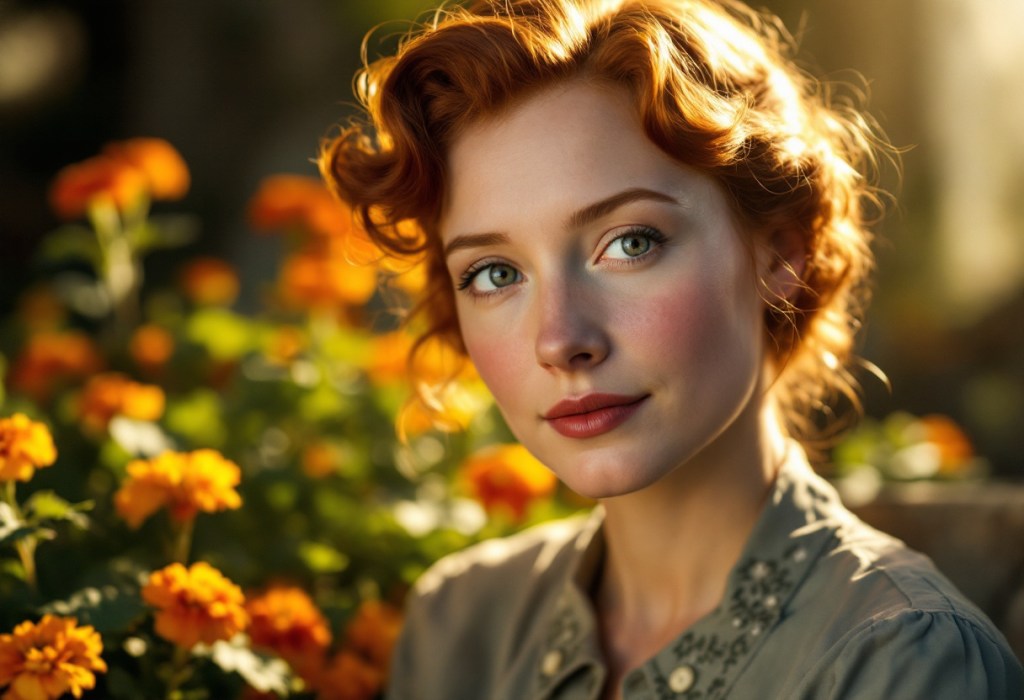
9th September 1939
The wireless crackled with Mr Chamberlain’s solemn words again this morning, and I find myself turning to my garden diary as much for comfort as record-keeping. The late roses still bloom despite everything – how remarkable that they should flower so faithfully when the world has turned quite upside down. Perhaps there is God’s hand in this, that beauty persists even as darkness gathers across Europe.
I spent the morning tending to the kitchen garden, harvesting the last of the summer beans whilst little Margaret helped me tie them in bundles. Her small fingers worked so carefully, and I watched her face – so earnest and concentrated – thinking how children possess this marvellous capacity to live entirely in the present moment. She chattered about her dreams from the night before, something about flying over our apple trees and seeing all the neighbouring gardens spread below like a patchwork quilt. “Mummy,” she said, “in my dream the carrots grew as tall as church spires!” Such delightful fancy. I pray her dreams remain filled with growing things rather than the shadows that seem to press upon us all.
The nasturtiums by the kitchen window have taken on the most brilliant orange hue – almost defiant in their brightness. I cannot help but think of them as little soldiers, standing guard with their cheerful faces turned towards the light. When I was her age, my own mother would tell me that nasturtiums were the flowers of optimism, that they chose to bloom in the poorest soil and harshest conditions. “They remind us,” she would say, “that goodness can flourish anywhere if the will is strong enough.”
This afternoon, whilst mending socks by the parlour window, I found myself dwelling upon the nature of character – particularly what it is in people that sets one’s nerves on edge, as my grandmother would have put it. I suppose what troubles me most is encountering folk who seem to possess no capacity for wonder, no appreciation for the simple miracle of growth and renewal that surrounds us daily. Those who view everything through the lens of immediate gain or loss, who cannot see the poetry in a seedling pushing through earth, or find joy in a child’s imaginative ramblings.
There was a woman at the village meeting yesterday – I shall not name her, for that would be uncharitable – who spoke only of rationing and shortages, of what we should expect to lose in the coming months. Whilst I understand such practical concerns are necessary, her manner suggested she found a curious satisfaction in cataloguing our prospective hardships. She reminded me of those gardeners who examine their plants only for signs of blight and disease, never pausing to marvel at the healthy growth before their eyes. Such people seem to lack what I might call a gardener’s faith – the belief that with proper tending and trust in the Almighty, even the smallest seed contains infinite possibility.
I have been reading to the children each evening from The Secret Garden, and yesterday evening, as I spoke of Mary Lennox discovering that “where you tend a rose, a thistle cannot grow,” I felt a peculiar certainty that we must cultivate hope as deliberately as we tend our vegetables. The wireless brings such grim tidings, yet here in my own small domain, the tomatoes continue to ripen and the late-planted lettuce shows promising green shoots.
Charles wrote from his regiment – still in training, thank the Lord – and mentioned that the lads spend their evenings talking of home, of gardens and harvest time, of sweethearts and mothers’ cooking. How telling that in times of uncertainty, the mind turns to the most fundamental things: the soil beneath our feet, the food we have grown with our own hands, the tender shoots we have nurtured from seed to flower.
Before retiring, I stepped into the garden one final time. The night air carried the scent of honeysuckle and the earthy richness of turned soil. In the darkness, I could almost sense the invisible work of growth continuing – roots extending deeper, stems reaching higher, preparing for tomorrow’s light. If I close my eyes and listen carefully, I fancy I can hear the secret conversations between the plants, their whispered encouragements to one another to persevere, to keep growing, to trust in the coming spring even as autumn approaches.
In early September 1939, Britain entered the Second World War after Germany invaded Poland, leading to declarations of war by Britain and France on 3rd September. The period saw rapid mobilisation at home: the evacuation of children from cities began, gas masks were distributed, and air-raid precautions and blackouts were enforced while many awaited the feared bombing that initially did not come, later termed the “Phoney War.” Rationing of food and fuel followed as the conflict deepened, and men were called up while women increasingly took on war work. The war widened with the fall of France in 1940 and the Blitz on British cities, ultimately lasting until 1945.
Bob Lynn | © 2025 Vox Meditantis. All rights reserved. | 🌐 Translate


 Vox Meditantis
Leave a reply to Bob Lynn Cancel reply