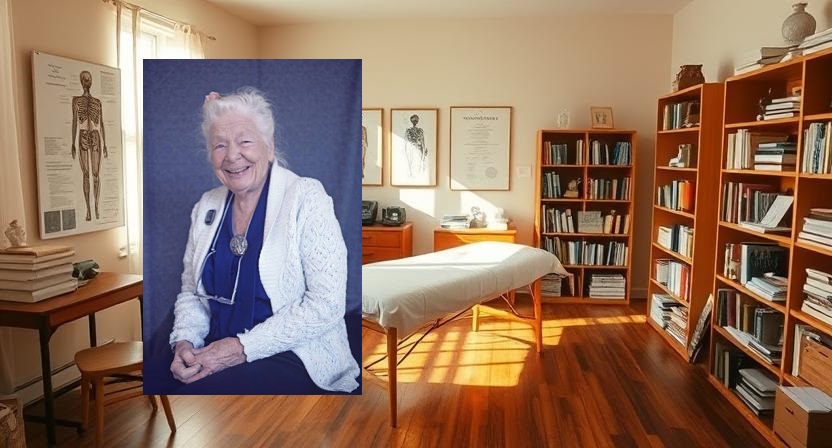
Ida Pauline Rolf (1896-1979) earned her PhD in biochemistry from Columbia in 1920 and became the first woman to hold a research position at the prestigious Rockefeller Institute, where she published 16 scholarly papers on phosphatides and lipid chemistry. Yet her greatest contribution emerged when she left mainstream biochemistry to develop “Rolfing” – a revolutionary approach to understanding how connective tissue shapes human structure and movement. Today, with modern fascia research validating many of her insights about the body’s structural networks, Rolf’s interdisciplinary vision demonstrates how scientific training can lead to paradigm-shifting breakthroughs in health and human performance.
Good morning, Dr Rolf. It’s wonderful to speak with you today. I’d like to begin by asking about your early path into science. What drew a young woman from the Bronx to pursue chemistry at Barnard in 1912?
Well, you must understand the times. This was 1912 – women weren’t exactly queuing up for chemistry courses. But I had a father who built docks and piers, an engineer who understood materials and forces. Perhaps that influenced my curiosity about how things held together, how structures worked.
At Barnard, I threw myself into everything – Mathematics Club, German Club, business manager of the student bulletin. I was elected Vice President of my class in 1916. The faculty recognised my work with Departmental Honours in Chemistry, and I was accepted into Phi Beta Kappa. But what really shaped me was timing – graduating in the middle of the Great War meant opportunities opened for women that hadn’t existed before.
You went straight to Columbia for your PhD whilst working at the Rockefeller Institute. That’s quite remarkable for a 21-year-old woman in 1917.
Remarkable, perhaps, but necessary. The men were off fighting in Europe, and suddenly institutions needed capable researchers. I was fortunate to work under Phoebus Levene – a brilliant man studying the chemistry of life itself. He was investigating nucleic acids and phosphatides, the essential fats that make up cell membranes.
My dissertation was titled “Three Contributions to the Chemistry of the Unsaturated Phosphatides.” Rather dry sounding now, isn’t it? But I was exploring lecithin and cephalin – the very molecules that allow our cells to maintain their boundaries whilst remaining permeable to life. Looking back, I can see how this early work with membrane chemistry influenced everything that followed. Cells must be both stable and adaptable – just like the human body itself.
Can you walk us through the technical details of your phosphatide research? What exactly were you discovering about these cellular components?
Ah, now you want the proper scientific exposition! Very well. Phosphatides are complex lipids – what we’d now call phospholipids – that form the fundamental architecture of cell membranes. I was specifically investigating the unsaturated fatty acid chains attached to these molecules.
The technical challenge was immense. We had to extract these compounds from brain tissue, egg yolks, soybeans – then use chemical techniques to identify their precise structure. I published papers on brain cephalins and lecithins, showing that the degree of unsaturation in the fatty acid chains affected membrane fluidity. We developed methods for preparing pure cephalin samples and characterising their glycerophosphoric acid components.
What fascinated me was discovering that these molecules weren’t simply static building blocks. The unsaturated bonds created flexibility – membrane fluidity that allowed cellular processes to occur. A cell with rigid, fully saturated phosphatides would be like a stone wall. But with the right degree of unsaturation, membranes became dynamic interfaces capable of selective permeability.
This principle – that structure determines function, and that optimal function requires both stability and adaptability – became central to everything I later developed. The human fascial system operates on identical principles, but scaled up from molecular to organismal level.
Your work at Rockefeller was clearly successful – you published 16 papers and reached the rank of Associate. Yet in 1927, you walked away from this promising career. What prompted such a dramatic change?
Promising career? For a woman in 1927? Let me be frank – I had reached the ceiling. Associate was the highest non-tenured position available to someone like me at Rockefeller. The men around me, often with less rigorous training, were advancing to full professorships whilst I remained perpetually “promising.”
But the real catalyst was personal. Health problems – both my own and my family’s – that conventional medicine couldn’t address adequately. I had two sons, and when traditional medical approaches failed us, I began searching elsewhere. I took leave to study mathematics and atomic physics in Zurich, homeopathy in Geneva.
You see, my scientific training hadn’t abandoned me – it had taught me to question assumptions and seek evidence wherever it might lead. If orthodox medicine had no answers, perhaps the answers lay outside orthodoxy.
This led you into what many would consider alternative healing methods. How did your scientific background influence your exploration of osteopathy, yoga, and other approaches?
“Alternative” is a term used by those who wish to dismiss without investigation. I approached each modality with the same rigour I’d applied to phosphatide chemistry. I studied with Pierre Bernard, who brought authentic yoga techniques from India. I worked with osteopaths like Amy Cochran, who had developed something called Physio-synthesis. I attended classes with William Sutherland, the pioneer of cranial osteopathy.
My scientific training proved invaluable because I could discern wheat from chaff. Many practitioners made grand claims without evidence, but some had observed real phenomena that deserved investigation. The osteopaths, particularly, understood that structure and function were intimately related – that restoring proper alignment could improve physiology.
What struck me most forcibly was their recognition of connective tissue – fascia – as what they called “the organ of form”. This resonated deeply with my understanding of cellular architecture. Just as phosphatides provide structural integrity to cells whilst allowing dynamic function, fascia appeared to serve similar roles throughout the organism.
Let’s discuss the development of your structural integration method. How did you transition from studying these various approaches to creating something entirely new?
By the 1940s, I was essentially running a practice from my Manhattan apartment, working with people who had exhausted conventional medical options. These were individuals with chronic disabilities, persistent pain, structural imbalances that seemed intractable.
My breakthrough came through careful observation combined with hands-on experimentation. I noticed that working systematically with fascial restrictions in a specific sequence – addressing superficial layers before deeper ones, establishing length before width, working from core to periphery – produced more lasting changes than random intervention.
I developed what became known as the “Ten Series” – a systematic approach to reorganising the body’s connective tissue network. Each session had specific goals: the first three sessions address the superficial fascial envelope, sessions four through seven work with deeper structural relationships, and the final three integrate these changes into coordinated movement patterns.
The genius, if I may say so, was recognising that we’re not simply treating symptoms or fixing broken parts. We’re facilitating the body’s innate capacity to organise itself more efficiently in the gravitational field. An effective human being is a whole that is greater than the sum of its parts.
Can you provide a detailed technical walkthrough of how structural integration actually works at the tissue level?
Certainly. Understanding fascial architecture is crucial. Fascia isn’t simply wrapping material – it’s a continuous three-dimensional network that surrounds every muscle fibre, groups fibres into functional units, connects muscle to bone, and provides structural continuity throughout the organism.
The technical approach involves applying specific manual pressure to fascial restrictions whilst encouraging movement that reorganises tissue relationships. We’re working with the viscoelastic properties of connective tissue – its ability to deform under sustained pressure and maintain new configurations.
Recent research has validated what I observed decades ago: fascia contains mechanoreceptors that respond to manual pressure, influencing proprioception and motor control. When we apply sustained pressure – what I termed “slow, deep work” – we’re not simply stretching tissue mechanically. We’re stimulating mechano-transduction pathways that trigger cellular remodelling.
The key insight is working with bio-tensegrity principles. The body functions as an integrated tensional network where local changes influence global organisation. By systematically addressing restrictions in specific sequences, we can facilitate structural reorganisation that improves mechanical efficiency and reduces compensatory strain patterns.
Modern studies show that structural integration increases fascial tissue elasticity, improves superficial blood perfusion, and decreases tissue stiffness – exactly the changes I predicted based on my understanding of connective tissue physiology.
Your method faced considerable scepticism from the medical establishment. How did you navigate this professional isolation?
Professional isolation? I was already isolated the moment I became a woman in science. The medical establishment’s scepticism was nothing new – it was simply another manifestation of institutional resistance to ideas that challenge established hierarchies.
But I had advantages that pure alternative practitioners lacked. My scientific credentials were impeccable. I could discuss fascial architecture using proper anatomical terminology, explain physiological mechanisms, and design systematic approaches rather than relying on mystical hand-waving.
The real validation came through results. When people with chronic disabilities experienced significant improvement after years of failed conventional treatment, word spread. I didn’t need medical establishment approval – I had something far more convincing: reproducible outcomes.
Tell us about your relationship with Esalen Institute in California. How did that partnership transform your work?
Fritz Perls brought me to Esalen in 1964. Fritz was a remarkable character – the father of Gestalt therapy – and he understood immediately what I was trying to accomplish. He became one of my most effective advocates after experiencing the work firsthand.
Esalen provided something I desperately needed: a platform for systematic teaching. Until then, I had trained only my son in the method. At Esalen, I could spend six months each year training practitioners, typically working with groups of students for intensive periods.
The environment was perfect – a community of people exploring human potential, willing to question conventional assumptions. I trained approximately one hundred practitioners over those years, establishing the foundation for what would become the Rolf Institute.
But I must say, the 1960s atmosphere sometimes frustrated me. There was a tendency toward what I considered woolly thinking – people drawn to “alternative” approaches because they rejected scientific rigour rather than applying it more broadly. I insisted that my students understand anatomy, physiology, and biomechanics. This wasn’t mystical work – it was applied science.
Looking at current fascia research, how do you feel about the scientific validation of your insights?
Profoundly vindicated, if I’m honest. For decades, I was told that fascia was simply “packing material” – inert tissue with no significant function. The medical establishment dismissed my observations about connective tissue plasticity and its role in structural integration.
Now we have research confirming that fascia is our richest sensory organ for proprioception, that it contains mechanoreceptors crucial for movement coordination, that manual therapy can measurably alter fascial properties. The Fascia Research Congresses – ironically started by the foundation bearing my name – have revolutionised understanding of connective tissue.
Studies show that structural integration measurably improves fascial tissue elasticity, reduces stiffness, and enhances superficial blood perfusion. Research demonstrates effectiveness for chronic pain, postural problems, and movement dysfunction. Everything I predicted based on careful observation and systematic application is being confirmed through controlled scientific investigation.
The bio-tensegrity model that I intuited – the idea that the body functions as an integrated tensional network rather than a collection of separate parts – is now recognised as fundamental to understanding human biomechanics.
You’ve mentioned mistakes and misjudgements. What would you do differently if you were starting today?
I would be more systematic about documentation from the beginning. My approach was intensely practical – I was more interested in developing effective techniques than in publishing research papers. This made it easier for critics to dismiss the work as unscientific.
I also underestimated the importance of political skills within professional communities. My directness – what some called abrasiveness – sometimes alienated potential allies. Perhaps if I had been more diplomatically astute, the integration with mainstream medicine might have occurred sooner.
But my greatest regret involves training standards. In my enthusiasm to spread the work, I sometimes accepted students who lacked adequate scientific background. This led to practitioners who understood the techniques without grasping the underlying principles. Some began making claims I never endorsed – about “energy fields” and other concepts that had no basis in my teaching.
I should have insisted on more rigorous educational prerequisites and maintained tighter control over how the work was presented to the public.
What advice would you give to women entering STEM fields today, particularly those interested in interdisciplinary approaches?
First, master your foundations completely. Don’t let anyone suggest that because you’re interested in “alternative” approaches, you can bypass rigorous scientific training. My credibility came from having earned a proper PhD in biochemistry and publishing peer-reviewed research. This made it impossible to dismiss me as a dilettante.
Second, be prepared for institutional resistance, but don’t let it embitter you. The establishment resists new ideas not from malice but from natural conservatism. Your job is to produce evidence so compelling that resistance becomes untenable.
Third, document everything methodically. I was too focused on practical results and not sufficiently attentive to research protocols. Modern practitioners have enormous advantages in terms of measurement tools and research methodologies – use them!
Finally, remember that interdisciplinary work requires mastering multiple disciplines, not superficially sampling from them. My understanding of cell membrane chemistry informed my approach to fascial architecture. My training in biochemistry provided the conceptual framework for understanding tissue plasticity. You cannot build bridges between fields you don’t thoroughly understand.
How do you view the current state of integrative medicine and manual therapy?
With mixed feelings. On the positive side, there’s unprecedented scientific interest in approaches that were once considered fringe. Fascia research has exploded, providing mechanistic explanations for phenomena I observed purely through clinical work.
But I’m concerned about the proliferation of techniques claiming to work with fascia without understanding the underlying principles. Having a scientific-sounding name doesn’t make something scientific. True integration requires understanding both the mechanisms and the systematic approaches needed for lasting change.
I’m pleased that structural integration itself has maintained high training standards and continues supporting research. The institutes carrying on this work have resisted the temptation to water down the training or make unsupported claims about mechanism.
What gives me greatest satisfaction is seeing properly trained practitioners using my methods to help people achieve structural integration whilst advancing our understanding through careful research. This represents the kind of productive synthesis between science and practice that I always envisioned.
Any final thoughts about your legacy and the future of your work?
The work was never about me personally – it was about understanding how human beings can function most effectively within the gravitational field. My contribution was recognising that fascial architecture could be systematically reorganised to improve structural efficiency and overall health.
The real test of any scientific contribution is whether it opens productive avenues for further investigation. By that measure, I believe the work has succeeded. Fascia research continues expanding our understanding of human biomechanics. Practitioners trained in structural integration continue helping people achieve better function and reduced pain.
But the most important legacy may be the demonstration that rigorous scientific training can lead to revolutionary insights when applied outside conventional boundaries. My background in biochemistry didn’t limit my thinking – it provided the conceptual tools needed to understand complex biological systems at new scales.
That’s the message I’d want young scientists to understand: don’t let disciplinary boundaries constrain your curiosity. The most important discoveries often occur at the intersections between established fields. But master your foundations first – then use them to explore uncharted territories with confidence and precision.
The human body remains endlessly fascinating, and we’ve only begun to understand its remarkable capacity for adaptation and integration. There’s much work yet to be done.
Letters and emails
Following our conversation with Dr Ida Rolf, we’ve received dozens of thoughtful letters and emails from readers eager to explore different aspects of her groundbreaking work and remarkable journey from biochemistry to structural integration. We’ve selected five particularly compelling questions from our growing community – spanning continents and disciplines – who want to ask her more about her life, her work, and what she might say to those walking in her footsteps.
Camila Esteban, 34, Biomedical Engineer, São Paulo, Brazil
Dr Rolf, your transition from studying molecular phosphatides to working with whole-body fascial networks represents a massive scale jump – from nanometres to metres. How did you mentally bridge that gap between cellular membrane chemistry and organismal structure? Did your understanding of lipid bilayer dynamics actually inform your manual therapy techniques?
Ah, Miss Esteban, you’ve hit upon the central intellectual challenge of my entire career! The scale transition was indeed enormous – from studying molecular structures measured in angstroms to working with fascial networks spanning the entire human form. But you see, the principles remain remarkably consistent across these scales.
When I was investigating phosphatides under Levene at Rockefeller, I became fascinated by how these molecules created selective permeability – allowing certain substances through whilst maintaining cellular integrity. The phosphatide bilayer isn’t rigid; it’s a dynamic interface that responds to mechanical forces, temperature changes, and chemical gradients. The degree of unsaturation in those fatty acid chains determines membrane fluidity – too rigid and the cell dies, too fluid and it loses its boundaries.
This concept proved absolutely crucial when I began observing fascial behaviour. Fascia operates on identical principles but at macroscopic scale. Like phosphatide membranes, fascial tissues must maintain structural integrity whilst allowing dynamic adaptation. The collagen and elastin networks create what I came to understand as “intelligent boundaries” – tissues that can resist excessive force whilst yielding appropriately to promote optimal function.
My hands-on work revealed that fascial restrictions behave much like phase transitions I had studied in lipid chemistry. When you apply sustained pressure to restricted fascia – what I termed “slow, deep work” – the tissue undergoes a kind of reorganisation analogous to lipid membrane restructuring. Both involve breaking existing molecular arrangements and allowing new, more efficient configurations to emerge.
The real breakthrough came when I recognised that both cellular membranes and fascial networks serve as information processing systems. Just as phosphatides regulate what enters and exits cells, fascia regulates force transmission throughout the body. Both systems require optimal organisation to function effectively.
I spent countless hours observing how manual pressure affected tissue quality – noting changes in texture, temperature, and responsiveness. Without sophisticated instruments, I had to develop exquisite tactile sensitivity. My training in analytical chemistry proved invaluable here because I understood the importance of consistent methodology and careful observation.
The scale jump wasn’t really a jump at all, you see. It was recognition that the same fundamental principles governing molecular organisation also govern organismal structure. Nature doesn’t reinvent principles at different scales – she applies them consistently. Understanding phosphatide behaviour gave me conceptual tools for understanding fascial architecture that simply weren’t available to practitioners without biochemical training.
That’s why I always insisted my students understand anatomy and physiology thoroughly. You cannot work intelligently with tissues you don’t understand at multiple levels of organisation.
Hiroshi Takeda, 41, Physical Therapist and Movement Researcher, Kyoto, Japan
I’m fascinated by your comment about working ‘with gravity rather than against it.’ In your era, you didn’t have access to motion capture systems or force plates that we use today to quantify biomechanical efficiency. How did you measure whether your interventions were actually improving someone’s relationship with gravitational forces? What were your key indicators of successful structural integration?
Mr Takeda, you’ve identified precisely the challenge that kept me awake many nights in those early decades! Without your modern gadgetry – and believe me, I would have welcomed such tools – I had to develop what you might call “analogue measurement techniques” based on careful observation and consistent methodology.
My primary indicators were threefold: visual assessment, palpatory changes, and functional improvement. For visual assessment, I developed what I called “structural photography” – taking standardised photographs from multiple angles before and after the work. I’d position clients against a grid background, ensuring consistent lighting and camera placement. The changes in plumb line relationships, shoulder levels, and overall postural organisation were often quite dramatic when documented this way.
But the real precision came through palpatory assessment. After years of handling phosphatide samples and conducting delicate chemical extractions, my hands had developed extraordinary sensitivity to textural changes. I could detect variations in tissue density, temperature, and what I termed “aliveness” – the quality of responsiveness under pressure. Restricted fascia feels dense, cool, and somewhat dead to the touch. Properly organised tissue has a springy quality, warmth, and immediate responsiveness.
The functional measurements were perhaps most convincing. I’d assess breathing capacity – noting rib cage expansion and ease of respiration. Range of motion testing showed immediate improvements in shoulder elevation, spinal rotation, and hip flexibility. Gait analysis, though crude by your standards, revealed changes in stride length, foot placement, and overall movement efficiency.
My most reliable indicator was what I called “gravitational ease.” A well-integrated person stands and moves with less effort – you can observe this in their breathing patterns, muscle tension, and general demeanour. They appear more “settled” into their structure rather than fighting against it.
I also developed simple balance tests. A person properly organised in gravity can maintain equilibrium with less muscular effort. I’d have clients stand on one foot, walk heel-to-toe, or perform simple movement sequences. Improved structural integration invariably produced better balance and coordination.
The beauty of working with gravity is that it provides an absolute reference point. Unlike subjective measures of “feeling better,” gravitational efficiency has observable, measurable characteristics. A person either stands with ease or struggles against their own structure. The difference becomes apparent to any trained observer.
Your modern instruments undoubtedly provide more precise quantification, but the fundamental principles I identified remain valid. Good structure serves function, and function reveals the quality of structural organisation.
Nandi Zulu, 28, Physiotherapy Student, Cape Town, South Africa
Dr Rolf, you mentioned feeling isolated as a woman in science even before developing structural integration. I’m curious about the informal networks that sustained you – were there other women scientists or practitioners who understood your journey? How did you maintain confidence in your observations when the entire medical establishment dismissed fascial significance?
Miss Zulu, your question strikes right to the heart of what sustained me through decades of professional loneliness. You’re quite right – the isolation was profound, and it began long before I left conventional biochemistry.
At Barnard and Columbia, I was fortunate to have a few remarkable women who understood the peculiar challenges we faced. There was a small circle of us – women pursuing advanced degrees in the sciences – who would gather informally to discuss not just our research, but the particular obstacles we encountered. We shared strategies for dealing with professors who questioned our commitment, colleagues who assumed we were merely marking time before marriage, and the constant need to prove ourselves twice over.
But after leaving Rockefeller, that network largely disappeared. The women I had known in academic circles couldn’t understand my departure from “legitimate” science. They saw my interest in alternative approaches as a betrayal of everything we had worked to achieve. One colleague actually told me I was “letting down the side” by abandoning serious research for what she called “laying on of hands nonsense.”
The isolation deepened considerably during the 1930s and 1940s. I was working alone in my apartment, developing techniques that had no recognised professional framework. There were no conferences, no journals, no community of practitioners exploring similar territory.
What saved my sanity – and my confidence – was correspondence with a handful of individuals who understood the broader implications of what I was attempting. Fritz Perls, whom I met much later at Esalen, became perhaps my most important intellectual companion. He grasped immediately that structural work and psychological integration were intimately connected.
I also maintained contact with several physicians who had observed the results of my work firsthand. They couldn’t publicly endorse what I was doing – it would have jeopardised their careers – but they privately acknowledged the improvements they witnessed in patients conventional medicine couldn’t help.
My deepest sustenance came from the work itself and the people who experienced profound changes. When a woman who hadn’t been able to raise her arms above shoulder height for years suddenly could reach overhead freely, when a man with chronic back pain found relief after decades of suffering – these results provided unshakeable confirmation that I was onto something real.
I kept meticulous records, not just for scientific purposes, but to remind myself during dark moments that the work was valid regardless of institutional recognition. The human body doesn’t lie, Miss Zulu. It responds to effective intervention whether or not that intervention has official approval.
Isolation taught me self-reliance, but it also taught me to trust my observations over conventional wisdom.
Jonathan Price, 37, Science Writer, Toronto, Canada
Here’s a hypothetical scenario: imagine if you had stayed at Rockefeller and modern molecular biology tools became available to you in the 1940s – electron microscopes, protein crystallography, early biochemical assays. Do you think you could have convinced the medical establishment about fascial importance through laboratory research alone, or was the hands-on bodywork component essential for developing your insights about structural integration?
Mr Price, that’s a fascinating speculation that I’ve actually pondered many times over the years. The hypothetical is particularly intriguing because those very instruments you mention – electron microscopy, X-ray crystallography – were being developed just as I was leaving Rockefeller. Dorothy Hodgkin was already making her first forays into protein structure determination in the 1930s.
But here’s what I’ve come to understand: laboratory research alone would never have revealed the principles of structural integration, no matter how sophisticated the instruments. The fundamental insights required direct, tactile engagement with living tissue under gravitational stress. You simply cannot understand fascial behaviour from fixed specimens or isolated tissue samples.
Consider this: even today, with all your remarkable imaging technologies, the most crucial discoveries about fascia are coming from researchers who combine laboratory investigation with hands-on clinical observation. The mechanoreceptors, the viscoelastic properties, the biotensegrity principles – these were observable through manual examination decades before instruments could measure them.
Had I remained at Rockefeller with access to advanced biochemical techniques, I might have made significant contributions to our understanding of collagen cross-linking or elastin structure. Perhaps I could have characterised the molecular basis of fascial viscoelasticity. Such work would certainly have been valuable and probably more readily accepted by the medical establishment.
But I would never have discovered that fascial restrictions in the pelvis affect shoulder mobility, or that working with the superficial fascial envelope before addressing deeper structures produces more lasting results. These insights emerged only through years of hands-on experimentation with living, breathing, moving human beings.
The laboratory provides controlled conditions that reveal isolated mechanisms. Clinical work reveals how those mechanisms function within integrated biological systems. Both perspectives are essential, but they’re fundamentally different ways of knowing.
What gives me confidence in this assessment is observing how modern fascia research has developed. The most productive investigations combine sophisticated laboratory techniques with careful clinical observation. Researchers who work only in the laboratory often miss the functional significance of their findings, whilst clinicians without scientific grounding make claims they cannot substantiate.
The real tragedy of the hypothetical scenario you propose is that institutional science in my era couldn’t accommodate the kind of interdisciplinary thinking that structural integration required. Even with better instruments, the compartmentalisation between basic research and clinical application would have constrained the discoveries.
Innovation often requires stepping outside established frameworks entirely. Sometimes you must abandon the laboratory to understand what the laboratory data actually means.
Eva Müller, 45, Osteopath and Fascia Researcher, Vienna, Austria
Your decision to leave Rockefeller Institute in 1927 was incredibly bold, especially considering the economic uncertainty leading to the Great Depression. Looking back, do you think there’s an ethical responsibility for scientists to pursue unconventional research paths when they observe phenomena that established institutions ignore? How do we balance institutional stability with innovative discovery?
Dr Müller, you’ve raised the question that has haunted me throughout my career – the tension between scientific responsibility and institutional loyalty. The timing you mention is particularly poignant because I left Rockefeller just two years before the market crash that devastated so many lives.
But I’ve come to believe that scientists have a profound ethical obligation to pursue truth wherever it leads, regardless of institutional comfort. When I observed phenomena that established medicine ignored or dismissed – the role of fascial restrictions in chronic pain, the possibility of structural reorganisation through manual intervention – I faced a moral choice. I could remain silent to preserve my position, or I could investigate these observations despite professional risk.
The decision became clearer when I considered what scientific training actually represents. We’re taught to observe carefully, question assumptions, and follow evidence even when it challenges accepted beliefs. If we abandon these principles for institutional security, we betray the very essence of scientific inquiry.
My experience taught me that institutional stability often conflicts with innovative discovery because institutions naturally resist ideas that threaten established hierarchies. The medical establishment had enormous investment in existing treatment approaches. Acknowledging the significance of structural work would have required admitting that conventional medicine had overlooked fundamental aspects of human physiology.
But here’s what I learned about balancing stability with innovation: true security comes from developing work that produces undeniable results, not from maintaining institutional approval. When people with chronic disabilities experienced dramatic improvement through structural integration, that created a different kind of stability – one based on genuine contribution rather than bureaucratic position.
The ethical dimension became particularly clear when I recognised how many people were suffering needlessly because effective approaches remained unexplored. Every day I spent in comfortable academic isolation was another day that individuals with structural problems went without help that I might be able to provide.
I won’t pretend the decision was easy. I had a family to support, and leaving Rockefeller meant abandoning financial security during increasingly uncertain times. But I’ve never regretted prioritising investigation over comfort.
The real test of scientific ethics isn’t whether you can maintain institutional approval whilst pursuing safe research. It’s whether you have the courage to investigate phenomena that matter, even when doing so requires sacrificing conventional success.
Innovation demands risk-taking. Scientists who prioritise security over discovery serve neither science nor society effectively. Sometimes the most responsible choice is the one that appears most irresponsible to institutional authorities.
Reflection
Dr Ida Pauline Rolf passed away in 1979 at age 82, having witnessed the early stirrings of scientific interest in fascia research that would eventually validate her life’s work. Her voice in this imagined conversation reveals themes that echo through countless women’s experiences in STEM: the ceiling of “promising” careers, the isolation of pursuing unconventional paths, and the courage required to trust one’s observations over institutional approval.
What emerges most powerfully is Rolf’s insistence on scientific rigour even whilst exploring territory dismissed by mainstream medicine. Her perspective likely differs from some historical accounts that portray her transition from biochemistry as a complete break with scientific thinking. Instead, she presents it as scientific method applied more broadly – observation, hypothesis, testing, and refinement carried into manual therapy.
Certainly, gaps remain in our understanding of her motivations and methods. The exact techniques she developed, her private struggles with professional isolation, and the precise evolution of her ideas remain partially obscured by time. Some practitioners have undoubtedly embellished her legacy with claims she never made.
Yet her influence proves undeniable. Today’s fascia research conferences regularly reference her insights about connective tissue integration. The Rolf Institute continues training practitioners worldwide, whilst research validates her observations about fascial mechanoreceptors and biotensegrity principles. Modern integrative medicine increasingly recognises the interconnected nature of structure and function she championed.
Perhaps most significantly, Rolf’s story illuminates how scientific breakthroughs often require individuals willing to sacrifice institutional security for investigative truth. In our era of interdisciplinary collaboration and evidence-based integrative approaches, her journey from biochemistry laboratory to bodywork practice seems less like abandonment of science than like its courageous extension into previously unexplored territories.
Her legacy reminds us that innovation demands both rigorous training and the audacity to apply it in unexpected ways.
Who have we missed?
This series is all about recovering the voices history left behind – and I’d love your help finding the next one. If there’s a woman in STEM you think deserves to be interviewed in this way – whether a forgotten inventor, unsung technician, or overlooked researcher – please share her story.
Email me at voxmeditantis@gmail.com or leave a comment below with your suggestion – even just a name is a great start. Let’s keep uncovering the women who shaped science and innovation, one conversation at a time.
Editorial Note: This interview represents a dramatised reconstruction based on extensive historical research into Dr Ida Rolf‘s life, work, and documented statements. Whilst grounded in factual sources including her published papers, biographical accounts, and recorded teachings, the conversational format and specific responses are imaginative interpretations designed to illuminate her scientific contributions and personal journey. Readers should understand this as a creative exploration of historical themes rather than verbatim historical testimony.
Bob Lynn | © 2025 Vox Meditantis. All rights reserved. | 🌐 Translate


Leave a comment