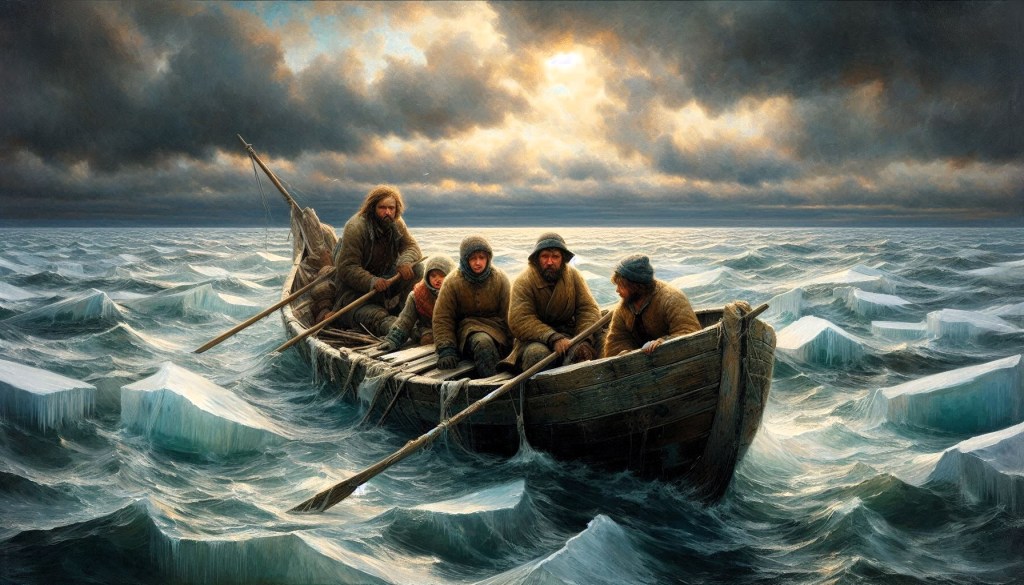
Hudson Bay, Canada – 22nd June, 1611
The sun hangs merciless overhead, a brass coin suspended in the endless vault of sky, whilst I sit here in this cursed shallop with naught but water stretching to every horizon. Twenty-second day of June, in the year of our Lord sixteen hundred and eleven, and I find myself contemplating a most peculiar irony: how I once complained of having too little time, when now I am blessed—or perhaps cursed—with an abundance of it, yet each moment may well be amongst my last.
How do I waste the most time each day? The question haunts me as surely as the cry of the gulls that wheel above us, mocking our predicament. In my comfortable chambers back in London, I would have dismissed such inquiry as philosophical prattle, the sort of idle musing better suited to university scholars than to men of action such as myself. Yet here, adrift upon Hudson’s Bay—named, with bitter irony, for my own endeavours—I find my thoughts returning repeatedly to the countless hours I squandered in my former life.
“Father?” John’s voice breaks through my reverie. My son, barely seventeen years of age, sits huddled against the rough planking of our makeshift vessel, his face already bearing the ruddy marks of exposure to wind and salt spray. “The wind has shifted again.”
I glance at our meagre sail, fashioned from a torn piece of canvas the mutineers saw fit to leave us. Robert Juet’s treacherous face flashes through my memory—how he smiled as they lowered us into this death trap, claiming they were being merciful by providing us with powder and shot, some victuals, and this iron pot that now serves as both cooking vessel and bailer. Merciful! As if casting a man and his child upon the mercy of these frigid waters could ever be construed as kindness.
“Aye, lad, I see it,” I reply, adjusting our heading as best I can manage with our crude oar. “We must make the most of every breath of wind, every shift in current.”
Make the most of it. The phrase catches in my throat like a fish bone. How many mornings did I lie abed in London, complaining of the fog, the cold, the dampness that seeped through the very stones of the city? How many afternoons did I fritter away in taverns, nursing a tankard of ale whilst engaging in heated debates about matters of no earthly consequence—whether the new translations of scripture were superior to the old, whether the King’s policies regarding trade with the Low Countries would prove beneficial or ruinous?
I recall one particular evening at the Mermaid Tavern, when I spent nigh on four hours arguing with a merchant about the proper method of preserving meat for long voyages. Four precious hours! And what did I accomplish? Nothing save the consumption of several pints and the cultivation of ill will towards a man whose only crime was disagreeing with my methods. That merchant, wherever he may be this day, likely sits comfortable by his hearth, his belly full, his concerns limited to profit margins and inventory.
Meanwhile, here I sit with my son and three loyal men—Thomas Woodhouse, Adam Moore, and Philip Staffe—each of us acutely aware that our remaining victuals will last perhaps a week if we ration them severely. Every crumb of hardtack becomes a treasure more precious than Spanish gold. Every drop of brackish water must be measured and considered.
“Look there, Father,” John whispers, pointing towards the southern horizon. “Is that land?”
I follow his gaze, squinting against the glare. My eyes, weakened by years of poring over charts and navigational instruments, struggle to distinguish between cloud-shadow and distant shore. How many hours did I waste in my study, surrounded by maps and treatises, planning theoretical voyages whilst neglecting the simple pleasure of conversing with my son? How many evenings did I spend hunched over my desk, calculating distances and plotting courses, when I might have been teaching John the constellations, sharing tales of my adventures, or simply listening to his dreams and fears?
“‘Tis difficult to say, lad,” I admit, though my heart leaps with desperate hope. “The eye plays tricks upon a man when land and sky meet in such fashion.”
The irony cuts deep as any blade. In London, I would check my pocket watch dozens of times each day, always conscious of appointments to keep, meetings to attend, correspondence to answer. Time was the enemy then—there was never enough of it. I rushed through meals, barely tasting the roasted fowl or fresh bread. I hurried past flower sellers and street musicians, deaf to their songs, blind to their simple beauty. I dismissed my wife’s gentle queries about my day with terse responses, my mind already racing ahead to the next voyage, the next commission, the next opportunity to add to my reputation as an explorer of northern waters.
Now, time stretches before us like this endless expanse of bay, each moment pregnant with possibility yet shadowed by doom. We have time to observe how the light changes throughout the day, painting the water in shades of blue and grey and green I never noticed during my hurried passages aboard properly provisioned vessels. We have time to count the ripples that spread from our oar, to memorise the patterns of foam that trail in our wake, to study the behaviour of the seabirds that follow us in hope of scraps.
“Father,” John says quietly, “do you think they will send search parties?”
The question pierces my soul. My poor boy, still clinging to hope whilst I wrestle with the likelihood that we have been abandoned to whatever fate God sees fit to bestow upon us. How do I answer? Do I offer false comfort, or do I burden him with the harsh mathematics of our situation?
“The Company will not write off the Discovery lightly,” I reply, choosing my words with the care I once reserved for diplomatic correspondence. “She is a valuable vessel, and they will want to know her fate.”
What I do not say is that by the time any relief expedition could be organised and dispatched from England, we will be long past requiring rescue. The mutineers will likely claim we died during the winter, victims of the harsh climate rather than their treachery. History will record that Henry Hudson vanished in the bay that bears his name, another victim of the relentless quest for the Northwest Passage.
I think of the letters I never wrote, the words I never spoke. How many times did I postpone writing to my dear friend Captain John Davis, always promising myself I would compose a proper epistle next week, when I had more leisure? How many conversations with my wife did I cut short with promises to continue them later, when my mind was not occupied with pressing maritime concerns?
Later. Always later. As if time were an inexhaustible resource, a bottomless purse from which I could draw indefinitely.
The sun begins its descent towards the western horizon, painting the sky in brilliant shades of orange and crimson. Such beauty surrounds us, yet it marks another day lost, another step closer to whatever end awaits us in this wilderness of water. How many sunsets did I miss whilst bent over ledgers in my study? How many dawns passed unnoticed as I slept away the precious morning hours?
Thomas Woodhouse, loyal soul that he is, attempts to lift our spirits by recounting tales of survival he has heard from other mariners. Stories of men who subsisted on seaweed and rainwater for weeks, of castaways who fashioned tools from driftwood and built shelters from sea wrack. His words are kind, meant to encourage, yet they only serve to remind me of all the stories I might have told my son during our quiet evenings at home—tales of courage and adventure that might have prepared him better for this ordeal.
As darkness approaches, we make our camp such as it is, huddled together for warmth in the bottom of our small craft. The iron pot, filled with seawater, will serve as our pillow and headrest. Our clothing, though adequate for an English summer, provides scant protection against the chill wind that cuts across these northern waters like a blade fresh from the forge.
John sleeps fitfully against my shoulder, and I find myself memorising the rhythm of his breathing, the weight of his head, the way his hair curls at the nape of his neck just as it did when he was a babe. How many nights did I work late in my study whilst he waited for me to come and hear his prayers? How many opportunities for tenderness did I sacrifice upon the altar of ambition?
The stars emerge one by one, the same constellations I have used for navigation countless times, yet tonight they seem different—closer, more personal. Each pinprick of light represents distances I can barely comprehend, journeys that make our present voyage seem but a puddle compared to an ocean. Yet here, in this moment, the space between myself and my son, between our small boat and the vast bay that surrounds us, contains more meaning than all the leagues I have sailed in pursuit of glory and gold.
I close my eyes and allow my mind to wander back to London once more. I see myself standing before the fireplace in my study, warming my hands whilst complaining about the delay in receiving the latest reports from the Muscovy Company. Such concerns seemed monumental then—trade routes and profit margins, royal patents and commercial rivalries. Now they appear as insubstantial as morning mist, dissolving at the first touch of genuine hardship.
The wind picks up, setting our makeshift sail to fluttering like a wounded bird. I adjust our heading slightly, trusting more to instinct than to any clear sense of direction. We are beyond the reach of familiar landmarks now, beyond the comfort of known charts and established routes. Each choice we make—whether to head east or west, whether to hug what shore we can find or strike out across open water—carries consequences that will determine whether we live or perish.
Yet even in this extremity, my mind continues to catalogue the countless small ways I squandered the gift of ordinary time. The hours spent in worry over matters that resolved themselves without my intervention. The energy expended in petty disputes with fellow explorers over precedence and recognition. The mornings wasted in bed, reluctant to face another day, when I might have been walking in my garden, appreciating the simple miracle of roses blooming or listening to the song of thrushes in the hedgerows.
Morning comes with a grey dawn that seems to emerge from the water itself rather than descending from the sky. My joints ache from our uncomfortable night, and the salt spray has left a bitter taste in my mouth that no amount of rationed water can wash away. Yet I am alive, my son is alive, and for this moment, that must suffice.
As I watch John stir to wakefulness, his eyes struggling to focus in the pale light, I make a silent vow. Whatever time remains to us—whether it be days, weeks, or merely hours—I shall not waste a single moment in regret or recrimination. I shall speak with my son as I should have done years ago. I shall notice the play of light upon water, the patterns of clouds, the intricate beauty of this world that God has seen fit to place before us.
For I have learned, perhaps too late, that time is not something to be hoarded or hurried through, but rather to be inhabited fully, moment by precious moment. And if this shallop becomes our final resting place, if Hudson’s Bay claims us as it has claimed so many others, at least we shall meet our fate with eyes wide open, hearts full of wonder, and souls prepared for whatever lies beyond the horizon of our earthly voyage.
The waste of time, I now understand, lies not in the moments themselves, but in our failure to recognise their infinite worth until they have slipped forever beyond our grasp.
The End
Bob Lynn | © 2025 Vox Meditantis. All rights reserved.


 Vox Meditantis
Leave a reply to Hudson and the Northwest Passage – Ingliando Cancel reply