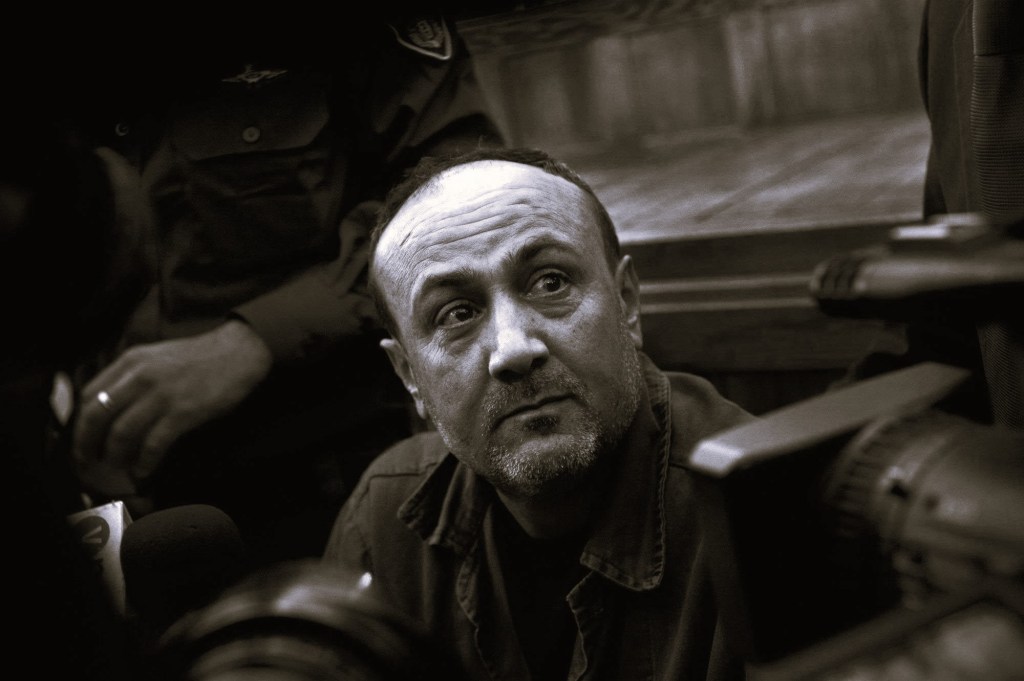
Despite spending over two decades in Israeli prison, Marwan Barghouti stands as the most popular Palestinian leader alive, consistently outpolling Hamas and offering a rare beacon of unity in a fractured political landscape. His lasting appeal lies not in extremism but in his unique ability to bridge factional divides whilst maintaining steadfast commitment to Palestinian liberation through both resistance and negotiation. As the Gaza war rages and the West Bank suffers under intensifying violence, Barghouti represents something Hamas cannot: a pathway to peace that doesn’t require Palestinians to abandon their dignity or their dreams of statehood.
Beyond Hamas: The Search for Peaceful Leadership
The question of Palestinian leadership after Hamas has become urgent as the devastating war in Gaza exposes the limitations of militant governance. Current polling reveals a telling paradox: whilst Hamas retains support for its resistance against Israeli occupation, Palestinians increasingly favour negotiated solutions over armed struggle. This creates space for leaders who can embody resistance whilst pursuing diplomatic paths to statehood.
Barghouti occupies this crucial middle ground with unparalleled authority. Unlike current Palestinian Authority President Mahmoud Abbas, whose popularity languishes below 10%, Barghouti commands respect across all Palestinian factions. His credentials as a former leader during both the First and Second Intifadas cannot be questioned by those who demand resistance to occupation, yet his consistent advocacy for a two-state solution and prisoner exchanges demonstrates pragmatic commitment to peace.
The imprisoned leader’s approach differs fundamentally from Hamas’s strategy. Where Hamas governs through armed control and religious ideology, Barghouti advocates for democratic unity and secular nationalism. His 2006 National Conciliation Document, co-authored with leaders from Hamas, Palestinian Islamic Jihad, and other factions, recognised Israel’s existence whilst maintaining Palestinian rights to resistance against occupation. This document became the foundation for Palestinian unity efforts, proving Barghouti’s unique capacity to bridge seemingly irreconcilable differences.
Recent polling underscores this appeal. In presidential scenarios, Barghouti consistently defeats all rivals, including Hamas leaders. When offered as an independent candidate leading his own electoral list, 20% of Palestinians would support him compared to 27% for Hamas and 24% for Fatah. These numbers reflect his status as a unifying figure who transcends factional loyalty.
The Mandela Effect: Understanding Barghouti’s Enduring Popularity
Barghouti’s sustained popularity amongst Palestinians born after his 2002 imprisonment speaks to something deeper than mere nostalgia. Like Nelson Mandela, his moral authority has grown rather than diminished during incarceration, transforming him into a symbol of principled resistance and hope for liberation.
His prison years haven’t been spent in passive waiting. Barghouti has revolutionised Palestinian political education through his “Revolution of Light” programme, teaching international relations, English, and Hebrew to fellow prisoners. Over 600 Palestinians have graduated under his tutelage, learning crucial lessons about unity, coalition-building, and the importance of understanding one’s opponents. This educational mission reflects his deeper political philosophy: that Palestinian liberation requires not just resistance but preparation for statehood and coexistence.
The curriculum tells the story. Barghouti insists his students study Israeli affairs and learn Hebrew, not to abandon Palestinian identity but to engage effectively with Israeli society. He teaches that “you can perhaps succeed 50% of your goals as an individual, but you can succeed 90% as a group”. These lessons resonate powerfully with younger Palestinians who’ve witnessed the failures of both factional division and purely militant approaches.
His moral consistency enhances this appeal. Throughout his trial, Barghouti refused to recognise the Israeli court’s legitimacy whilst maintaining his support for armed resistance against military targets and his opposition to attacks on civilians. This principled stance – accepting consequences whilst refusing to legitimise occupation – embodies the dignity that Palestinians feel has been absent from their current leadership.
The contrast with existing leadership couldn’t be starker. Whilst Abbas is viewed as disconnected from Gaza’s suffering and too willing to coordinate with Israeli security forces, Barghouti maintains credibility with all Palestinian constituencies. His criticism of factional infighting as a “catastrophe” and his calls for unity before liberty resonate with Palestinians exhausted by internal divisions.
Hope Amidst Devastation: Resistance and Resilience
The ongoing war has devastated Palestinian society yet paradoxically strengthened belief in the need for unified leadership. With over 50,000 Palestinians killed in Gaza and intensifying violence claiming 224 children in the West Bank since the ceasefire began, the human cost of continued conflict has never been clearer. Yet rather than crushing Palestinian aspirations, this suffering has reinforced determination to achieve statehood through more effective means.
Recent polling reveals this evolution in Palestinian thinking. Support for the two-state solution remains strong at 74% in Gaza and 47% in the West Bank, whilst 47% now favour negotiations as the primary path to ending occupation. This represents a significant shift from earlier periods when armed resistance enjoyed majority support. Palestinians increasingly recognise that whilst resistance may be necessary, liberation requires political solutions.
Barghouti embodies this sophisticated understanding. His pre-imprisonment warnings to Israeli politicians that peace process failures would lead to violence proved prescient. Now, his calls for mass civil disobedience and popular resistance offer alternatives to both futile armed struggle and ineffective diplomatic capitulation. His 2016 plan, smuggled from prison, envisioned “hundreds of thousands” participating in organised resistance that would force international intervention.
The territories’ capacity for hope despite devastating circumstances reflects deeper currents in Palestinian society. Women leaders speak of resilience that will enable Gaza to “rise up” after the war ends. Educational programmes continue even as schools are destroyed, with organisations relocating to safer areas to maintain services for traumatised children. This determination to preserve and build civil society institutions demonstrates the foundation upon which future Palestinian statehood could rest.
Barghouti’s vision of democratic Palestinian governance offers structure for these aspirations. His advocacy for technocratic government, accountability measures, and factional reconciliation provides blueprints for post-conflict reconstruction. Unlike Hamas’s religious-military model or the PA’s corrupt authoritarianism, Barghouti represents democratic nationalism that could command international legitimacy whilst maintaining Palestinian authenticity.
The Path Forward: Unity Before Liberty
The release of Marwan Barghouti has become a central demand not just of Palestinians but increasingly of those seeking sustainable peace. Former Israeli intelligence officials and international mediators recognise that no lasting solution can emerge without Palestinian leadership that commands genuine popular legitimacy. Barghouti remains the only figure capable of reconciling Hamas with Fatah, forming a unity government, and negotiating credible agreements with Israel.
His supporters argue that if the international community genuinely seeks to resolve the Gaza conflict, it must push for Barghouti’s release. The alternative – continued fragmentation between the PA’s West Bank authoritarianism and Hamas’s Gaza militancy – offers no pathway to peace. Only a leader who combines moral authority, factional credibility, and commitment to both resistance and negotiation can bridge these divides.
The urgency grows daily. As Israel’s far-right government pursues maximalist goals including potential population transfer from Gaza, the window for two-state solutions narrows. Palestinian society needs leadership that can mobilise international support whilst maintaining internal unity. Barghouti’s unique combination of revolutionary credentials and diplomatic pragmatism offers the last, best hope for achieving Palestinian statehood through negotiated settlement rather than endless conflict.
Palestinians have their Mandela. The question now is whether the world will recognise that peace requires his freedom to lead his people towards the liberty they’ve sought for generations.
Bob Lynn | © 2025 Vox Meditantis. All rights reserved.

 Vox Meditantis
Leave a reply to As Hamas Considers A Peace Deal, The Man Most Palestinians Want To Lead Them Sits In An Israeli Jail – Global Upfront Newspapers Cancel reply