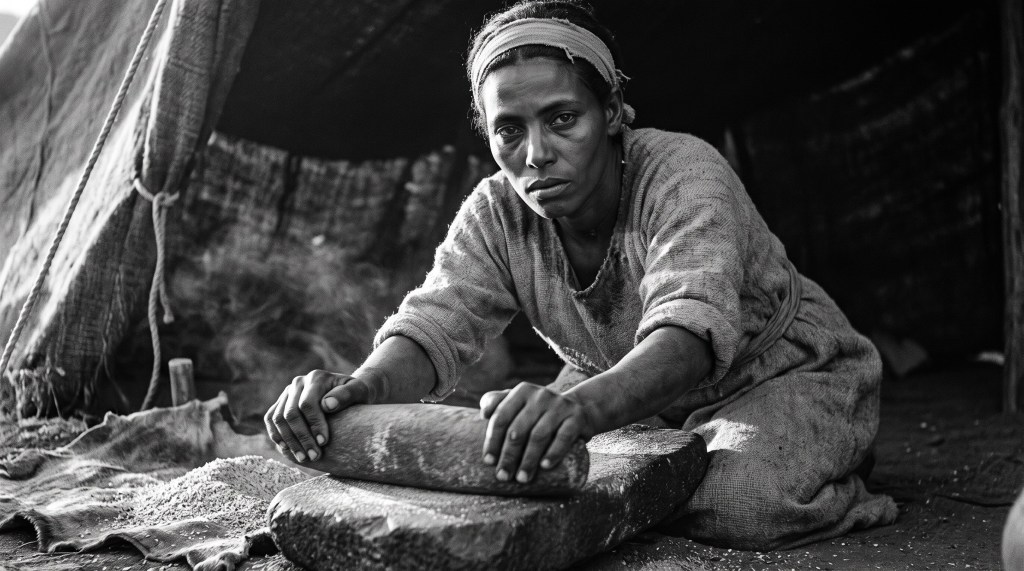
Beyond the Rib: Hagar, El Roi and the Slave Woman Who Named God

The barley meal is still under her fingernails. In a tent at Mamre, the woman the scribes called the Egyptian sets down her quern and speaks. She was taken, then given, and the law was on her mistress’s side. They sent her into the wilderness of Beer-sheba with bread and a single skin of water, and she walked a bowshot off so she need not watch her son die. Yet Genesis 16:13 records that she named God: El Roi, the God who sees me. I ask her what the text skips. History lost her voice. She has not lost ours.

Read the full post.

Bob Lynn | © 2026 Vox Meditantis. All rights reserved.

5 responses to “Beyond the Rib: Hagar, El Roi and the Slave Woman Who Named God”

  1. Lenny Appadoo avatar

    Thanks for continuing the saga of Sarai and Hagar. Your last two questionnaires got me investigating further and discovered that Islam has a higher reverence for Hagar than their Christian counterparts.
    They also grant the wells special deference.
    You did touch on the running between the hills that Muslims honour during their Haj pilgrimage. It would have been interesting if you added a Muslim questionnaire.

    Liked by 1 person

    1. Bob Lynn avatar

      Lenny, this is the comment I was half hoping nobody would leave, because it’s right, and the gap is wider than the one you’ve spotted.

      When I built the panel for Sarah I had a rabbi on it and a Reformed canon, and I was pleased with the range. What I actually had was a Jewish reader and a Christian reader, with a philosopher who believes in nothing sitting between them, and all three of them arguing inside the same inherited frame. Sarah is venerated in Islam too. The wife of Ibrahim, the mother of Ishaq, honoured in a tradition that never names her in its scripture but has kept her at the centre of the family story. Not one Muslim voice at that table, in a series about a household that Islam reveres at least as deeply as my own tradition does.

      Your point about Hagar pushes harder than reverence, though. A Muslim questioner would not have submitted a supplementary question at all. They would have gone at the frame. In Islamic tradition the son taken up the mountain is usually understood to be Ishmael rather than Isaac, and the line of promise runs through Hagar’s boy instead of around him. The entire architecture of promise-through-Isaac, the one Paul built his allegory on, is contested by a great many people who read these chapters with as much care as I do. I put that question to a moral philosopher and a systematic theologian, and never to the tradition that would have refused the premise outright.

      On the wells you have caught me being cautious in the wrong place. I let Hagar say she did not know whether she had run between the two hills, which was honest of her and a little cowardly of me. The Sa’i is not a picturesque detail to be hedged at. It is a rite performed by crowds every year, and the well has a name and a memory in a tradition that has kept her in daily practice while mine kept her as a cautionary tale about a woman who could not leave well alone. I have since learned that there is a tradition placing her grave in the curved enclosure beside the Kaaba, which I did not know when I wrote a word of it.

      So: in the instalments to come I will build multi-faith perspectives in deliberately, in the main interview where the figure allows it and on the panel of questioners where the subject warrants it. I won’t pretend every piece calls for it, and a token Muslim questioner tacked onto a subject that doesn’t need one would be worse than none. But where a figure is shared between traditions, as Sarah and Hagar both are, the panel should look a little more like the readership.

      Best wishes,

      Bob

      Liked by 1 person

      1. Lenny Appadoo avatar

        Thanks for entertaining the thought, though I follow neither of these traditions, being irreligious. It was just something interesting I stumbled upon, and you need to take credit for leading me in that direction.

        Liked by 1 person

  2. J.K. Marlin avatar
    J.K. Marlin

    So interesting, throughout, particularly appreciated was Hagar as a tribe (a people or nation) rather than an individual. Christians so easily loose the metaphor, seek to find individuals in these Hebrew Bible names. As a Christian, learning more of the Hebrew bible interpretations I am now mindful that “the suffering servant” of Isaiah has origins as a metaphor for the nation of Israel, yet a common Christian interpretation is that the suffering servant refers to Jesus. So too, Hagar is to some a suffering servant, and to others, the people who they are. I appreciate an ever widening viewpoint.

    Liked by 1 person

    1. Bob Lynn avatar

      Thank you – this is a generous reading, and I have to be straight with you about one thing before I take the compliment, because I think you may have been kinder to Professor Kowalski than Hagar was to him.

      The piece didn’t argue that Hagar is a tribe. It argued the opposite, and let the tribal reading in only as a complication. Kowalski put it to her that she was a name attached to a people, that the two wilderness scenes read like an origin story told twice, and she refused the reduction in fairly blunt terms: “I did not name myself. They did. Twice over they did.” What she granted was narrower and more interesting. A name can be a person and a people at once, the way Esau is a man and Edom is a country a few chapters later. Genesis itself does this. Ishmael gets twelve princes in 25:12-18 and a great nation in 17:20, and yet Genesis 16 gives us a pregnant woman running from a mistress who has been cruel to her, and a private name for God that no one else in scripture ever uses. The text will not let you choose. That is what I tried to hold open, and I suspect I held it more loosely than you did.

      The Hagrites are real, as it happens. 1 Chronicles 5:10 has them fighting Reuben, and Psalm 83:6 lists them among Israel’s enemies. Whether that people took their name from her, or she took hers from them, or both are downstream of some third thing, nobody can say with confidence. I flagged that as one of the unknowns and I stand by the flag.

      On Isaiah, your instinct is sound and the tension is exactly where you put it. The servant is called Israel outright in 41:8 and 44:1, and then in 49:5-6 he is distinguished from Israel and given a job to do for Israel’s sake. Nobody has ever fully resolved that, and I don’t think the text wants it resolved. Reading the servant as a nation suffering among the nations and reading him as one man who suffers on their behalf are both attempts to answer a question the poetry deliberately leaves hanging.

      Where I would press you is this. Reading a woman as a symbol is precisely the operation that erased Hagar in the first place. Philo turned her into a schoolroom and Paul turned her into a mountain, and both of them were reading metaphorically with great sophistication. Elizabeth Castelli makes the point that the allegory was the violence. So the widening viewpoint you describe is real and I share your pleasure in it, and it has a cost when the figure being widened is a slave woman with a name.

      Best wishes,

      Bob

      Like

Leave a Reply