If you could erase one event from history, what would it be?
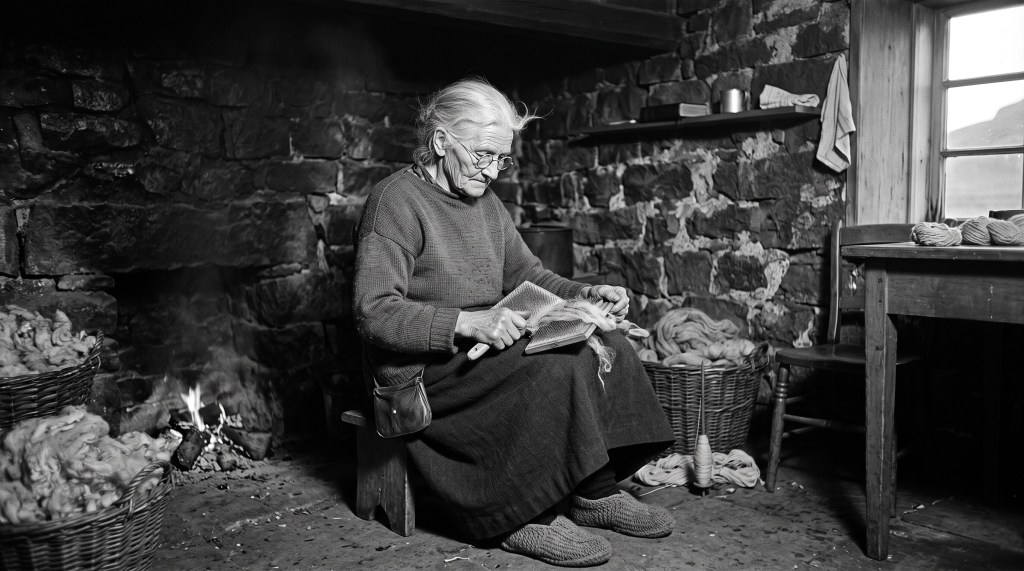
19th August, 1941. A stone-walled cottage in a small Faroese village. Wind against the glass. The smell of lanolin, peat smoke, salt. Wool in stages of preparation on every surface. A single window looking towards a grey headland and the darker sea beyond. She sits with the carding cards, drawing raw fleece: in thick hand-knitted woollen slippers, spectacles low on her nose, the small leather pouch at her side. She does not stop when the listener enters.
You want to sit, sit. The stool by the peat is steadier than the chair. The chair is not what it was.
She does not look up. The cards draw.
I went down to the harbour this morning. There was a delivery yesterday and I had salt coming to me, so I went.
The English soldiers were there. The same two that are usually there at that hour. The fair-haired one nodded to me. I nodded back. That is the extent of it between us. A year and four months of nodding. They came in April of last year, and we have been nodding since.
They are not bad men. I will not say they are bad men. The widow at the lower end of the road had a heavy basket last week, and one of the soldiers carried it for her. He could not speak what she speaks, and she could not speak his, and still the basket was carried from there to here. That is something.
But they are there.
The cards draw.
Every morning, there. They decide what comes into the harbour and what goes out. Who sails and when. In the first spring they were here, they let us fly the Merkið. The flag. We had not done that before, not in that way, not as our own. They said: you may fly it. And we fly it.
I am glad of it. I will not pretend otherwise.
And yet somebody in a room somewhere wrote that down. Put ink to paper: you may fly your flag. And we said thank you, and we meant it, and we were grateful.
She finds a burr in the fleece and works it out slowly with her thumb.
You asked me a question. Or I heard it asked. I have been carrying it since, like this, like a burr in the wool. You must work these out carefully or you pull the thread wrong.
What would I undo. One event from the whole of what has happened. One day in all of history.
I have been turning it about.
People would say: the war. This one or the one before. Go back to Sarajevo, in fourteen, and move the motor car differently down the street, and see what comes of it then. Thousands of lives in it, perhaps millions. You cannot easily weigh that.
Or they would say: the hunger. We had a bad year here when I was small, and worse on other islands. Children like sticks, yellow. You could say: put that right first.
Or they would say: what the Germans have done to Denmark. Our mother-country, they call it, though I have never been there and my mother never was and her mother never was. It is flat there, they say, and warm in the summers, and not much like here. But still. What is happening there now. You could say: undo that.
These are large things. I do not say they are not large.
She glances toward the window. The headland is losing its shape in the thinning light.
The light at this hour. You notice it this time of year. In June you lose track of the time; it is bright so late. Now it falls flat on the headland and goes early. The islands show as themselves in that light. Old stone. Old sea. Everything as it is and not trying to look otherwise.
My grandmother. She was not a woman who repeated herself. You learned to listen the first time. She would say a thing once and set it down between you, the way you set a fish on the table. There it is. You see what it is. She did not need to say more.
She told me once what it was like in eighteen-sixteen, when she was young. She said: the old men wept on the Tinganes.
That is all she said. The old men wept on the Tinganes.
I was a girl. I thought: yes. Of course. What else would you do.
She draws the cards. Slow and steady.
The fourteenth day of January. Eighteen-sixteen.
That is the day I would unmake.
She does not hurry. The cards continue.
Not the war. Not the hunger. Not my husband’s death. I will come to all of that. But first I want to tell you what happened on that day, in case you do not know it, though you may know it well enough, and I will tell you either way.
They abolished the Løgting.
The Danish king. A royal decree. The Faroe Islands were made an amt. A county. A piece of Danish administration, as if we were any county on the flat mainland, with an administrator sent from Copenhagen to see that things were done in the proper order.
Do you know what the Løgting is. I will tell you what it was.
It is old. Old enough that you cannot hold it in your mind at one time. The Norse folk who first came to these islands brought it with them, or they made it here; it does not matter which. Their way was this: when there were matters that concerned the folk, the folk gathered at the thing-place and the matters were spoken aloud. Not a word handed down from a king above. The folk’s own word, spoken among themselves, worked out in the open air. On the Tinganes, in Tórshavn. That spur of basalt going out into the harbour. You know it.
Nine hundred years they kept it.
She holds the cards still for a moment. She pushes her spectacles up her nose with the back of her wrist.
People speak of a thing kept for nine hundred years and they say: a fine old tradition. They mean it kindly. They picture a ceremony, something brought out on occasions and put away again afterwards, like good linen at Easter.
That is not what the Løgting was.
She holds up the carding cards briefly.
When the wool comes off the sheep it comes wrong. Tangled and dirty and full of knots and burrs and the animal’s whole year in it. You cannot spin it as it comes. You must card it: draw it through the teeth again and again until the fibres lie smooth and even and can be made into something that will hold.
The Løgting was the carding of the folk’s life. The business of the islands. Who could fish where. What was owed. What was to be done about a dispute, a debt, a boundary, a hard winter. The knots of living on these cliffs, in these waters. You cannot govern a place without working through the knots. The Løgting was the tool for it. Our tool. Not given down from above. Made here, for here, kept for nine hundred years.
Take that tool out of a people’s hands.
She does not finish the sentence.
The man who signed it. I do not know if he was a wicked man. Perhaps not. He was far away. He had never seen these cliffs. He had never stood on the Tinganes in a January wind and felt what it is to stand in a place that has been a law-place for nine hundred years. One of his ministers had an idea of proper administration, and the idea was written down, and the pen made it true.
That is what a pen can do from far enough away. It does not need to see you to silence you. It does not need to know you.
She sets the cards down. She opens the small leather pouch at her side, takes out the folded handkerchief, holds it a moment, puts it back without using it. She picks the cards up.
My husband’s jersey. He died in the winter of thirty-six. His heart, in the end. This jersey hangs a world too wide on me and always has. I have not got his shoulders. But it is warm, and it is his, and I have not exchanged it.
I would not undo his death.
I know how that sounds. But his dying was his. It was ours, between us, what we had the whole of it, and the dying at the end was part of that whole. You carry what belongs to you. It is yours to carry. I would not put it in a pile of things to be unmade.
The hunger years. The four men I knew taken by the sea. You carry those too. The sea is not choosing when it takes from you. The sea is being what it is.
The war. The war is a thing the sea does, or the sky does. No. I know what I am saying: men make war. I am not a fool. But when war comes it comes the way the sea comes. You dress for it, you watch the sky, you take in the line when you see what is building. And when it comes anyway, and it does come anyway, you stand and you wait for it to go through.
We stood through the last one. We are standing through this one. The boats sitting idle. The young men’s faces. The boys’ mothers. I will not say more than that. But you bear it.
She draws the cards once, slowly.
These things must be borne. The sea is not choosing. The sky is not choosing.
But a man who takes a pen.
A man who sits in a warm room in a flat city that does not smell of peat smoke or lanolin or salt, who takes a pen and chooses to write the word, and the word goes out over the water and silences nine hundred years of gathered voices.
That is a choosing. And a choosing stands under a different weight from a storm.
What is written in Deuteronomy. Thou shalt not remove thy neighbour’s landmark, which they of old time have set. I am not a preacher and I will not make a sermon of it. But that line has been in my bones since I was a girl, and I have never once read it or heard it without thinking of the Tinganes.
You do not judge the sea. The sea owes you nothing. But a man who governs owes the governed something. He owes them the law that was theirs before he arrived. He does not get to cross it out because it does not fit his idea of how a county should look on a map.
The peat breathes. She looks at nothing for a moment.
They gave it back. In fifty-two. Eighteen-fifty-two. Thirty-six years later. And people say: there, you see. It was put right.
I say: what was put right.
They gave back a voice. A body that could speak and be heard, if those above it chose to hear. Not a body that could decide. You may speak. We are listening. And then the man in Copenhagen decides.
A voice without hands.
Take the cards away from a carder and give her back the right to say what she would like to card, and the man with the cards will listen, and the man will decide what is done. That is not the Løgting. That is a portrait of the Løgting. A shadow of it on the wall.
A pause. She turns the fleece over in her hands.
And now. Nineteen-forty-one. A hundred and twenty-five years on. The Løgting sits again in Tórshavn. The men deliberate; they speak. And still there is a hand above it. Copenhagen’s hand. And Copenhagen itself is under a German boot this year.
Hand above hand above hand. And at the bottom of it, these islands. The county. The amt. That is what they made of us.
A war strips things bare. Takes the furniture out of the room and you see the shape of the walls. The shape of the walls here has not changed since eighteen-sixteen.
She works. The evening is fully dark beyond the window now. The fire is the light in the room.
I have talked too long. I do not usually go on like this. You asked a thing and it opened, and I let it. That is not always wise at my age. You begin and you cannot see where the end of it is.
She draws the cards. Stops. Draws them again.
My grandmother. Her face when she said it. Old women keep their faces flat; you learn to do that, if you live long enough. But she had something on her face when she said it. The old men wept on the Tinganes. She had been young and she had stood back, the way the young stand back from things they do not yet understand. And then she had understood, and she had put it away inside herself and kept it, all her long life, and she set it down between us on the table, once, without flourish.
I have kept it.
The wrong does not get smaller for being old. The wrong is the same size it was. Only the people who hold it get smaller, and fewer, and in the end perhaps there are none of them left. And then perhaps the wrong goes under the ground. The ground looks flat. You would not know there was anything beneath it.
Unless someone has kept it.
A long silence.
The fourteenth day of January. Eighteen-sixteen. That I have always known. I did not need to look at it long.
She draws the cards. The fire breathes. The wind has not stopped, and it will not stop. After a while, the sound of the cards is the only new sound in the room.
Bob Lynn | © 2026 Vox Meditantis. All rights reserved.


Leave a comment