The Fog’s Edge

The Fog’s Edge

How do you deal with uncertainty?

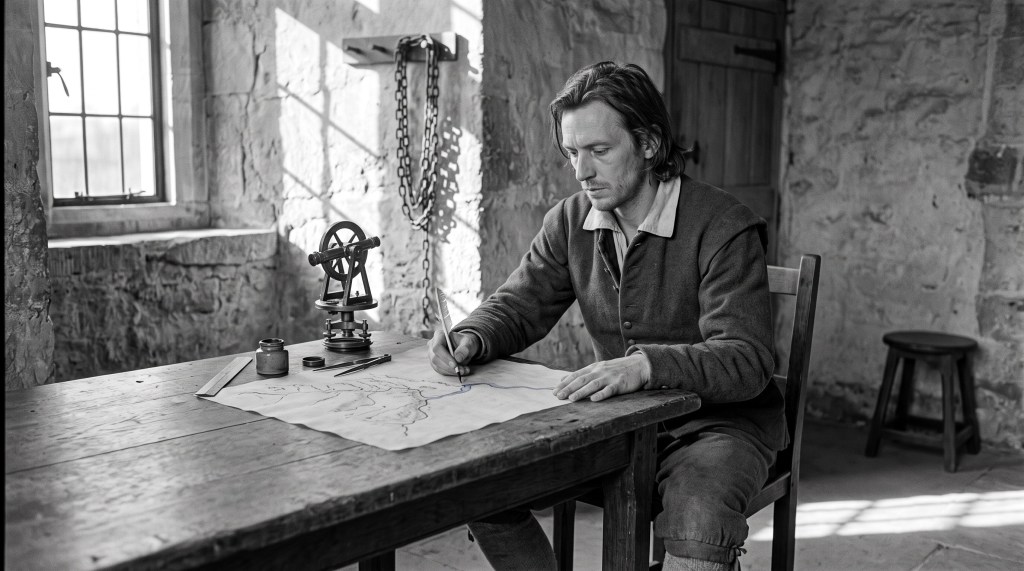
Gloucester, August 1644. A Royalist surveyor, taken prisoner by the Parliamentarian garrison, is compelled to chart the surrounding counties for the enemy. His maps may save lives or end them; he cannot know which. His only remedy is the work itself: the nib, the vellum, the slow dominion of one inch to the mile.

A woman arrives with a question that stills his steady hand: How do you deal with uncertainty?

In prose of extraordinary restraint and beauty, The Fog’s Edge is a monologue about the quiet courage of small, certain acts in a world that will not hold still.

Read the original post.

Bob Lynn | © 2026 Vox Meditantis. All rights reserved.

3 responses to “The Fog’s Edge”

  1. Steven S. Wallace avatar
    Steven S. Wallace

    Bob —

    I thought this was really great. A mapmaker and prisoner of war facing death draws maps for his captors. (That was a great touch in describing his peacetime purposes… to draw lines to settle disputes.) The alternative is to say no and be shot. So he maps out the battlefields. He either survives to write another day, or eventually outlives his usefulness.

    One might think his plight causes him to be cowardly. But what if the battles, in the fog of war, go on regardless of his mapping which is no real advantage to his enemy.

    I was struck by the questioning posed of the woman. Is she really or is she a subpar of his own maddening character. I think she is imaged. I rather like thinking of his work as being a symptom of his circumstances. He cannot run nor fight. So je carved out a place for him to keep his sanity but it’s only an illusion.

    Dealing with uncertainty…. In an uncertain world. Come to think of it, that is what he is trained to do… resolving the uncertainties of litigation by settling disputes about land. It is honorable work. But here he is drawn out of the water by the craziness that is war. Really great piece of work and I am astounded, again, by your creativity in coming up with this in 24 hours. Bravo. 👏🏻 👏🏻👏🏻

    SSW

    Liked by 1 person

    1. Bob Lynn avatar

      Thank you so much for reading this carefully and for taking the time to write something this considered. It genuinely means a lot, and I’m glad it earned that from you.

      You’ve put your finger on something I was trying to get at with the peacetime surveying – that his trade was always about resolving a small, human uncertainty. Two neighbours arguing over where a boundary runs. He settles it with a chain and a level eye, and everyone goes home. There’s a decency in that. And then the war yanks him out of that and asks him to do the same thing for generals, except now the resolution doesn’t send anyone home. It sends them somewhere else entirely. I think you’ve named that shift better than I did in the piece, honestly.

      Your point about whether his mapping actually matters in the fog of war is one I hadn’t fully articulated to myself while writing, and I think you’re right that there’s something quietly defiant in that. He pours his care into the work partly because the work is all he has, but also because there’s a part of him that suspects – or perhaps hopes – that the lines won’t change the outcome. That the cavalry will ride where they ride regardless of what he’s drawn. It lets him keep his hands clean, or at least clean enough to sleep. Whether that’s true or just a comfort he tells himself, I’m not sure even he knows.

      And the woman – I love that you’ve read her as imagined. I think that’s a perfectly valid way into the piece, and I won’t close the door on it. I’ll say only that in my own head, while I was writing, she was there in the room, on that stool, real as the vellum. But the piece doesn’t need me to confirm that, and honestly, if she works better for you as the part of himself he’s arguing with – the part that wants to ride into the fog rather than sit at its edge with a pen – then that’s a reading I’m genuinely happy to stand behind. Maybe she’s both. Maybe he’s conjured her because seven weeks in a room with nothing but a theodolite and your own guilt is a long time to go without someone to talk to.

      And yes, “he carved out a place to keep his sanity but it’s only an illusion” – I think that’s the whole thing in one line. He knows it’s an illusion. That’s what makes it sad rather than merely sad. He’s not deluded. He’s just choosing the one small, honest delusion available to him and calling it sufficient for the afternoon.

      I appreciate the kind word about the 24 hours. Most of that was spent staring at a blank page and feeling the full weight of the uncertainty I was supposedly writing about, which felt at least thematically appropriate.

      Thank you again. It’s a rare and lovely thing to have a reader think this hard about a piece. You’ve made my day.

      Bob

      Liked by 1 person

      1. Steven S. Wallace avatar
        Steven S. Wallace

        I got the idea of the woman being imaginary from listening to the pod cast. They throw out ideas and counterpoints. It seemed interesting to me to have this woman be imagined. But I can see if that was not your thought pattern. It’s a fantastic piece.

        SSW

        Liked by 1 person

Leave a comment