What’s a moment when you realized you were officially an adult?
Nafplio, Greece. Thursday, the sixteenth of August, 1832.
CHARACTERS
THE LOVER: A young Greek man of twenty-three.
THE DIVER: A man of Hydra, perhaps fifty.
SCENE
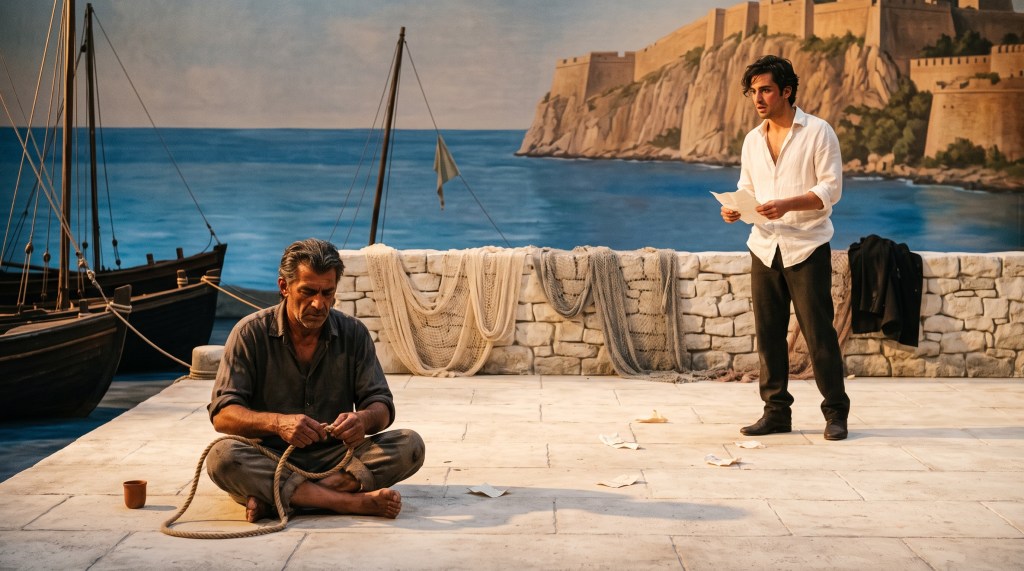
The quay at Nafplio, late afternoon. The August heat has not yet relented but is considering it; the day’s hammer-blow has become something that can, just, be borne. Against a sky still bleached white at its height, the limestone bulk of the Palamidi fortress rises sheer from the cliff above the town, its walls turning from chalk to amber as the hour deepens. Below, the Argolic Gulf moves between two shades of blue, neither of which quite has a name. Two caiques are moored along the quay; a third rides at anchor a little distance offshore, a quarantine pennant hanging limp from its mast, awaiting clearance. Nets dry on a low stone wall. The air is salt, thyme, and the faint tar of recently caulked hulls. Somewhere in the town, a church bell has just struck five. Cicadas sound in the scrub above the waterline.
THE DIVER sits cross-legged on the quay stone, a rope across his thighs. He is perhaps fifty, or a hard-worn forty; it is impossible to say. His skin is the colour of cured oak, his hands enormous, salt-cracked, the nails dark. He works a splice with the unhurried patience of a man who has performed this task ten thousand times. His right ear is swollen and discoloured behind the lobe, a thread of dried blood along its fold. He does not look up.
THE LOVER stands near the water’s edge, a few feet from the Diver. He is twenty-three, his face flushed from the heat and from something else, his collar open at the throat. His coat lies abandoned on the low wall behind him. Around him on the quay stone lie four or five scraps of paper: discarded verse. In his hand is a letter; the paper has gone soft at its creases from much folding and unfolding. He has been here since the bell struck three.
He is reading from the letter. His lips move. He stops. He folds it. He takes three paces toward the water. He takes three paces back. He sits on the wall. He unfolds the letter. He reads again.
THE LOVER: She writes of oleanders.
He looks at the letter. He looks at the sea.
THE LOVER: She says the oleanders are out along the road south of the town. That there are goats on the hillside in the mornings. That she can hear the bells from her window.
A pause. He re-folds the letter.
THE LOVER: Goats and oleanders.
He holds the letter in his lap and regards what remains of the afternoon.
THE LOVER: I have been attempting to reply since the bell struck three. Look at all of this.
He gestures at the scraps of verse on the stone around him. The Diver does not look. The Lover picks one up, reads it silently, and his face does something small and pained. He holds it over the water and lets it fall. It settles on the surface and drifts. He watches it.
THE LOVER: I cannot write what I mean. The words arrive and they are not the right ones. They are Homer’s words. Solomos’s words, God give him long years. They are the words men have always used for this, for other women in other cities, and when I write them I am wearing another man’s coat. The fit is wrong. But I keep putting it on.
He stops. He laughs, once, shortly, with little warmth in it.
THE LOVER: Forgive me. I don’t know why I am telling you this. I have been speaking to the sea for two hours and it has not answered. Now I am speaking to you.
The Diver works. He pulls a thread through, tests the splice.
THE LOVER: Are you from Hydra?
THE DIVER: Aye.
THE LOVER: I thought so. The lines of the boat. I can recognise a Hydriot rigging.
A pause. The Diver says nothing. He holds the rope toward the light, peers along its length.
THE LOVER: Your ear is bleeding. There, behind the fold of it.
The Diver touches the ear. Looks at his fingertip. Wipes it on his knee. Returns to the rope.
THE DIVER: Aye.
THE LOVER: From the diving?
THE DIVER: Aye.
Pause.
THE LOVER: Does it…
He stops himself. He looks at the water instead.
THE LOVER: I saw her first in May. She was at a window in Tripoli, an upper window near the market. I was below in the street. I looked up and she was there and the afternoon light was behind her. That is the whole of it. I looked up and she was there.
He pauses. He picks at the crease in the letter.
THE LOVER: I did not speak to her. I had no courage. I spent the rest of the day composing the speech I should have given, and it was the most beautiful speech in the history of the Greek people. She did not hear it because I delivered it to the wall of the stable where they had put my horse.
Something close to a smile crosses his face. Then it goes.
THE LOVER: Now I am composing letters that are equally beautiful and equally unheard.
He sets the letter down on the wall beside him.
THE LOVER: I have been asking myself, all afternoon and for longer than this afternoon, since the morning the letter came, since before it came: whether what I feel is a real thing. I know what love is from the poets. I know it from the Psalms also: “My heart is sore pained within me, and the terrors of death are fallen upon me.” And it seems to me I am suffering precisely as described. But then I wonder. Whether I have read too many descriptions of the suffering and have mistaken the description of the rain for the rain itself. Whether my heart is genuinely pained or whether I know what a pained heart is supposed to look like and am enacting it for an audience that is not here.
He looks at the Diver. The Diver works on.
THE LOVER: You are not listening.
The Diver says nothing. He turns the rope in his hands, finding the next frayed section.
THE LOVER: No. You are listening. You are simply not answering. Which is a privilege I have not managed today.
He goes to the edge of the quay and looks down into the water. The bottom is visible: pale stone, the drift of small fish.
THE LOVER (not quite to the Diver, not quite to himself): Is there a moment. When a man knows. When the boyhood is done and what follows is the man’s portion. Not a gradual change, not the slow shift of seasons, but a single moment. An hour. A day on which you woke knowing.
He turns.
THE LOVER: I had believed love was that moment. I read this in the poets and I believed it. That a boy enters the fire and if it does not consume him he comes out the other side something sturdier. Something that can carry its name without apology. And now I am in the fire and I feel nothing of the kind. I feel like a boy wearing his father’s coat.
He looks down at the quay stone. He picks up another scrap of verse. Drops it.
THE LOVER: My father was in the war before he was my age. Had already…
He stops. He sits back on the wall.
THE LOVER: He does not speak of it. I used to think that was dignity. The dignity of a man who has suffered and does not perform the suffering. Now I think perhaps certain things cannot be recounted. They can only be carried. And the man who has carried them knows this, and the man who has not does not, and there is no bridge between the two that words can build.
The light has shifted. The Palamidi’s shadow has stretched further across the quay stone. The water below it has darkened by a shade.
THE LOVER: What is it like. Down there. When you go all the way down.
The Diver is still for a moment. He sets the rope across his knees and looks at the water.
THE DIVER: Dark. Very quiet.
He picks the rope up again. The Lover watches him.
THE LOVER: And you go willingly? Every morning?
THE DIVER: Aye.
THE LOVER: How far do you go?
THE DIVER: Forty fathoms. Some days more.
A pause.
THE LOVER: Are you not afraid?
The Diver’s hands slow on the rope. The pause itself says something.
THE DIVER: Every time.
THE LOVER (very quietly): Every time.
He stares at the Diver.
THE LOVER: Then how does a man go down, if he fears it every time?
The Diver works one knot. Then another. He does not look up.
THE DIVER: You hold your breath. And you go.
Silence. The water. The cicadas in the scrub above the waterline. Somewhere in the town, a door opens and closes.
THE LOVER (after a long moment): I think I am afraid. Not of the sea, not of depth. I mean that I am afraid she will look at me and find there is some readiness, some quality of a full-grown man, that I do not yet possess, and she will see the want of it before I have seen it myself. That I will write the letter and she will read it and know me at once for a boy with borrowed words. And that will be…
He cannot finish it. He looks at the Diver’s hands on the rope.
THE LOVER: How old were you? The first time you went down?
THE DIVER (not looking up): Twelve.
THE LOVER: Twelve.
A beat.
THE DIVER: How old are you?
THE LOVER: Twenty-three.
The Diver nods, once, slowly. He returns to his rope.
THE LOVER (with a small, rueful sound): You think that young.
The Diver neither agrees nor disagrees. He works.
THE LOVER (quietly, half to himself): Perhaps there is no moment. Perhaps the coat never fits, and men simply agree to behave as if it does and pass that agreement on, in silence, to their sons. Perhaps that is what everyone calls manhood.
A long pause. The light is fully golden now, long and low across the quay stone. A gull lifts from the wall, turns once over the water, and goes.
THE DIVER (flatly, not looking up): There was a man in Hydra.
The Lover looks at him. The Diver works on.
THE DIVER: Good diver. Good man.
He pulls a thread through the splice.
THE DIVER: One morning he came up wrong. Hit his head on the keel.
Pause.
THE DIVER: He didn’t come up.
The Lover is very still.
THE LOVER (after a moment): You were there.
THE DIVER: Aye.
Silence. A rope creaks against a cleat. The water laps.
THE LOVER: Was that…
He cannot quite ask it. He tries again.
THE LOVER: Was that when you knew?
A pause long enough that the Palamidi’s shadow has shifted visibly on the stone. Long enough for the Lover to look away from the Diver and out toward the water, and then slowly back.
The Diver sets the rope down. He reaches to one side, where a small clay cup has been sitting on the stone throughout the afternoon, and pushes it across toward the Lover without looking at him. Water, from hours ago, warm now from the stone.
He picks the rope up and begins the next section of the splice.
THE DIVER: I went back down because the sponge was there.
He works. The rope. The splice. The last of the light on his cracked hands.
The Lover looks at the cup. He does not yet drink. He lifts it in both hands, as one might receive something in a church without knowing what it is.
The bell in the town marks the quarter hour. The cicadas. The water lapping at the quay stone.
The Lover sets the letter down on the stone beside him. He does not pick it up again.
After a long moment, very quietly:
THE LOVER: “Cast me not away from thy presence.”
The Diver does not respond. He works.
The light changes on the water.
The scene ends.
Bob Lynn | © 2026 Vox Meditantis. All rights reserved.


Leave a comment