A Licence to the Wind

A Licence to the Wind

If you had to give one life-changing tip, what would it be?

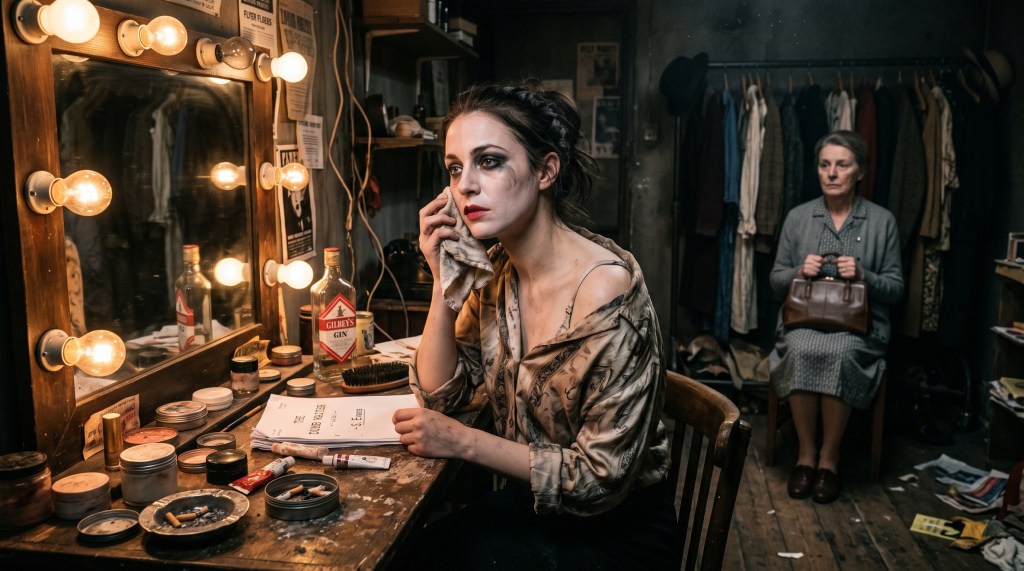
London, 1968. Stage censorship is dead, and the theatre is finally free. In a sweltering Soho dressing room, a radical young playwright has just performed her most controversial, unredacted work. She expects triumph; instead, she finds only paralysing doubt.

Waiting in the shadows is a ghost of the old regime: the stoic, anonymous woman who spent decades crossing out the very words spoken tonight. As mirror bulbs die, two opposed women engage in a devastating duel about art, conscience, and the crushing weight of absolute freedom.

When the barricades fall, what remains? A truly masterful exploration of its heavy price.

Read the original post.


Bob Lynn | © 2026 Vox Meditantis. All rights reserved.

2 responses to “A Licence to the Wind”

  1. Anna Waldherr avatar

    “The YOUNGER WOMAN: I feel as though I was entitled to say what I said, and I cannot decide whether that is the same thing as having said something worth saying…

    THE OLDER WOMAN: Do not mistake permission for value.”

    The dialog between these two women has profound relevance for our current culture. Many barricades have been knocked down in recent years. Not all, however, should have been. Nor does the fact they were knocked down justify what has come after.

    We are all born w/ a conscience. What we choose to do w/ that asset is reflected in our actions. Do we recognize it as a gift from God, strive to educate and refine it? Do we follow it, to the best of our ability, despite opposition? Or do we ignore it?

    Restrictive or not, the law is not a substitute for conscience.

    Liked by 1 person

    1. Bob Lynn avatar

      (The dressing room. The Older Woman has her hand on the brass doorknob, paused. The Younger Woman sits at the mirror, the damp cloth resting against her cheek. From the darkened, empty auditorium beyond the walls – or perhaps from the very dust and heat of the room itself – the words of a modern reader, Anna, seem to hang in the silence, an echo from a future yet to be written. The Younger Woman lowers the cloth. She looks at the Older Woman’s reflection in the glass.)

      THE YOUNGER WOMAN:
      Did you hear that? A voice from the stalls. From a long way down the road, by the sound of it. She says not all barricades should have been knocked down.

      (She gives a short, breathless laugh, devoid of humour.)

      THE YOUNGER WOMAN:
      It is remarkably easy to say that when you are not the one who was suffocating behind them. She asks if we follow our conscience despite opposition. Yes. We do. Because opposition is the anvil upon which the thing is struck into shape. If it is a gift from God, as she calls it, it is a terribly heavy one, and it does not arrive with instructions. We have to bleed for it to make it ours. Tonight, my conscience feels like a bruise. But it is mine.

      THE OLDER WOMAN:
      (Releasing the doorknob, turning slightly to face the room)
      She makes a vital distinction, the woman who left this thought with us. “Nor does the fact they were knocked down justify what has come after.” That is the precise, unyielding burden you are sitting with, isn’t it?

      (The Older Woman steps away from the door, her posture as rigid and composed as ever, though the shadows in the room are deeper now.)

      THE OLDER WOMAN:
      You speak of the barricades as if they were merely walls. They were also load-bearing. The young invariably believe that removing the cage will teach the bird to fly. They do not anticipate that it merely teaches the bird how vast the sky is, and how terribly small and fragile the bird happens to be.

      THE YOUNGER WOMAN:
      But if you never open the cage, you never know if the bird is weak, or if the iron was just too thick! You heard her. She knows the law is not a substitute. Your office spent twenty-three years pretending it was. You used your red ink to enforce a public conscience because you were terrified of what people would do if they had to rely on their own.

      THE OLDER WOMAN:
      We used our red ink to maintain a standard of public decency, because we understood that an unrefined conscience is merely an appetite.

      (The Older Woman looks toward the empty space where the voice seemed to originate, her expression grave, acknowledging the modern reader’s insight.)

      THE OLDER WOMAN:
      The lady in the dark understands what my office perhaps forgot in its later years, and what your generation is only just beginning to discover in the wreckage. She asks if we strive to educate and refine this gift. Indeed. A conscience that is not educated by history, by restraint, and by duty, is just a collection of passing impulses. You feel triumphant when the law steps aside, but the law was only ever a boundary. Conscience is the terrain. If the terrain is barren, no amount of boundary-shifting will make it yield a harvest.

      THE YOUNGER WOMAN:
      (Quietly, turning fully away from the mirror to look at the Older Woman)
      And if the terrain is barren… what then?

      THE OLDER WOMAN:
      Then you must plant something new. And you must tend it. And you must bear the agonising responsibility of the harvest. The law is a fence. Conscience is the husbandry. If you do not tend the soil, it matters very little who tore down the fence.

      (A long silence. The distant rumble of the Tube vibrates through the floorboards, a reminder of the vast, moving city above them.)

      THE OLDER WOMAN:
      She is right to remind you. The barricades are down. The red ink is dry. You have your freedom. Now comes the much harder work.

      (The Older Woman picks up her leather bag. She does not look back as she opens the door and steps out into the corridor. The door clicks shut. The Younger Woman is left alone. She looks at her half-cleaned face in the glass, picks up the damp cloth, and, with a newfound, terrifying deliberation, begins to wash away the rest of the paint.)

      Liked by 1 person

Leave a comment