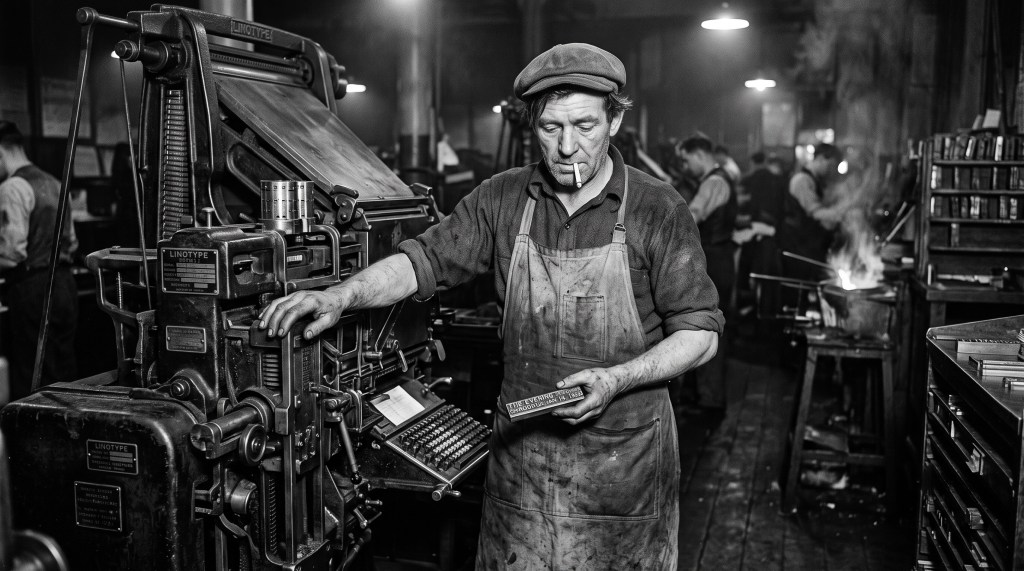
What’s a skill you consider basic, that most people don’t actually know how to do?
Tuesday, 1st August 1933
You want to know what a basic skill is. A skill that most people can’t do. Right.
He doesn’t stop typing. His fingers cross the keyboard without once looking down.
Have a seat on that galley stand. Not that one. That’s got forme on it and I’ll thank you to leave it alone. The other one, yes, there you are. Rest yourself and open your notebook, and try if you would not to fidget. There’s not much room for error at this machine, and a man bumped at the wrong moment is a man who loses his line. On a night like tonight, a lost line is not a luxury I can spare.
One other thing: don’t breathe too deep, not just yet. The fumes off the pot will get a new man right behind the eyes before he’s had time to account for it, and in my experience a journalist laid low by lead fumes writes a thinner piece than one who’s kept his head.
That smell, before you think to ask, is the metal. Lead, tin, and antimony, the three of them together in what the trade calls type metal. It runs in that pot there at better than four hundred degrees. Four hundred and fifty on a hard night, and this is shaping up to be one, given what’s coming down from upstairs. You can feel the warmth of it already, standing where you are. That isn’t August you’re feeling, or not only. Two in the morning in August on Fleet Street is close enough of itself, God knows, but that warmth at your back is the pot. She’s always warm. She never cools. Twenty-three years I’ve been at this machine, through winters cold enough to put ice on the Thames, and she has never once faltered. More reliable than the government, I’ll say that for her. And considerably hotter.
A line is cast. He listens to the mechanical sequence: the clunk, the hiss, the solid drop of the slug, the rattle of brass matrices ascending to the distributor. He examines the slug for perhaps half a second and sets it in the galley without breaking his rhythm.
Now. Your question.
A basic skill that most people can’t do. I’ll tell you what I can do that you can’t, and then I’ll show you, because showing is quicker than telling, and I’m short on time tonight if not on inclination.
Look at that line of matrices in the elevator. Those brass pieces, lined up there, waiting to be cast. Take a proper look. Can you tell me what they say?
He waits.
No. Of course you can’t. They’re reversed.
Every character in that line is a mirror image of itself. Every letter, every figure, every comma and full stop and opening bracket. The ‘e’ faces the wrong way. The ‘s’ goes the wrong direction. The ‘p’ and the ‘q’ look near enough identical to an untrained eye, and that, as it happens, is where the saying comes from. Mind your p’s and q’s. It started as a compositor’s warning, or so the old hands have it, though the rest of the world has long since forgotten as much. Because if you cannot tell a reversed ‘p’ from a reversed ‘q’ at a glance, in this light, under time pressure, you have no business sitting at this machine, and you will be told so in fairly short order.
Each of those pieces is a brass mould. The shape of the letter is cut into it as a hollow, cut in mirror image, because when the pot drives molten metal against that face, what comes out the other side is a raised letter, reversed back to the correct way round. That’s your slug: a solid bar of type metal with a line of words standing up on it, ready for inking and press. It comes out right because the matrix went in reversed.
Now. Before I cast that line, I read it. In the moment before I throw the lever. I look at those matrices and I read them from right to left, mirror-imaged, and I do it as naturally as you read the writing in your notebook. I can tell at a glance whether there’s a wrong matrix in the line, a dropped character, a transposition, a piece of damaged brass that’ll give you a broken face on the slug. I can see it before the metal goes in. And if I see it, I clear it, reset the line, and no one is any the wiser. The edition is none the poorer.
That is what I’d call a basic skill. Reading mirror-image characters at speed, under the conditions you can hear and feel for yourself right now. Forty machines running at once, all night. The heat. The clock. And behind me, always, the pot.
He taps the side of the machine once, almost absently, the way a man might set his hand on the shoulder of a colleague he trusts.
How did I come by it? Nobody taught me. That’s the first point worth understanding. The man who sat in this chair before me was a proper Fleet Street craftsman, a Chapel man all his working life, served a full apprenticeship, knew the trade from the stone up. He showed me the keyboard, which isn’t laid out as a typewriter is, but by the frequency of letters, lower-case to the left, upper-case to the right, ninety characters in all. He showed me how to keep the magazine clear and how to listen for a bind in the distributor. He did not show me how to read a mat line backwards. To him it required no instruction. It was simply what you did. What you had to do. The understanding in the trade was that you arrived not knowing it, and after some months you knew it, and if you hadn’t found it in yourself by then, the trade had ways of making that plain.
What I find interesting about the learning of it is this. It doesn’t feel like learning to read backwards. It feels like learning a second script. A second writing that lives alongside the first in the same territory of the mind, and after a time the two sit there quite peaceably without troubling one another. At home in the morning I read the paper at the kitchen table, my paper more often than not, the very lines I cast last night, and I read it left to right without effort. I come in here at midnight and I read the matrices right to left and reversed, and I do that without effort as well. The eye learns to move differently in different conditions. You don’t choose it. It comes on its own, in its own time. You just have to keep yourself at the machine long enough for it to arrive.
Which is more than can be said for most things in this country at present.
He casts another line. Checks it. Sets it in the galley. He lights a cigarette without pausing, with the economy of a man who has done this ten thousand times in the middle of other work.
But that’s only the half of what you came to hear, and the quieter half at that. The other half is the squidge.
From your expression I’d say you don’t know the word.
A squidge is what happens when the casting cycle fails. When there’s a crack in the mould, or a hard jam in the line that didn’t clear properly, or, and this is the one that concentrates the mind above all others, when there’s moisture in the mechanism. Any trace of water, any at all, and it encounters the molten metal, and what you get is not a cast. What you get is a decision made by four hundred and fifty degrees of liquid lead to go somewhere. And the somewhere it chooses is not always to the good of the men in the vicinity.
That’s a squidge.
I’ve seen a squidge take a man’s hand. Not badly, not as badly as it might have gone, but badly enough. I’ve seen a young lad fresh out of his apprenticeship catch a spatter across the wrist and stand there staring at it with the glazed, stupefied expression men get when they’re hurt too fast to feel it yet. I’ve seen a good man spend a fortnight at St Bartholomew’s on account of a squidge that came from a hairline crack he hadn’t spotted, because he hadn’t thought to look, because complacency is the cheapest of failings and it costs the most.
A brief pause. When he speaks again, something in his voice is harder and quieter at once.
The right thing to do in a squidge is not to look at it. I’ll say that plainly, because it runs against every sound instinct a rational man has. When something goes wrong, you look at it. That is, as a general rule, the correct approach. But if you look at a squidge, you’re moving your face towards the thing that is throwing hot lead at you, and your face is considerably harder to replace than your wrist. So: you do not look.
What you do instead is reach into the mechanism by feel. Into the housing of the machine, in the dark, with your right hand, and you locate the jam and you clear it before the pot fires again. Your hand goes in, and I mean with decision, not with hesitation, because hesitation is merely a slower way of being hurt, and decision is the only quality this machine respects. You find the blockage by touch. The knowledge of where everything is in that housing doesn’t live in my eyes. It lives in my hands. I don’t consult it consciously. I don’t reason it through. I know the temperature of every surface in there, know which parts are always hot and which parts are intermittently hot and which parts I can touch without consequence and which parts I can touch only if I’m ready to be quick about it. I know the sound of a serious jam against the sound of a minor bind. I know, from the vibration in the frame, whether I have three seconds or seven. And I can find a jammed matrix in the dark of that housing by the feel of it alone, as surely as a blind man finds the right coin in his own coat pocket.
I have never timed it. There are men in this building who’d put a stopwatch to it and give you a number in seconds and fractions of seconds. I’d not thank them for the figure. I don’t want to know how long it takes, because knowing would mean thinking about it, and thinking about it would slow me down. It is a thing done before thought has time to arrive. That is precisely why it works.
He exhales a long breath of smoke. Across the room the compositors at the stone work in silence, and the rows of machines keep their unbroken rhythm.
Now. Before you go back upstairs with your notes, there’s something I’d ask you to consider, because I see how a man in your position looks at a room like this. I know what you see. You see machinery and heat and men in aprons at two in the morning and galleys full of lead type and a great deal of noise. You think: here is the mechanical end of the enterprise. The thinking happened upstairs, the writing and the editing and the weighing of events. Down here is the labour, and the labour is unskilled, or near enough.
I’d ask you to look again.
Every line I’ve cast tonight is going into tomorrow’s paper. Every line is a fact, or it ought to be, and a fact cast in lead goes out to sixty thousand people before the city wakes. What I set, they read. If I set it wrong, they read something wrong. A wrong name. A wrong figure. A wrong account of something that has happened in this world and matters to the people who buy this paper on their way to work.
The World Economic Conference that’s gone to its grave these last few weeks, having settled nothing of use to the working man, and what that signifies for men who are already on their uppers. The Means Test, and what it means to a family man to stand before a board of clerks and account for every stick of furniture in his house before they’ll allow him what he’s owed. These things are in this paper tonight. These words came down from upstairs as copy, and they came down to me, and I have cast them in metal, and the metal will go on the stone, and the stone will go to press, and the press will run, and the vans will go out into the dark. And if any word of it went wrong in my hands, it would go wrong for sixty thousand people.
I feel the weight of it. Not in any high or rarefied sense. I’m not a man for elevated sentiment at two in the morning. But in the plain and practical sense of a craftsman who knows that his reading of a mat line in mirror image, his clearance of a squidge in the dark of his machine, is what stands between what was written and what is received. That is not nothing. It has never been nothing.
We are the last hands the language passes through before it goes to press. Every man in this room. And the best of us, not the cleverest, not the most schooled, but the best of us in the sense that has always counted in a trade, can read it backwards.
Now. I’ve five more takes before the foreman comes round, and he has never in my experience waited for philosophy. If you’ll excuse me.
He turns back to the keyboard without ceremony. The machine resumes its unbroken rhythm, as though the conversation had been nothing more than a brief pause between lines.
Bob Lynn | © 2026 Vox Meditantis. All rights reserved.


 Vox Meditantis
Leave a comment