Do you believe in fate/destiny?
Do you know what day it is?
To you, perhaps, it is merely another page turned in your digital calendars, a quiet Sunday evening in this year of 2026. But to me… to us, it is the day the eagle flew from steeple to steeple, all the way to the towers of Notre-Dame.
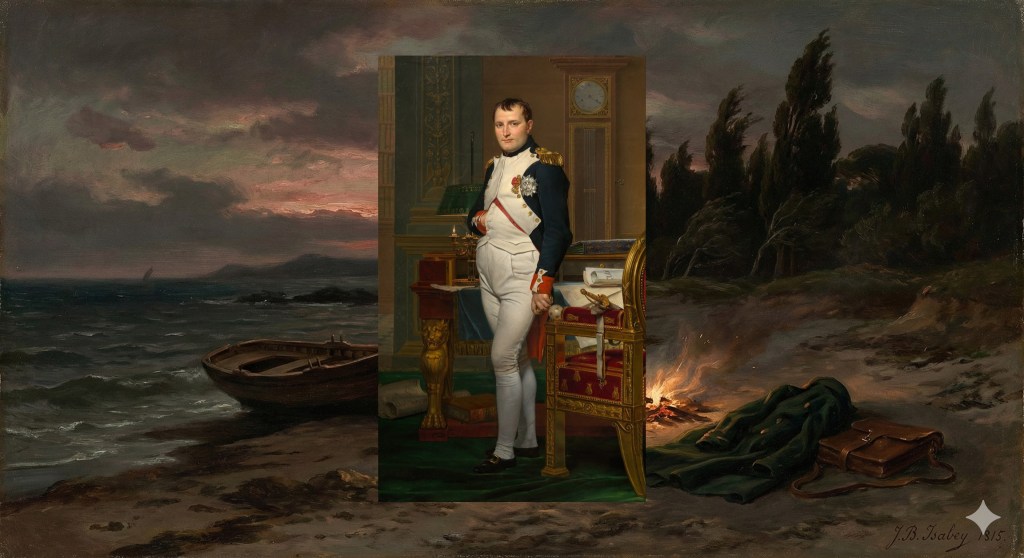
It was the first of March, 1815, when my boots touched the sand at Golfe-Juan. I had left the mockery of an empire they gave me on Elba, slipped the British blockade, and returned to claim France. They sent entire armies to arrest me. I walked out alone, opened my coat, and offered them my chest. Not a single shot was fired. They wept and remembered their Emperor.
You look at me now, a spectre of history, and you ask me a question that has shadowed my name from the burning sands of Egypt to the frozen hell of Russia: Do I believe in fate? Do I believe in destiny?
It is a word you moderns throw about when you wish to excuse your own failures. I watch your world in 2026, and I confess, it amuses and infuriates me in equal measure. You have built a society of unprecedented marvels and unparalleled cowardice. You fight your wars now with invisible strings – drones buzzing in the sky like mechanical insects, striking from the clouds without the honour of looking your enemy in the eye.
You have algorithms and thinking machines – ghosts in your glowing glass rectangles – telling your leaders what to think, what to say, and how to govern. Your politicians are managers, not conquerors. They poll the mob before they dare to take a step. I led the mob; I did not ask its permission to build a civilisation!
Look at Europe today. Still a fractured theatre of bickering states, still terrified of the Bear in the East, still reliant on the merchants across the Atlantic. I tried to give you a unified Europe, a continent of laws, the Napoleonic Code, standard measures, an empire of reason! But you preferred your squabbles. Now you face a changing climate, borders that mean nothing, and a populace mesmerised by screens, fed on a diet of digital rumours and engineered panic. You have all the knowledge of the world at your fingertips, yet your leaders possess the souls of shopkeepers.
And so, in the midst of this sterile century, you ask me of destiny.
Yes. I believe in destiny. I was called the Man of Destiny. But you fundamentally misunderstand what the word means. You think of destiny as a carriage you sit in, which drives you safely to a preordained destination. You think it is written in the stars, a divine right. That is the comforting lie of the Bourbons, the delusion of kings who are born to power and do nothing to earn it.
Destiny, my friend, is not a script. It is a tempest. It is a violent, howling wind that sweeps across the centuries. Most men hide from it. They board up their windows, clutch their purses, and pray for the storm to pass.
But a few… a rare few, when they hear that wind, they step outside. They raise their sails. They harness the gale.
When I was a boy in Corsica, a minor noble with a strange accent, there was no script that said I would wear the crown of Charlemagne. When I was a starving artillery officer in Paris, my destiny was not waiting for me on a silver platter. I forged it in the crucible of Toulon. I seized it at Austerlitz. Destiny is a woman; she favours the bold, the audacious, the ones who are willing to demand her compliance.
I believed I was a child of destiny because I recognised the exact moment when the tide of history was turning, and I threw myself into the current. I became the instrument of the age. France needed a saviour from the chaos of the Revolution, and I made myself that saviour.
But do not mistake destiny for immortality. The tempest that lifts you can just as easily smash you against the rocks. I learned that at Waterloo. I learned that on the miserable, rat-infested rock of Saint Helena. Destiny is fickle. When you stop moving, when you hesitate, when you let arrogance blind your judgement – as I did in the Russian snows – she abandons you to the cold.
Your leaders today, in 2026, wait for destiny to save them. They wait for technology to solve their crises, for markets to self-correct, for these artificial intelligences to map the perfect future. They are passengers.
If you want to survive the tempests of your own time – the wars, the shifting climates, the terrifying dawn of your thinking machines – you must stop waiting for history to happen to you. Destiny is the marriage of circumstance and iron will.
It is the first of March. The anniversary of my grandest gamble. I stepped onto the beach with a thousand men and took back an empire with nothing but the sheer force of my presence. That was not fate doing the work for me. That was me, grabbing fate by the collar and commanding it to obey.
So, do I believe in destiny? I believe in the destiny that is written by the edge of a sabre and the relentless fire of the human spirit. Nothing less.
Now, leave me to my memories. The Mediterranean breeze is calling, and there is a march to Paris that I must relive.
Napoleon Bonaparte (1769-1821)
Bob Lynn | © 2026 Vox Meditantis. All rights reserved.

 Vox Meditantis
Leave a comment