The white dust of Elba was a different kind of devil than the sucking mud of Poland or the biting frost of the Berezina, but it found its way into a man’s lungs all the same. Étienne coughed, a dry, rattling sound that tasted of pulverised limestone and salt air, as he wiped his brow with a forearm mapped by the scars of Marengo and Austerlitz. He was no longer carrying a Musket Model 1777; instead, his hands – huge, calloused things that looked like they had been carved from the very rock he worked – gripped a heavy iron trowel.
Around him, the Villa dei Mulini was a hive of frantic, seemingly domestic industry. To the casual observer, it was merely an ageing manor house being dragged into the modern era by a man with too much time and a dwindling treasury. Carpenters hammered at the window frames of the new ballroom; gardeners moved heavy terracotta pots of lemon trees with the rhythmic precision of an infantry drill; and masons, under Étienne’s sharp eye, laid the final slabs of the terrace overlooking the shimmering Mediterranean.
“Keep that mortar wet, you lazy dogs!” Étienne barked, his voice still carrying the parade-ground rasp of the Old Guard. “The Emperor wants this balustrade finished before the sun dips. Do you think he conquered half of Europe with shoddy joints and crooked lines?”
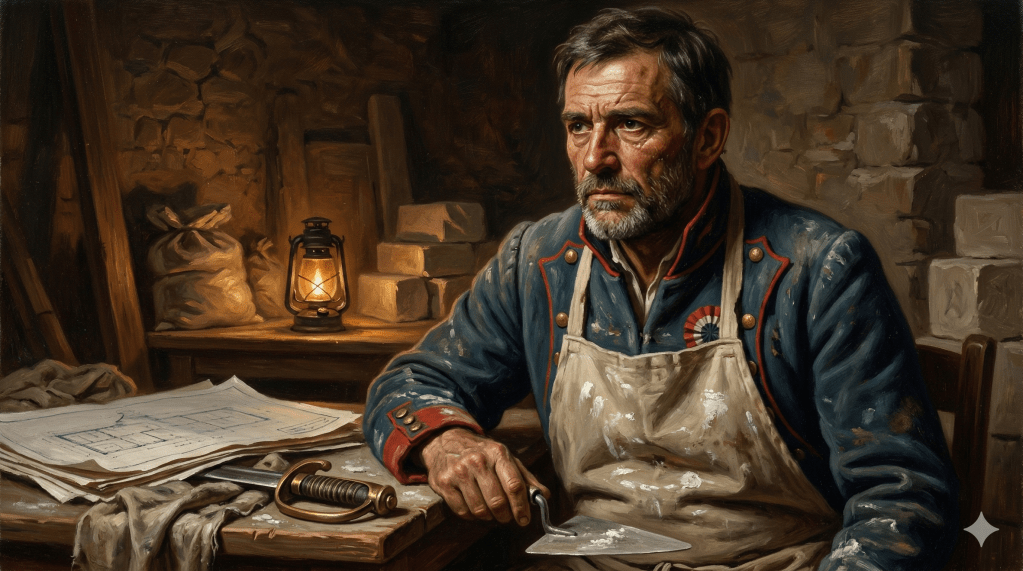
The “Emperor” appeared then, emerging from the cool shadows of the villa into the brutal glare of the February afternoon. Napoleon Bonaparte did not look like the master of the world. He wore a simple green coat, stained at the cuffs with yellow drafting ink, and a pair of trousers that had seen better days. In his hand, he clutched a roll of architectural blueprints as if they were the maps of a fresh campaign.
“Étienne,” the Emperor said, his voice low and buzzing with that restless, electric energy that had always made men follow him into the mouth of hell. “The drainage in the lower garden. It is two pouces off the mark. If the spring rains come as the locals suggest, my lemon trees will drown in their own shoes.”
“I shall see to it myself, Sire,” Étienne replied, snapping a crisp salute that felt strangely out of place amidst the piles of gravel and sacks of lime.
“See that you do. A man’s home is his final redoubt, Étienne. If the foundations are weak, the man is weak.”
Napoleon turned as the sound of approaching hoofbeats echoed against the stone walls. Sir Neil Campbell, the British Colonel appointed to act as the “shadow” of the fallen titan, rode into the courtyard. He dismounted with the practiced, stiff-backed elegance of the English aristocracy, his red coat a jarring splash of colour against the dusty white of the villa.
“Good morning, General,” Campbell called out, his tone an infuriating blend of professional courtesy and patronising pity. He used the title ‘General’ pointedly, a constant reminder that the title of Emperor had been stripped away by the Treaty of Fontainebleau.
Napoleon didn’t flinch. He offered a tight, polite smile – the smile of a man playing a very long game of whist. “Colonel Campbell. You find me in the midst of a crisis. The marble for the foyer has arrived from Carrara, but the grain is… inconsistent.”
Campbell walked over, tapping his riding crop against his boot as he surveyed the chaos of the construction. He looked at the half-finished walls, the stacks of timber, and the weary soldiers-turned-labourers. To Campbell, it was a pathetic sight – a lion trying to build a cage for itself out of twigs and mud.
“You have been quite the busy bee these last few months, Bonaparte,” Campbell remarked, strolling toward the edge of the terrace where the land fell away to the sea. “New roads across the island, a hospital, this villa, even a theatre. One would think you intended to stay here for a hundred years.”
“A man must occupy his mind, Colonel,” Napoleon replied, joining him at the precipice. “Idleness is the rust of the soul. I have traded the sword for the trowel. Is that not what your government desired?”
Campbell chuckled, a dry, English sound. He looked back at the villa, then at the Emperor, whose eyes were fixed on the horizon – specifically toward the North, toward France.
“I must confess, I find it fascinating,” Campbell said, leaning against a pile of unlaid paving stones. “I’ve seen the monuments you raised in Paris – the Vendôme Column, the arches, the great bridges of the Seine. They were built by the labour of thousands and the gold of conquered nations. Yet here you are, arguing over the price of lime and the placement of a privy.”
The Colonel paused, a glimmer of genuine curiosity breaking through his professional mask. “Tell me, Bonaparte, of all the grand designs you’ve ever drafted, is this modest villa truly the most ambitious DIY project you’ve ever taken on?”
Étienne, standing only a few paces away, felt a sudden, sharp tension in his chest. He stopped his work, the trowel hovering over the mortar.
Napoleon let out a short, bark-like laugh. He stepped closer to Campbell, his stature seemingly expanding despite his lack of a uniform. “Ambitious, Colonel? You think this is ambition? To patch a roof and plant a few lemons?”
He swept a hand toward the villa, then toward the harbour where his small brig, the Inconstant, sat at anchor. “Ambition is not about the size of the stone, but the strength of the illusion. You see a man fixing a house because he has nowhere else to go. I see a man building a screen so large that an entire world can hide behind it.”
Napoleon smiled then, a flash of the old, terrifying brilliance that had scorched the maps of Europe. “To answer your question, Colonel: yes. It is the most ambitious project of my life. For when a man builds a palace, he is merely a king. But when he builds a prison for himself, and invites his enemies to hold the keys… that is when he is truly a master-builder.”
Campbell blinked, momentarily unsettled by the intensity in the other man’s gaze. But he shook it off, attributing the outburst to the lingering delusions of a defeated ego. “Well,” the Colonel said, straightening his coat. “It is a fine house, General. A bit drafty, perhaps, but a fine house nonetheless. I shall leave you to your masonry. I sail for Livorno tonight for a brief change of air. I trust the lemons will be in good health upon my return?”
“You may count on it, Colonel,” Napoleon murmured, his voice as smooth as polished marble. “Everything shall be… transformed by the time you return.”

As Campbell rode away, the dust settling in his wake, Napoleon turned to Étienne. The mask of the “hobbyist architect” dropped instantly. His eyes were no longer on the drainage pipes.
“The wind is shifting to the south, Étienne,” the Emperor whispered.
“It is, Sire,” Étienne replied, his heart hammering against his ribs like a trapped bird.
“The mortar on the terrace – will it be dry by midnight?”
“It will be dry enough to walk on, Sire. And strong enough to hold the weight of an army.”
Napoleon nodded, his gaze turning once more to the sea. “Good. Then let us finish this ‘DIY project’. Tonight, we stop building houses, and we begin building history.”
Étienne watched him walk back into the shadows of the villa. He looked down at his trowel, then at the heavy, rough stone under his hand. He realised then that every brick they had laid, every bag of lime they had hauled, had not been for a home. They had been building a bridge – a bridge made of boredom and distraction – and tonight, they were finally going to cross it.
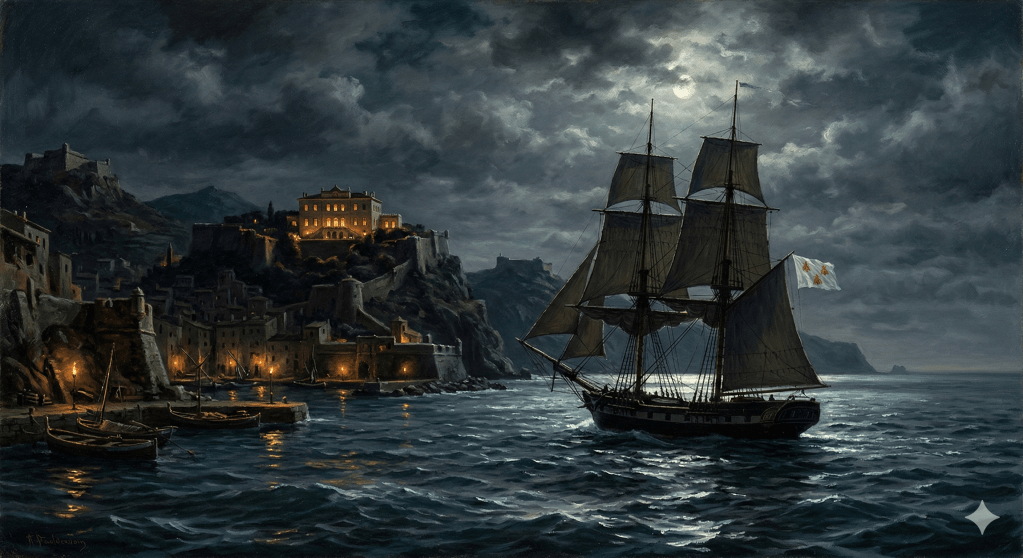
The evening of the 25th of February descended upon the Villa dei Mulini not with the quiet grace of a Mediterranean twilight, but with the frantic, shimmering energy of a grand masquerade. To any observer peering through a glass from a British frigate, the hilltop was a beacon of civility. The “Emperor’s” villa was ablaze with candlelight, the flickering yellow tongues reflecting off the fresh white plaster that Étienne and his men had frantically smoothed only days before.
Inside, the air was a thick soup of expensive perfume, roasting meats, and the sharp, alkaline tang of drying lime. Napoleon had insisted on a ball. It was to be his “housewarming,” a celebration of the completed renovations.
Étienne stood near a fluted Corinthian column – one he had personally helped haul from the docks – wearing his best livery. It felt like a straightjacket. His fingers, cracked and stained with the grey grit of his trade, twitched for the familiar weight of a cartridge box. Underneath his fine silk waistcoat, the scars on his chest seemed to itch with the approaching storm.
“Steady, you old war-horse,” a voice hissed beside him. It was Sergeant Bastien, usually seen in a leather apron hauling timber, now looking absurdly uncomfortable in a valet’s powdered wig. “If you scowl any harder, the English guests will think the soup is poisoned.”
“It’s the smell, Bastien,” Étienne muttered, his eyes tracking the room. “All this lace and lavender. It smells of surrender. We should be in the dark, not dancing under chandeliers.”
“Patience, mason,” Bastien whispered, adjusted a tray of crystal flutes. “The Little Corporal knows what he’s doing. Look at them. They’re eating out of his hand.”
Across the ballroom, Napoleon was a whirlwind of social grace. He moved among the Elban elite and the few British officers remaining on the island with the practiced ease of a country squire. He talked of crop rotations; he debated the merits of Italian opera; he laughed – a loud, boisterous sound that Étienne knew was as manufactured as the faux-marble finish on the skirting boards.
Colonel Sir Neil Campbell was not there – he had already departed for his “change of air” in Livorno – but his subordinates were. Captain Adair, a young British officer with a chin like a box-iron, stood near the buffet, watching the Emperor with a mixture of boredom and faint amusement.
Napoleon drifted toward him, a glass of watered wine in hand. “A fine evening, Captain? I trust the music is to your liking? I had the sheet music brought from Naples specifically to celebrate the completion of the West Wing.”
Adair bowed stiffly. “It is a charming house, General. Remarkable what you’ve done with such… limited resources. My mother is quite the enthusiast for home improvements; she would find your dedication to the masonry truly inspiring.”
“One must build something, Captain,” Napoleon said, his eyes twinkling with a mirth that didn’t reach his ears. “If not an Empire, then a terrace. If not a grand army, then a grand staircase. It is all a matter of scale, is it not?”
Adair chuckled, a sound of polite dismissal. “Quite so. Though I imagine the scale of a staircase is rather easier on the nerves than the scale of a battlefield.”
“Infinitely,” Napoleon agreed. He turned slightly, catching Étienne’s eye. It was a fraction of a second – a sharp, piercing look that sent a jolt of electricity down Étienne’s spine. It was the signal.
“Étienne!” Napoleon called out, his voice ringing across the ballroom. “The crates of ‘decorations’ that arrived this afternoon. Have they been moved to the cellar? I won’t have the ladies tripping over packing straw in the morning.”
“They are being moved as we speak, Sire,” Étienne replied, his voice steady despite the roar in his ears.
“See to it personally. I want the house perfect for tomorrow’s inspection.”
Étienne bowed and backed out of the room, his heart hammering a frantic rhythm against his ribs. The moment he cleared the heavy oak doors of the ballroom, the world changed. The music faded into a ghostly echo, replaced by the rhythmic, muffled thud of boots on grass.
He hurried down the back stairs to the kitchens and out into the cool, salt-heavy night. In the shadows of the stables – the very stables Campbell had mocked – the “gardeners” were at work. But they weren’t planting lemons.
Rows of men from the Old Guard, their faces blackened with soot, were silently hauling heavy wooden crates from the cellar. These were the boxes marked ‘Venetian Glass’ and ‘Florentine Tiles.’ Étienne watched as a soldier pried one open with a crowbar. Inside, nestled in straw, were rows of Charleville muskets, their barrels gleaming like oil in the moonlight.
“Easy with the ‘glass,’ lads,” Étienne growled, stepping into the fray. “We don’t want to wake the neighbours.”
“Is it time, Foreman?” one of the men asked, his eyes bright with a feral hunger.
“It’s time. The ‘DIY project’ moves to the docks. Every crate of ’tiles’ goes onto the Inconstant. If a British patrol asks, we’re moving the Emperor’s personal library to his seaside pavilion for the spring.”
For the next four hours, Étienne moved in a fever dream of logistics. This was the true masonry – the construction of a secret. They moved tons of equipment under the very noses of the dancing officers. While the violins played The Marriage of Figaro in the ballroom, six hundred men were slipping through the shadows of the olive groves toward the harbour.
Each crate Étienne shouldered felt lighter than the stones he had carried all winter. He felt the beautiful, terrible irony of it all. They had used the British obsession with Napoleon’s “domesticity” as a shroud. Every road they had paved was a path for their cannons; every wall they had built was a screen for their movements.
Near midnight, Étienne stood on the pier as the final crate of ammunition was swung onto the deck of the Inconstant. He looked back up the hill. The lights of the Villa dei Mulini were still burning bright. To anyone watching, the party was still in full swing. Napoleon had ordered the servants to keep the music playing and the candles lit until dawn, creating the perfect silhouette of a man content with his renovations.
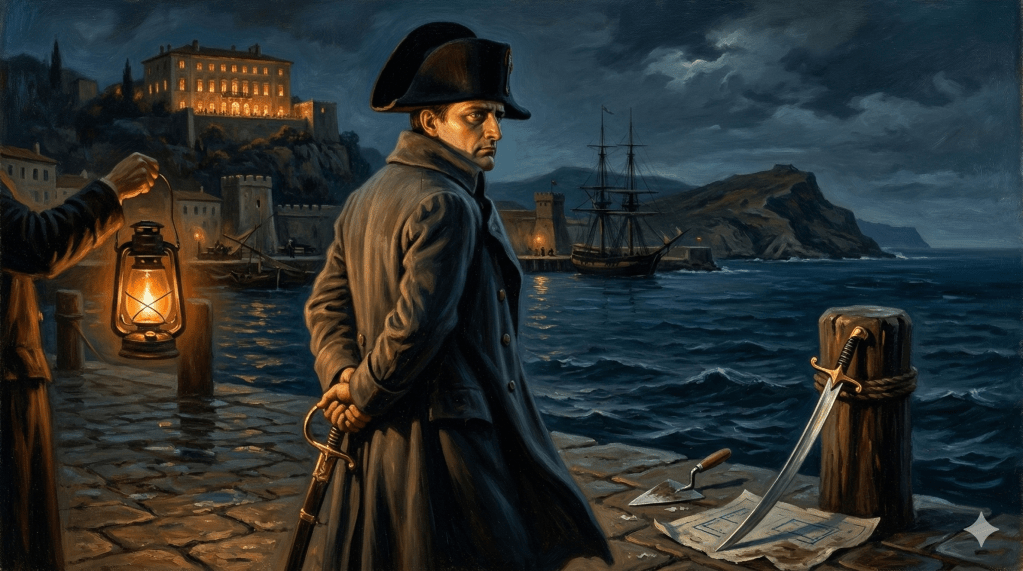
A small boat pulled alongside the pier. A figure wrapped in a dark, salt-stained cloak stepped out. It was the Emperor. He looked at the ship, then back at the glowing villa on the hill.
“The house is finished, Étienne,” Napoleon whispered, the sea spray dampening his face.
“It is a fine piece of work, Sire,” Étienne replied, his hand resting on the cold iron of a ship’s rail.
“The Colonel will be disappointed when he sees the state of the garden in the morning,” Napoleon mused. “We’ve left quite a mess of the flowerbeds.”
“Let him have the lemons, Sire,” Étienne said, a grim smile touching his lips. “We’re going back for the laurels.”
Napoleon stepped onto the deck, and for the first time in ten months, his posture lost the rounded, weary slump of the architect. He stood tall, the wind catching his cloak. “Cast off,” he commanded. “The ‘renovations’ begin in France.”
The Mediterranean night was a shroud of ink and velvet, smelling of brine and the cold, metallic tang of the coming spring. On the deck of the Inconstant, Étienne felt the ship heave beneath his boots – a living, swaying thing, far removed from the unyielding limestone floors of the Villa dei Mulini. The brig’s sails snapped taut, catching a southerly breeze that felt like the very breath of Fate.
Behind them, the lights of Portoferraio were receding into shimmering pinpricks. High on the ridge, the Villa dei Mulini still glowed, a luminous ghost-house. The music from the ballroom would be stopping soon, the candles guttering out in their silver sconces, leaving only the smell of burnt wax and the silence of an empty stage.
“Look at it, Sergeant,” Étienne murmured to Bastien, who was busy coiling a thick hemp hawser. “The most expensive birdcage in the world. And the bird has flown.”
Bastien spat a glob of tobacco juice into the dark water. “Let the English have the cage. I’ve had enough of playing the valet, Étienne. My hands miss the grease of a wheel-hub and the kick of a musket. This ‘DIY’ business… it makes a man’s blood turn to dishwater.”
“It served its purpose,” Étienne said, his eyes scanning the horizon for the low, predatory silhouette of a British patrol frigate. “Every stone we laid was a second bought. Every flower Napoleon planted was a lie told to a Colonel who thought he knew the measure of a man.”
A sharp footfall sounded on the timber deck. Napoleon emerged from the shadows near the helm. He had discarded the ink-stained green coat of the architect. Now, he wore the familiar grey overcoat, buttoned to the chin against the sea spray, and the iconic bicorne hat that had haunted the dreams of every king in Europe. He looked less like a man who had spent the winter arguing over drainage pipes and more like a force of nature recently unshackled.
“The Zephir,” Napoleon said, his voice cutting through the wind. “She is closing.”
Étienne stiffened. To the leeward side, a French royalist brig – the Zephir – was indeed tacking toward them, her lanterns swinging like malevolent eyes. Under the Bourbon flag, she was technically their enemy, tasked with policing the waters around the “Emperor’s” little kingdom.
“Should we beat to quarters, Sire?” Étienne asked, his hand instinctively dropping to the hilt of the sabre he had reclaimed from its hiding place in a crate marked ‘Roofing Shingles’.
“No,” Napoleon replied, a ghost of a smile playing on his lips. “We shall continue the ‘renovation.’ We are still merely travellers, are we not? A gentleman and his servants, returning from a coastal excursion.”
The Zephir pulled within hailing distance, her gun-ports closed but her crew visible along the rail. A voice boomed across the water in French, demanding the Inconstant’s business.
“It is the Captain of the Zephir,” Napoleon whispered. “He is an old acquaintance. Let us see if he remembers the blueprints.”
Captain Taillade of the Inconstant stepped to the rail, his voice amplified by a brass speaking-trumpet. “We are the Inconstant, bound for the mainland! We carry the Emperor’s personal effects!”
“And how is the Emperor?” the voice from the Zephir shouted back, a note of mocking curiosity in the wind.
Napoleon stepped to the rail then, pulling Étienne and a few others into the light of a deck-lantern. He gestured for the men to keep their hats low, to look like weary labourers.
“The Emperor is marvellously well!” Napoleon roared back himself, his voice carrying the unmistakable, commanding timbre of a man who had addressed grand armies on the eve of glory.
There was a long, suffocating silence from the Zephir. Étienne held his breath, his fingers white-knuckled on the rail. He could almost hear the gears of the other captain’s mind turning. Did he recognise the voice? Did he see the shadow of the bicorne?
Finally, the reply came: “Pass, Inconstant! Safe travels to your master!”
The Zephir veered away, disappearing into the gloom. A collective exhale swept through the men on deck, a sound like a retreating tide.
“He knew,” Étienne whispered, looking at Napoleon. “He knew exactly who was speaking.”
“Of course he knew,” Napoleon said, turning away from the rail. “Men do not forget the sound of the sun rising. He saw the ‘DIY project’ for what it was, Étienne. A temporary shelter before the march.”
As the night wore on toward the dawn of the 27th, the lights of Elba finally vanished beneath the curve of the earth. The “ambitious project” was now entirely metaphorical. The villa was gone; the gardens were a memory; the marble stairs were for other men to climb. All that remained was the mission.
Étienne found himself standing by the prow as the first grey light of morning touched the waves. He took a small, jagged piece of white Elban limestone from his pocket – a fragment he had kept from the terrace of the Villa dei Mulini. He looked at it for a moment, remembering the dust, the lime-burns on his hands, and the patronising smile of Colonel Campbell.
With a flick of his wrist, he tossed the stone into the sea.
“The foundation is laid,” he murmured to himself.
Napoleon approached him, looking out toward the distant, invisible coastline of France. “Tell me, Étienne,” the Emperor said, his voice quiet, almost intimate. “Now that the work is done… was it worth the toil? The masonry? The masquerade?”
Étienne stood at attention, the sea wind whipping at his hair. “Sire, I have built many things in my life. I have built fortifications at Toulon and bridges over the Rhine. But I think I shall remember the Villa dei Mulini best of all.”
“And why is that?”
“Because, Sire,” Étienne replied, a fierce, loyal light in his eyes, “it was the only house I ever built that was designed to be burnt down the moment we left it. It wasn’t a home. It was an escape.”
Napoleon nodded slowly, his gaze fixed on the North. “Exactly. It was a masterpiece of architecture, Étienne. For the greatest thing a man can build is not a palace that stands for a thousand years, but a moment that changes the next hundred.”
The sun broke over the horizon then, turning the Mediterranean into a field of beaten gold. The Inconstant surged forward, her bow cutting the water like a mason’s chisel through soft clay. The DIY project was over; the Emperor was no longer an architect of stone, but an architect of empires once again. And Étienne, the mason of Elba, finally let go of his trowel to grip the cold, familiar steel of his rifle.
France was waiting.
On 26th February 1815, Napoleon Bonaparte escaped exile on Elba with approximately 1,150 followers and a small fleet of seven ships. After ten months spent ostensibly modernising the island’s infrastructure, he landed at Golfe-Juan on 1st March, beginning the Hundred Days campaign. This swift return to power forced the European powers at the Congress of Vienna to mobilise over 700,000 soldiers to oppose him. His defeat at the Battle of Waterloo on 18th June 1815 led to a second, permanent exile on St Helena and the final collapse of the First French Empire. This upheaval accelerated the development of the “Concert of Europe,” a precursor to modern international diplomacy and collective security frameworks.
Bob Lynn | © 2026 Vox Meditantis. All rights reserved.

 Vox Meditantis
Leave a comment