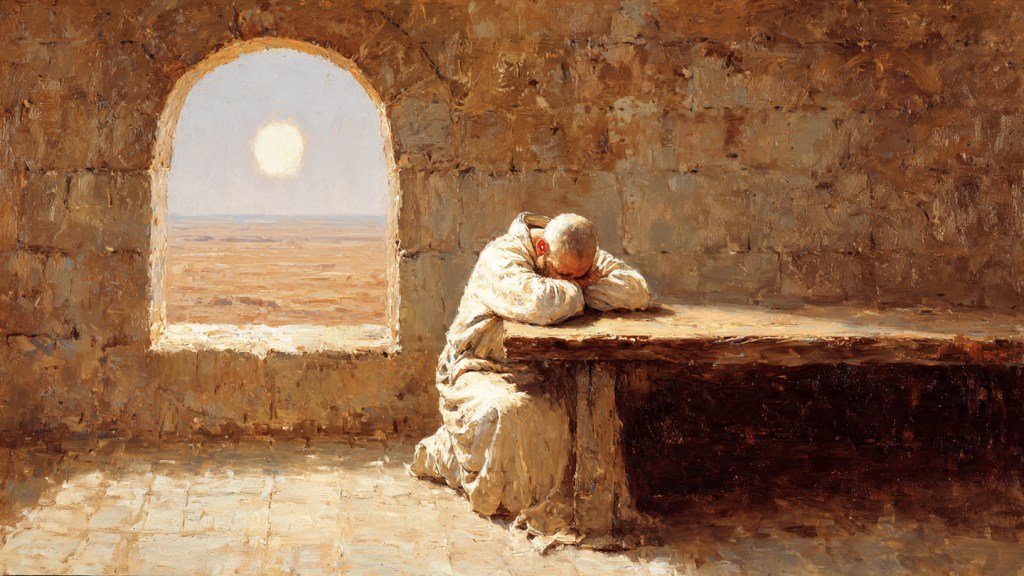
In 2014 a team of psychologists at the University of Virginia locked volunteers, one at a time, in a small, featureless room and told them to do nothing but think. No phone, no book, no music – just six to fifteen minutes alone with whatever floated through their minds. Before the session began, each participant was given a mild electric shock and asked whether they would pay money never to feel it again. Most said yes. Then the door closed. Within minutes, 67 per cent of the men and 25 per cent of the women reached for the button and shocked themselves anyway. One especially desperate man pressed it 190 times.[1][2]
“Simply being alone with their own thoughts for fifteen minutes was apparently so aversive that it drove many participants to self-administer an electric shock that they had earlier said they would pay to avoid,” the lead researcher, Timothy Wilson, wrote in the journal Science. Something about enforced stillness was so intolerable that physical pain looked like a reasonable trade.[1]
That study cracked open one of the oldest, most neglected puzzles of the human mind: what is boredom, exactly – and why does it hurt so much? Most of us treat it as trivial, a minor inconvenience to be scrolled away. But the scientists, philosophers and theologians who have spent years investigating the condition tell a very different story. Boredom, they argue, is a profound internal alarm, an emotion as purposeful as pain itself – one that, when ignored or drowned out, can corrode everything from individual mental health to the cohesion of entire societies. And paradoxically, the modern world’s relentless campaign to eliminate boredom may be the very thing making the epidemic worse. To understand why, we need to follow the detective trail from a clinical psychology lab in Canada, through the scorched monasteries of fourth-century Egypt, and into the glowing rectangle in your pocket.[3][4][5]
I: The Unengaged Mind
John Eastwood did not set out to become the world authority on doing nothing. In 2001, the clinical and cognitive psychologist at York University in Toronto was treating young men who arrived at his office with a complaint that no textbook quite covered. They were not depressed, not anxious in any conventional sense. They were, in their own words, “just… bored.” Some were still living in their parents’ basements, playing video games for twelve hours a day, unable to launch themselves into adult life. Their chief symptom was a grinding, unshakeable emptiness that nothing – not the games, not the internet, not the fridge – could fill for long.[5]
“When I started talking to people about my interest in studying boredom, in around the year 2000, I got all kinds of interesting reactions,” Eastwood recalled. “Some people thought it was weird, crazy or unworthy of study. Others said, ‘I’m never bored – people who get bored are weak characters.’ And then some said, ‘That’s really cool, I struggle with boredom and it would be great to understand it’”. The scorn was itself a clue. Boredom, unlike depression or anxiety, carried a stigma of personal failure – a sense that the sufferer simply was not interesting enough to entertain themselves. Eastwood wanted to know whether that judgement was fair.[5]
He began by trying to do what no one had properly done: define the thing. He and his colleagues combed the scientific literature, interviewed hundreds of people about how boredom actually felt, and arrived at a deceptively simple sentence. Boredom, they wrote, is “the aversive experience of wanting, but being unable, to engage in satisfying activity”. Read that again. It is not laziness. It is not relaxation. It is a frustrated desire – a motivational engine that is running, desperately, but whose wheels have no grip on any surface.[6][5]
What made the definition powerful was its emphasis on attention. A bored person, Eastwood argued, is someone who cannot connect their mental resources with anything in the environment – or even anything inside their own head – that feels worthwhile. They are focused on the fact that they cannot focus, and they blame the world for it. “Like the trap of quicksand,” Eastwood and his team wrote, “such thrashing only serves to strengthen the grip of boredom by further alienating us from our desire and passion, which provide compass points for satisfying engagement with life”.[5]
In the lab, the picture grew richer. Boredom, it turned out, was not one single state but a restless oscillation. At times it bred lethargy – eyelids drooping, body slumped. At other times it flipped into agitated restlessness – pacing, foot-tapping, a manic need to do something. Often it swung between the two in the same episode, like a needle unable to settle on a compass heading. Eastwood also discovered that people with alexithymia – a clinical inability to identify their own emotions – were especially boredom-prone. “Feelings are like compass points that help orient us,” he explained. “If we lack emotional awareness, we lack the capacity to select appropriate targets for engagement with the world”. Without knowing what you want, you cannot know where to point your attention.[6][5]
Around the same time, a young researcher named Erin Westgate, working at Wilson’s lab at the University of Virginia, was building a complementary framework. Where Eastwood stressed attention, Westgate added a second ingredient: meaning. In her Meaning and Attentional Components model – the MAC model – boredom was the result of two distinct failures, either of which was sufficient on its own. The first was an attentional mismatch: the task was too easy or too hard for the brain’s available resources. The second was a meaning mismatch: the task was disconnected from anything the person actually valued. A student zoning out in a tedious lecture might be suffering from attentional boredom – underload. A corporate lawyer reviewing contracts she finds morally hollow might be suffering from meaningless boredom – the work is engaging enough, but it does not matter to her. And when both attention and meaning fail together, the result is a particularly toxic mixed boredom that is difficult to escape.[7][8]
The MAC model generated a striking prediction: different types of boredom should produce different downstream behaviours. Attentional boredom, Westgate found, pushed people towards interesting activities – puzzles, novelty, anything that rebalanced their cognitive load. Meaningless boredom pushed them towards enjoyable activities – comfort food, social media, anything that delivered a quick hit of pleasure even if it lacked depth. The distinction mattered enormously, because it implied that the typical modern response to boredom – grabbing the phone – was not a cure but a category error: treating a crisis of meaning with a dose of stimulation.[9][8]
Eastwood arrived at the same conclusion from his clinical work. “If you see yourself as a vessel to be filled,” he said, “that makes you more vulnerable to subsequent experiences of boredom. You’ve turned yourself into a passive entity that’s trying to be stimulated rather than understanding you’re the subject who goes out into the world and creates meaning”. What he was describing was nothing less than a crisis of human agency – a state in which the self’s capacity to act, to choose, to want purposefully, had broken down. And here the trail took a sharp and unexpected turn.[10]
II: An Ancient Name for a Modern Disease
If boredom were merely a defect of modern attention spans, we might reasonably expect it to have no history before the smartphone. But Eastwood himself noted that boredom “has tentacles that lead into philosophy, sociology, theology and neurobiology”. Pull on the theological tentacle and you tumble backwards seventeen centuries, into a sun-blasted Egyptian desert where a monk named Evagrius of Pontus was fighting what sounds, across the millennia, like exactly the same enemy.[10]
Evagrius, born around 345 AD in what is now Turkey, was one of the Desert Fathers – Christian ascetics who withdrew into the Egyptian wilderness to pursue holiness through prayer, manual labour and silence. He compiled one of the earliest lists of eight deadly temptations, which would eventually evolve into the seven deadly sins of Western tradition. The sixth on his list was acedia – a Greek word derived from akēdeia, meaning “without care”. And his description of it, written in the fourth century, reads like a clinical case study from Eastwood’s lab.[11][3]
“The demon of acedia, also called the noonday demon, is the most oppressive of all the demons,” Evagrius wrote in his Praktikos. “He attacks the monk about the fourth hour and besieges his soul until the eighth hour” – roughly from ten in the morning until two in the afternoon, the long, sweltering midday of the desert.[12][3]
What happens next is astonishingly precise:
“First of all, he makes it appear that the sun moves slowly or not at all, and that the day seems to be fifty hours long. Then he compels the monk to look constantly towards the windows, to jump out of the cell, to watch the sun to see how far it is from the ninth hour, to look this way and that… He instils in him a dislike for the place and for his state of life itself, for manual labour, and also the idea that love has disappeared from among the brothers and there is no one to console him… He leads him on to a desire for other places where he can easily find the wherewithal to meet his needs and pursue a trade that is easier and more productive.”[3]
The distorted perception of time. The compulsive glancing – at the window in the fourth century, at the clock on the screen in the twenty-first. The hatred of one’s current task. The fantasy that somewhere else, doing something else, life would finally feel bearable. The simultaneous desire to do and inability to want anything that is available. Evagrius could have been writing a clinical intake note.
But Evagrius saw something deeper. Acedia was not merely uncomfortable. It was, uniquely among the eight temptations, a compound vice – rooted simultaneously in anger and desire. “The listless one hates whatever is in front of him and desires what is not,” he wrote. “And the more desire drags the monk down, the more hate chases him out of his cell. He looks like an irrational beast, dragged by desire, and beat from behind by hate”. Where the other demons attacked one part of the soul, acedia “enveloped the entire soul and strangled the mind.” It even contained within itself “almost all the other thoughts” – a meta-temptation, a kind of universal solvent of the spiritual life.[3]
Saint Thomas Aquinas, writing nine centuries later, described it as “a sort of heavy sadness… that presses down on a man’s mind in such a way that no activity pleases him”. The theologian Gabriel Bunge, analysing Evagrius’ corpus, traced acedia’s roots to philautia – self-love – “that all-hating passion, which manifests itself in a thousand ways as a state of being stuck in oneself that renders one incapable of love”. The scholar Kevin Corrigan called it “a sort of material-less, object-less smog of inert boredom”.[11][12][3]
The parallels to the modern psychological picture are not coincidental. Both traditions describe a fracture in the self’s relationship with its own purposes. Eastwood’s “crisis of agency” and Evagrius’ “crisis of love” are describing the same rupture from different angles – one secular, one sacred. Eastwood himself acknowledged this convergence: “Boredom is complex and under researched, and has tentacles that lead into philosophy, sociology, theology and neurobiology. It’s endlessly fascinating”.[10]
For the Desert Fathers, the remedy was not distraction but its opposite: perseverance. Stay in the cell. Do not flee. “If the spirit of acedia comes over you, do not leave your dwelling,” Evagrius counselled, “for in the same way that one might polish silver, so will your heart be made to shine”. The monk who endured the noonday demon without running away would find, on the other side, “a state of peace and ineffable joy”.[3]
That prescription – sit with the pain, do not reach for the nearest escape – is remarkably close to what Eastwood would tell his patients sixteen centuries later.
III: The Philosophers’ Warning
The theological thread was not the only ancient strand. Philosophers had been circling the same quarry for centuries, and their warnings about diversion now read like prophecy.
In seventeenth-century France, the mathematician and Catholic thinker Blaise Pascal wrote one of the most celebrated observations in the Pensées: “All of man’s troubles come from his inability to sit quietly in a room by himself”. Pascal argued that human beings are addicted to diversion – any activity, however trivial, that prevents them from confronting the reality of their own condition. “The only thing that consoles us for our miseries is diversion. And yet it is the greatest of our miseries,” he wrote. “For it is that above all which prevents us thinking about ourselves and leads us imperceptibly to destruction. But for that we should be bored, and boredom would drive us to seek some more solid means of escape, but diversion passes our time and brings us imperceptibly to our death”.[13][14][15]
The logic is devastating. Boredom, for Pascal, was not the enemy. It was the alarm. Diversion was the enemy, because it silenced the alarm before the sufferer could act on the signal. Left alone in a room, a king would “necessarily fall into a foreboding of maladies which threaten him, of revolutions which may arise, and lastly, of death and inevitable diseases”. The entire apparatus of court life – hunting, gambling, war – existed to prevent that confrontation. Pascal, in effect, predicted the smartphone three and a half centuries early.[16]
Two hundred years later, Søren Kierkegaard devoted a chapter of Either/Or to the problem. His aesthete character declared that “boredom depends on the nothingness which pervades reality; it causes a dizziness like that produced by looking down into a yawning chasm, and this dizziness is absolute”. Kierkegaard’s proposed solution – the “rotation method” – came in two forms. The vulgar, extensive method was to constantly change one’s surroundings and activities: a new city, a new lover, a new hobby. This, Kierkegaard warned, was doomed to fail, because it mistook the scenery for the problem. The artistic, intensive method was to change one’s mode of perceiving – to look at the same world with different eyes, the way a prisoner might find infinite fascination in a spider. Limitation, not novelty, was the key to resourcefulness. It was, once again, an argument against reaching for the nearest distraction.[17][18]
Arthur Schopenhauer, writing around the same period, took the bleakest view of all: boredom, he argued, was a reminder of “the worthlessness and vanity” of existence itself. When we are not striving for something, we are forced to confront the emptiness at the heart of our desires. Even the word “boring” was a child of this era. The verb “to bore” – meaning to weary or make dull – first appeared in English in 1768; the noun “boredom” did not enter the language until 1852, in Charles Dickens’ Bleak House. Lord Byron, in Don Juan (1823), captured the new social reality in a couplet: “Society is now one polished horde, / Formed of two mighty tribes, the Bores and Bored”.[19][20][5]
The word was new. The condition, as the monks and philosophers knew, was ancient. But something had changed. Boredom was becoming democratised.
IV: The Democratisation of Boredom
Here the pace quickens. The texture shifts. We leave the slow narrative of one researcher’s journey and plunge into the faster, more urgent question: what has the modern world done with boredom, and what has boredom done to us?
Norwegian philosopher Lars Svendsen, in A Philosophy of Boredom, argued that the phenomenon as we now know it is inseparable from modernity itself. Before the Romantic era, human beings understood themselves primarily through collective identities – clan, guild, parish. With the rise of individualism at the end of the eighteenth century, the burden of creating personal meaning shifted onto the solitary self. And with the Industrial Revolution, for the first time in human history, large populations had both the leisure time and the self-awareness to notice the void. Boredom, Svendsen wrote, was “democratised” – no longer the exclusive affliction of monks, aristocrats and philosophers, but the baseline hum of ordinary life.[21][22]
The French sociologist Émile Durkheim, writing at the turn of the twentieth century, gave this condition a structural name: anomie. When societies undergo rapid change – industrialisation, urbanisation, the collapse of traditional moral frameworks – individuals lose the shared norms that once regulated their desires. Without those limits, wants become infinite and satisfaction becomes impossible. Durkheim was not writing about boredom specifically, but the overlap is unmistakable: a state of purposeless agitation, unmoored desire, and the restless search for something – anything – to fill the gap.[23][24]
Now fast-forward to the present. Global daily screen time across all devices rose from nine hours in 2012 to eleven hours in 2019. Young people receive a median of 237 push notifications on their phones every day. A study analysing first-person video recordings found that 89 per cent of smartphone interactions are initiated by the user, not the device – people check their phones roughly once every five minutes, not because the phone demanded it, but because they could not bear not to. Americans, on average, touch their phones 2,617 times a day.[25][26]
And yet, far from banishing boredom, this tsunami of stimulation appears to be making it worse. A 2024 paper in Nature Human Behaviour marshalled evidence from multiple pathways. Digital media fragments attention: the mere presence of a smartphone on a desk is sufficient to diminish cognitive performance and increase errors. Habitual media multitasking – scrolling Twitter while half-watching Netflix – increases attentional failures and reduces enjoyment of both activities. Switching between short videos, fast-forwarding and skipping content further erodes attention and intensifies boredom. The paradox is precise: the tools designed to kill boredom are training the brain to be more distractible, and therefore more bored.[4][25]
Eastwood had anticipated this. “I think boredom is such an aversive state that we want to banish it as quickly as possible,” he said. “We turn to quick and easy ways to banish it – we play a video game or turn the music up or go to a movie. All these things are effective in the short term. But when that movie ends or the music stops, there’s an even greater chasm of boredom. It’s like a drug, an addiction; we need more and more intense stimulation to stave off boredom”.[5]
Svendsen coined a term for this escalating treadmill: hyper boredom – “an intensified form of boredom characterised by an inability to find meaningful engagement even amidst endless distractions”. It is Evagrius’ noonday demon, reskinned for the attention economy. The monk who could not stop glancing at the window is the commuter who cannot stop glancing at the lock screen. The desert cell and the open-plan office impose different aesthetics of confinement, but the internal experience – that agonising, oscillating inability to want what is available – is structurally the same.[22]
The consequences ripple outward. Chronic boredom correlates with depression, substance abuse, pathological gambling, overeating, aggression, and risky driving. The Whitehall II study, which tracked British civil servants for over two decades, found that those who reported high levels of boredom were significantly more likely to die young. Wijnand van Tilburg’s experiments at the University of Southampton showed that bored people cling harder to group identity and become harsher towards outsiders – a finding with unsettling implications for political polarisation in an era of mass boredom. Boredom, it turns out, is not a private inconvenience. It is a social force.[5]
And yet the signal, if we could hear it, is benign. “Think of the concept of pain,” Eastwood said. “Pain is a signal that keeps us healthy. If someone has ill-fitting shoes, that might motivate them to get new shoes. Similarly, boredom has the potential – if we listen to that signal and respond appropriately – to keep us healthy. Pain keeps us physically safe. Boredom keeps us moving towards a meaningful life”.[10]
V: Voices
“Boredom can be a cue that, if we listen to it and respond appropriately, can help us experience a more meaningful life. Think of it as a signal and ally towards a more fulfilling life, rather than a problem to obliterate.” – John Eastwood, psychologist, York University[10]
“Boredom informs us whether our current activity is something we are able to and want to be doing. Much like pain, boredom provides unpleasant but important feedback about our lives.” – Erin Westgate, psychologist, University of Florida[7]
“He makes it appear that the sun moves slowly or not at all, and that the day seems to be fifty hours long.” – Evagrius of Pontus, fourth-century Desert Father[3]
“The only thing that consoles us for our miseries is diversion. And yet it is the greatest of our miseries.” – Blaise Pascal, seventeenth-century mathematician and theologian[13]
“Boredom depends on the nothingness which pervades reality; it causes a dizziness like that produced by looking down into a yawning chasm.” – Søren Kierkegaard, philosopher[18]
“Digital media makes it harder for people to maintain focus on daily activities and reduces their intention to stay focused, thus increasing boredom.” – Tam et al., Nature Human Behaviour, 2024[25]
“When we are quiet and by ourselves it gives us a chance to get in touch with our feelings and needs, and this experience can arm us with the information we need to go out and connect with the world.” – John Eastwood[5]
“If the spirit of acedia comes over you, do not leave your dwelling, for in the same way that one might polish silver, so will your heart be made to shine.” – Evagrius of Pontus[3]
Bob Lynn | © 2026 Vox Meditantis. All rights reserved.
References
- People Choose Electric Shocks Over Sitting Quietly for 15 … – In psychology experiment one man shocked himself 190 times rather than sit doing nothing.
- [PDF] Just think: The challenges of the disengaged mind | Semantic Scholar – It is found that participants typically did not enjoy spending 6 to 15 minutes in a room by themselv…
- Overcoming Listlessness: Learning from Evagrius of Pontus – The demon of acedia, also called the noonday demon, is the most oppressive of all the demons. … Ev…
- People are increasingly bored in our digital age – In recent years, there has been an increase in both reports of boredom and greater use of digital me…
- The exciting side of boredom | BPS – The trap of quicksand. Professor John Eastwood and his colleagues at York University in Canada have …
- Q&A with John Eastwood on boredom | Psychwire – How can boredom be a positive force in our lives? Unlock the benefits of boredom with John Eastwood.
- Why Boredom is Interesting – libra etd – According to the Meaning and Attentional Components (MAC) model investigated here, boredom signals a…
- Why Boredom Is Interesting – Erin C. Westgate, 2020 – Is boredom bad? It is certainly common: Most everybody gets bored. There is a sense that boredom som…
- Running Head: BOREDOM IS INTERESTING
- The good and bad of boredom – The York University researcher delves into his endless fascination with boredom
- Acedia: Beating Back the ”Noonday Devil” – Word on Fire – Ancient monks understood the demonic threat behind the spiritual torpor of “acedia,” and many of the…
- Acedia: The Noonday Demon | Eclectic Orthodoxy – Acedia, says Evagrius, is the “noon-day demon” that attacks the believer when the sun is at its high…
- Quote by Blaise Pascal: “The only thing that consoles us for … – But for that we should be bored, and boredom would drive us to seek some more solid means of escape,…
- Pascal on Misery and Diversion | – But diversion amuses us and guides us imperceptibly to death’. – Blaise Pascal, Pensées (Indianapoli…
- Our Addiction to Agitation – “If man, however filled with sadness he may be, can be prevailed upon to indulge in some diversion, …
- Blaise Pascal : On Diversions – Anthologia – “When I have set myself now and then to consider the various distractions of men, the toils and dang…
- Rotation method – In philosopher Søren Kierkegaard’s Either/Or, the rotation method is a mechanism higher-level aesthe…
- Kierkegaard, “The Rotation Method” Part 4 (Either/Or) – The remainder of the essay is how to engage in the “rotation method”: how to live in this world with…
- Bored – Etymology, Origin & Meaning – “wearied, suffering from ennui,” 1823, past-participle adjective from bore (v.2). … See origin and m…
- The History of Boredom – You’ve never been so interested in being bored
- A Philosophy of Boredom by Lars Svendsen – Using more literary than philosophical sources, though there is a section on Heidegger’s idea that b…
- A Philosophy Of Boredom Lars Fr H Svendsen
- Anomie Theory in Sociology – by C Nickerson · Cited by 19 – Durkheim believed anomie arises when societies go through rapid socia…
- Boredom as Anomie – Sociologist Emile Durkheim wrote: “The state of anomie is impossible whenever interdependent organs …
- People are increasingly bored in our digital age – PMC – by KYY Tam · 2024 · Cited by 20 – Smartphone use increases inattention, simultaneously intensifying …
- Attention Spans, Focus Affected By Smartphone Use – The prime culprit in hijacking attention spans is the smartphone. Americans, on average, touch their…


 Vox Meditantis
Leave a reply to KikiFikar Cancel reply