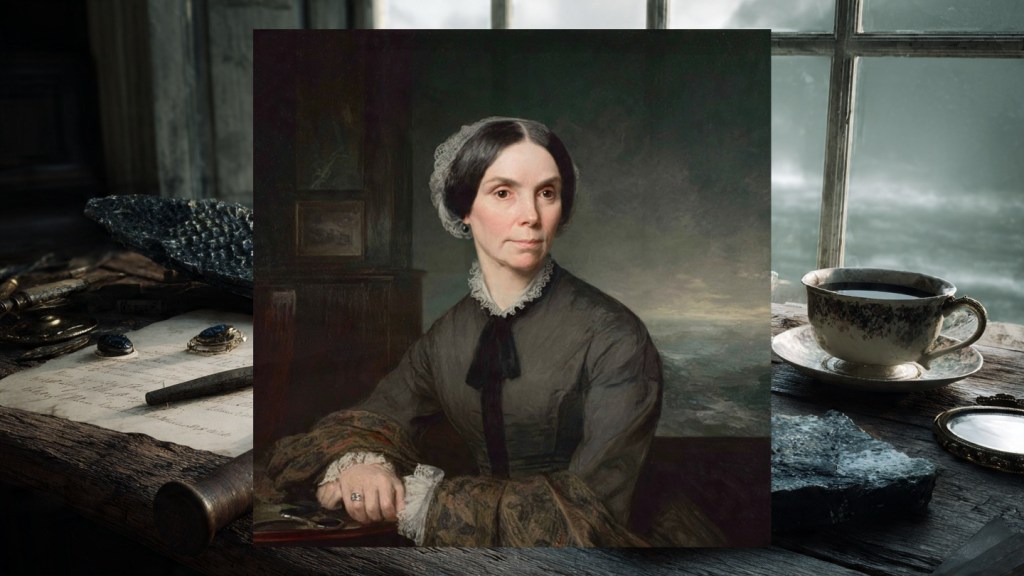
The following interview is a dramatised reconstruction, grounded in historical correspondence and museum records to authentically represent Elizabeth Philpot’s life and work. While all dates, discoveries, and scientific details are factual, the dialogue is an interpretive narrative designed to give voice to her documented legacy.
Elizabeth Philpot (1779–1857) was a British fossil collector, ichthyologist, and scientific illustrator whose meticulous work along the Jurassic Coast helped build the foundations of modern palaeontology. Her collection of over 400 specimens – including more than 40 type specimens – is now housed at the Oxford University Museum of Natural History, and her correspondence with leading geologists such as William Buckland and Louis Agassiz shaped the classification of fossil fish during a pivotal era of discovery. Yet for nearly two centuries, her name has been eclipsed by that of her younger collaborator, Mary Anning, and by the male scientists who published the findings she helped make possible. Today, we invite her to set the record straight.
Miss Philpot, welcome. It is an extraordinary privilege to speak with you. You lived and worked through what many geologists now call the heroic age of British palaeontology – the first decades of the nineteenth century, when the cliffs of Lyme Regis yielded ichthyosaurs, plesiosaurs, and pterosaurs for the very first time. And yet, I suspect most of our readers will know you, if at all, as “Mary Anning’s friend.” I’d like to change that today.
I should be obliged if you would. Mary was remarkable – I have never doubted it, and I never shall. But friendship is not a profession, and I did not spend fifty years on those cliffs merely to be agreeable company.
Then let us begin at the beginning. You were born in London in 1779. What brought you to Lyme Regis?
My brother John. He was a solicitor, and a good one, and he determined that my sisters Mary and Margaret and I should have a house on Silver Street in Lyme. We arrived in 1805. I was twenty-five. London was expensive and we were unmarried – I shall spare you the calculations of what that meant for a woman’s prospects. John was practical. Lyme was not London, but it was affordable, and it was by the sea.
And the fossils? Were they part of the appeal?
Not at first. The appeal was simply the coastline – the air, the walking, the light on the water. But then one begins to look down. And once you look down on a Lyme beach, you cannot stop. The ledges of the Blue Lias are layered like the pages of a book – alternating limestone and shale, laid down in the early Jurassic, roughly 195 to 200 million years ago. The sea and the rain do the work of turning those pages for you. Every winter storm, every cliff fall, every high tide exposes something new. It is a library that writes itself, if you have the patience to read it.
And you had the patience.
I had the patience, the eyesight, and – if I may say so – the organisational temperament. My sisters collected too. Margaret had an excellent hand for gastropods. Mary – my sister Mary, not Anning – was thorough. But I was the one who catalogued. I was the one who labelled. I was the one who wrote the letters.
Let us talk about that labelling, because I think it is more important than most people realise. Your collection eventually comprised around 400 specimens, including more than 40 type specimens – a remarkable total for any collector. How did you organise them?
By species, by stratum, and by locality. Every specimen received a label in my own hand, stating what it was, where precisely it had been found, and in which bed of the Lias it had occurred. I also included, where I could, a brief description of what the living creature might have looked like – for the benefit of visitors who were not trained in anatomy.
That is essentially what a modern museum database does.
I do not know what a “database” is, but I know what confusion looks like. Gentlemen would arrive in Lyme, purchase a basket of ammonites from a dealer on the Cobb, carry them back to London or Oxford, and then have not the faintest notion which cliff they came from or which bed they had fallen out of. A fossil without provenance is a paperweight. I was determined that my collection should not be a heap of paperweights.
And that rigour attracted serious scientists to your door.
It did. William Buckland came regularly from Oxford – he had been visiting Lyme since his student days, from about 1801 onwards. William Conybeare, Henry De la Beche, James Sowerby, Richard Owen, and eventually Louis Agassiz – all of them examined our collection. But they came not merely because we had fine specimens. They came because they could trust our labels.
When did you first meet Mary Anning?
She was a child. Ten or eleven, perhaps – I do not recall the exact year. Her father Richard had been selling fossils from the beach to visitors, and after his death in 1810 the family was in terrible poverty. Mary and her brother Joseph continued the trade. I saw her on the beach one day, picking through a fresh fall of mudstone with a small hammer and a sharp eye, and I thought: this girl knows what she is looking at.
There was a twenty-year age difference between you, and a considerable difference in social standing. Did that create tension?
Of course it did. I will not pretend otherwise. I was a solicitor’s sister; she was a carpenter’s daughter. I had been educated; she had attended the Congregational chapel school and could read and write, but she had not had the benefit of books. But the cliffs do not care about your station. When you are scrambling across wet Lias in a skirt, watching the tide and listening for rockfall, what matters is whether the person beside you can be relied upon. Mary could always be relied upon.
You encouraged her to read scientific literature.
I did. I lent her Sowerby’s volumes on molluscs. We would return from the beach to my house, or hers, and sit together turning the pages, comparing our finds against the plates. She had an extraordinary eye – she could spot a vertebra in a cliff face at fifty yards – but she did not always understand the anatomical significance of what she had found. I tried to provide that context. Not because I thought myself superior, but because the knowledge existed and she deserved access to it.
That sounds remarkably like mentorship.
It was not a word I would have used. I simply thought it absurd that a girl who could identify an ichthyodorulite by sight should not know why it mattered.
Let us turn to your particular expertise – fossil fish. You became so accomplished in this area that Louis Agassiz himself, the world’s foremost authority on the subject, relied on your knowledge when he visited Lyme in 1834. Can you walk our readers through what that work actually involved?
Gladly. The Blue Lias and the overlying Charmouth Mudstone are rich in the remains of bony fishes – Actinopterygii, as the formal name has it. The specimens most commonly encountered are flattened impressions preserved in the fine-grained limestone or shale. One finds scales, skulls, jaws, fin spines – and occasionally a complete articulated skeleton, which is a rare joy.
How did you identify and classify them?
By anatomy. The shape and arrangement of the scales, the structure of the skull bones, the number and position of the fins, the form of the teeth. Fossil fish are deceptive – they compress during burial, so that a three-dimensional creature becomes a two-dimensional shadow. One must learn to read that shadow. A scale that appears round in life may appear oval in compression, depending on the angle of burial. The trick is to examine many specimens of what one believes to be the same species, noting the range of variation, before committing to an identification.
And the ichthyodorulites – the dorsal fin spines of sharks – were particularly difficult?
Wickedly so. They are isolated elements, separated from the cartilaginous skeleton that has long since decayed. Matching a spine to a species is like matching a single finger bone to a complete hand – possible, but only with extensive comparative material. When Agassiz arrived in Lyme in 1834, Mary and I were able to show him fossils of thirty-four different fish species. He wrote in his journal that we had demonstrated “with utter certainty which are the ichthyodorulites – dorsal fins of sharks – that correspond to different types”. I confess I was pleased by that.
He named a species after you – Eugnathus philpotae, now reclassified as Furo philpotae.
He did. It is a handsome little fish. I was honoured – though I note that he named two species after Mary and only one after me, so perhaps my honour was precisely measured.
Was there rivalry between you and Anning on the fish work?
No. Mary’s passion was the great marine reptiles – the ichthyosaurs, the plesiosaurs. She understood fish perfectly well, but her heart was in the larger creatures. Fish were mine. We divided the labour quite naturally, and I think we were both the better for it.
Now we come to what I consider one of the most extraordinary episodes in the history of science – the fossil ink. In 1826, Mary Anning found what appeared to be a dried ink chamber inside a belemnite fossil. She brought it to you. What happened next?
She brought it to me in a state of high excitement. The belemnite guard – the solid calcite bullet, which is the part everyone finds on the beach – was unremarkable. But attached to it was a soft, dark, powdery mass, roughly the size and shape of a small gall-bladder. Mary was quite certain it was an ink sac. I was sceptical.
Why?
Because the animal had been dead for approximately 200 million years. I could accept the preservation of bone, of shell, of tooth – these are mineral structures. But ink is organic. It is soft tissue. The idea that soft tissue could survive diagenesis – the compression, heating, and chemical alteration of burial over geological time – seemed fanciful.
And yet.
And yet. I took a small quantity of the powder, placed it in a dish, and added water. The powder resisted at first – it did not dissolve easily. But with patience and gentle grinding, it began to yield a dark brown suspension. I took a brush to it. It behaved exactly as sepia ink behaves. It flowed. It held a line. It dried to a warm brown-black.
For our more scientifically inclined readers – what was actually preserved in that ink sac?
I did not know then. I know now – or rather, your century knows – that the pigment is eumelanin, a complex biopolymer that is extraordinarily resistant to chemical degradation. Modern analysis has confirmed that fossil cephalopod ink from the Jurassic is chemically almost identical to the ink of the living cuttlefish, Sepia officinalis. The eumelanin structure – its cross-linked polymer chains, its reactive double bonds – survived because it was already, in life, one of the most stable organic molecules in nature. Diagenesis barely altered it.
And you used this 200-million-year-old ink to illustrate your fossils.
I did. In a letter to Mary Buckland – Dr Buckland’s wife – dated 9th December 1833, I enclosed a sketch of an ichthyosaur skull painted entirely in fossil sepia. I was rather proud of the conceit: an extinct creature, drawn in the ink of another extinct creature from the same ancient sea. There is a poetry in that which I do not think requires explanation.
Other local artists soon adopted the practice.
They did. Once word spread that the reconstituted ink was usable, it became rather fashionable in Lyme. I believe the novelty appealed as much as the quality – though I should say the quality was genuinely good. The ink had a warmth of tone that commercial sepia could not quite match.
Did you ever run out of fossil ink?
Not once Mary began finding more belemnites with preserved sacs. They are rare – finding one is, as someone in your century put it, “a billion to one chance” – but the Lias at Lyme is exceptionally rich. We accumulated enough to keep several artists supplied.
Your correspondence with William Buckland is fascinating – and it reveals you as far more than a passive collector. In your letters you chased him for the return of borrowed specimens, corrected his identifications, and reported Mary Anning’s near-death experiences with an almost journalistic precision.
Dr Buckland was a brilliant man and a dreadful borrower. I once had to write to Mrs Buckland to remind him that he had taken a section of plesiosaur vertebrae from me – “one with the process, ten others, and a chain set in a box”. That was years earlier. He had simply forgotten. I liked him enormously, but I trusted him with my specimens about as far as I could throw a belemnite guard.
And the letter about Mary Anning nearly being crushed by a cart?
That was 8th December 1833. She had gone to the beach before sunrise – as she always did, the woman had no sense of reasonable hours – and was crossing the bridge when a cart wheel threw her against the wall. Fortunately she was extricated in time and was not prevented from her daily work. I reported it to Mrs Buckland with a mixture of horror and resignation. Mary had a talent for surviving things that ought to have killed her. She had been struck by lightning as an infant and lived. I sometimes thought the Almighty had made her indestructible for the specific purpose of tormenting me with worry.
Let us address the elephant in the room – or rather, the ichthyosaur in the drawing room. You were barred from the Geological Society of London. Every woman was. The Society did not admit female members until 1919, more than sixty years after your death.
I am aware.
How did that exclusion affect your work?
In the most practical way imaginable: I could not present my own findings. When Mary Anning identified the fossilised ink sacs in 1826, it was William Buckland who reported the discovery to the Geological Society in 1829. When I showed Agassiz our fish specimens, it was Agassiz who published the classifications. I do not say these men were thieves – they were not. They acknowledged us. Buckland mentioned the “Miss Philpots” in his publications. Agassiz named species after us. But acknowledgement is not authorship. A footnote is not a title page.
Did you ever consider trying to publish independently?
Where? The learned journals were controlled by the societies, and the societies did not admit women. Thomas Huxley – a man I never met, but whose opinions I have since been made aware of – believed that five-sixths of women would “stop in the doll stage of evolution”. This was not an eccentricity. It was the prevailing assumption. The female brain was held to be too fragile for rigorous science. I assure you, my brain was not fragile. My patience was occasionally fragile. My temper, certainly.
You are described by Tracy Chevalier in her novel Remarkable Creatures as “prickly”. Fair assessment?
I prefer “precise.” But I concede the point. I was not always easy company. I had strong opinions about the correct identification of a Dapedium and I was not inclined to soften them for the comfort of a gentleman who had misread a skull plate.
In the spirit of honesty – were there moments when you got it wrong?
Several. I recall one specimen – a partial jaw – that I was convinced belonged to a new species of Lepidotus. I wrote to Dr Buckland about it with considerable confidence. Agassiz, when he examined it in 1834, determined it was a damaged specimen of a species already known. The jaw had been fractured during burial in a way that altered its apparent proportions. I had been deceived by taphonomic distortion – the way the burial process changes the shape of a fossil. It was a humbling lesson.
How did you respond?
I relabelled the specimen. What else does one do? Science is not a matter of being right the first time. It is a matter of correcting oneself honestly. I suspect the gentlemen at the Geological Society were not always so scrupulous.
There was also a period of tension between you and Mary Anning, wasn’t there?
There was. I will not say much about it because the particulars are private. But yes – there were years when we were less close. The pressures on Mary were immense. She depended on selling fossils for her livelihood; I did not. I collected for knowledge; she collected for survival. That difference created friction. There were occasions when a fine specimen went to a buyer rather than to my collection, and I am ashamed to say I was not always gracious about it. She needed the money. I needed the specimen. We were both right and both wrong.
You reconciled.
We did. The cliffs brought us back together. They always did.
One of the things that fascinates me about your story is the nature of the work itself. Collecting fossils is dramatic – everyone can picture the cliff face, the hammer, the storm. But what you did afterwards – the cleaning, labelling, cataloguing, comparing, corresponding – that is the infrastructure of science. Without it, a fossil is just a rock in a drawer.
You are quite right, and I thank you for saying it. The labour of organisation is not glamorous. It does not make for stirring illustrations. But it is what allows a discovery to become knowledge. When Conybeare described the plesiosaur in 1824, he mentioned examining a skull in my possession. That skull was available to him because I had cleaned it, identified it, labelled it, and stored it properly. If I had simply tossed it into a box with fifty ammonites, it would have been useless to him.
And this kind of work – curatorial, taxonomic, organisational – was disproportionately done by women in your era.
It was. And I suspect it still is, in one form or another. The women who prepare the specimens, who maintain the databases, who check the references – they are the scaffolding on which the building stands. Remove the scaffolding, and the building collapses. But no one photographs the scaffolding.
Looking back across the full span of your work – is there anything you would do differently?
I would have drawn more. I was a competent draughtswoman, but I was often more concerned with accuracy of labelling than with the quality of my illustrations. When Agassiz visited, he brought Joseph Dinkel, his own artist, who produced watercolours of specimens from my collection that were far superior to anything I had managed. I realised then that I had underinvested in the visual record. A good illustration communicates more than a label. I knew this – I had proved it with the fossil ink – and yet I did not apply the lesson consistently enough to my own practice.
That is a surprisingly modern self-critique. Data visualisation, in contemporary terms.
I do not know the phrase, but I understand the principle. The eye grasps what the text cannot convey. I should have painted more fish.
Were there also scientific beliefs you held that turned out to be wrong?
I was slower than I should have been to accept that the world was older than the Mosaic account suggested. I was a churchwoman. The idea that the Earth might be millions – let alone hundreds of millions – of years old was deeply uncomfortable to me in my younger days. I came around to it, as the evidence compelled me. But I was not swift about it. Mary, who had less theological baggage, was quicker to accept the implications of what we were finding.
Your collection – the Philpot Collection – is now at the Oxford University Museum of Natural History, where it has been since 1880. It includes more than 40 type specimens, and it contains the holotype of Dapedium punctatum and part of the holotype of Squaloraja polyspondyla. What does it mean to you to know that your specimens are still being studied?
It means that I did my work properly. A type specimen is the reference standard for a species – if it is lost or degraded, the species description becomes uncertain. That my labels are still legible, that my provenance data is still trusted, that scholars still consult the collection nearly two hundred years after I assembled it – that is a vindication I could not have imagined but had always hoped for.
And the Lyme Regis Museum – originally called the Philpot Museum – was founded by your nephew Thomas on the very site of Mary Anning’s old home and fossil shop. The two of you are literally inseparable, even in stone.
That would have amused Mary. She would have said something rude about spinsters and then laughed. I miss her laugh. It was completely indecorous.
In 2012, a team of chemists published a paper in the Proceedings of the National Academy of Sciences confirming what you discovered empirically in your sitting room – that fossil cephalopod ink preserves its original eumelanin chemistry virtually intact across 160 million years. They used mass spectrometry, X-ray photoelectron spectroscopy, and solid-state nuclear magnetic resonance to prove it. You used a dish of water and a paintbrush.
I am pleased to hear that their instruments agreed with my dish of water.
The discovery has implications for understanding the preservation of organic molecules in deep time, for pigment chemistry, and even for the reconstruction of colour in extinct animals. Your observation – that the ink could be reconstituted – was the first step in a research programme that continues to this day.
I did not think of it as a “research programme.” I thought of it as a curiosity. Mary found something strange; I tried something obvious. The obvious thing worked. That is often how science proceeds – not in grand theoretical leaps, but in small practical tests. What happens if I add water? What happens if I grind it finer? What happens if I try a different brush? Science is a sequence of “what happens if,” conducted by people too stubborn to stop asking.
You have been portrayed in recent years by Fiona Shaw in the film Ammonite and as a central character in Tracy Chevalier’s novel Remarkable Creatures. How does it feel to be rediscovered?
Gratifying and slightly absurd. I understand that in one version of events I am depicted as a romantic figure, which I assure you I was not. I was a woman in a bonnet with a hammer and a magnifying glass, covered in Lias mud. Romance was not the primary consideration.
But the broader point of these portrayals – that women like you were essential to the history of science, and that your contributions were erased or minimised – that point is valid?
Entirely valid. And not only for women of my station. Mary Anning was excluded far more cruelly than I was. She was poor, she was a Dissenter, she was female, and she was self-taught. I at least had the protective colouring of gentility. Mary had nothing but her genius and her stubbornness. If history has been unkind to me, it was monstrous to her.
If you could speak to a young woman entering the geosciences today – or any branch of STEM – what would you say?
Label everything. Trust your own observations. Do not assume that a gentleman with a university degree knows more than you do about a specimen you have spent three hours cleaning with a needle. And when you find something that does not fit the prevailing theory, do not discard it. File it carefully, note it precisely, and wait. The theory will catch up. It always does.
Any final words?
We do not collect curiosities. We collect data. The difference is everything.
Miss Philpot, thank you. It has been an honour.
The honour is mine. Now, if you will excuse me, I believe the tide is going out.
Questions from Our Community
Since we announced this conversation, our inbox has been overflowing with messages from readers around the world. It seems Elizabeth Philpot’s story has struck a chord not just with palaeontologists, but with archivists, artists, and analysts who recognise a kindred spirit in her meticulous work. We have selected five letters from our global community that press further into the technical and personal realities of her life – asking the questions that only a fellow practitioner would know to ask. From the chemistry of ancient ink to the ethics of collecting, here is what you wanted to know.
Rosa Velasco (29, Marine Biologist, Valencia, Spain)
I study modern fish populations, and we often look at scales to determine age and growth patterns. When you were classifying your fossil fish with Agassiz, did you ever try to use the growth rings on the scales to estimate how old the individual fish were when they died, or was the preservation in the Blue Lias too coarse for that kind of microscopic detail? I’m curious if you ever saw evidence of disease or injury on the bones that might tell us how they lived, rather than just how they looked.
Miss Velasco, you have asked a particularly good question, and one that touches upon the very limits of what we could observe with the instruments at our disposal. I shall answer directly: no, I never attempted to count growth rings on the scales to estimate the age of individual fish. Not because the idea did not occur to me – it did, in a vague sort of way – but because the preservation was entirely inadequate for such fine work, and our magnification was insufficient.
Allow me to explain the practical difficulties. The fossil fish from the Blue Lias are, as I have said, compressed flat. A living fish scale is a three-dimensional structure – a thin plate with overlapping edges, slightly convex. When buried in mud and subjected to the weight of overlying sediment for 200 million years, that scale is crushed into a paper-thin wafer. Any fine surface detail – the sort of concentric rings you describe observing in modern scales – is either obliterated by the compression or obscured by the mineral replacement that has turned the organic material into stone.
In the best-preserved specimens – and I had some very fine Dapedium and Pholidophorus – one could see the general outline of the scales, their arrangement in rows, and occasionally the ornamentation on their surfaces. But to distinguish growth rings? That would have required magnification far beyond what we possessed.
I had a simple hand lens – what we called a magnifying glass – which gave perhaps six or eight times magnification. This was sufficient for examining the shape of a tooth, the arrangement of fin rays, or the sutures between skull bones. But it was not sufficient for reading fine concentric lines on a flattened, mineralised scale. The compound microscopes of the 1820s and 1830s were improving – Mr Joseph Jackson Lister had made great strides in correcting the distortions that plagued earlier instruments – but such microscopes were expensive, delicate, and frankly not much used by geologists at that time. We were people of hammers and chisels, not lenses and slides.
Had I possessed a modern microscope of the sort Dr Buckland might have had at Oxford, I might have attempted it. But even then, I suspect the preservation would have defeated me. The scales are not merely compressed; they are often incomplete, fractured, or coated with a thin film of pyrite or calcite that obscures the original surface. One would need an exceptionally well-preserved specimen – perhaps one preserved in a concretion, where the surrounding rock protected the fossil from distortion – and even then, I am not certain the rings would be visible.
As for your second question – whether I observed evidence of disease or injury on the bones – yes, occasionally, though I confess I did not always recognise it for what it was. I recall one specimen of what I believed to be Ichthyosaurus communis – a vertebra with a peculiar thickening on one side, as though the bone had swollen and then healed in an irregular fashion. I assumed it was a malformation of burial, but now I wonder whether it might have been a healed fracture or an infection. Mary found similar irregularities in the ribs of larger ichthyosaurs – rib bones that appeared to have been broken and then mended, leaving a callus of bone at the site of the injury.
We did not think of these as “palaeopathologies” – that is your word, not mine – but we recognised them as curiosities. Dr Buckland was fascinated by such things. He once speculated that the broken ribs might have resulted from combat between males, or from the violent contractions of childbirth, as ichthyosaurs were viviparous. I thought the childbirth theory rather fanciful, but I kept my opinion to myself.
The difficulty, Miss Velasco, is that when one is attempting to classify a creature that no living person has ever seen, one is constantly torn between interpreting the specimen as it is and interpreting it as it might have been distorted by time. A broken rib could be a healed injury – or it could be a rib that was snapped during fossilisation when a cliff collapsed. A swollen vertebra could be disease – or it could be mineralisation that has proceeded unevenly. Without a living ichthyosaur to compare against, one is always guessing.
I think this is why I preferred fish. The bony fish of the Lias are bizarre – some of them have teeth like chisels, others have eyes the size of walnuts – but they are still fish. One can examine a modern herring or a modern pike and extrapolate, cautiously, to the fossil forms. The great marine reptiles offered no such comfort. They were entirely unlike anything living. Every vertebra was an argument waiting to happen.
Gatis Rozentāls (42, Data Archivist, Riga, Latvia)
You mentioned that taphonomic distortion – the squashing of fossils during burial – tricked you once with that Lepidotus jaw. I deal with corrupt data sets all the time, but I have software to help me spot patterns. Without computers or statistical models, what was your specific mental process for distinguishing between a species’ natural variation and the physical damage caused by millions of years of rock pressure? Did you have a ‘control’ specimen you always measured against?
Mr Rozentāls, your “corrupt data” is a clever phrase; in my day the corruption was literal – the rock presses, the cliff falls, the sea scours, and the specimen pays the price.
When faced with the question you put – “Is this true difference, or is it mischief done by time and stone?” – the first rule was simple: never trust a solitary example. If a jaw, a spine, or a patch of scales appeared to propose a new creature, it must do so again and again, in other specimens, preferably taken from the same bed and found at different times; otherwise it was more likely a trick of breakage, flattening, or a chance twist in the layers.
The second rule was to seek a “best witness” – what you call a control. I prized specimens found in nodules, for the nodule often shelters the bones from the worst crushing, and when it splits cleanly it may give you both halves – part and counterpart – like a book opened at the proper place. With such a piece beside me, I compared every doubtful fragment: the curve of a dentary, the spacing of the teeth, the line of the jaw-joint, the form of the opercular plates in bony fishes. If the “new” feature vanished when set against a better-preserved example, I assumed the novelty belonged to damage, not nature.
The third rule was symmetry. Living creatures are built with a sort of honesty: left and right are not identical, but they rhyme. When a skull roof looked wildly skewed to one side, or a jaw seemed to flare as though melted, I asked whether the distortion followed the grain of the stone. If the oddity ran in the same direction as the bedding or the cracks, I distrusted it. If, however, the same peculiarity appeared on both sides of a head – or in several individuals – then it deserved consideration as true structure.
The fourth rule was repetition across parts. A species is not a single trait, but a family of traits that keep one another company. If a fish’s jaw suggested one sort of feeding, I looked to see whether the teeth agreed, whether the cranial bones suited that manner, whether the scales belonged to the same general kind. When only one element was strange and all the rest ordinary, I treated the strangeness as suspect until proved otherwise.
Now for the uncomfortable truth: even with these habits, errors occurred. When Louis Agassiz came to Lyme in 1834, Mary Anning and I laid out fish fossils in quantity – thirty-four species by the tally recorded – and he was generous enough to remark in his journal upon our certainty in matching ichthyodorulites (those troublesome fin spines of sharks) to their proper kinds. Yet I had, at times, been too quick to proclaim a “new” jaw or an “uncommon” proportion, only to find that a fracture, a shift, or the long squeeze of burial had altered the shape. Agassiz’s visit was useful not only for the honour of it, but for the discipline: he forced one to justify every judgement, and to admit, plainly, when the stone had deceived the eye.
You ask about a mental process, so I shall put it plainly: I made myself argue against my own enthusiasms. I would set the specimen down, take it up again in a different light, turn it end for end, and try to persuade myself that it was merely damaged. If it survived that cross-examination – if it remained stubbornly itself across several examples, in different states of preservation – only then did I allow myself to write a confident label.
And those labels mattered. The Philpot collection grew to around 400 fossils, and I took pains that the notes attached to them were not mere ornaments but practical aids: where it was found, what it resembled, what features were trustworthy, and what might be artefact. If modern archivists see kinship in that, they are welcome to it; the goal was the same in any century – to keep the record from being ruined by noise, haste, or vanity.
Seija Nyman (65, Retired Art Restorer, Helsinki, Finland)
The chemistry of your fossil ink fascinates me. We know that sepia is light-sensitive and fades over time when exposed to UV radiation. Since your drawings have survived in albums for nearly two centuries, did you notice if the ‘revivified’ prehistoric ink behaved differently on the paper compared to the commercial sepia of your time? Did it have a different granularity or binding quality that made it harder – or perhaps easier – to control with a fine brush?
Mrs Nyman, you have an artist’s eye for the practicalities, which I appreciate. It is one thing to say “the ink works,” and quite another to ask how it handles under the brush.
To answer you directly: yes, the revivified ink was different. Commercial sepia, as you likely know, is prepared from the ink sacs of modern cuttlefish (Sepia officinalis), dried and ground with gum arabic to create a cake or fluid. It is smooth, warm in tone – a rich, reddish-brown – and it flows with a certain oily ease.
The fossil ink was… harder. Wilder, perhaps. When I first ground the dry powder from the belemnite sac – what we now call Belemnotheutis or Geoteuthis – it was granular. It resisted the water initially, sitting upon the surface like soot. I had to grind it very thoroughly with a little gum water to persuade it to suspend.
Once mixed, however, the colour was not the warm, reddish sepia of the shops. It was darker – a cooler, profound brown, verging almost on charcoal-grey in the denser washes. It lacked that slight transparency of modern sepia; it was more opaque, more like an earth pigment than a dye. When I laid it on the paper, it bit. It did not wash out as easily as modern ink; it stained the fibres instantly.
You ask about granularity. Yes, there was a coarseness to it. Even after grinding, it retained a microscopic grit that gave the wash a texture – a slight tooth. For scientific illustration, this was actually a virtue. It allowed me to render the rough texture of bone or the granular surface of a limestone matrix with a naturalism that smoother inks could not quite match. It felt, in a strange way, as if I were painting with the rock itself – which, I suppose, I was.
As for fading: I am gratified to hear my drawings have survived. I always suspected the fossil ink might be more permanent than the modern variety. My reasoning was simple: if this pigment had already endured burial, pressure, and darkness for untold ages without losing its virtue, why should a little English sunlight trouble it? It had already survived the end of a world; I imagined it could survive a drawing room.
It pleases me to think of you, a restorer, looking at those lines. You are seeing the very substance of the Jurassic ocean, reconstituted by my hand, held fast in the paper. There is a permanence in that which defies even the best chemistry of our own time.
Liam Roux (34, Speculative Fiction Writer, Nantes, France)
History is often a game of inches. If you and your sisters had decided to settle in a chalk landscape like Dover instead of the Jurassic clays of Lyme Regis, do you think your analytical mind would have found a different outlet, or was there something specific about the chaos of the landslips – the constant revealing and destroying of evidence – that triggered your need to organise it? Basically, was it the fossils that made you a scientist, or were you a scientist looking for a subject?
Mr Roux, that is a question that requires me to untangle the thread of my own nature from the thread of circumstance, which is never an easy task. But I will attempt it.
You ask if I would have been a different woman in Dover. Dover is chalk, of course. White cliffs, flint, echinoids, the occasional shark tooth – but nothing like the riot of the Lias. The chalk is a quieter burial ground. It yields its dead reluctantly.
If we had settled there, I suspect I would still have collected something. I have always had a mind that requires a project. Before fossils, I had a certain fondness for botany, but flowers are frustratingly ephemeral. They wilt. They change colour. One presses them, and they become dry ghosts of themselves. I think I wanted something harder – something that would not argue with me about its own preservation.
But you are right about the chaos of Lyme. There is a peculiar violence to this coast that suited me, though I did not know it until I arrived. The Blue Lias does not just sit there; it slumps, it slides, it shatters. The cliffs are in a constant state of undoing. To live here is to live in a machine that is perpetually taking itself apart.
For a woman of my station – a “spinster,” to use the polite dismissal – life is often prescribed as a series of quiet, static duties. Needlework. Calls. Correspondence. The expectation is that one will be decorative and essentially motionless. The cliffs offered the opposite. To make sense of the Lias, one must be out in the weather, boots deep in clay, watching the very earth shift under one’s feet. It demands a vigilance that is the antithesis of the drawing room.
If I had lived in Dover, I might have become a very competent conchologist, arranging shells in pretty drawers. But I do not think I would have become a scientist in the same vein. The chaos of Lyme forced me to think about time, about destruction, about the sequence of life and death. It forced me to ask how these things came to be here, and why they were broken just so. The chalk might have given me a hobby; the Lias gave me a vocation.
And, of course, Dover would not have given me Mary Anning. I cannot separate my work from hers. She was the spark that caught the tinder. Without her wildness, her fearless eye, I might have remained merely a polite collector. She taught me that a lady could – and sometimes must – get entirely covered in mud to find the truth.
So, no. I do not think I was a scientist looking for a subject. I think I was a woman looking for a purpose, and the Lias – violent, messy, and magnificent – gave me one that was large enough to occupy a lifetime.
Pilar Ortiz (50, Museum Curator, Buenos Aires, Argentina)
We struggle today with the ethics of private collecting versus public access. You bought specimens, but you also collected them yourself, and you eventually donated your best pieces to Oxford. In your time, many fossils were ground up for medicine or sold as curiosities to tourists who let them rot in garden sheds. Looking back, do you think the commercial market for fossils – which supported Mary Anning – saved more specimens than it destroyed, or did we lose critical scientific data because the best pieces were sold to the highest bidder rather than the most careful observer?
Miss Ortiz, you raise a question that often troubled me, though we did not use the language of “ethics” and “public access” in quite the way you do now. We spoke of stewardship.
To be blunt: without the commercial market, there would have been no science at Lyme Regis. It is a harsh truth, but necessary. Mary Anning did not hunt fossils for the romance of it; she hunted them to put bread on her table and coal in her grate. If there had been no gentlemen to buy her ichthyosaurs – no Colonel Birch to auction his collection for her benefit, no Duke of Buckingham to purchase her plesiosaur – she would have been forced into service or net-making, and those great discoveries would have been washed away by the tide.
However, the danger you identify is real. I saw many fine specimens vanish into the cabinets of wealthy men who regarded them as mere trophies – conversation pieces to be displayed alongside a stuffed crocodile or a curious piece of coral. Such fossils were often effectively lost to science. They were not described, not drawn, and eventually, when the collector died and his heirs grew bored, they were often discarded or scattered at auction without their provenance.
I was in a privileged position. I could afford to keep what I found. I bought from Mary when I could – to support her, yes, but also to secure the specimen – and I collected with my own hands. My sisters and I decided early on that our collection was not a “cabinet of curiosities” but a library of reference. We made it available to any serious man of science who asked.
But I was haunted by the thought of what would happen after my death. I had seen too many collections broken up. That is why I determined that my fossils should go to Oxford. Not because I loved the university – it had no place for women, after all – but because it had a building, a curator, and a catalogue. It offered the only thing that matters in the end: continuity.
You ask if we lost critical data to the highest bidder. Undoubtedly. I saw specimens of rare beauty sold to tourists who treated them as toys. I saw “sea dragons” constructed by dealers who joined three different skeletons together to make a more saleable monster – Thomas Hawkins was notorious for “improving” his specimens with plaster and paint until truth was entirely obscured by artifice.
But consider the alternative. If the market had not existed, the quarrymen and the locals would have smashed the “curiosities” into road metal or built them into walls. The money gave the stones value. And that value, however crude, bought enough time for science to notice them. It was an imperfect system, driven by vanity and hunger, but it saved more than it destroyed. My task – and Mary’s, in her way – was to steer the best of it toward the light.
Closing Reflection
Elizabeth Philpot died in Lyme Regis in 1857, at the age of 77. She outlived Mary Anning by a decade, staying on in the house on Silver Street, surrounded by the collection that had been her life’s work. Her passing marked the end of an era – that brief, brilliant window when the Jurassic Coast was first being read by those who walked its beaches.
In listening to her voice today – reconstructed here through historical empathy and the evidence she left behind – we are reminded that science is not only built on the breakthroughs of the famous, but on the quiet, relentless infrastructure provided by the overlooked. Philpot’s story challenges our modern craving for the “lone genius.” She was a collaborator, a mentor, and above all, a curator. In a time before databases, she understood that a fossil without context is just a stone. Her insistence on rigorous labelling, on provenance, and on the precise distinction between biological truth and geological accident, laid the groundwork for the professional ichthyology that followed.
We have ventured into speculation here, imagining her specific responses to questions about scale rings or the durability of ink. Historical records tell us that she classified fish with Agassiz and that she painted with fossil sepia; they do not tell us exactly how she felt about the granularity of the pigment or the frustration of a hand lens. By giving her a voice, we do not claim to replace the silence of the archives, but to fill it with a plausible echo – one grounded in the realities of her class, her gender, and her science.
Some may ask whether a male author should be the one to reconstruct the voice of a 19th-century woman. It is a fair question. My answer is that silence is the greater enemy. Elizabeth Philpot has been quiet for too long. If my research can serve as a scaffold to lift her story back into the light, then I am content to be the carpenter, not the architect. The architecture belongs to her. Her life is a testament to the fact that passion often exists in the spaces history forgets to look.
Her legacy endures not in statues, but in the drawers of the Oxford University Museum of Natural History, where her fish still swim in stone, and in the work of every young woman today who picks up a hammer or a pipette and refuses to be dismissed. Philpot showed us that you don’t need a university degree to be a scientist; you need eyes, patience, and the stubbornness to trust what you see.
When we look at a modern reconstruction of a Jurassic ocean, teeming with life and colour, we are looking through Elizabeth Philpot’s eyes. She was the one who realised that the ink of the past could still write the future. And in that revitalised pigment, she left us a message: the world is older, stranger, and more beautiful than we know, if only we take the time to label it properly.
Editorial Note
This interview and closing reflection are a dramatised reconstruction, written as historical fiction informed by documentary evidence rather than a verbatim record. The dialogue, scene-setting, pacing, and interior reflections have been invented to create a readable narrative voice, but they are constrained by what is known (and not known) about Elizabeth Philpot’s life, work, and social world. Her life and work are documented in surviving accounts and later institutional summaries, but the archive does not preserve her full voice in a continuous transcript form.
Where the historical record is clear (dates, places, named correspondents, broad outlines of her collecting and collaborations), the piece aims to stay faithful to those facts. Where the record is thin (tone, private motives, precise wording, day-to-day routines, specific technical habits not recorded), the piece uses informed inference and period-appropriate plausibility. Any statements of feeling, private intention, or conversational phrasing should therefore be read as interpretive – an attempt to render what the sources imply, not proof of what she said.
This framing protects reader and writer alike: it separates evidence from imagination, acknowledges uncertainty, and avoids presenting conjecture as settled history. The goal is not to “speak for” Philpot in a way that replaces her, but to create a platform that makes her documented achievements, constraints, and contributions easier to hear in the present. Readers are encouraged to treat this as a companion to the sources, not a substitute for them.
Who have we missed?
This series is all about recovering the voices history left behind – and I’d love your help finding the next one. If there’s a woman in STEM you think deserves to be interviewed in this way – whether a forgotten inventor, unsung technician, or overlooked researcher – please share her story.
Email me at voxmeditantis@gmail.com or leave a comment below with your suggestion – even just a name is a great start. Let’s keep uncovering the women who shaped science and innovation, one conversation at a time.
Bob Lynn | © 2026 Vox Meditantis. All rights reserved.


 Vox Meditantis
Leave a reply to Bob Lynn Cancel reply