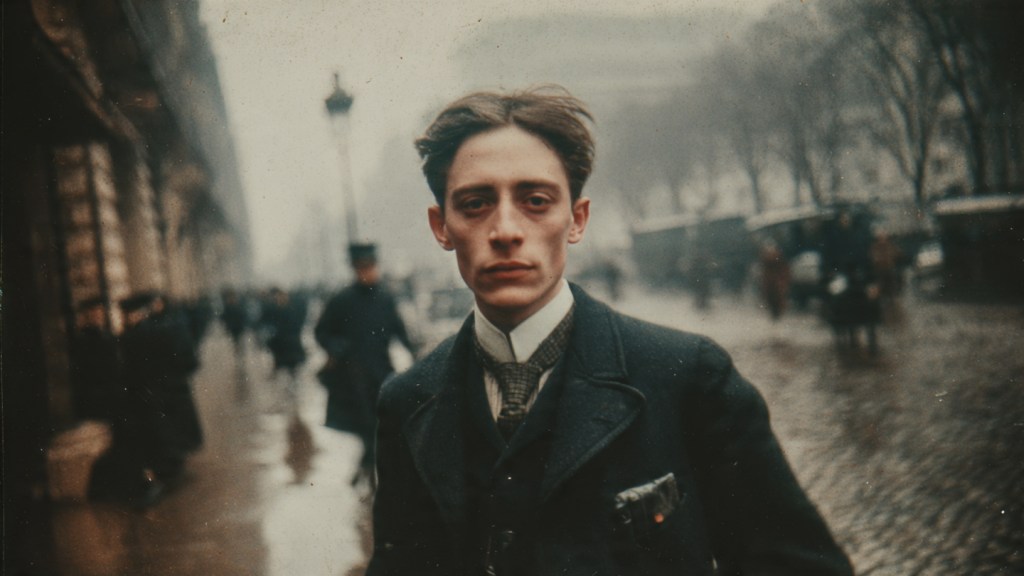
Do you spend more time thinking about the future or the past? Why?
I: The Geometry of Condemnation
The ink in the pot had thickened to a black sludge, turning sluggish in the biting cold of the morning. Henri blew on his fingers, watching the white plume of his breath disintegrate against the grey stone of the École Militaire. It was not yet nine o’clock, but the sky over Paris was a bruised purple, unwilling to admit the sun.
Henri checked the nib of his pen again. It was a nervous tic, a useless ritual against the freezing temperature that had seized the city since the new year began. He was a junior clerk for the War Office, a man of small stature and smaller ambition, tasked today with a duty that felt less like stenography and more like undertaking. He was to record the procedural minutiae of the morning: the time of arrival, the reading of the warrant, the compliance of the prisoner. The official history was already written, of course – the verdict delivered weeks ago – but the Army required the ledger to be balanced.
Beside him, leaning against the damp brickwork of the press enclosure, stood Moreau. Older, with a moustache waxed into aggressive points that defied the damp, Moreau was a journalist for a conservative gazette who viewed the world with the weary amusement of a man who had seen too many governments fall.
“Stop fidgeting, Henri,” Moreau murmured, not looking at him. He was watching the troops assemble. “You’ll smudge the page before the man is even in irons.”
“My hands are cold,” Henri said, tucking his notebook under his arm to chafe his wrists.
“It is the chill of history,” Moreau said, stamping his boots on the cobblestones. He turned his head slightly, his eyes narrowing as he studied the younger man. “Tell me, Henri. In your little room at the Ministry, amongst your files… do you spend more time thinking about the future or the past?”
Henri blinked, startled by the abstraction of the question. The courtyard was filling with the rhythmic clack-clack-clack of boots on stone as the regiments wheeled into position – lines of infantry, cuirassiers, and artillerymen forming a rigid square, a cage made of men.
“The past, I suppose,” Henri answered, his voice thin. “That is my job. To file what has happened. To ensure the records are correct.”
“Why?” Moreau pressed, a small, cynical smile touching his lips.
“Because the past is solid,” Henri said, feeling foolish. “It cannot be changed. It is safe.”
Moreau laughed, a sharp bark of sound that was swallowed by the roll of a drum echoing from the main gate. “You are a fool, Henri. Look at this,” he gestured with a gloved hand at the vast, geometric formation of five thousand soldiers. “We are not here to observe the past. We are here to manufacture the future. You think this is a punishment? It is a vaccination. They are inoculating the Army against doubt. If they do this spectacle correctly, the future is safe for the Generals. If they stumble… well.”
He left the thought hanging as the drums ceased abruptly. A silence, heavy and unnatural, descended on the courtyard. The air seemed to tighten.
“Garde à vous!” The command cracked like a whip across the square.
Henri opened his notebook. The paper was damp.
From the corner of the yard, a small group emerged. Four artillerists with drawn sabres surrounded a solitary figure. Captain Alfred Dreyfus marched with a gait that was almost too perfect, a mechanical stiffness that betrayed a terror held in check by the last shreds of discipline. He wore his full dress uniform, the dolman dark and impeccably tailored, the red trousers bright against the slush, the gold braid gleaming with a mockery of splendour.
Henri’s pen hovered. 08:45. The prisoner enters.
He looked small. That was what Henri had not expected. In the illustrations in the papers, the traitor was drawn as a hook-nosed gargoyle, a looming monster of sedition. In the flesh, walking toward the centre of the square where General Darras sat atop a restless horse, Dreyfus looked merely like a man who had ceased to be human and had become a symbol.
The clerk watched the prisoner halt before the General. The distance was considerable, but the acoustics of the courtyard carried the General’s voice with chilling clarity. Darras raised his sword, the steel catching the flat, grey light.
“Alfred Dreyfus, you are unworthy to carry arms. In the name of the people of France, we degrade you.”
Henri wrote the words down. They looked sterile in his shorthand. Unworthy. Degrade.
Then, the script broke.
“Soldiers!” Dreyfus’s voice erupted, not a broken plea, but a shout that tore through the disciplined silence. He raised both arms, his white-gloved hands trembling not from cold, but from a fury that vibrated in the air. “I am innocent! I am innocent! Vive la France! Vive l’Armée!”
The pen slipped in Henri’s fingers. A blot of ink, dark as blood, bloomed on the page next to the word Degrade.
This was not in the order of ceremonies. The schedule Henri had been shown earlier – the one drafted by the protocol office – had allotted time for the reading of the sentence, the stripping of rank, and the parade. It had not allotted time for the condemned man to scream of his love for the country that was crushing him.
“Write it down,” Moreau whispered, his cynicism momentarily replaced by a sharp, predatory attention. “Don’t you dare leave that out.”
But Henri was paralysed. He watched as a giant of a man, a Sergeant-Major of the Republican Guard, stepped forward to the prisoner. The violence that followed was shocking in its intimacy. The Sergeant-Major reached out and ripped the gold epaulettes from Dreyfus’s shoulders. The sound was distinct – a wet, heavy tearing of fabric and thread that seemed louder than the drums.
Next came the braid from the sleeves. The red stripes from the trousers. The velvet collar. The Sergeant-Major moved with the brutal efficiency of a butcher dressing a carcass, throwing the pieces of gold and wool onto the muddy stones.
Dreyfus did not collapse. He did not weep. He maintained that terrible, rigid posture, shouting again over the tearing sound. “On the heads of my wife and children, I swear I am innocent! You are degrading an innocent man!”
The crowd gathered outside the railings, the civilian mob that had been baying for blood since dawn, roared in response. “Death to the Jew! Death to the Judas!” Their hatred washed over the wall like a physical wave.
Henri looked down at his notebook. The official ledger. He looked at the ink blot. He thought of Moreau’s question. Do you spend more time thinking about the future or the past?
If he wrote what he saw – a man standing upright while his honour was surgically removed, a man whose voice rang with a truth that metal and braid could not silence – he was complicating the future. He was creating a record that would not balance. The comfortable thing, the safe thing, was to write: The prisoner was stripped of his rank.
But the sound of the tearing cloth echoed in his ears. It sounded like the rending of a veil.
“Long live France!” Dreyfus screamed again, his uniform now a tattered ruin, hanging off him in rags.
Henri swallowed the bile rising in his throat. His hand shook, but he dipped the pen into the sludge-thick ink. He did not write what the protocol demanded. He wrote what the air demanded.
The prisoner declares his innocence, Henri wrote, his script jagged and hurried. He does not cease to cry out.
It was a small rebellion, hidden in graphite and ink, but as the Sergeant-Major took Dreyfus’s sword and broke it across his knee – the snap of the metal ringing out like a gunshot – Henri realised he was no longer just recording the past. He was, in his own terrified way, terrified of the future he was helping to build.
II: The Parade of the Pariah
The two halves of the sabre lay in the slush like the broken hands of a clock, pointing to no hour at all. The Sergeant-Major kicked the shards aside with a heavy boot, his face a mask of bored brutality. The metal skittered across the cobbles, a discordant chime that signalled the end of the ritual’s surgical phase and the beginning of its theatrical one.
Henri stared at the debris scattered in the mud: the gold braid, the red stripes, the brass buttons. They looked less like military insignia now and more like the entrails of a slaughtered animal, steaming faintly in the frigid air.
“It is done,” the Staff Officer standing near the press enclosure muttered. He was a tall man with a clipped beard, his eyes scanning the notebook in Henri’s hands rather than the prisoner. “The traitor is dead. Now we merely bury the man.”
But the man refused to be buried.
“Garde à vous! En avant!”
The drums began again, a low, rolling thunder that seemed to vibrate in Henri’s teeth. The “parade of the pariah” had commenced. Dreyfus was compelled to march the perimeter of the courtyard, passing before the eyes of every soldier, a living lesson in the price of betrayal.
Henri watched the figure trudging through the filth. The Captain’s uniform was now a grotesque rag, the threads hanging loose where the rank had been ripped away, his jacket gaping open. He looked like a beggar, yet he marched with a terrifying, rhythmic precision.
“Look at him,” Moreau whispered, his breath smelling of tobacco and stale coffee. “He marches as if he is on review at Longchamp. It is unnatural.”
“He marches like a soldier,” Henri said, the words slipping out before he could check them.
Moreau shot him a sharp glance. “Careful, Henri. That sounds like sympathy. Sympathy is a form of treason today.”
The procession drew nearer to their position. The press enclosure was situated near the railings, close to where the Republican Guard stood like statues. As Dreyfus approached, the roar from the street outside grew deafening. “Dirty Jew! Judas! To the river with him!” The mob was invisible behind the high walls, but their hatred was a physical pressure, pressing against the stones.
Henri gripped his pencil so hard the wood creaked. He looked down at his page. He had written: The crowd expresses its patriotism.
He looked up. He saw the face of Alfred Dreyfus passing ten feet away. The man’s spectacles were misted with cold and sweat. His face was a ruin of exhaustion, pale as parchment, but his jaw was set in a line of granite. He was not looking at the ground. He was looking at the soldiers, at the officers, at the journalists. He was looking at them.
“You are not Romans!” Dreyfus shouted suddenly, turning his head towards the press box. The voice was hoarse now, shredded by his earlier screams, but distinct. “You have no right to condemn an innocent man!”
A hussar in the line spat at the prisoner’s feet. An officer on a horse turned his back ostentatiously.
“Write that he stumbled,” the Staff Officer commanded, leaning over Henri’s shoulder. His voice was low, smooth, and dangerous. “Write that he hung his head in shame. The people need to know he felt the weight of his sin.”
Henri’s hand hovered over the paper. The ink was freezing on the nib again. The future or the past?
If he wrote that Dreyfus stumbled, he was securing the future. He was protecting the Army’s honour, ensuring the public slept soundly, knowing the monster had been cowed. It was a small lie, a garnish on the truth. Who would it hurt? The man was already on his way to Devil’s Island. He was a ghost walking.
But the past – the immediate, undeniable past of five seconds ago – insisted otherwise. Dreyfus had not stumbled. He had looked them in the eye.
“He… he did not stumble, mon Capitaine,” Henri stammered, not daring to look up. “He spoke to us.”
“He barked like a dog,” the Officer corrected, his gloved finger tapping the notebook page. “And dogs do not have histories, clerk. They only have obedience. Fix the record.”
The Officer moved away, satisfied that his order was reality.
Henri sat frozen. The cold was seeping through his boot soles, turning his toes to stone. He thought of Lucie Dreyfus. He had seen her picture in the papers – a woman with dark, intelligent eyes, always shown in the shadow of her husband’s disgrace. She was not here. She was somewhere in this grey, frozen city, perhaps sitting by a window, waiting for the clock to strike, knowing that with every chime, her husband was being dismantled.
If Henri wrote the lie, he was stealing the only thing Lucie Dreyfus had left: the truth of her husband’s courage. He was robbing a woman he had never met of a memory she would need to survive the years ahead.
“Why are you hesitating?” Moreau asked softly. He was sketching the scene, his charcoal strokes quick and violent. “The Captain gave you an order. Manufacture the future, Henri. It is what we are paid for.”
“I am wondering,” Henri whispered, “if the future can be built on a foundation of slush.”
“It is the only thing it is built on,” Moreau replied, shading the hollows of Dreyfus’s eyes in his sketch, making him look darker, more sinister than the man passing before them. “The past is messy, Henri. It is full of contradictions and shouting men who won’t admit they are dead. The future is clean. The future is a story we agree upon. Look.”
Moreau pointed with his charcoal. Dreyfus had reached the far gate. The prison van – a black, windowless carriage that looked like a hearse – was waiting. The police were holding back the crowd, who were surging against the railings, baying for a glimpse of the traitor.
The prisoner stopped one last time before the dark maw of the van. He turned back to the courtyard, to the five thousand men who had stripped him. He raised both arms again, a puppet with its strings cut, yet refusing to fall.
“I am innocent!”
The cry was weaker now, carried away by the wind. The door of the van slammed shut. The lock clicked – a final, mechanical punctuation mark.
The Staff Officer returned, rubbing his hands together. “Excellent. A dignified proceeding. The Army is cleansed.” He looked down at Henri’s notebook. “You have the notes? The stumbling? The silence of the accused? The dignity of the troops?”
Henri looked at the page. The wet ink shone dully. He thought of the question that had started the morning. Do you spend more time thinking about the future or the past?
He realised then that the question was a trap. The Army thought only of the future – of strategy, of morale, of the next war. Dreyfus, screaming in the mud, was trapped in the past – in the facts of 1894, in the evidence, in the truth.
Henri was the bridge. And bridges, he knew, were built to be walked upon.
“I have the notes, sir,” Henri said, his voice flat. He closed the notebook. He did not show the Officer the page where, in the margins, away from the official columns, he had scratched three words in a shorthand so tight it looked like a tremor of the hand: He stood tall.
“Good man,” the Officer said, turning away. “Have the fair copy on my desk by noon. We must catch the evening editions.”
“Come, Henri,” Moreau said, snapping his sketchbook shut. “The show is over. Let us go and drink something warm. The history books are written. There is nothing left to see.”
But as they gathered their things, Henri looked back at the empty courtyard. The mud was churned into a chaotic script of footprints, a language no one could read. The gold braid still glittered in the filth, bright and accusing, waiting for the snow to cover it up.
“It is not over,” Henri murmured to the empty air. “It is only just beginning.”
III: The Page That Refused to Lie
Noon did not arrive with bells or fanfare. It came like a lid being set upon a pot.
Henri climbed the stairs of the Ministry with the taste of iron in his mouth, as though he had been biting coins. His boots left dark crescents of melt-water on every landing. The corridors smelled of damp wool, sealing wax, and a faint medicinal whiff that always reminded him of hospitals – places where men were cleaned up before the living were permitted to look upon them.
He had imagined, foolishly, that the spectacle in the courtyard might exhaust itself; that once the Army had made its point, it would relax its grip. But the building was taut with purpose. Clerks leaned over desks as if their spines had been hinged. Messengers moved at a quick, obedient trot, their eyes fixed ahead like horses guided by blinkers. Even the air seemed to listen.
At his table, Henri unfolded his notebook. The ink blot he had made beside degrade had dried into a hard, glossy stain. It looked like a small, dark seal pressed by accident – an omen, he told himself, and then despised himself for melodrama.
A door clicked behind him.
“Clerk.”
Captain Vallin. Henri did not need to turn; the voice had the particular chill of a man who used courtesy as a knife. Vallin’s footsteps crossed the room, unhurried.
“The fair copy,” Vallin said. “On my desk. Now.”
Henri turned his chair, rising too quickly, nearly upsetting the inkwell. “Yes, mon Capitaine.”
Vallin took the notebook from Henri’s hands as though it were already his. He scanned the pages with a faint smile, the smile of a man inspecting a uniform for lint.
“Much is… superfluous,” Vallin observed. “A shout here. A phrase there. One must not confuse noise with meaning.”
Henri’s throat tightened. “The condemned spoke, sir.”
“The condemned performed,” Vallin corrected. “The ceremony was conducted at the École Militaire precisely so that France might see order prevail.” He tapped a fingernail on the paper. “The record must reflect that order.”
Henri’s eyes fell to Vallin’s hand: neat nails, clean cuffs, no trace of mud. It struck him that Vallin had not needed to stand close enough to smell the slush, or hear the tearing cloth at arm’s length. Vallin’s order was the luxury of distance.
“And the crowd?” Vallin continued. “You wrote ‘patriotism’. Good. The citizenry was outraged, as it should be.”
Henri heard, as if again through stone walls, the snarling chant from outside the railings – words that had felt less like patriotism than a kind of fever. He did not repeat them. There are obscenities that turn a page unclean.
Vallin’s gaze sharpened. “You look troubled, clerk. Do you spend more time thinking about the future or the past?”
Henri’s stomach dropped. The question again – first a journalist’s jest, now an officer’s examination.
“The past, sir,” Henri said, because it was the safe answer.
“Then keep it tidy,” Vallin replied. He handed the notebook back as one might return a borrowed knife, and for a moment Henri’s fingers brushed Vallin’s glove. Leather. Smooth. Unyielding. “No flourishes. No sympathy. France has had enough of sentimentality.”
When Vallin had gone, Henri remained standing. He listened to the Ministry’s ordinary sounds – paper shifted, a chair leg scraped, the distant tick of a clock – until he could no longer distinguish them from the drumbeat he still felt in his skull.
He sat. He opened a fresh sheet of official paper. At the top he wrote, with careful flourishes, the title dictated by protocol.
His hand moved as if it belonged to someone else.
At such an hour, in the courtyard… He described formations. Commands. Procedures. He wrote the ceremony as it was meant to be remembered: clean lines, proper nouns, the impersonal voice of the state. He did not write about the sound a man makes when his honour is torn away in public. He did not write about the sharp, wet tear of cloth.
Yet the words he left out crowded in his mind, elbowing for space.
He paused. The nib hovered. He heard Dreyfus’s hoarse insistence – an innocence proclaimed again and again as the degradation proceeded. Henri had not known, before that morning, that a man’s voice could make an entire square of soldiers feel less solid.
He set the pen down.
In the drawer of his desk, beneath an envelope of routine receipts, lay his private stenographer’s pad – the one not stamped with any seal, the one that belonged to him as a person rather than to him as an instrument. He had used it in the courtyard, in moments when his official notebook felt too visible, too easily policed.
Henri slid it out now. Its pages were filled with shorthand marks like insect tracks. Near the bottom of one page he had written, cramped and viciously small, the three words that had startled even him:
He stood tall.
He stared at that line as if it were a stranger.
If Vallin saw it, Henri would be dismissed at best. At worst… he did not let himself name the worst. In Paris, the worst had a habit of becoming ordinary.
A knock came at the doorframe. Not Vallin. A different face.
Mademoiselle Lenoir, from the copying office. She carried a bundle of papers pressed to her chest, her cheeks pink from the cold. Henri had noticed her only in passing before: a brisk young woman with ink-stained fingertips and an expression that suggested she trusted no man’s handwriting.
“You are late with your fair copy,” she said, without apology. “They are restless upstairs.”
Henri’s mouth opened, then closed again. He had intended to say something harmless. Instead he heard himself ask, very softly, “Mademoiselle… do you spend more time thinking about the future or the past?”
She blinked, as if he had offered her a foreign coin.
“The future,” she answered after a beat. “I am not wealthy enough for nostalgia.” Then her gaze shifted to the stenographer’s pad half-hidden beneath his elbow. “Why do you ask?”
Henri felt heat rise under his collar. “Because the past is being… arranged.”
Lenoir’s expression did not soften, but it sharpened into something more human than efficiency. “Everything is arranged, monsieur. The question is: arranged by whom?”
Henri swallowed. He could taste his own fear – stale, like old bread. “A man was humiliated today in the name of France.”
Her eyes flickered, a quick glance left and right, towards the corridor where footsteps might appear. Then she leaned in, lowering her voice. “I heard. My brother is in the artillery. He says the condemned cried out that he was innocent.”
Henri’s hands tightened on the edge of the desk. “He did.”
“And you wrote it?”
Henri hesitated. In that pause, he understood that silence was also a kind of writing.
“I wrote enough,” he said at last.
Mademoiselle Lenoir studied him, weighing him in the manner of someone who had learnt early that men’s consciences were unreliable currency. “Enough for whom?”
Henri looked down at the official fair copy – so neat, so dead. He imagined it travelling from desk to desk, acquiring signatures like blessings, hardening into a permanent truth. He imagined, too, the condemned man being shipped far away, beyond ordinary maps, until a place called Devil’s Island became his entire world.
He heard himself speak, not with courage exactly, but with a kind of resignation.
“Enough for the future,” he said. “Not enough for the soul.”
Lenoir’s mouth tightened. “Then keep what is enough for your soul, monsieur. And be clever about it.”
Henri’s heart pounded. “You think I should hide it?”
“I think,” she replied, gathering her bundle more firmly, “that if a thing is true, it will not always stay buried – unless everyone helps to bury it.”
She turned to go, then stopped, her hand on the doorframe. “Give them what they demand. They have the power. But keep what you saw.”
When she had left, Henri sat very still. Outside, the Ministry clock chimed the quarter-hour. Each note sounded like a footfall marching away.
He returned to his fair copy and finished it – tidy, obedient, bloodless. Then, with hands that no longer trembled, he folded his stenographer’s pad into an oilcloth wrapper and slid it into the inside pocket of his coat, where it pressed against his ribs like a warm stone.
It was not heroism. It was not even defiance, not in the grand manner that newspapers admired. It was merely refusal – the smallest refusal, the kind that could be mistaken for caution.
Henri rose, carrying the fair copy to Captain Vallin’s office. On the way he passed a high window and saw, beyond the glass, Paris moving as if nothing had happened: carts, pedestrians, the indifferent flow of the day. The city was already stepping into its future.
At Vallin’s desk, Henri placed the fair copy down.
Vallin glanced at it, satisfied. “Good. Clean. Correct.”
Henri bowed his head. “Yes, sir.”
As he turned to leave, Vallin added, almost conversationally, “You see? The past can be made safe.”
Henri paused at the threshold. His fingers touched, through the fabric of his coat, the hidden pad.
“Yes,” he said, the word tasting strange in his mouth. “Made safe.”
In the corridor, where no one could see his face, Henri whispered the answer he could not give aloud.
He spent his time thinking not of the past or the future, but of the thin, trembling line between them – the line a man must sometimes hold with nothing more than ink, memory, and the stubborn mercy of refusing to forget.
On 5th January 1895, Captain Alfred Dreyfus was publicly stripped of his rank in the courtyard of the École Militaire, an event witnessed by 5,000 soldiers and thousands of jeering civilians. Convicted on falsified evidence of passing secrets to Germany, he was sentenced to life imprisonment on Devil’s Island, a penal colony off the coast of French Guiana. For twelve years, the “Dreyfus Affair” deeply divided France, pitting the Army and Church against republicans and intellectuals, culminating in Dreyfus’s full exoneration and reinstatement in 1906. The scandal exposed the depths of European antisemitism, directly influencing Theodor Herzl to advocate for a Jewish state, and remains a defining historical example of how state institutions can weaponise “truth” against the individual.
Bob Lynn | © 2026 Vox Meditantis. All rights reserved.

 Vox Meditantis
Leave a comment