What’s something you wish you could unlearn from the 90s but can’t?
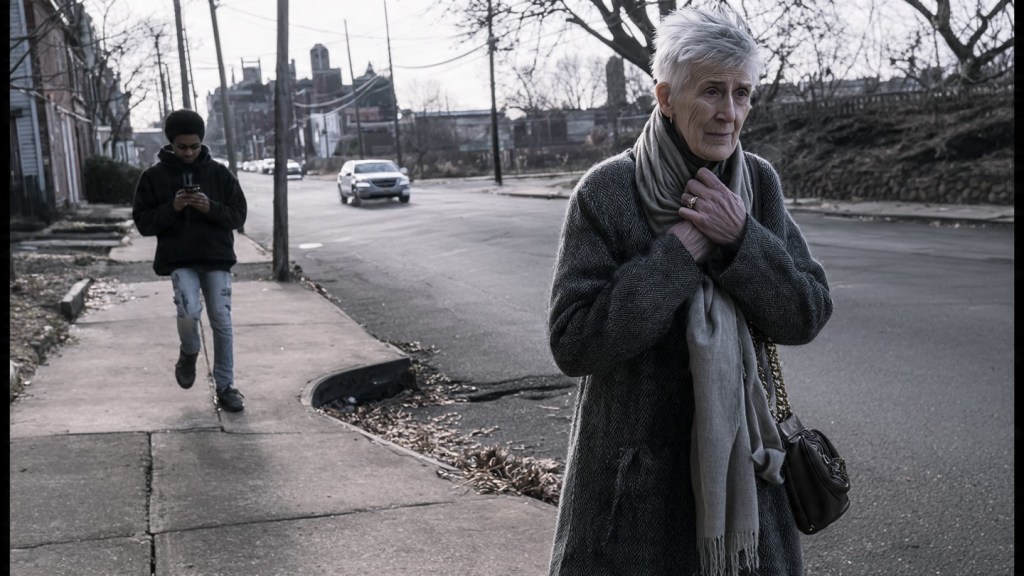
There’s a kind of wariness I picked up in the 1990s that I wish I could shake, even now, three decades later. It’s the instinct to cross the street when I see a young Black man walking towards me after dark. My body does it before my mind can object, and the shame arrives a half-second too late to stop my feet.
I’m seventy-seven years old, and I’ve lived in New Corinth my entire life except for two years at secretarial college in Wilmington. I raised my two daughters in a flat near the old Pennsylvania Railroad depot, worked twenty-eight years as an administrative assistant at the county offices on Market Street, and watched this city transform more times than I care to count. But it was the 1990s – those brutal, terrifying years when New Corinth recorded 127 murders in 1993 and the crack epidemic turned our streets into war zones – that carved something permanent into my nervous system that I cannot seem to unlearn.
The Fear That Took Root
I was in my mid-forties during those years, old enough to remember when downtown New Corinth felt safe, young enough to still walk to work every morning. My route took me down Market Street, past the shops that were closing one by one, replaced by check-cashing stores and bars that opened too early and closed too late. The city I’d grown up in – already wounded by the Iron Works closure in 1978 and the long decline of the shipyards – was collapsing inward in a way that felt both sudden and inevitable.
The violence wasn’t abstract. My daughter’s friend was shot in a dispute over twenty dollars near Minerva Creek. A colleague’s son disappeared into addiction and never came back. The elderly Polish woman who lived below me was robbed at knifepoint in the hallway of our building at three o’clock on a Tuesday afternoon. Every week brought new stories, new casualties, new reasons to be afraid. The fear wasn’t unreasonable – it was survival instinct in a city where the systems meant to protect us had largely given up.
But here’s what I wish I could unlearn: I started cataloguing people by threat level. Young men, particularly young Black men from Riverside, became automatic warnings. I’d see someone walking down Fourth Street in a particular way – baggy clothes, a certain posture, a look I told myself I recognised – and I’d change my path. I’d clutch my handbag tighter. I’d avoid eye contact whilst simultaneously watching every movement. I became an expert in the choreography of urban fear, and thirty years later, my body still remembers the steps.
What New Corinth Taught Me – and What It Didn’t
I’m not naive about what happened in the 1990s. The crack epidemic devastated inner-city neighbourhoods, and the violence was real. Riverside, where the city’s African American community had built churches and schools and businesses for over a century despite crushing discrimination, bore some of the worst of it. But what I learnt in those years wasn’t nuanced or fair – it was blunt and tribal: stay away from certain streets, avoid certain people, trust the distance you can keep.
The cruelty is that I knew better even then. I worked alongside Black colleagues for decades. I watched Riverside residents show up at community meetings fighting for their neighbourhood whilst the rest of us wrote it off. I saw the mothers walking their children to school past corners where dealers worked, trying to maintain normalcy in conditions that would have broken me. But fear is a powerful teacher, and it taught me to see threat before humanity, category before individual.
Now it’s 2025, and New Corinth is transforming again. The riverfront has new flats and restaurants. The university campus downtown brings students who jog along Minerva Creek at night without a second thought. Crime has dropped significantly from those nightmare years, though it remains above state averages. Mayor Patricia Williams – the city’s first African American female mayor – ran on equitable development, and there’s talk everywhere of New Corinth’s “comeback”.
But I’m still carrying the 1990s in my bones. Last week I was walking to the chemist near the renovated waterfront, and a young Black man in his twenties was walking towards me. He was on his mobile phone, laughing at something, completely absorbed in his own life. And I felt it – that old tightening in my chest, that automatic calculation of threat. I crossed to the other side of the street before I’d consciously decided to do it. He didn’t even notice. Why would he? He was just trying to get wherever he was going, same as me.
The Unlearning I Can’t Manage
I’ve tried. I truly have. I volunteer at the food pantry at Saint Mary’s, where I work alongside residents from every neighbourhood, including Riverside. I’ve attended community meetings about policing and erasure, listening to younger activists explain how the city’s so-called revitalisation is pushing out the very people who held it together during the worst years. I understand intellectually that the fear I learnt in the 1990s was never about individuals – it was about a city in crisis, about systems failing, about what happens when 1,200 jobs disappear from a place like the Iron Works and nothing sustainable replaces them.
But understanding doesn’t undo the reflex. The 1990s taught me to be afraid in a way that bypasses thought. It’s lodged somewhere deeper than reason, in the part of me that just wants to get home safely, that remembers too many funerals, too many news reports, too many nights lying awake wondering if my daughters were safe walking back from their evening shifts. And the worst part – the part that makes me ashamed even as I write this – is that the young man I crossed the street to avoid last week probably wasn’t even born when New Corinth hit 127 murders in 1993. He’s inherited none of the violence I’m still protecting myself against. But I can’t seem to see him without that history rising up between us.
What This City Deserves
New Corinth has survived extraordinary hardship – the Depression’s breadlines along Market Street, the wartime mobilisation, the collapse of our industrial base, the crack epidemic, the opioid crisis that killed eighty-nine people in 2017. We’re still here, stubborn as the Delaware River that defines our geography, still trying to figure out what we become when we’re not what we used to be. The city deserves better than residents like me who can’t let go of the worst years, who project old terrors onto new faces.
I know the 1990s were an anomaly, not a permanent truth. I know that Riverside – which white people like me largely abandoned to its own defences during those years – is now facing displacement as developers discover its “authenticity”. I know that the young people walking New Corinth’s streets today are facing their own challenges: an opioid crisis that makes the crack epidemic look geographically contained, a city where twenty-eight per cent of residents live below the poverty line, the priced-out realities that are pushing longtime families out of neighbourhoods they held together when no one else cared.
But knowing all of this doesn’t stop my body from remembering what it learnt. The 1990s taught me to keep a distance I can’t close, to see danger in melanin and youth, to let a decade of genuine crisis harden into something uglier – a permanent suspicion that I carry like the dented handbag I’ve clutched through thirty years of walking these streets. I wish I could unlearn it. I wish the fear would release its grip. But every time I cross the street, every time I avoid eye contact, every time I clutch my bag a bit tighter, I’m choosing the lesson the 1990s burned into me over the person standing right in front of me, just trying to live their life.
That’s what I wish I could unlearn from the 1990s but can’t: the distance. The terrible, automatic distance between my fear and someone else’s humanity. New Corinth taught me many things over seventy-seven years – resilience, stubbornness, the pride of a city that refuses to disappear. But the 1990s taught me something I’m ashamed to carry, and no amount of riverfront renewal or downtown revitalisation seems able to wash it away.
Bob Lynn | © 2025 Vox Meditantis. All rights reserved.


 Vox Meditantis
Leave a comment