What’s your favorite cartoon?
Tuesday, 9th December 2025
Someone ought to explain why children’s programming looks most philosophical when no one is actually watching it – when the screen flickers above a café counter like a sermon being delivered to the steam wands and the pastry case, whilst grown adults negotiate caffeine and deadlines in whispered conference below.
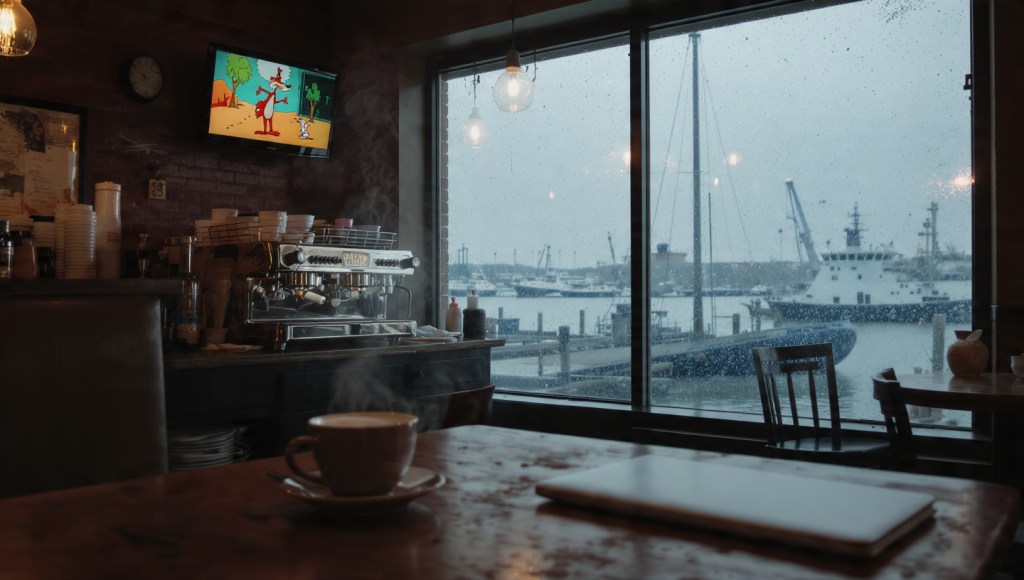
I was at Marcus’s this morning, laptop blessedly closed in obedience to yesterday’s experiment in subtraction, when I noticed the small television mounted over the espresso machine. A children’s channel was running through its morning catalogue – bright shapes hurtling across desert landscapes, elaborate contraptions failing with operatic precision, a road runner who understood the assignment and a coyote who absolutely did not. Through the steamed-up glass beyond Marcus’s counter, the harbour was doing its usual December negotiations with the light, all grey and reluctance. Inside, Wile E. Coyote was mid-plummet, having just run well past the edge of a cliff that shouldn’t have held him but did, right up until he looked down.
I knew, before my coffee arrived, what today’s writing prompt would ask. Some questions telegraph themselves.
The Eternal Pursuit
If I answer honestly – and the entire premise of these entries has been an exercise in risking honesty when evasion would be more dignified – my favourite cartoon is exactly what you’d expect from a woman who has spent fifty-eight years perfecting the art of elaborate schemes that collapse at the crucial moment: Looney Tunes, specifically the Road Runner and Wile E. Coyote shorts that arrived in our household every Saturday morning with the regularity of sacrament.
Not for the slapstick, though there was plenty. Not for the Road Runner, who barely registered as a character – more a principle with feathers, existing simply to be, unbothered and impossibly fast. What captivated me, from perhaps age seven onward, was the coyote himself: ingenious, determined, forever constructing increasingly complex solutions to a problem that might have been solved by eating literally anything else in the desert.
Father would sit with the weekend paper, half-watching, occasionally glancing up to offer dry commentary on the structural integrity of whatever Acme product was about to fail. “That anvil’s poorly anchored,” he’d note, just before it plummeted. Mother, who’d actually seen Nevada deserts and had opinions about their accuracy, would provide running geographical corrections: “The saguaro cacti are wrong – those are Sonoran, not Mojave,” or “That roadrunner should be half that size, honestly, they’re not that impressive in real life.”
And small-Catherine, cross-legged on the carpet, absorbed what turned out to be a weekly masterclass in persistence and denial: that gravity is negotiable until you acknowledge it, that the gap between your ambition and your execution can be traversed at speed if you simply refuse to notice the drop, and that failure – spectacular, repeated, inevitable – doesn’t actually excuse you from showing up next week to try again with a different contraption.
I didn’t know then that I was learning the choreography I’d spend three decades perfecting. Running well past the cliff-edge of my energy. Noticing the drop only when someone – Father Walsh, Jenny, occasionally a patient brave enough to turn the tables – pointed out that I’d been suspended in mid-air on momentum and professional competence alone, and perhaps it was time to admit I’d run out of ground.
The Adult Eye
These days my cartoon preferences have moderated into something quieter, more economical. I’ve developed an affection for single-panel drawings – the sort published in literary magazines and stuck to refrigerators, where two people at a dinner table constitute an entire psychological novel, where a woman standing alone in a kitchen can contain multitudes, where the caption does half the work and the white space does the rest.
The New Yorker cartoons, particularly. Gary Larson’s The Far Side collections that Jenny keeps pressing into my hands. Those spare, intelligent drawings where almost nothing happens and everything is implied – a dog at a psychiatrist’s office, a man realising his life’s ambition was someone else’s anxiety dream, the exact moment when the mundane tips into the absurd and becomes, somehow, true.
These feel closer to the consulting room than the Road Runner ever did. Fifty minutes distilled into a single frame. The entirety of a person’s struggle rendered in a face, a posture, the angle of a chair. No elaboration required. The drawing trusts you to understand what isn’t shown.
It’s struck me more than once these past months that this blog has felt less like memoir and more like a series of daily panels: same harbour, same woman, new caption. Each entry a small rectangle of time in which I attempt to render something true about what it costs to finally, belatedly, risk being seen. The scenery barely changes – Victorian windows, Delaware water, the reliable circuit of Marcus’s café and the museum and the consulting room – but the interior weather shifts just enough that the same view means something different today than it did in October.
Like a cartoonist, I’ve been redrawing myself each day with minor variations and a very small audience, discovering that repetition itself can be a form of inquiry. What changes when you keep showing up to the same page? What emerges when you’re willing to be publicly incompetent at new activities, to let your horizon lines list drunkenly, to admit that sometimes the elaborate scheme is just avoidance with better production values?
The Audience Question
Which brings me to the awkward arithmetic I’ve been conducting between sessions lately, the sort of accounting that feels simultaneously necessary and faintly embarrassing: this blog’s readership is small enough to seat comfortably at my kitchen table, with three chairs to spare and room for the optimistic bots who arrive daily to see if I’ve finally said something monetisable.
Seven regular readers, near as I can determine. Jenny, who comments in person rather than online and has been known to text when I’m “hiding behind theory again.” David, who mentioned a post once in passing with the careful courtesy of someone trying not to admit they’ve been paying attention. Father Walsh, checking in from whatever deliberations about Wilmington currently occupy his conscience. Maggie at the Historical Society, mining these entries for the oral history project I’ve agreed to with more ambivalence than enthusiasm. Two patients – former, thankfully, the ethical complications would be baroque otherwise – who’ve told me they find it helpful to see the therapist as human. And one person I can’t identify, a regular IP address from somewhere in Philadelphia, who never comments but reads every entry within hours of posting, and whom I’ve privately named the Archivist.
Seven people. Possibly eight on a good week, if you count Tom when Jenny reads passages aloud to him over tea.
This would be, by any algorithmic standard, a failure. No viral moments. No think-pieces written about my think-pieces. The metrics suggest I should either improve my reach or pack it in and save everyone the awkwardness of witnessing a public project that never quite achieved liftoff.
But here’s the clinician’s reframe, the one I offer patients when they’re catastrophising about invisible audiences who don’t actually exist: if one person in a room is enough to justify an hour of my attention – and I’ve built thirty years of practice on exactly that premise – why should three or four readers not be enough to justify a page?
Quality of attention over quantity of eyes. Intimacy over performance. The willingness to show up for the people who are actually here, rather than the imagined thousands who might arrive if only I learned to be more … something. More entertaining. More confessional. More carefully curated. More like someone else.
When Cartoons End
I’ve been thinking lately – and this is where yesterday’s theme about doing less meets today’s question about favourite cartoons – that every strip benefits from knowing when to pause. Even the funny ones. Especially the funny ones, perhaps.
The Road Runner cartoons worked precisely because they were six minutes long, not sixty. They knew their architecture: setup, chase, failure, dust cloud, repeat. The pleasure was in the ritual, the predictable beats executed with just enough variation to stay surprising. But they also knew to end. To let the coyote dust himself off, to let the roadrunner disappear into the painted horizon, to grant everyone – characters and viewers alike – a rest before the next installment.
I’m beginning to suspect that this particular strip – Daily Reflections from a Harbour Psychiatrist Learning to Risk Ordinary Intimacy – has run its first season. Not because it’s failed, though the metrics would gleefully argue otherwise. But because the work I came here to do – the experiment in visibility, the daily practice of showing up without full professional armour, the risk of narrating my own fumbling attempts at watercolours and domesticity and late-life connection – that work has served its purpose.
I’ve learned what I came to learn: that being seen costs something, but being perpetually hidden costs more. That my small readership is, in fact, the perfect size – intimate enough to feel like conversation, public enough to require honesty, sparse enough that I’m not performing for strangers but practicing presence with something close to community.
And I’ve discovered the thing I most needed to discover: you don’t actually need an audience of thousands to justify taking yourself seriously. Seven people is enough. One person is enough. The woman in the mirror, deciding each morning whether to show up to her own life, is enough.
What Happens Off the Page
The thing about cartoons – and about blogs that function like cartoons – is that they only show you the chase, the contraption, the spectacular failure. What they don’t show is what the coyote does between episodes. Where he goes when the cameras aren’t running. Whether he sits quietly on a rock somewhere, watching the desert light change, considering alternate careers that might involve less falling and more ground beneath his feet.
These entries have given me the discipline of daily attention, the practice of translating lived experience into something shareable, the courage to admit in public what I’ve spent decades avoiding in private. But they’ve also become, if I’m honest, a way of converting presence into narrative before I’ve fully inhabited the presence itself. A way of making experience legible before it’s complete. A way of running past the cliff-edge and only noticing I’m airborne when I check the blog statistics to see who’s watching.
Yesterday I wrote about doing less. About protecting the gaps between sessions, about turning the phone off in the evenings, about letting some days go unrecorded so that life might occasionally happen outside the frame I’ve been so carefully drawing.
Today I’m admitting that the blog itself might be one of the things I need to do less of. Not to stop entirely – not yet, perhaps not ever – but to let it rest. To discover what the characters do when they’re not required to be on the page every day, performing their small incremental changes for whoever happens to be watching.
There will be time, later, to return. To assess. To see whether the experiments of autumn 2025 – the watercolours, the museum work, the tentative domesticity with David, the upcoming Québec trip – yield anything worth reporting once they’ve been lived rather than narrated in real time.
But for now, I’m going to practice the thing the roadrunner already knows: how to simply be, unbothered and present, without requiring elaborate contraptions or constant documentation to justify the miles covered.
Marcus has just set down my second coffee with a nod that might mean “the usual” or might mean “I know,” which in a town this size amounts to the same thing. Above the espresso machine, the coyote is still falling, still failing, still showing up next week with undiminished optimism and a fresh Acme delivery.
The harbour through the steamed glass looks cold and faithful. The consulting room upstairs will open its doors at two, regardless of whether I’ve narrated the morning. And tonight, the laptop might stay closed – not because there’s nothing to say, but because some of what wants saying needs to be lived before it becomes story.
Québec awaits on Friday. David has a standing invitation for Saturday coffee when I return, and whatever the harbour’s doing that morning. The museum’s stillness rooms will open in the new year, offering spaces for the kind of quiet this blog has been circling around but not quite achieving.
Seven readers. Eight on a good week. All of them invited to imagine, with me, what happens when a woman finally stops running past her own edges and allows herself, just briefly, to look down – not at the drop, but at the ground she’s already standing on.
The coyote would understand. Eventually.
Catherine
Bob Lynn | © 2025 Vox Meditantis. All rights reserved.


 Vox Meditantis
Leave a reply to Maile McCoy Cancel reply