Do you ever see wild animals?
Saturday, 6th December 2025
The question wants accounting – Do you ever see wild animals? – and at quarter past six this morning, with floorboards complaining beneath unfamiliar weight and Linda’s laugh threading through plaster from the room I’d excavated with archaeological intent, I thought the more honest answer might be: I’m learning what it means to live amongst them.
The kettle performed its small thunder whilst Michael’s voice rumbled low through the wall, discussing something that required Linda’s gentle counterpoint. I stood in my own kitchen feeling oddly displaced, aware that having guests means surrendering the fiction that these rooms belong entirely to me – that the morning rituals I’ve perfected over three decades constitute natural law rather than solitary habit.
By seven they’d emerged, Linda already dressed with the competence of someone accustomed to primary school mornings, Michael moving with that particular Bennett gait – Father’s ghost made flesh – checking the weather through harbour-facing windows as though assessing tolerances, calculating whether the day would hold.
I offered tea, scrambled eggs that refused to be spectacular, toast soldiers because some habits transfer cleanly from childhood. Linda moved into my space with surprising ease, finding mugs without asking, wiping counters I hadn’t noticed needed attention, loosening something territorial I didn’t know I’d been guarding. She has that gift – the warm authority of someone who’s spent forty years teaching six-year-olds that order needn’t mean rigidity, that kindness can have structure.
Michael asked, with studied casualness, what I’d planned for the day. I said I thought we’d walk the harbour’s edge, perhaps out toward the old shipyard reserve where the Delaware meets scrubland – nothing grand, just the geography I’ve been occupying. Linda’s eyes lit with the particular pleasure of someone who enjoys being shown a place through the eyes of someone who actually inhabits it.
The Estuary’s Menagerie
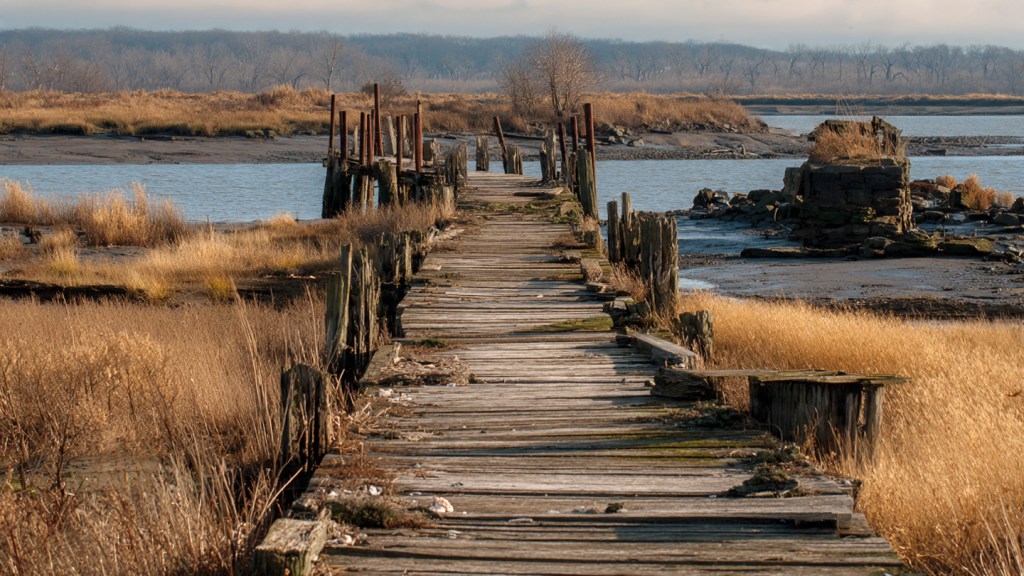
By nine we’d crossed into the territory where industry surrenders to accident – the reserve that formed when the shipyards closed in ’89 and the city, lacking funds for development, simply let the land remember what it had been before cranes and wages. Paths thread through spartina grass and rusty machinery half-claimed by earth, markers of commerce slowly returning to salt marsh.
The morning held that December clarity – cold enough to sharpen edges, bright enough to make silhouettes sing. We walked the raised boardwalk, the Delaware spreading pewter-grey to our left, and Michael asked questions with engineering precision about flood mitigation, about whether the pilings would hold another decade, about load factors I couldn’t possibly calculate.
Then Linda stopped, hand lifting in the universal semaphore for hush – and there, hauled out on the tidal flat like question marks made flesh, a small pod of harbour seals. Six of them, maybe seven, their pelts dappled silver-grey, utterly unconcerned with our observation. One yawned with comic exaggeration. Another rolled ponderously, scratching some private itch against barnacled stone.
We stood – three Bennett-adjacent adults in sensible coats – and watched wild things be exactly as they were, requiring nothing from us, magnificent in their absolute ordinariness.
Michael said, quietly, “I’d forgotten they were here.”
Linda touched his elbow, brief and eloquent.
Further along the path, where the boardwalk gives way to scrub and the old shipyard footings jut through undergrowth like broken teeth, a red fox stepped from the bramble. Not hurried, not particularly concerned – just crossing from one territory to another with the confidence of someone who knows these paths better than the signs the Parks Department erected. Its coat caught the low sun, rust and amber, and for three heartbeats we were entirely still – the fox assessing whether we warranted concern, us trying not to breathe loudly enough to break the spell.
Then it was gone, slipped through chain-link fencing the city forgot to mend, leaving only the impression that we’d been granted audience rather than the reverse.
“They’re nesting in the old storage buildings,” I said. “Tom Callahan – harbour walker, lived here sixty years – says there’s a whole family denning near the crane foundations.”
Michael turned, something complicated moving across his face. “Do they ever come into town proper?”
“Occasionally. Bins left uncovered. The restaurant district after midnight. They’re adapting.” I paused. “We’ve made them suburban.”
At the furthest point of the walk, where the path terminates at a concrete pier that once serviced supply barges, gulls wheeled overhead with the sort of ragged majesty that refuses to be picturesque – arguing, bullying each other off the best perches, dive-bombing crab pots with tactical precision. Linda laughed at their sheer bloody-mindedness, the way they made survival look like performance art.
“Your mother would have loved this,” she said, and I felt the observation land – accurate, tender, the sort of thing only someone who’d sat through twenty years of Bennett family dinners could offer. Mum would have delighted in the seals’ indifference, the fox’s proprietorial crossing, the gulls’ unbothered thuggery. She’d have found them kindred.
Michael stood watching the water with an expression I recognised from my consulting room – the look of someone whose inner weather doesn’t match the forecast, who’s managing admirably whilst something underneath paces a too-small enclosure.
Retirement, I’ve learned through thirty years of listening, doesn’t free everyone equally. Some people step into unstructured time like it’s a longfield they’ve been waiting to cross. Others – the ones whose identity has been load-bearing for forty years – find that afternoons without problems to solve feel less like freedom than a particular variety of drowning.
“Linda’s been suggesting walks,” Michael said, not quite answering a question I hadn’t asked. “Pottery classes. Yesterday I reorganised the garage. Twice.”
Linda, tactfully, had moved down the pier to photograph something – providing distance whilst remaining findable.
“You spent four decades being the person who solves,” I said. “The body doesn’t know what to do when the problems politely decline your services.”
He nodded, hands in pockets, shoulders carrying tension he probably couldn’t name.
“You’re a caged animal, Michael. But the cage was competence, and you built it so well you forgot it had doors.”
He looked at me then – the sort of look that acknowledges being seen when you’d rather stay strategic.
“And you?” he asked. Gentle, but landing. “You pacing any enclosures?”
Fair.
Interiors, Unvarnished
We walked back as the tide was thinking about turning – gulls settling into their low-water routines, seals beginning the slow paddle back toward deeper channels. Linda rejoined us and Michael’s shoulders had dropped a fraction, the morning’s wildness having done whatever it is that proximity to undomesticated things accomplishes – reminds us we’re animals too, that rest isn’t failure, that sometimes the bravest thing is to simply sit in sun on a rock and digest breakfast without agenda.
Back at the flat, I made tea whilst Michael inspected the Victorian plasterwork with professional interest and Linda, without ceremony, began assembling lunch. She moved through my kitchen with the ease of someone who understands that hospitality is collaborative – finding the bread knife, the good butter, the chutney I’d forgotten I’d bought, constructing sandwiches that looked like care made edible.
I stood at the threshold of my own space, watching her work, and felt something unknot that I hadn’t realised I’d been bracing. For years I’ve treated this kitchen as fortification – my domain, my rituals, the place where I control variables and produce outcomes that signal competence. Linda, by simply making lunch without asking permission, was quietly demonstrating that shared space doesn’t have to mean invasion. That letting someone else chop and stir might be trust rather than failure.
She handed me a knife and a cucumber with the sort of matter-of-fact kindness that brooks no refusal. “You slice, I’ll butter. Division of labour.”
We worked in companionable quiet, the sort that only arrives when two people have decided that efficiency matters less than presence. Michael reappeared from his inspection of the ceiling rose, reporting that whoever had done the restoration work knew their craft, and accepted his sandwich with the particular gratitude of someone who recognises when they’ve been tended without fuss.
We ate at the small table overlooking the harbour – the one where I’ve eaten alone more times than I’ve bothered counting, where David washed dishes with improbable care after Bartók, where this morning three people sat without needing to make grand statements about belonging.
Linda mentioned Emily and Matthew, Susan’s children, both navigating their thirties with varying degrees of grace. Michael added a story about David – his David, not mine – who’d rung last week to discuss a project going predictably wrong, needing his father’s engineering mind to solve what management had complicated. The conversation had that easy specificity of people who know each other’s cast of characters, who can reference shared history without footnotes.
I realised, somewhere between the second cup of tea and Linda’s observation about the quality of harbour light, that this was what I’d been avoiding for years. Not dramatic confrontation or unwanted scrutiny, but this – ordinary family intimacy that doesn’t require credentials. Being the sister who fumbles and doubts, not just the competent youngest who sends annual reports of successful independent living.
Michael asked, carefully, if I was managing. The question carried freight – concern about the flat I inhabit alone, the work I do that he doesn’t entirely understand, the life that from Baltimore must look either admirably self-sufficient or worryingly solitary, depending on the angle.
I could have offered the précis. The professional shorthand that signals everything’s handled, no concern required.
Instead I said, “I’m learning to stop performing quite so hard. It’s uncomfortable. I’m terrible at it. But I think it might matter.”
He nodded, the sort of acknowledgment that doesn’t demand elaboration but leaves space for it.
Linda reached across and squeezed my hand, brief and sufficient.
No grand revelations. No therapeutic breakthroughs. Just three people at a table, harbour light making everything momentarily kinder than it probably deserved to be.
The Corridor of Risk
This afternoon, whilst Michael napped with the enviable competence of someone whose body still remembers how to rest when horizontal, and Linda sat reading in the chair by the window, my phone lit with David’s name.
Saw a small herd of deer this morning on my run – edge of town, near the old miller’s path. Eight of them, just standing in the mist like they’d been painted there. Thought you’d want to know the wildlife census continues.
Not a grand declaration. Not a demand for response. Just – evidence that he’d thought of me whilst encountering something worth noticing. That the conversation we’d been having about wild things and suburban adaptation and the courage required to be visible had continued in his solitary morning, and he’d wanted to fold me into it.
I wrote back: The harbour seals are unimpressed with human observation. The fox near the shipyard has better things to do than perform wildness for tourists. I think they’re teaching me something about refusal as a spiritual practice.
His reply arrived as I was making tea for Linda, who’d looked up from her book with the expression of someone who’d registered a change in atmospheric pressure.
Next week’s concert is Brahms. Would you like to risk it?
Linda, with impeccable timing, asked if I took milk in my tea – giving me privacy whilst making clear she’d noticed the smile I was failing to suppress.
I said yes to both the milk and the Brahms, in that order.
The afternoon unspooled with the unhurried grace of December Saturdays when there’s nowhere urgent to be – Michael waking and suggesting a walk before dark, Linda discovering the secondhand bookshop on Harbour Street and returning with three mysteries and a biography she insisted I’d want to read, the slow assembly of dinner that involved all three of us in the kitchen and only minor territorial negotiations about who was responsible for what.
Tomorrow they’ll leave mid-morning, return to Baltimore and the structured routines that await them there. The guest room will empty, the flat will return to its ordinary rhythms.
But tonight the rooms hold voices that aren’t mine, laughter that doesn’t require my facilitation, the ordinary architecture of people who’ve known each other long enough that silence isn’t failure and interruption isn’t rudeness.
Wild animals, the question asked. Yes – out there in the spartina grass and the shipyard ruins, adapting to territories we’ve accidentally created by forgetting to control everything. Seals on tidal rocks. Foxes in crane foundations. Deer at the town’s edge, stepping carefully through mist.
But also here – in Victorian rooms above a consulting practice, in a kitchen where Linda moved without asking permission, in the pocket of my phone where David’s messages arrive like small acts of faith. We’re all of us learning, I think, what it means to stop performing domestication quite so thoroughly. To risk being seen in our wilder iterations – restless, uncertain, pacing the enclosures we’ve built from competence and calling them safety.
The harbour has darkened now, the Delaware holding the last light like something it might return in spring. Tomorrow will require its own accounting. For tonight, this is enough: a flat that smells of roasted vegetables and rising bread, a brother who’s learning to sit with unstructured afternoons, a sister-in-law who knows when to offer tea and when to offer silence, and the small daily courage of letting family see the rooms unvarnished – evidence that I’m mid-process, not finished, still discovering what it means to be ordinarily, imperfectly here.
The deer are at the edge of town. The fox crosses territories without asking permission. The seals rest on rocks, requiring nothing from observers but the grace to let them be exactly as they are.
Perhaps that’s the lesson – not that we need to return to wildness, but that we might occasionally grant ourselves the same unapologetic presence. Stop explaining. Stop earning the right to occupy space. Just – be, with all the ragged majesty of gulls bullying crab pots and calling it living.
The weekend continues. The guests are here. The harbour keeps its counsel.
And I, for once, am learning to keep mine a little less tightly – to let the wild and the domestic blur at their edges, to discover that safety might look less like control and more like the willingness to be seen mid-crossing, between territories, still learning where I’m going.
Catherine
Bob Lynn | © 2025 Vox Meditantis. All rights reserved.


 Vox Meditantis
Leave a comment