If you could meet a historical figure, who would it be and why?
Thursday, 20th November 2025
The museum keeps Wednesday afternoons for quiet hours – a concession to those of us who find crowds more exhausting than illuminating – and I’ve fallen into the habit of walking through the Civil War exhibit when the galleries hold only footsteps and the particular silence that gathers around old photographs. There’s a daguerreotype near the back wall, dated 1863, showing freed families arriving by river. New Corinth as harbour, as threshold, as the place where one chapter ended and another began without any certainty about its opening line.
I return to it more often than I can justify professionally. The image shows perhaps two dozen people on a wooden dock, their faces carrying that peculiar gravity the camera required – long exposures that captured exhaustion as much as hope. Most gaze directly at the lens with expressions that resist easy reading. But there’s a woman in the back row, partially obscured by those standing in front, whose face I find myself studying as if she might suddenly speak. She has no recorded name. The archive lists her only as part of the group, one body among many, identified by journey rather than identity.
If you could meet a historical figure, who would it be and why? The prompt arrived this morning with the cheerful presumption that I’d name someone whose Wikipedia entry runs to several thousand words.
The Expected Answers
I entertained them briefly, the way one entertains houseguests one doesn’t particularly want but feels obliged to acknowledge. Freud, perhaps – though I suspect an hour with him would reveal less about the unconscious than about his need to be correct in every room he entered. A suffragist, maybe – Stanton or Anthony – women whose courage I admire and whose company I’d likely find exhausting, the way visionaries often are when you’re trying to have a conversation rather than join a campaign.
Or one of the pioneering community psychiatrists – Caplan, perhaps, or Minuchin – whose work shaped how I think about healing as something that happens in neighbourhoods, not just consulting rooms. But even as I assembled this respectable list, I knew I was performing. These answers would flatter my profession without costing me anything, the intellectual equivalent of bringing wine to a dinner party and leaving before the washing up.
The Honest Answer
What I actually want is this: to sit on a harbour bench with the unnamed woman from that photograph. Not to interview her – God knows she’s been studied enough, reduced to data points about migration patterns and Reconstruction demographics – but simply to ask what she’d be willing to tell me. What it cost to leave, wherever she’d come from. What hope felt like when the Delaware first came into view, when the river delivered her here to New Corinth with its promises and its brutal uncertainties.
I’d want to know whether she had time to grieve what she’d left, or whether survival demanded she keep moving, keep arranging the next day’s logistics before the previous day’s losses could announce themselves fully. Whether anyone asked her name in a way that suggested it mattered. Whether the city kept any of the promises the river seemed to make.
And I’d want to tell her – though this feels presumptuous – that her face has kept me company these past months as I’ve worked with Maggie on the museum project, designing what we’re calling ‘stillness spaces’. Small rooms with benches and windows, places where visitors can step away when an exhibit becomes too much, where they’re given explicit permission to leave and return, to pace their encounter with history according to what their bodies can bear rather than what the gallery hours demand.
We’re trying to build a museum that acknowledges what she didn’t have: the luxury of quiet hours, of choosing when to engage with difficulty and when to step back. She arrived here with no exit visa from trauma, no ticket that said she was allowed to leave and come back when she was steadier.
The Migrations We Carry
My own family’s migrations were quieter, smaller in scale, and came with choices she likely never had. My mother left Nevada’s casino floors for Washington, drawn by my father’s steadiness and the promise of a life less governed by other people’s luck. Then both of them left Washington for New Corinth in 1971, choosing this harbour town with its shipyard work and its accumulated kindnesses, a place just far enough from larger cities to feel possible.
These were decisions, not flights. Risks, but calculated ones. My parents had the luxury – and it was a luxury – of weighing options, of writing letters back and forth until my father’s careful consideration met my mother’s adventurous leap somewhere in the middle.
The unnamed woman in the photograph had no such correspondence, no leisure to decide whether New Corinth suited her temperament. She had the river, and whatever lay on the other side of it, and the operational question of whether today was more survivable than yesterday.
And yet here we both are, in a sense – she in the archive, nameless but not invisible, and I in the building next door, designing spaces that try to honour the reality that some histories ask more of us than a single viewing can hold.
What Survives
Unarchived stories survive in bodies, of course. In the way my mother’s hands moved when she was anxious, a restlessness I’ve inherited and spent decades trying to discipline into professional composure. In my father’s habit of checking, without seeming to, that everyone was still upright – a quality he practised on bus passengers and that I now practise in consulting rooms.
They survive in recipes, in the particular way risk and steadiness combine when you’re stirring stock into risotto – my mother’s boldness meeting my father’s patience, both necessary, neither sufficient on its own. In silences, too. The things my mother never quite explained about why she left Nevada. My father’s careful omissions about what it cost him to drive those Washington routes during the years before the Civil Rights Act made courtesy a legal requirement rather than a revolutionary act.
The woman in the photograph left her own silences, gaps the archive can’t fill because no one thought to ask, or because she had good reasons not to answer. What I’d want most from meeting her isn’t information for the historical record – it’s been plundered quite enough already. I’d want her to know that someone, more than a century later, is still looking at her face and wondering. Still trying to build something – modest, imperfect – that acknowledges the labour she did simply by surviving.
What the Museum Teaches
The project with Maggie has clarified what I want this work to do, both in the galleries and in my consulting rooms. Not simply to soothe – though there’s mercy in that – but to honour those who had no quiet hours, no permission to pace their grief, no bench to rest on when the cost of witness became too high.
Every stillness space we’re designing is an admission that history isn’t neutral, that some stories arrive in the body before they reach the mind, that the archive’s silences are as significant as its documentation. We’re trying to create the conditions she didn’t have: time, space, the radical permission to stop.
It won’t resurrect her name. But it might mean that someone else – standing in front of that same daguerreotype, feeling the weight of all those unrecorded journeys – will have a place to sit down, to let their breathing steady, to return when they’re ready rather than when the museum’s schedule demands it.
That feels, in its small way, like a form of reply.
Late-Life Gratitude
If I could meet her, I’d also want to admit this: the risks I’m taking now, at fifty-eight, are embarrassingly modest by comparison. Saying yes to watercolours with the wrong brushes. Booking a room in Québec. Allowing someone past the professional persona I’ve spent thirty years perfecting. Volunteering to be interviewed for the oral history project as a subject rather than the safe observer.
These aren’t flights to freedom. They’re not migrations under duress. They’re the ordinary experiments of someone who has had every advantage she didn’t – education, choice, the luxury of time to consider whether risk is warranted before taking it.
And yet they cost me something, these small acts. They require setting down the competence I’ve used as shelter and attempting the messier work of simply being present, of allowing myself to be seen without credentials to hide behind.
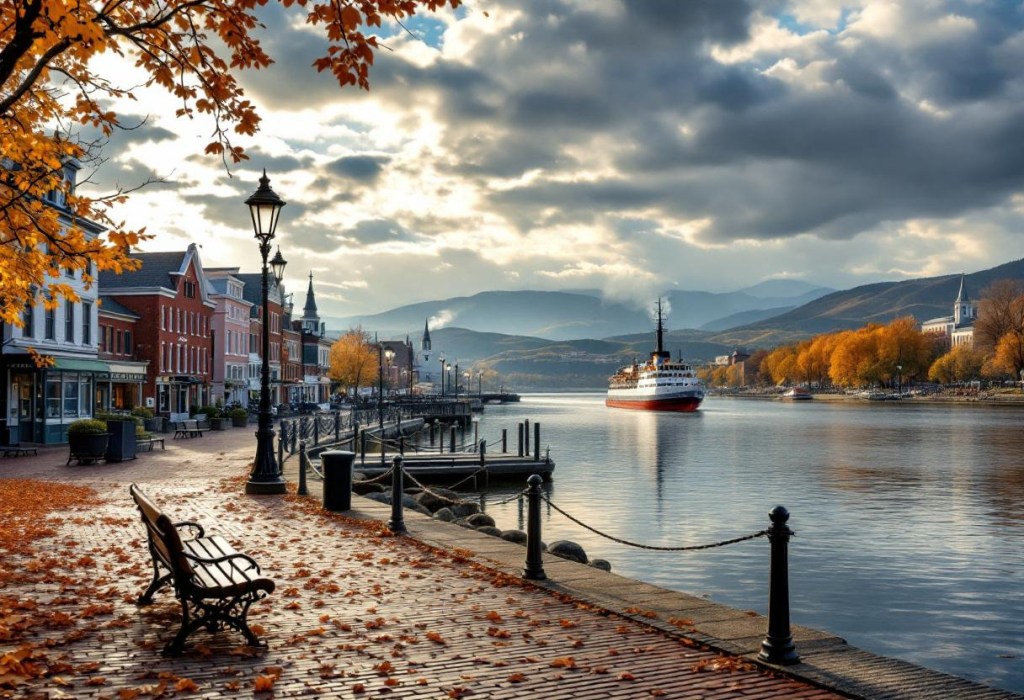
If she were here – on a harbour bench, November light doing its long, slanted work across the Delaware – I think I’d want her to know that her presence in that photograph, her unnamed persistence, has given me something I didn’t know I needed. A reminder that courage isn’t always dramatic. That sometimes it’s just the decision to stay visible when erasure would be easier. That survival, when conditions deny you every other form of authorship, is itself an act of defiance.
My late-life risks are small. But they’re acts of gratitude for those who had far less room to choose, who made the larger journeys so that people like me – daughters of Nevada change girls and Washington bus drivers – could have the luxury of worrying about watercolour paper and whether to say yes to Saturday coffee.
That seems, somehow, like enough for one Thursday evening.
The harbour is darkening now, the kind of November dusk that arrives without asking permission. Tomorrow I’ll walk past the museum again, probably pause at that daguerreotype, probably won’t learn her name. But I’ll keep showing up to the work – the stillness spaces, the consulting room, the ordinary architecture of care – and hope that counts for something in the ongoing conversation between what was and what might yet be.
If you could meet a historical figure, I’d choose her. The woman with no recorded name, only a face in a photograph and the echo of a river crossing. Not to extract her story, but to offer what I can: attention, a bench, and the simple acknowledgment that she was here, that it mattered, that someone is still learning from her quiet refusal to disappear.
Catherine
Bob Lynn | © 2025 Vox Meditantis. All rights reserved.

 Vox Meditantis
Leave a comment