What’s your favorite month of the year? Why?
Tuesday, 18th November 2025
If the year insists on a favourite, mine is October, though it never looks like a sensible choice. It behaves less like a destination and more like a corridor laid between brighter rooms, and perhaps that is precisely why I keep finding myself most alive there.
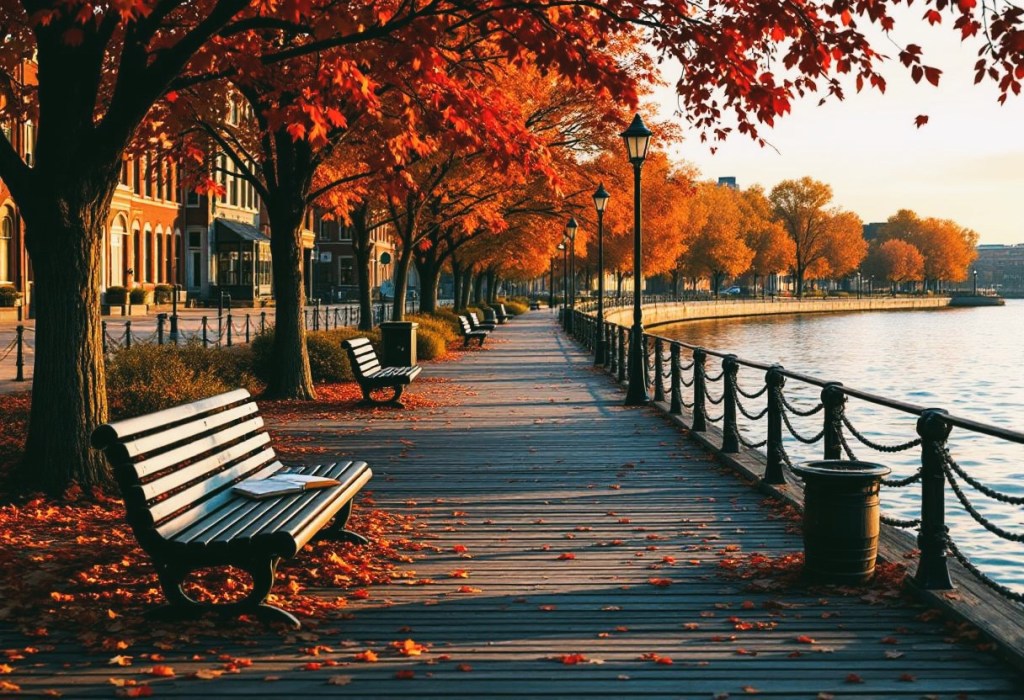
The harbour light was already withdrawing by half past four this afternoon, the kind of mid‑November retreat that makes even my high Victorian windows look slightly apologetic. Downstairs, the consulting room had just finished its usual work – grief and irritation and shy hope folded into notes for next week – when I noticed the way the thin sun fell across my desk calendar, lingering on last month as if it hadn’t quite finished with me. October looked crowded in a way June never does: small pencilled stars in the margins, arrows crossing out old plans and inserting new ones, evidence that I’d been, by my own cautious standards, unnervingly active.
Todays writing prompt sits on the corner of the blotter, polite but insistent: What’s your favourite month of the year? Why? It ought to be one of the glamorous ones – June with its long evenings, or May when the harbour smells of possibility rather than damp rope – but my eye kept snagging on those October annotations like a finger on loose thread.
An October montage
If I were unkind, I’d describe this autumn as a sequence of small administrative tasks, none of them remarkable on paper. But replayed as a kind of internal newsreel, October has started to look suspiciously like the month I stopped rehearsing bravery and attempted the smallest possible version of it.
First frame: a Tuesday morning between patients, the harbour still smudged from overnight rain, when I composed and actually sent a message to Maggie at the Historical Society. She’d mentioned, over coffee and museum floor plans, that she needed participants for an oral‑history project on New Corinth’s professional life – teachers, shipyard foremen, clergy, clinicians. For weeks I’d nodded, pleased in principle, quite certain she meant other clinicians, the sort who don’t mind their own faces ending up in archives. Then one mild October morning I wrote, with more equanimity than I felt, If you’re still looking for participants, I’d be willing to be interviewed. I pressed send before I could talk myself out of it, and immediately felt as though I’d opened a window in a room I’d grown used to breathing in.
Next: the telephone call to Harbour Street Community Centre. I’d been walking past the Tuesday evening watercolour class for years, watching people bend over paper under good fluorescent light, the way their shoulders looked looser when they emerged. Mother would have signed up the first week, turned up with the wrong brushes, and charmed three people into lending her the right ones before the first wash dried. I, on the other hand, had perfected the art of walking by with an expression that said perhaps someday. On a dull Thursday in early October I picked up the phone between sessions and heard myself say, Yes, the Tuesday watercolour class – do you have room for one more absolute beginner? They did.
Then there was the message to David about the Bartók. He’d mentioned the concert in passing at the café, the way one mentions the weather or council roadworks, quiet and a little tentative: I’ve heard the violinist is extraordinary, are you thinking of going? In the past I might have let the suggestion drift off into the Delaware air, storing it under pleasant hypotheticals. Instead, one Tuesday afternoon with October light treating the harbour like something worth keeping, I wrote, If you’re still planning to attend the Bartók on Thursday, would you like to sit together? It was a small sentence that required the full co‑operation of my cardiovascular system.
And, tucked in among clinic notes and river clean‑up reminders, the neat little rectangle of an email confirmation from a hotel in Québec City. I’d read about the place months earlier – a modest inn above the Saint Lawrence, autumn trees doing their best impression of stained glass – but had filed it firmly under lives lived by other people. On the fourteenth, after a morning of listening to other people yearn for lives a fraction braver than the ones they were living, I brought up the booking page. Dates, card details, a long pause over the button, and then: Confirm. The screen flickered its bureaucratic approval, and I sat back in my chair feeling both foolish and oddly expanded, as though my life had grown half a size without consulting me.
None of these moments would make a year‑in‑review montage, much less a memoir. But together they have given October a particular texture – like a corridor in which, for once, I kept opening doors rather than admiring how neatly they were framed.
The months that look like endings
The more interesting question, of course, is why all of this happened in October rather than in some self‑respecting season of beginnings. Why do I seem to come most alive when the trees are losing things and the evenings arrive indecently early, instead of in the showier brightness of summer when everyone else appears to be thriving on command?
Part of it is sheer physiology. Summer in New Corinth has always felt slightly performative – tourists and festivals and the social expectation that one ought to be having a marvellous time at the harbour, preferably in linen. My temperament has never entirely complied. By July the light feels almost interrogatory, as if it’s asking for proof that one is making the most of things. October, by contrast, makes no such demands.
Its light slants. It forgives. It understands that some of us need endings to begin.
There is also the quieter fact that my work moves to a different register in autumn. The frantic summer crises – exams, family holidays, unexpected romances that burn through July and collapse in August – have largely resolved, or imploded. By October, people arrive in the consulting room with less theatre and more truth. They’re tired. The year has shown its hand. We begin, together, the sort of work that doesn’t fit easily into New Year’s resolutions.
Perhaps it’s unsurprising that my own courage tends to follow the same schedule. When the harbour looks like hammered copper and the boardwalk smells of wet wood, it becomes easier to admit the things I’ve been postponing – not just clearing Mothers belongings, though that remains the longest running deferral – but the quieter acts of self‑authorship I’ve been leaving in the wings.
Elizabeth’s leaps, Joseph’s routes
October has always felt, in some obscure way, like my parents’ month. Mother would have loved it here – the neon of Nevada traded for the mellower lights along Harbour Street, the way the town seems to dress itself for departure without quite going anywhere. She had a positive genius for choosing adventure over prudence: midnight drives into the desert, new dances, new recipes, new friends acquired in the time it takes most people to find a parking space. For her, risk was less a category than a default setting.
Father, by contrast, was the patron saint of reliable routes. First in Washington, D.C., then here in New Corinth, his life was organised around timetables, bus lines, the dignified art of getting people where they were going without incident. He would have appreciated October’s punctuality – the way the clocks change on schedule, the satisfying symmetry of evenings drawing in when they are supposed to.
I’ve spent most of my adult life oscillating between these two inheritances. Professionally, I’ve followed my father: steady practice, predictable hours, responsible decisions that make good sense on paper and are therefore notoriously hard to argue with. Privately, I’ve longed – quietly, and usually in theory – for my mother’s willingness to book flights before considering her bank balance, to say yes to unvetted invitations, to walk into rooms without rehearsing her exit.
This October has felt different precisely because I tried, however tentatively, to hold both legacies at once. Volunteering for Maggie’s interview was my mother’s voice: Oh, go on, tell them a story or two – it won’t kill you. Choosing a regular weekly commitment to watercolour class, rather than a one‑off workshop I could easily cancel, was my father’s: routes, Catherine, not stunts. Inviting David to Bartók carried her appetite for connection into his quiet, careful world, while booking Québec with enough notice to rearrange my clinic hours without abandoning anyone felt like something my father might have secretly admired.
For the first time, October has looked less like a month I endure between tourist season and winter, and more like a shared project with the two people whose contradictions built me.
Inheritance and audit
None of this, however, happened in a vacuum. The same month that found me pressing Confirm on a Québec hotel also delivered a different kind of envelope, this one bearing the Historical Society’s letterhead and my mother’s maiden name in small, tidy type.
Maggie had warned me, gently, that some of Elizabeth’s early correspondence had surfaced during a donation review – a cache of letters from Nevada days, written to a New Corinth friend who later became involved with local archives. They’d been boxed and mislabelled for decades, quietly waiting in a storeroom while I walked past the building on my way to the harbour, occasionally wondering whether my mother had ever quite existed before New Corinth or whether she had simply arrived fully formed, with charm and recipe cards.
When Maggie placed the first photocopy on the table between us – a page of my mother’s handwriting, young and looping and full of desert weather reports – I experienced something closer to cross‑examination than nostalgia. October became, in that moment, both inheritance and audit.
Here was the woman whose boldness I’ve been using as both inspiration and excuse. In her letters she sounds exactly as I’d imagined – teasing and affectionate, with a gambler’s comfort around uncertainty – but also more conflicted than the family myth allows, noting nights when the neon felt more like interrogation than glamour. Reading her at twenty‑something, still working the casino floor, wondering aloud whether this life would give her anything she could pass on, I felt a peculiar tightening of the accounts.
What, exactly, have I done with the life her risks purchased? Have I honoured my father’s steadiness, or have I occasionally hidden inside it? Is my careful, well‑respected practice in this harbour town an expression of their combined legacy, or a hedge against the parts of it that scare me?
These are not questions one can answer in a single month, however well intentioned. But their arrival in October, alongside my modest flurry of bookings and invitations, made the season feel less like a mood and more like a set of gently slanted scales.
October as corridor
So when todays prompt asks about a favourite month, what it’s really probing is when, in the year’s turning, I feel most aligned with the life I’m actually living rather than the one I occasionally perform. October wins, not because it is prettiest, but because it behaves like a hallway I have finally stopped hurrying through with my head down.
It is the month where the year’s story becomes legible enough to read back. There is still time, just, to adjust the ending. One can add a class on Tuesday evenings, a flight north, a chair moved closer to the window in the consulting room, an extra place at the kitchen table.
October is the place in the year where both my parents seem to walk beside me – Mother urging, “Try it, what’s the worst that happens?” and Father reminding, “You can alter the route without abandoning the passengers.” It is also when the archives seem most talkative, sliding my mother’s letters across polished tables and asking, without accusation, And what will you write back, in the choices you make now?
A corridor is not, traditionally, where one lingers. It is where coats are shrugged off, where one decides whether to turn left into the kitchen or right into the sitting room, where visitors hesitate to see whether they are truly welcome or merely tolerated. For years I’ve treated October this way – something to be moved through en route to the supposed clarity of winter or the festive obligations of December.
This year, the corridor has acquired furniture. An easel on Tuesday nights. A reserved seat at a concert, with someone beside me who washes dishes as if practising a sacrament. A signed consent form for an interview in which I am the one answering questions rather than asking them. A booking reference for a small room overlooking a river that is not the Delaware, where I will be no one’s psychiatrist for three days.
Next October’s table
If October is my favourite, it is because it has finally convinced me that corridors are where lives actually pivot – quietly, in the act of deciding whether to open or close a door. Summer is all façade and sunshine; October is where contracts are signed, emails are sent, and one dares to imagine a life very slightly less defended.
By this time next year, if courage holds at even its current modest levels, I hope the month will contain more than a sequence of solo experiments. I would like my kitchen table – currently excellent at hosting notebooks and risotto for one – to have, by next October, more than one person who appears there regularly enough to have a preferred chair. Perhaps David, with his careful hands and unexpected laughter. Perhaps Jenny, libation of tea in hand, editing my evasions as if they were catalogue entries. Perhaps even one of my far‑flung relatives, curious to see what sort of life the youngest Bennett has built at the edge of this small harbour.
Favourite month, then, is less a verdict on weather than a declaration of intent. October is when I seem most willing to live as though time is not infinite, as though delays are not always virtuous, as though corridors deserve more than hurried footprints.
Summer can keep its confident light. Give me instead the slanting afternoons of October and early November – the months that look like endings but keep turning out to be beginnings with better manners – and the chance, next year, to answer this same question with a table slightly more crowded than it is tonight.
Catherine
Bob Lynn | © 2025 Vox Meditantis. All rights reserved.

 Vox Meditantis
Leave a comment