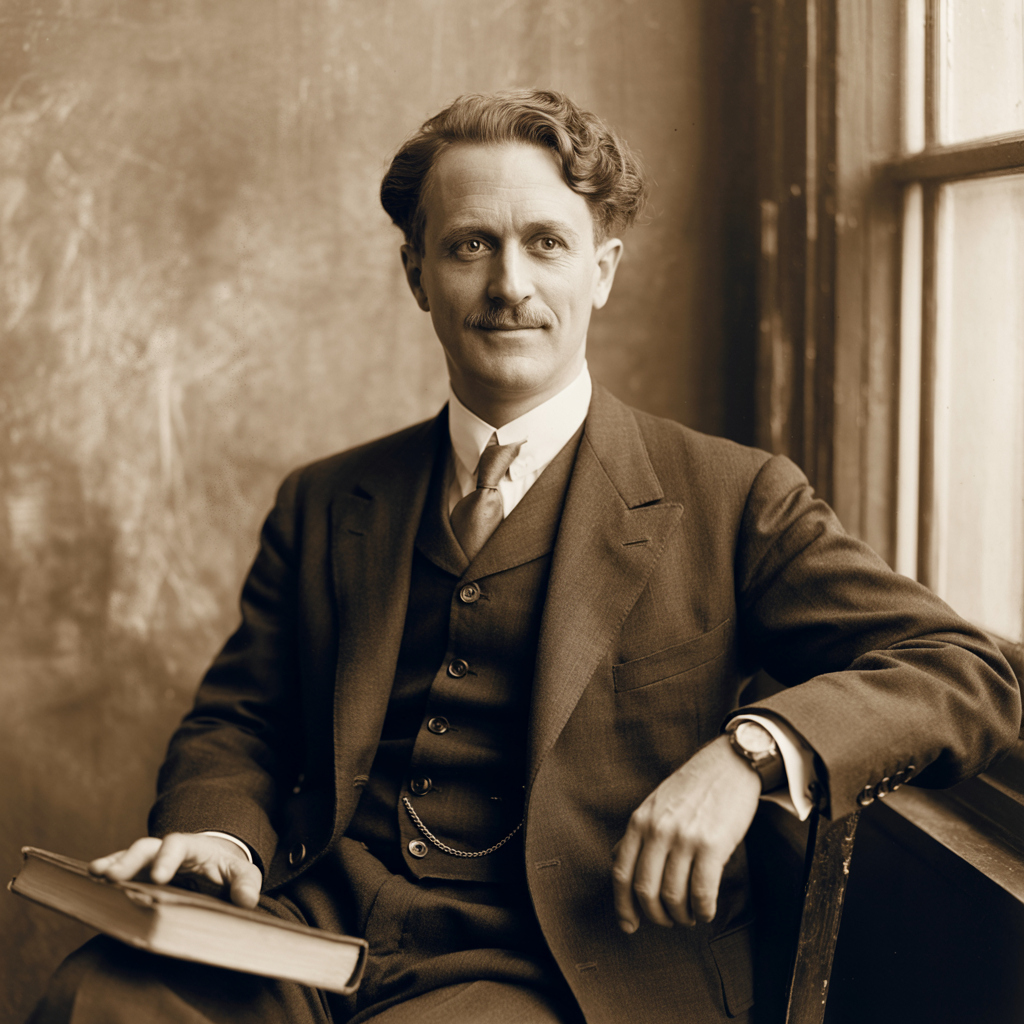
What part of your routine do you always try to skip if you can?
Monday, 12th November 1906
Took the boys to the old Netley Abbey this afternoon, that great skeletal ruin upon the Southampton Water, where the wind sings through Gothic apertures and ivy swarms up what was once the glory of the Cistercians. The silence there is not true silence at all – it is a kind of breathing hush, punctuated by the cries of gulls and the distant throb of steamers making their way down to the Solent. Young Frederick asked me why the monks left their stones to fall, and I told him that knowledge outlasts its houses; that what was learnt in prayer and manuscript endures even when the walls do not.
We spread our luncheon upon a lichened slab that might once have borne a saint’s effigy. The boys chattered about their lessons – Latin declensions, the names of the constellations, the weight of a cubic foot of water – and I found myself quite giddy with pride at their eagerness. Then I told them the news from this morning’s paper: that in Paris, at the Château de Bagatelle, a Brazilian gentleman named Santos-Dumont has this very day flown a queer contraption of his own devising – an aeroplane, they call it – some two hundred and forty yards through the air, sustained aloft by its own engine and wings. The boys’ eyes grew wide as saucers. “Higher than this arch, Papa?” asked little Arthur, pointing upward at the roofless nave. “Perhaps twice as high,” I said, “and carried along for more than twenty seconds before it came to earth again.”
We fell silent then, all three of us, listening to the wind whistle through the broken tracery. It seemed to me that the very stones were listening too, as if the monks who once walked here in contemplation might marvel at what the modern world contrives. I thought of the care required to build such a machine – the draughtsmanship, the mathematics, the patient trial and error – and it struck me that this is what I hope most to instil in my sons: not mere facts, but a hunger for understanding, a joy in the pursuit of what is not yet known.
A confession, written small: If I am honest, there is one element of my daily round I should gladly omit were it not for the scandal it would cause. Each morning I am expected to shave with cold water before the fire is properly laid, a Spartan discipline my own father imposed and which I maintain more from habit than conviction. I confess I linger over my tea and delay the razor as long as decency permits, hoping the kettle might be boiled a second time and a jug of hot water smuggled upstairs. The boys do not yet suffer this particular mortification, but I suppose it awaits them in due course.
We tarried until the light began to fail and the ruin took on that eerie, silvered quality peculiar to November dusk. Frederick asked whether the flying machine might one day carry men across the Channel, and I allowed that it might – that what seems fanciful today may be commonplace for his children. As we walked back through the fallen choir, our boots crunching upon the gravel, I was struck by the strange kinship between this ancient wreck and the fragile, stuttering aeroplane in Paris: both testaments to man’s reach, one towards heaven in stone, the other towards heaven in flight.
The boys chattered all the way home, their voices bright against the gathering dark.
Edwardian era aviation saw a milestone on 12th November 1906, when Alberto Santos-Dumont’s 14-bis achieved Europe’s first officially recognised, sustained powered flight at Bagatelle, covering about 220 metres at roughly 6 metres height in 21.5 seconds before landing before a large public audience. This followed his shorter prize-winning hop of 60 metres on 23rd October 1906 and earlier trials that year near Paris, developments closely watched by European clubs recording standards. The feat energised continental aviation, influencing peers and public demonstrations, and was soon followed by further trials until early 1907, after which the 14-bis was abandoned as designs rapidly evolved. The flight’s significance lies in its public, ratified status, helping to normalise heavier‑than‑air flight in Europe and accelerating competition, record‑keeping, and technical refinement.
Bob Lynn | © 2025 Vox Meditantis. All rights reserved.

 Vox Meditantis
Leave a comment