Who is the most famous or infamous person you have ever met?
Thursday, 11th November 1948
I am writing this in the back cellar of Jessop’s warehouse, down by Tilbury Dock. The door is bolted and I have wedged a crate against it besides. The smell of damp rope and coal dust is thick enough to taste, but I dare not go upstairs until I am certain the customs men have moved on to Warehouse Seven. I heard their boots on the cobbles not twenty minutes past, and the particular sharp rap of their torch handles against the iron shutters. They are looking for something, or someone. I do not intend it to be me.
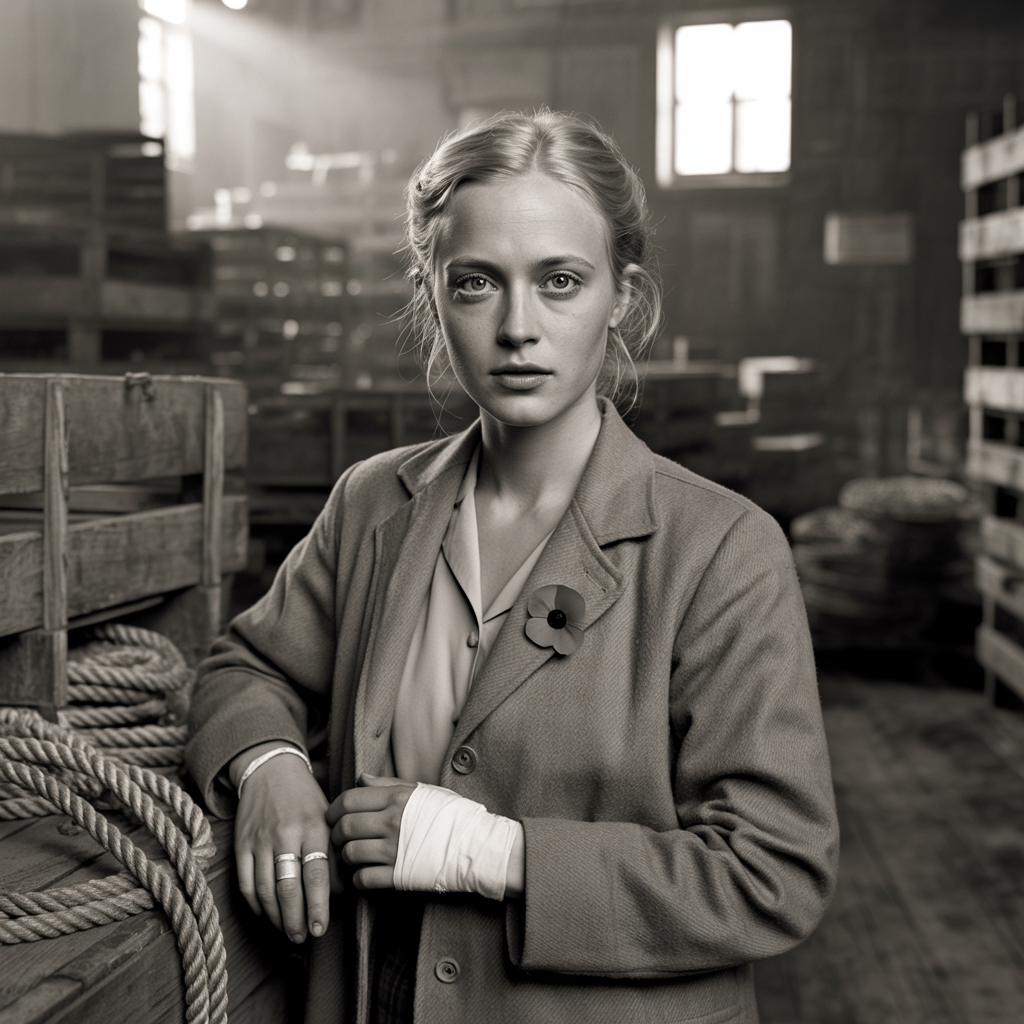
The two minutes’ silence at eleven o’clock caught me unawares. I had been counting bales in the loading bay when the siren went up from the docks, and every man and woman stopped where they stood. I could hear the creak of the cranes stilling, and the slap of water against the wharfside. Even the gulls seemed to hold their noise. I stood with my head bowed amongst the Baltic timber and the tea chests from Ceylon, and thought of my brother Arthur, who did not come back from Normandy, and my father, who came back from the Somme but never truly left it. The poppies on the memorial by the dock gates were bright as fresh blood this morning – some wag had piled them so high they spilled onto the pavement. Blood and sacrifice. That is what they call it in the newspapers, as if the words could make clean what was waste and ruin. I cut my hand badly on a packing crate this afternoon, and the blood ran down into the sawdust and turned it rust-brown. It is a small enough price, I suppose, set against what was paid.
The wireless this morning carried the service from the Cenotaph. I listened to it in Mrs. Kowalski’s café before the docks opened, nursing a cup of tea that was more milk than anything else. The King was there, and Mr. Attlee, and all the great men in their black coats and poppies. The Last Post sounded thin and distant through the wireless speaker, competing with the clatter of crockery and the hiss of the tea urn. Mrs. Kowalski wept into her apron – her husband was at Monte Cassino and she has not spoken of him since. I did not weep. I have learned to keep my face still and my thoughts to myself. In my trade, a loose tongue or a readable expression can cost you dear.
I am more watchful than ever these days. The permits and coupons are a maze, and the Ministry inspectors are everywhere, sharp-eyed and officious. There is talk of a crackdown on the black market, and I know that Freddie Marsh was pulled in last week for selling Utility cloth at twice the fixed price. They let him go with a caution, but his name is noted now, and that is as good as a brand. I deal in small things – tins of meat from the American supply ships, nylons when I can get them, sometimes a bolt of fabric that has “fallen off” a lorry near the East India Dock Road. Nothing to hang me, but enough to make me cautious. I keep my ledgers in code and my cash in three separate places. Trust no one, my father used to say. He learned that at Ypres, and I have learned it at the docks.
The question came to me this afternoon, as I was sitting on an upturned crate waiting for the customs men to pass: Who is the most famous or infamous person I have ever met? It is not a question I have considered before, but the answer came quick enough. It was Mr. Ernest Bevin, the Foreign Secretary, though I did not know who he was at the time. It was in the winter of ’45, just after the war ended, and I was queueing for coal at the depot in Poplar. The queue stretched halfway down the street, and we were all of us frozen and tempered short. A big man in a shabby overcoat came and stood behind me, and after a bit he began to talk – about the docks, and the unions, and the need to rebuild. He had a docker’s hands and a docker’s way of speaking, blunt and plain. I told him I was hoping to start a small haulage business, moving goods between the docks and the railway yards, and he said, “Good luck to you, girl. We’ll need every hand we can get.” It was only later, when I saw his picture in the Daily Herald, that I realised who he was. I do not know if that makes him famous or infamous – some say he is a great man, others that he is too cosy with the bosses and the Americans. I only know that he spoke to me as one docker to another, and did not look down his nose.
But it is movement that occupies me most these days – the coming and going of ships and trains and lorries, the timetables and routes and cargoes. I have a list of departure times tucked into my stocking top even now: the SS Rotterdam sails for Hamburg at dawn tomorrow, and the night goods train to Birmingham leaves Euston at half past midnight. There is a lorry driver named Harris who will take a load to Manchester for thirty shillings and no questions asked, and a barge captain on the canal who owes me a favour. I think constantly of where I must go next, what I must move, which roads are safe and which are watched. The Berlin Airlift is all over the wireless – planes flying day and night to break the blockade, coal and flour and tinned milk dropping from the sky. It makes me think of my own small loads, my tins of corned beef and my contraband soap, and I wonder if there is much difference between them and those great lumbering aircraft, except in scale. We are all of us shifting cargo from one place to another, trying to keep body and soul together in a world where everything is rationed and controlled and watched.
The customs men have gone now. I can hear the ordinary clatter of the docks resuming – the clang of winches, the shout of the foremen, the rumble of lorries on the cobbles. I shall fold this diary away behind the loose brick in the cellar wall, where I keep my other papers, and go back upstairs. There is a shipment of tinned ham coming in on the afternoon tide, and if I am quick and careful I can have half of it loaded onto Harris’s lorry before the tally clerk notices the discrepancy. It is not honest work, perhaps, but it is the work I have, and I am good at it.
They say the Princess is due to give birth any day now. The whole country is waiting, and the newspapers are full of it. New life, they call it, and hope for the future. I do not begrudge them their hope. But I will keep my ledgers in code and my cash hidden, and I will watch the docks and the roads and the men in uniform. That is how I survive. That is my own small sacrifice, if you like – not blood on a foreign field, but a life lived in the shadows, always moving, never quite still. I think of Arthur, who gave everything, and my father, who gave too much and was left hollow. I give what I can, which is vigilance and cunning and a head for figures. It is enough. It will have to be.
The light is fading now. Time to go.
In post-war Britain of 1948, the nation was rebuilding amid rationing, housing shortages, and economic austerity following victory in the Second World War. Food and clothing remained tightly controlled, fuelling a vigorous black market that thrived around the docks. Overseas, the Berlin Airlift was underway, as British and American aircraft delivered supplies to West Berlin in defiance of the Soviet blockade. At home, the newly founded National Health Service marked the beginning of a modern welfare state. Within two years, rationing would start to ease, and Britain’s recovery – symbolised by the birth of Prince Charles that same month – began to take shape.
Bob Lynn | © 2025 Vox Meditantis. All rights reserved.


Leave a Reply