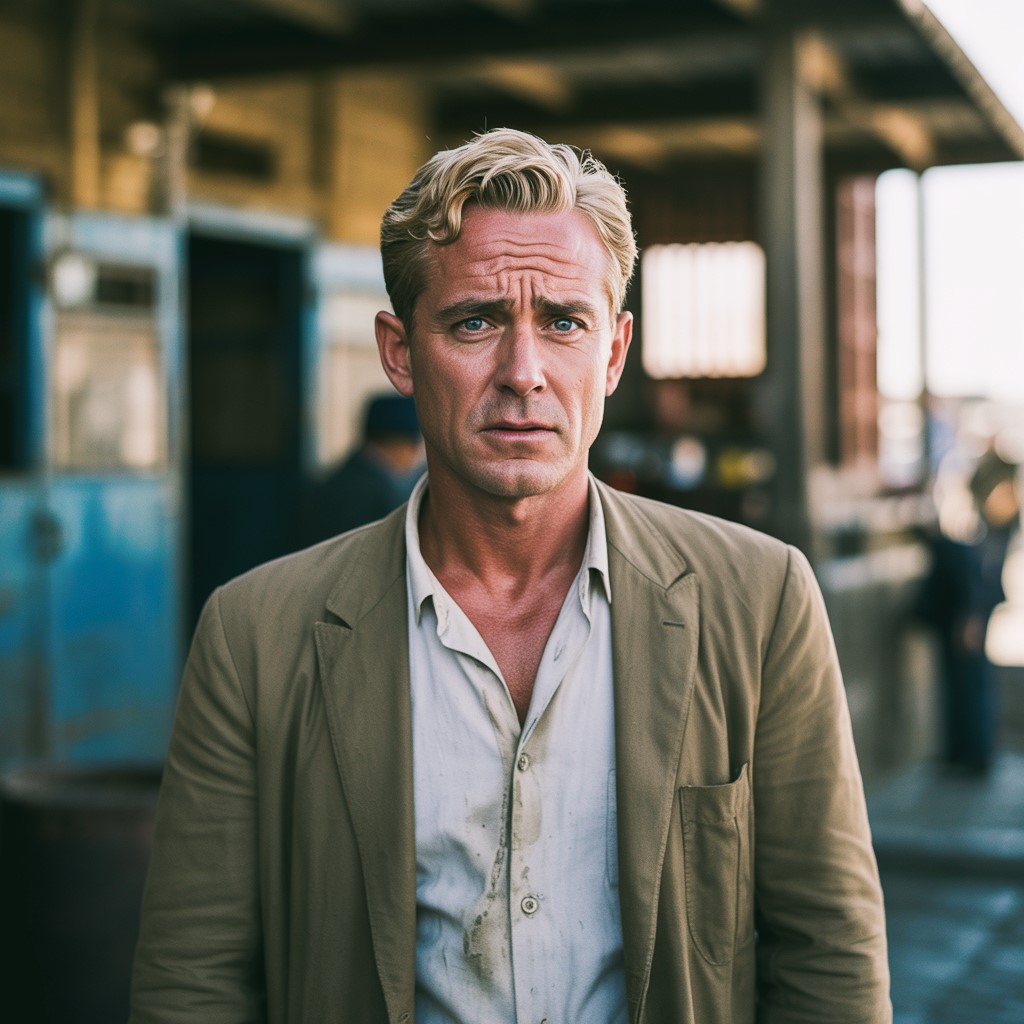
Thursday, 4th November 1954
Port of Oran, past seven o’clock
The crossing to Marseille has been delayed again. Three days now I have sat in this miserable customs shed whilst they turn over every crate and bale, and the queue of lorries stretches back to the main gate like penitents waiting for absolution they shall never receive. The officials are pale and short-tempered. One can smell their fear beneath the pomade and cigarette smoke.
I ought to have left on Tuesday. Matthews wired from Algiers on Monday evening – trouble in the Aurès, attacks on the gendarmerie – and advised all British traders to make arrangements promptly. I thought him an alarmist. The last steamer of the month was already full, and I had two contracts yet to settle: one for cork, another for esparto grass. Good margin on both. Now the cork sits in a warehouse under armed guard, and the grass merchant has not been seen since Wednesday morning. His son came to the hotel, a boy of perhaps sixteen, and pressed a canvas pouch into my hands without a word. Inside: his father’s papers, a small brass key, and a folded note asking me to settle the man’s account with a supplier in Sidi Bel Abbès. I have the pouch in my jacket now. It weighs more than it ought.
The wind off the harbour carries dust and the smell of iodine. Everything here tastes of salt and sand. This morning, waiting in the queue, I watched a soldier scrape the red earth from his boots with the edge of his bayonet, methodical, almost tender, as though the soil itself were evidence of some crime. When he caught me looking he turned away.
They are searching for weapons, of course, and leaflets, but one senses they are searching for something less tangible: proof of loyalty, or guilt. My passport is in order. My trade is legitimate. Yet when the inspector holds each invoice to the light and asks where I acquired this shipment, or who vouched for that supplier, I feel the tightness in my chest that comes when one has done nothing wrong but cannot prove it.
I think often now of what Father used to say: that a merchant’s fortune rests not on goods but on trust, and trust, once broken, cannot be soldered back together like a cracked beam. I wonder what he would make of this place, these men with rifles at every corner, the shuttered cafés, the silence after curfew falls.
At noon the harbour master called us into his office – myself and four others, all with cargo waiting to be cleared. He is a thin Frenchman with a grey moustache and ink-stained fingers. He did not sit. He told us, in careful English and then again in French, that loading would resume tomorrow, God willing, but that manifests must now be counter-signed by the military governor’s office. He did not say why. He did not need to.
Afterwards, on the steps outside, one of the others – a wine exporter from Philippeville – asked me in a low voice what I thought would happen. I said I did not know. He said his wife had left for Marseille a week ago with their two daughters. He said he would follow as soon as his bonds were released. Then he asked me: What will your life be like in three years?
I had no answer. I wanted to say: safe, solvent, back in Surrey with a garden and no barbed wire. But three years is an age in this trade. Three years ago I was in Cairo during the riots. Three years before that, Benghazi. I have made my living at thresholds, at the points where one world meets another, where goods and currency and risk change hands. I do not know if such places will exist in three years, or if men like me will be welcomed at them.
What I did say, in the end, was this: I should like to be somewhere I do not need a travel pass to walk to the post office.
He laughed, though it was not a happy sound.
The steamer is due at first light. If it arrives, and if my papers clear inspection, I shall be aboard. If not, I shall wire London and wait for instructions. I have done what I can for the grass merchant’s son. The rest is beyond my control.
It is nearly dark now. From the window I can see the lights of the naval vessels in the roads, and beyond them the open sea. Somewhere out there is the life I mean to return to. But tonight the distance seems very great indeed.
Mid-1950s French Algeria saw mounting tensions that erupted on 1 November 1954, when the FLN launched coordinated attacks beginning the Algerian War of Independence, leading to curfews, tightened controls, and mass searches in ports like Oran. France responded with emergency measures and military deployment, framing the conflict as a security operation rather than a decolonisation struggle at first . Over the following years, violence escalated on all sides, with reprisals, bombings, and widespread detentions, reshaping daily life and trade across frontiers . The war lasted until the 1962 Evian Accords, which secured Algerian independence and triggered a vast exodus of European settlers and many loyalist Algerians to France.
Bob Lynn | © 2025 Vox Meditantis. All rights reserved.


 Vox Meditantis
Leave a comment