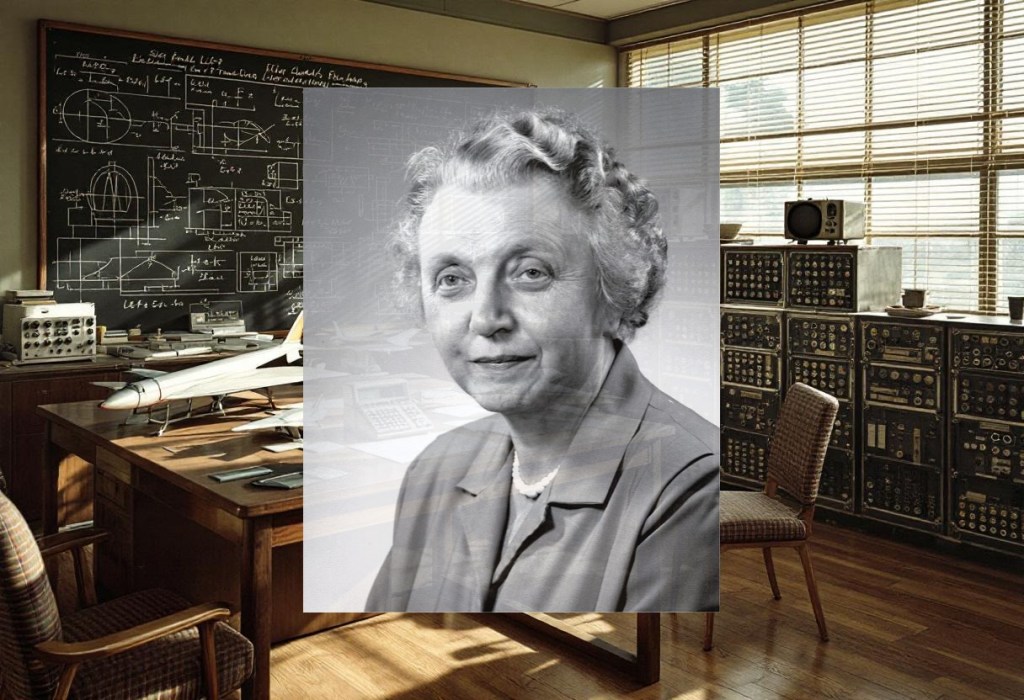
Irmgard Flügge-Lotz (1903–1974) was a German-American mathematician and aerospace engineer whose work transformed how we understand flight itself. At twenty-eight years old, working alongside Ludwig Prandtl at Göttingen’s Aerodynamics Research Institute, she solved a differential equation that had eluded one of the twentieth century’s greatest minds for more than a decade – the problem of calculating lift distribution across aircraft wings. Later in her career, she pioneered the theoretical foundations of discontinuous automatic control systems, the on-off switching mechanisms that govern everything from thermostats to spacecraft guidance. Yet despite these epochal contributions, she spent twelve years at Stanford University holding the rank of lecturer – teaching doctoral students, conducting groundbreaking research, and publishing revolutionary work – while performing every duty of a full professor, none of the title, and none of the pay. Her story illuminates both the architecture of flight and the architecture of erasure.
Professor Flügge-Lotz, thank you for joining us today. I should say straightaway that we’re speaking in 2025, fifty-one years after your passing, in a world quite different from the one you left. Aircraft have become nearly automated. Satellites control themselves. Yet your name remains far less known than it ought to be. Before we discuss the why of that, I wonder – what drew you to mathematics and aerodynamics in the first place? You came of age in Weimar Germany. That was not an obvious path for a girl.
No, it was not. But I think from very young, perhaps six or seven, I wanted a life which would never be boring. Mathematics offered that. There is always another question to ask, always another layer beneath the surface. My father was a professor of chemistry, so there was encouragement – not commonplace, but real. He did not discourage me when I announced I would study engineering. He said, very simply, “Then you must be twice as thorough as the men.” I took that literally. Twice as thorough. It became a habit.
I remember the Technische Hochschule in Hanover – I was often the only woman in the lecture hall. Sometimes I was the only woman in the entire building. One morning, a secretary refused to bring me tea because I was “doing men’s work” and she said it would be improper. I was twenty-three years old, exhausted from calculations, and I thought: This woman is protecting me from tea. I brought my own tea after that. And I kept my door open and my results visible. That is what you do. You make the work impossible to ignore.
You earned your doctorate in 1929 – the only woman in your cohort to do so. Immediately afterward, you joined AVA, Prandtl’s institute. That’s where the Lotz method emerged. Can we talk about that problem? What was Prandtl actually stuck on?
Ah, now this is the heart of it. You must understand: in those years, aerodynamic theory and practice were almost strangers to each other. We had good mathematics – Prandtl’s boundary layer theory was revolutionary – but translating theory into something an aircraft designer could use to build a wing? That was the gap.
The specific problem concerns the spanwise distribution of lift along a wing. Imagine you have a finite wing – not infinite, as mathematicians love to pretend. The lift is not uniform from root to tip. It’s stronger near the root, weaker toward the wingtip. This distribution depends on the wing’s geometry and also on the mutual interference between different sections of the wing. It’s a circular problem: you need to know the lift to find the pressure distribution, but you need the pressure distribution to find the lift.
Prandtl had proposed the lifting-line theory as a simplification. The idea is elegant: treat the three-dimensional wing as a line, replace its aerodynamic influence with a distribution of vortices along that line. Very clever. But calculating that vortex distribution rigorously? He could not close the equation. It required solving an integral equation – a very difficult integral equation.
And you solved it?
I solved one version of it, yes, but more importantly, I transformed it into something that engineers could actually compute. I reduced the problem to a series of simple arithmetic operations – what we would now call a computational algorithm. Instead of attempting the full integral, I approximated it by dividing the wing span into segments. For each segment, I could solve the relationship iteratively. It took months of calculation by hand, with pencil and paper and a good deal of coffee. But once you had the method, a draftsman – not even necessarily a mathematician – could apply it to any wing shape.
The beauty was in making the complex calculable. That is something people do not always understand about applied mathematics. The elegance is not in the abstraction; it is in reducing abstraction to practice.
How much faster was it compared to what people had been attempting?
What people had been attempting, frankly, was to avoid the problem. They used rough approximations or empirical tables based on limited wind tunnel data. My method? A skilled calculator could work through a complete wing design – several span sections, different geometric configurations – in perhaps a week. Previously, that work required months of wind tunnel testing or remained impossible. The accuracy was also superior: the method predicted lift coefficients to within perhaps two or three percent of experimental values, which was remarkable for the 1930s. Suddenly, designers could explore multiple wing configurations on paper before building a single model.
It became known as the Lotz method – that part I did not ask for, but I admit it has a certain tidiness to it – and within a few years, it was standard in aeronautical engineering offices across Europe and America. Even now, I’m told, it remains foundational to how engineers understand finite wing performance.
In 1937, Prandtl nominated you for a research professorship. You had already published thirteen papers and solved what he could not. And the Reich Aviation Ministry rejected it.
Yes.
I’m going to ask something directly: what was that rejection like, knowing the reason?
It was not surprising – I suppose that is the most honest answer. By 1937, the policies were already clear. Women could work, but not lead. We could solve problems, but not direct others. When the letter came, my first thought was not anger; it was relief that I need not pretend the reason was anything but what it was. The lie would have been worse than the rejection.
But yes, there was anger beneath that relief. I had done the work. Better than that, I had done work that Prandtl – Prandtl! – could not do. And a bureaucrat in Berlin decided that my sex made me unsuitable to lead a department. The tragedy is not personal vanity; it is that the Institute lost the chance to organise its research differently, and other young women saw that title and security were impossible, no matter what they achieved.
Wilhelm and I began to think at that time about leaving Germany. We did not know how much worse it would become. We only knew it was becoming worse.
You took a position at Deutsche Versuchsanstalt für Luftfahrt – DVL – in Berlin in 1938, after marrying Wilhelm. But your title there was “scientific advisor for aerodynamics,” which is to say, not a professorship. Not a leadership role.
A title that sounded important and meant nothing. I advised. I did not direct. I did not chair meetings; I attended them. It was a step backward, dressed up as a lateral move. But at DVL, there was serious work happening. The aerodynamics were sophisticated. And Wilhelm was there. In those years, that mattered very much.
During the war years – 1938 to 1944 – you both worked at DVL, which was integral to Nazi aircraft development. I should ask this plainly: how do you think about that period now?
I think about it as a trap with no good exits. We were not Nazis. Wilhelm was marked as politically unreliable – that phrase followed him his entire career. We did not believe in their ideology. We did not support their war. But we were German scientists in a German institute under a German dictatorship. We could refuse the work, and we would disappear. We could attempt to leave, and we might be stopped at the border. Or we could remain, do our work with integrity, and live with the knowledge that our calculations might contribute to machines and weapons we opposed.
Hermann Göring, who was the Reichsmarschall, he cared little for ideology in matters of technical competence. That protected us. It was a twisted mercy: a war criminal’s pragmatism allowed us to survive. I am not proud of that dependency. But neither will I pretend we had choices we did not have.
I think the honest answer is: we made the decision we could live with, and I have lived with it for seventy years. It was not a decision of heroism. It was a decision of compromise in an impossible situation. Some people have suggested – even scholars examining this period – that we should have done more. Perhaps they are right. I do not defend our choices; I only describe them. History is entitled to judge them. But judgment made from safety is always easier than choice made under duress.
After the war, you and Wilhelm emigrated to America. You went to Stanford in 1948. And there you encountered a different barrier – anti-nepotism rules. You were forced into a lecturer position while Wilhelm became a full professor. You held that lecturer title for twelve years, 1948 to 1960. You supervised doctoral dissertations as a lecturer. You taught courses as a lecturer. You published major research as a lecturer. Can you describe what that was like?
It was infantilising. That is perhaps too blunt, but it is the word. I was in my mid-forties, with a doctorate and nearly two decades of publications. I was recognised internationally. I had been an advisor – however improperly titled – in Berlin. And I was placed in the lowest rank of academic employment. The pay was perhaps half of what a full professor earned. There was no security. No respect, officially. The department was kind, personally, but kindness is not the same as justice.
I established a weekly seminar in Fluid Mechanics. I taught graduate courses. I worked on discontinuous control theory, which became my major research interest in that decade. My students were exceptional – many of them went on to significant careers. But every year, when the moment came to discuss rank and title, the answer was the same: anti-nepotism rules prohibited both Wilhelm and me from holding full professorship in the same department. Both of us, theoretically. But in practice, Wilhelm was the full professor. I was the lecturer.
I asked the administration once: what if I transferred to a different department? They said the rules applied university-wide. What if Wilhelm left? The conversation never happened. The assumption was clear: his rank was non-negotiable; mine was.
How did that affect your work? Practically, scientifically?
In some ways, it freed me. As a lecturer, I had few administrative obligations. I could spend time on research and students rather than committees. But it also meant I could not shape the department’s research direction. I could not hire colleagues. I could not influence resource allocation. And I was working constantly to prove something that should have been obvious: that I belonged in the role I was already filling.
In 1960, Stanford finally appointed me full professor. I was fifty-seven. The promotion did not come because they recognised an injustice; it came because my colleagues – domestic and international – had increasingly asked the university: why is the woman who is teaching at professorial level not called a professor? The embarrassment made them act. I appreciated the appointment. I was grateful. But I was also aware that I had been promoted not because I deserved it, but because the university’s reputation suffered from not promoting me.
Let’s turn to your second major work: discontinuous automatic control theory. You published your foundational text, Discontinuous Automatic Control, in 1953. That was during your lecturer years at Stanford. Tell us about that book and why you believed this theory mattered.
The world has become obsessed with continuous control – systems that vary smoothly and infinitely. Very elegant mathematics. Very impractical for many real problems. A thermostat does not vary smoothly. It switches: heat on or heat off. A fire-control system does not modulate continuously; it acquires a target and commits to an action. Many real systems work through discrete, extreme states.
Before my work, control engineers treated these discontinuous systems as approximations to continuous ones – a kind of mathematical illegitimacy. They tried to smooth them out, to force them into frameworks that did not fit them. I thought: why not treat them as what they are? Discontinuous systems have their own mathematics, their own elegance, their own optimality conditions.
The book attempted something unprecedented: a comprehensive mathematical framework for these systems. Not approximations. Not workarounds. Real theory. I worked through the conditions under which such systems were stable, when they could achieve optimal performance, how to design them properly. It took nearly a decade of research condensed into a text I hoped would be accessible to both mathematicians and engineers.
The book was described by reviewers as “the first attempt to treat such systems in a comprehensive and general way.” That’s remarkable – you essentially invented a field.
I organised a field that already existed in fragments. The mathematics was there. The applications were everywhere. But no one had asked: what is the coherent theory underlying all of these systems? That was the contribution – not inventing the applications, but revealing the mathematical architecture beneath them.
The technical walk-through, if you’ll indulge me: consider a simple on-off control system. You have a desired state – a setpoint – and you measure the actual state. The difference is the error signal. In a continuous system, the correcting action is proportional to that error; you adjust smoothly. In a discontinuous system, you have two extreme states: full correction or no correction. The control law switches between them based on whether the error is positive or negative.
The key insight is that this switching is not crude; it is optimal under certain conditions. If you want to reach a target state in minimum time, sometimes the mathematically perfect solution is to apply maximum control effort – switch to fully on – until the error reaches zero, then switch to fully off to maintain the state. No gradual adjustment. No modulation. Extreme action, precisely timed.
The mathematics involved analysing what we call the switching surface – the boundary in state space where the control law changes. On one side of this surface, the control is full-on; on the other, full-off. The trajectory of the system approaches this surface and remains on it, moving toward the setpoint. This is called sliding-mode control now, though that terminology came later.
The book also addressed the stability of such systems – how to ensure they do not oscillate wildly around the setpoint – and the conditions under which discontinuous control is superior to continuous control. Discontinuous control often converges faster and uses less energy because it commits fully rather than modulating tentatively.
What were the practical applications you envisioned?
Guidance systems for missiles. Autopilot systems for aircraft. Fire-control mechanisms. Temperature regulation in industrial processes. Any system where you have two extreme states and you need to switch between them intelligently. The theory explained why such systems worked and how to design them to be robust and efficient.
The applications have expanded enormously since then. I’m told – and you know more about this than I do – that discontinuous control now appears in robot swarms, in satellite manoeuvring, in fuel optimisation for spacecraft. It is embedded in systems I could not have imagined. That is gratifying. It means the theory was sound enough to outlive my own imagination of its uses.
You published a second major text, Discontinuous and Optimal Control, in 1968. Your career spanned from solving differential equations in the 1930s through establishing entirely new mathematical fields in the 1960s. How did your thinking evolve across those decades?
Very slowly, at first. The Lotz method was about making the complex calculable – reducing a differential equation to steps an engineer could execute. The discontinuous control work was different; it was asking: what mathematics does this class of systems actually require? Not: how do we force this into existing mathematics?
I think I became less interested in perfect solutions and more interested in understanding what solutions were actually possible. In aerodynamics, we wanted precision – lift coefficients to three decimal places. In control theory, I learned that precision is sometimes impossible and unnecessary. You need stability; you need to reach your target. The exact path matters less.
The Discontinuous and Optimal Control book was me attempting to unite those insights. It asked: given that a system is discontinuous, what is the optimal way to operate it? Not optimal in a dream world with infinite precision, but optimal in reality. I was older then, perhaps wiser, perhaps just more pragmatic. But I thought that was the more useful mathematics.
Did you have failures? Theoretical dead-ends or approaches you pursued that didn’t work?
Of course. Plenty. I once spent six months attempting to extend the Lotz method to swept wings – wings that angle backward at the wing root. I had convinced myself there was an elegant symmetry to exploit. There was not. I eventually abandoned the approach and returned to the first-principles calculations. The work was not wasted – it clarified why certain approximations failed – but it was not the breakthrough I expected.
In control theory, I initially tried to develop a unified treatment for both continuous and discontinuous systems. I thought there was a deeper mathematical structure that encompassed both. I was wrong. They are genuinely different, and the differences matter. Accepting that – recognising that two important classes of systems needed separate theoretical frameworks – was difficult. As a mathematician, you always want to unify, to find the deeper principle. Sometimes there is no deeper principle. There are just different phenomena requiring different tools.
You became Stanford’s first female full professor of engineering in 1960. Decades later, in 2014 – forty years after your death – Stanford named you one of thirty-five “Engineering Heroes” alongside figures like Larry Page and Sergey Brin. How does it feel to be recognised posthumously?
I do not feel it much, being dead. But I understand your question. It is pleasant that the work is acknowledged. It is also melancholic. If I had been named an Engineering Hero in 1960, when I was alive and working and could have influenced younger women’s choices, that would have mattered. Recognition in 2014 is a correction of history, and corrections are valuable, but they do not change the lived experience of being overlooked.
The company you mention – Page and Brin – they are entrepreneurs. Their work created visible products; they built companies; they changed how the world searches for information. My work is embedded in aircraft design and control systems, so thoroughly embedded that it is invisible. If you fly in a modern aircraft, discontinuous control theory is working in the autopilot system. You do not see it or think about it. It simply works. That invisibility may be a form of success – the tools became so fundamental that they vanished into practice – but it also means the recognition comes differently.
Your work is having a renaissance now. Recent research from 2021 develops new nonlinear lifting-line methods that build directly on the foundations you established at Göttingen. Modern aircraft design, UAV performance modelling, computational fluid dynamics – they all trace back to your method. Modern optimal control theory, which governs everything from satellite manoeuvring to Mars Rover navigation, builds on the discontinuous control framework you pioneered. Your theory is not history; it is active infrastructure.
That is what I hoped would happen, actually. Not that they would credit me at every step – that is impractical – but that the ideas would become so integral to how we solve problems that they would feel inevitable. That is the highest form of success for an applied mathematician. You want your methods to become the unnoticed scaffolding upon which others build.
What would you tell younger women entering STEM fields today? Especially given everything you navigated – barriers in Germany, barriers in America, structural discrimination, the anti-nepotism rules, the lecturer years?
First, choose your problem carefully. Not for its prestige, but because it genuinely captivates you. The problem should be worth spending years on, because you will spend years on it. Prestige and recognition are unreliable rewards; they come late or not at all. But understanding a problem deeply, solving it thoroughly – that is reward in itself.
Second, know that barriers you face are rarely personal failings. If an institution rejects you, it is usually the institution that is failing, not you. That does not make it hurt less, but it clarifies where the problem actually lies. Do not internalise the rejection as a verdict on your worth.
Third, work. Work visibly. Publish results. Establish seminars. Teach. Create structures that make your contributions undeniable. I could not control whether I received a professorship, but I could control the quality of my work and its visibility. The disparity between what the institution called me and what I was doing became so obvious that eventually they had to adjust.
Fourth – and this is crucial – find colleagues you can trust. Not mentors, necessarily, though Wilhelm was both husband and colleague to me. I mean people who see your work fairly and will advocate for you when you are not in the room. I had such people at Göttingen, and at Stanford. Those relationships made everything survivable.
And finally, allow yourself to want a life that will never be boring. That was my aspiration from childhood. I lived that. It was not always comfortable. It was not always just. But it was never boring, and there is value in that.
Is there anything you wish the record showed more clearly? A correction or a clarification?
Yes. I wish it were clearer that the Lotz method was not my single contribution but the visible part of years of theoretical work. And I wish the wartime years were discussed more honestly in institutional histories. We worked at DVL. It was not a secret. It happened. We made choices we did not always feel good about under circumstances we did not choose. That complexity should not be erased for comfort.
I also wish it were known that I did not work in isolation. Prandtl was generous with his time and insights, even after I left AVA. My colleagues at Stanford challenged my thinking in ways that strengthened the control theory work. Wilhelm and I collaborated constantly – though, frustratingly, his name appears on some results that were entirely mine, and my name is absent from some collaborative work because of how authorship was credited in those years. The achievement is always collective, even when institutions insist on singular names.
Professor, thank you. This has been extraordinary.
Thank you for asking the questions honestly. I could have spent this time defending myself or claiming innocence I do not possess. It is better to acknowledge what happened – the achievements and the compromises and the injustices – and let that complexity stand.
Letters and emails
Following the main interview, we received a remarkable surge of correspondence from scientists, engineers, students, and curious minds across the globe – all eager to extend the conversation with Irmgard Flügge-Lotz. The questions reflected genuine intellectual curiosity: some probing the technical decisions embedded in her methods, others exploring the personal costs of ambition in constrained circumstances, still others asking what her life might counsel to those now building their own paths through similar terrain.
We’ve selected five letters and emails from our growing community, each from a different continent and perspective. They ask her about trade-offs she made in her mathematical approaches, the friction between theory and physical reality, the intellectual freedom that came with change, the landscape of ideas that preceded her synthesis, and the deeply personal question of whether she would choose this remarkable, difficult life again – knowing what lay ahead. Together, these questions reveal what readers found most urgent to understand: not just what she achieved, but how she thought, what she questioned, and what wisdom she might offer to those now walking similar paths of rigour, resilience, and recognition deferred.
Elena Marković, 34 | Aeronautical Engineer | Zagreb, Europe
You mentioned that your Lotz method reduced the integral equation to “simple arithmetic operations” that a draftsman could execute. But I’m curious about the trade-offs you made in that transformation. When you approximated the full integral by dividing the wing span into segments, how did you decide on the number of segments? Was there a point where adding more segments gave diminishing returns in accuracy, and how did you communicate that practical boundary to engineers who wanted precision?
Ah, this is an excellent question – the kind that reveals you understand the heart of applied mathematics. The trade-off between accuracy and practicality was not incidental to the method; it was the method. Let me explain how I approached this.
When I began working on the spanwise lift distribution problem at Göttingen, the theoretical framework existed – Prandtl’s lifting-line theory was already established – but the integral equation governing it was intractable for practical use. The equation required knowing the circulation distribution along the wing span, which itself depended on the induced velocities at every point, which in turn depended on the circulation distribution. A circular dependency. Solving it exactly meant evaluating an integral whose kernel was singular at certain points. Mathematically rigorous, practically impossible.
My approach was to discretise the problem. I divided the wing span into a finite number of segments – typically between five and nine, depending on the wing geometry. Each segment was treated as carrying a constant circulation strength. Instead of solving for a continuous function, I solved for discrete values at specific spanwise stations. This transformed the integral equation into a set of linear algebraic equations – one equation for each station. A draftsman with patience and a good calculating machine could solve such a system in days rather than months.
Now, to your specific question: how did I decide on the number of segments? Through trial and iteration, initially. I tested the method on wings for which we had reliable wind tunnel data – elliptical wings, rectangular wings, tapered wings. I compared results using three segments, five segments, seven segments, nine segments. What I found was that accuracy improved rapidly from three to five segments, then more gradually from five to seven. Beyond nine segments, the improvement in accuracy was negligible – perhaps half a percent – but the computational labour increased substantially because you now had nine simultaneous equations to solve rather than five.
For most practical aircraft design work, five to seven segments provided lift coefficient predictions accurate to within two or three percent of experimental values. That was sufficient. Aircraft designers needed to understand the general lift distribution pattern – where the loading was concentrated, how much induced drag to expect – not to predict it to five decimal places. The real aircraft would have rivets and paint and weather damage that introduced far larger uncertainties than our mathematical approximations.
I documented this explicitly in my publications. I included tables showing how accuracy varied with segment number for several standard wing geometries. I also provided guidance on when to use more segments: wings with sharp taper ratios or unusual planforms benefited from seven or nine segments, whilst simple rectangular or mildly tapered wings could be adequately analysed with five.
The communication challenge you mention – how to convey this practical boundary to engineers who wanted precision – was real. Engineers are trained to distrust approximations. They want exact solutions. I had to emphasise that the method’s approximation error was smaller than the experimental uncertainty in the aerodynamic coefficients they were using as inputs. If your lift curve slope was known only to within five percent – which was typical for many aerofoil sections in the 1930s – then using nine segments instead of five to achieve one percent better accuracy in the calculation was pointless. You were chasing false precision.
I also pointed out that the method allowed rapid exploration of design alternatives. You could analyse ten different wing configurations in the time it would take to test one in the wind tunnel. That exploration capacity was worth more than marginal gains in precision for any single configuration. The goal was not perfect prediction; it was informing design decisions efficiently.
There was also a pedagogical dimension. By reducing the problem to arithmetic, I made lifting-line theory accessible to engineers who were not specialists in integral equations. They could see how circulation varied along the span. They could understand why elliptical loading minimised induced drag. The method demystified the theory, and that understanding was as valuable as the numerical results.
So to answer directly: five to seven segments became the standard recommendation because that balanced accuracy against effort, and because the error introduced by discretisation was smaller than other uncertainties inherent in the design process. The practical boundary was not determined by mathematics alone – it was determined by what designers actually needed to make informed choices about wing geometry. That is applied mathematics: solving the problem well enough, fast enough, and transparently enough to be useful.
Rafael Pinto, 41 | Aerospace Systems Designer | São Paulo, South America
In the interview, you spoke about discontinuous control as optimal under certain conditions – that applying maximum effort until reaching the setpoint is mathematically superior to gradual modulation. But I wonder: did you encounter cases where the theory predicted one outcome and real physical systems behaved differently? Friction, delays, sensor noise – how did the messiness of actual hardware shape your understanding of when discontinuous control remained truly optimal?
Yes – this is exactly the difficulty with control theory, and why I spent so much time on the problem of real implementation rather than idealised mathematics alone. The theory predicts optimal behaviour under certain assumptions: instantaneous switching, perfect sensing, no delays, no friction, no backlash in mechanical linkages. Real systems violate all of these assumptions constantly.
Let me give you a concrete example from fire-control systems, which we worked on extensively during the late 1940s and early 1950s. The theory says: measure the angular error between where your tracking system points and where the target actually is; if the error is positive, apply full corrective torque in one direction; if negative, apply full torque in the opposite direction. Simple. Optimal. In an idealised world, this drives the error to zero in minimum time.
But real fire-control servomechanisms have mass and inertia. When you command “full torque,” the motor does not respond instantaneously – there is electrical inductance, mechanical compliance in the drive train, friction in the bearings. By the time the system begins moving at full speed, the target may have changed position. Then, as the tracking mechanism approaches the correct angle, you command it to reverse – but it cannot stop instantly. It overshoots. Then it overshoots in the other direction. You get oscillation around the setpoint rather than clean convergence.
This phenomenon – which we called “chattering” in English, though the German term Rattern is more evocative – was the bane of discontinuous control systems. The theory predicted stability; the hardware chattered violently and wore itself out.
My response was to introduce what I termed a “dead zone” or “neutral zone” around the setpoint. Instead of switching at exactly zero error, you allow a small range – perhaps a fraction of a degree – within which no corrective action is taken. The system is permitted to rest within this tolerance band rather than hunting endlessly for perfect alignment. This violates the theoretical optimality – you no longer achieve zero error – but it produces a stable, usable system.
The size of this dead zone had to be calibrated to the physical characteristics of the particular hardware. A large, heavy tracking mount with substantial inertia needed a wider dead zone than a lightweight, responsive one. Too narrow, and you got chattering. Too wide, and your tracking accuracy suffered unacceptably. There was no universal formula – each application required empirical adjustment.
Sensor noise was another profound complication. The theory assumes you know the error signal exactly. But real sensors – potentiometers measuring angular position, rate gyros measuring velocity – produce signals contaminated with electrical noise, mechanical vibration, temperature drift. If your switching decision is based on whether the error is positive or negative, and the error signal is jittering around zero due to noise, your control system switches rapidly and randomly. More chattering.
We addressed this by introducing hysteresis into the switching logic. The control would switch from full-on to full-off not at the same error threshold, but at two different thresholds separated by a small margin. Once the system switched on, it would remain on until the error crossed a lower threshold; once it switched off, it would remain off until the error crossed a higher threshold. This created a kind of memory, preventing the system from reacting to every tiny fluctuation in the sensor signal.
I should also mention time delays, which were particularly troublesome in hydraulic and pneumatic systems. You command a valve to open, but there is a delay – perhaps a tenth of a second – before fluid pressure builds and actuates the mechanism. During that delay, the error continues to change. The system is always responding to outdated information. We found that discontinuous control became progressively less effective as time delays increased relative to the system’s natural response time. Beyond a certain delay – roughly when the delay exceeded one-quarter of the system’s period of oscillation – continuous proportional control often performed better than discontinuous control, despite the theory’s predictions.
So to answer your question directly: yes, repeatedly, the theory predicted one thing and hardware did another. My understanding evolved from “discontinuous control is optimal” to “discontinuous control is optimal when certain physical conditions are met, and we must modify the control law to accommodate real-world imperfections.” The final chapter of my 1953 book addresses these practical considerations explicitly, because I had learned – sometimes painfully – that elegant mathematics divorced from engineering reality is useless.
The messiness of actual hardware did not invalidate the theory; it refined the theory’s domain of applicability. That refinement was perhaps as important as the original theoretical framework.
Siti Nurhaliza, 36 | Mathematician and Policy Advocate | Kuala Lumpur, Asia
This is somewhat philosophical, but it matters to me as a woman in mathematics. You said you wanted “a life which would never be boring” – and you got exactly that, though not always willingly. But I wonder: if you could speak to your twenty-three-year-old self at Hanover, knowing what you know now about the barriers ahead, would you still choose this path? And do you think that question – whether to pursue excellence when the institution won’t honour it – is different now than it was then, or have the structures simply become subtler?
You ask a question I have asked myself many times, particularly in those years between 1948 and 1960 when I held the lecturer title and wondered whether perseverance was wisdom or stubbornness. If I could speak to my twenty-three-year-old self at Hanover – young, determined, the only woman in the engineering lectures – what would I say? Would I warn her away?
No. I would not. But I would tell her something she did not yet understand: that the work itself must sustain you, because recognition will not. I would tell her that she will solve problems that brilliant men could not solve, and the world will take years – sometimes decades – to acknowledge it. I would tell her that titles and positions will come late, if they come at all, and that she must decide whether doing the mathematics is sufficient reward when the institution refuses to honour it properly.
At twenty-three, I thought merit would be enough. I believed – naively, perhaps – that if I worked twice as thoroughly as the men, as my father advised, the professorships and recognition would follow naturally. They did not. The Reich Aviation Ministry rejected Prandtl’s nomination in 1937 not because my work was insufficient but because I was a woman. Stanford kept me as a lecturer for twelve years not because I lacked the qualifications but because anti-nepotism rules privileged my husband’s career over mine. Merit was necessary but not sufficient. That is the lesson I would want my younger self to understand earlier.
But here is what I would also tell her: the work was worth doing regardless. When I derived the method for calculating spanwise lift distribution, when I worked through the mathematics of discontinuous control systems, I was not thinking about titles or salary. I was thinking: This problem is beautiful, and I believe I can solve it. That intellectual satisfaction – the moment when a differential equation yields to your persistence, when a theoretical framework suddenly clarifies a class of phenomena that seemed chaotic – that is not diminished by institutional injustice. The injustice is real, but so is the satisfaction. They coexist.
Would I choose this path again? Yes. Not because it was easy or fair, but because the alternative – abandoning mathematics to avoid the barriers – would have been a kind of death. I wanted a life that would never be boring. I got that. The boredom would have been in surrender, in choosing safety over curiosity, in letting other people’s limitations define my possibilities.
Now, to the second part of your question: is it different now, or have the structures simply become subtler? I think both. The overt barriers – laws prohibiting women from certain positions, policies explicitly rejecting female candidates – those have largely fallen in many places, though not everywhere. That is genuine progress. But subtler barriers remain: the assumption that women will prioritise family over career, the expectation that we will be grateful for opportunities rather than demanding of recognition, the ways in which collaboration gets credited to senior men while junior women’s contributions disappear.
Anti-nepotism rules were formally rescinded by the American Association of University Professors in 1971 – three years before my death, decades after the damage to my career had already occurred. The policy change came too late for me but mattered for women who came after. That is often how progress works: reforms benefit future generations while failing to remedy harms already inflicted. It is frustrating but also necessary to acknowledge. The fight for equitable structures must continue even when the fighters do not personally benefit.
I think the question you pose – whether to pursue excellence when the institution will not honour it – is eternal, not historical. It is asked in different contexts, under different constraints, but the essential dilemma remains: do you do the work for external validation, or because the work itself demands to be done? If your answer depends entirely on validation, you will be crushed. Institutions are slow, resistant to change, and often unjust. If your answer is that the work matters regardless, then you have a chance – not at comfort, necessarily, but at integrity.
What I would tell young women now – what I would tell you, Siti – is this: choose problems that genuinely intrigue you. Build relationships with colleagues who see your work fairly. Publish rigorously and visibly. Demand recognition when it is due, but do not wait for permission to do excellent work. And understand that the structures may bend slowly, but they do bend, particularly when enough people refuse to accept them as immutable.
I was made full professor at fifty-seven. I was elected Fellow of the American Institute of Aeronautics and Astronautics in 1960, the first woman so honoured. I delivered the von Kármán lecture in 1971. These were corrections, not timely recognitions. But they happened because I continued working, because colleagues advocated, because the disparity between my contributions and my title became indefensible. The structures are subtler now, yes, but they are not invisible, and they are not unchangeable.
So: would I choose this path again, knowing the barriers? Yes. Because the alternative was not a path at all. It was standing still.
Chase Robinson, 52 | Control Systems Engineer | Seattle, North America
Your 1953 book on discontinuous control was described as the first comprehensive treatment. But what was already out there? What fragments of discontinuous control theory existed before you organised them into coherent mathematics? And were there competing frameworks or alternative mathematical approaches that you deliberately rejected, or did the field simply converge on your formulation because it was more elegant?
This is an important question because it addresses how scientific progress actually happens – not through solitary genius creating entirely novel frameworks from nothing, but through recognising patterns across scattered work and providing the unifying structure that was missing. When I began working on discontinuous control theory in the late 1940s, the field was not empty. It was fragmented.
What existed before my 1953 book? Quite a lot, actually, but in pieces that did not speak to each other. Engineers had been building on-off control systems for decades – thermostats, relay-based controllers, simple feedback mechanisms in industrial processes. These worked, sometimes quite well, but they were designed through empirical trial and error rather than theoretical principle. An engineer would build a thermostat, test it, adjust the switching thresholds until it stopped oscillating too violently, and call it done. There was no mathematical framework explaining why certain designs were stable and others were not.
In the control literature, there were scattered papers addressing specific aspects. Minorsky had worked on ship steering systems in the 1920s and touched on discontinuous control in that context, though his focus was primarily on continuous proportional-integral-derivative control. Hazen’s 1934 work on servomechanisms mentioned relay-based systems but did not provide general theory. During the war years – the 1940s – there was considerable classified work on fire-control systems and guided missiles that used discontinuous control, but that work was not available in the open literature and was often specific to particular military applications rather than offering general principles.
In the Soviet Union – and I learned this later – there was parallel work happening that I was not aware of initially. Researchers there were developing what they called “relay control” theory, addressing similar problems. But the Iron Curtain meant that our work proceeded largely independently. Scientific exchange between East and West in those years was minimal.
What was missing – what I attempted to provide – was a comprehensive mathematical treatment that applied across different physical systems and applications. I wanted to answer questions like: Under what conditions is a discontinuous control system stable? How do you design the switching logic to achieve desired performance? What are the trade-offs between speed of response and accuracy? When is discontinuous control superior to continuous control, and when is it inferior?
The mathematical tools I used were not invented by me – phase plane analysis, describing functions, Lyapunov stability methods – these existed. But applying them rigorously to discontinuous systems required careful attention to the behaviour near switching surfaces, to the existence and uniqueness of solutions for differential equations with discontinuous right-hand sides, to the conditions under which solutions could exhibit sliding modes along the switching boundary.
Were there competing frameworks? Not exactly competing, but there were alternative approaches that I considered and ultimately found less satisfactory. Some researchers tried to treat discontinuous systems as limiting cases of continuous systems – imagine a relay with very high gain, approaching a pure on-off characteristic. This approach has mathematical elegance, but it obscures what is actually happening physically. The system is discontinuous; pretending it is merely a very steep continuous function does not help you design it better.
Another approach was purely empirical: collect data from existing systems, develop design rules based on what had worked before, avoid mathematical theory altogether. This was common in industrial practice. The problem is that empirical rules do not transfer well to new applications. If your experience is with temperature control systems that respond slowly, you may design a relay controller for a fast electromechanical servo that performs terribly because the time scales are different.
My framework did not reject these approaches entirely – empirical knowledge was valuable, and limiting-case analysis had its uses – but I insisted that we needed rigorous theory that treated discontinuity as a fundamental characteristic rather than an inconvenient approximation. That directness, I think, is why the framework gained acceptance. It matched how engineers thought about these systems: the relay is either open or closed, the valve is either on or off, the control is either full forward or full reverse. The mathematics should reflect that reality.
Did the field converge on my formulation because it was more elegant? Partly. But also because it was useful. I included worked examples, design procedures, stability criteria that could be applied to real problems. The book was not just theory; it was a manual. An engineer could read it and then design a better relay controller for their particular application. That practicality mattered as much as the mathematical elegance.
I should also mention that the field did not stop with my 1953 book – quite the opposite. Researchers extended the framework, developed more sophisticated methods, addressed problems I had not considered. By the time I published Discontinuous and Optimal Control in 1968, the literature had expanded considerably. My contribution was not the final word; it was the foundational structure upon which others could build. That is what I hoped for: not to close the field, but to open it properly.
Jamila Bah, 28 | Physics Student and Science Writer | Dakar, Africa
You worked under Prandtl, a towering figure. Then you went to Stanford where your colleagues were accomplished but perhaps less legendary. I’m asking about intellectual courage: did moving away from Prandtl’s institute free you to pursue discontinuous control theory, or did leaving that environment cost you something in terms of validation and intellectual rigor? How do you think your career would have unfolded if you’d remained in Germany?
You ask about intellectual courage, and whether leaving Prandtl’s environment freed me or cost me something essential. The answer is both, and understanding which parts were loss and which were liberation required years to recognise clearly.
Göttingen under Prandtl was extraordinary. You must understand what it meant to work in that institute in the 1930s. Prandtl had built the modern field of fluid mechanics almost single-handedly – boundary layer theory, lifting-line theory, the wind tunnel as a research instrument. To be in his group was to be at the absolute centre of aerodynamic research. The intellectual standards were uncompromising. When I presented calculations, Prandtl would examine them with a kind of quiet intensity, asking questions that revealed whether you truly understood the physics or were merely manipulating symbols. That rigour shaped how I thought about problems for the rest of my career.
But there were constraints, too. Prandtl’s institute had its research directions, its priorities, its ways of approaching problems. Fluid mechanics, aerodynamics, wing theory – these were the topics that mattered. Control systems, automatic regulation, servomechanisms – these were considered engineering applications, perhaps interesting but not fundamental research. If I had remained at Göttingen, I doubt I would have pursued discontinuous control theory. There would have been no time for it, no encouragement, and frankly, no intellectual community interested in those questions.
Leaving Germany – first to Berlin, then to America – meant leaving that concentration of brilliance. Stanford in 1948 was not Göttingen in 1931. The aeronautics department was competent, certainly, but it was not the world’s leading centre. I felt that absence. There were moments when I missed being able to walk down the corridor and discuss a problem with someone of Prandtl’s calibre, someone who would immediately see the essential difficulty and suggest a path forward.
But Stanford gave me something Göttingen could not: freedom to define my own research direction. As a lecturer – absurdly titled though I was – I had few formal obligations beyond teaching. I was not part of a research group with predetermined goals. I could pursue whatever problems interested me. That autonomy was liberating. When I became fascinated with discontinuous control systems in the early 1950s, no one told me this was a distraction from more important work. I simply pursued it.
There is a paradox here that I think many researchers experience, particularly women. The prestigious institutions offer validation, resources, brilliant colleagues – but also constraints, hierarchies, expectations about what constitutes serious work. The less prestigious institutions, or the marginal positions within institutions, offer less validation but sometimes more intellectual freedom. You are overlooked, which is painful, but being overlooked also means being left alone to work on whatever you find compelling.
I think discontinuous control theory emerged because I was at Stanford rather than despite it. At Göttingen, I would have continued working on wing theory, perhaps made further refinements to the Lotz method, contributed to Prandtl’s research program. Valuable work, certainly. But not the work that defined the second half of my career.
As for validation and intellectual rigour – did I lose those when I left Prandtl’s environment? The validation, yes, temporarily. The rigour, no. Prandtl had trained me too thoroughly for that. I carried his standards with me: the insistence on physical understanding, the distrust of purely formal mathematics divorced from real phenomena, the requirement that theoretical results must eventually connect to measurable quantities. Those standards did not require Prandtl’s physical presence. They were internalised.
But validation did suffer. At Göttingen, when I solved the spanwise lift distribution problem, the recognition was immediate. Prandtl understood instantly what I had achieved. At Stanford, when I developed the discontinuous control theory, I was a lecturer publishing in a field that most of my colleagues did not work in. The recognition came slowly, from outside Stanford – from researchers in other institutions who read my book and found it useful. That external validation eventually forced Stanford to acknowledge what I had done, but it took years.
If I had remained in Germany? I suspect I would have continued in aerodynamics, possibly made further contributions to wing theory or boundary layer problems. I would have been more visible within the German scientific community, perhaps held a research professorship eventually – though the Nazi period and the war would have complicated everything unpredictably. But I do not think I would have developed control theory. That required the particular combination of freedom, necessity, and intellectual isolation that Stanford provided.
So: did moving away from Prandtl free me or cost me? It freed me to pursue problems he would not have considered central. It cost me the immediate validation that comes from working among recognised leaders. On balance, I believe the freedom mattered more. The validation came eventually, late but real. The freedom to define my own research direction – that was irreplaceable.
There is a broader lesson here, I think, for women in science. We are often told we should seek positions at the most prestigious institutions, work with the most famous advisors, follow the established paths. That advice is not wrong – prestige and connections matter. But sometimes the marginal position, the overlooked department, the unfashionable problem – these offer something equally valuable: the space to think differently, to pursue questions that the centre has not yet recognised as important. That space can be a gift, even when it does not feel like one at the time.
Reflection
Irmgard Flügge-Lotz passed away on 22nd May 1974, at the age of seventy, in Stanford, California – an ocean and a lifetime away from the Hanover lecture halls where she had been the only woman, from the Göttingen institute where she solved what Prandtl could not, from the Berlin offices where she worked under a regime she opposed. Her death came just three years after the American Association of University Professors formally rescinded the anti-nepotism policies that had forced her into a lecturer position for twelve years. She lived long enough to see the policy change but not long enough to witness the fuller reckoning with how profoundly such rules had damaged women’s careers. The timing is almost unbearably precise: reform arrived, as it so often does, too late to repair the harm but just in time to benefit those who followed.
What emerges most powerfully from this conversation – both the main interview and the community questions that followed – is the tension between intellectual satisfaction and institutional recognition. Flügge-Lotz returned repeatedly to the idea that the work itself must sustain you, because validation will not. She chose her problems carefully: the spanwise lift distribution that had stymied Prandtl, the discontinuous control systems that others treated as crude approximations rather than elegant phenomena deserving rigorous theory. She solved them not because she knew recognition would follow – it demonstrably did not, at least not promptly – but because the problems held an intrinsic fascination and she believed she could make them yield.
This is not the narrative we usually tell about scientific pioneers. We prefer stories where merit is rewarded, where breakthroughs lead directly to professorships and prizes, where talent rises inevitably through institutional ranks. Flügge-Lotz’s story refuses that comforting arc. She achieved firsts – Stanford’s first female full professor of engineering, first woman elected Fellow of the American Institute of Aeronautics and Astronautics – but experienced them as corrections rather than timely honours. The twelve years she spent as a lecturer, supervising doctoral students and publishing foundational texts whilst holding the lowest academic rank, represent not an anomaly but a pattern: women performing work at professorial level without the title, security, or compensation that should accompany it.
Her responses to the community questions revealed layers of complexity often smoothed over in institutional histories. When Elena Marković asked about the trade-offs in the Lotz method – how she decided on the number of wing segments, how she communicated practical boundaries to engineers demanding precision – Flügge-Lotz’s answer emphasised that applied mathematics is fundamentally about making complexity calculable, not about chasing false precision. Five to seven segments balanced accuracy against computational labour; beyond nine segments, the improvement was negligible compared to other uncertainties in aircraft design. This pragmatism – knowing when good enough is genuinely good enough – distinguishes useful engineering mathematics from purely theoretical elegance.
Rafael Pinto’s question about the gap between theoretical predictions and messy physical reality drew out perhaps her most technically revealing response. Discontinuous control theory predicted optimal behaviour under idealised conditions: instantaneous switching, perfect sensing, no delays. Real fire-control systems chattered violently. Real servomechanisms overshot. She developed dead zones, hysteresis, modifications to accommodate friction and sensor noise – refinements that violated theoretical optimality but produced stable, usable systems. This willingness to compromise mathematical purity for practical functionality speaks to her particular genius: she understood that the theory’s value lay not in abstract elegance but in whether an engineer could use it to build something that worked.
Siti Nurhaliza’s deeply personal question – would she choose this path again, knowing the barriers ahead? – prompted what may be the interview’s most emotionally direct moment. Yes, she would choose it again, not because it was fair but because the alternative was “a kind of death.” She wanted a life that would never be boring. She got that, though not always in ways she would have chosen. The institutional injustices were real; the intellectual satisfaction was also real. They coexisted, and she refused to let the injustice erase the satisfaction or let the satisfaction excuse the injustice. That dual consciousness – holding both truths simultaneously – is perhaps what contemporary readers most need to understand.
Chase Robinson’s question about what fragments of discontinuous control theory existed before her comprehensive treatment revealed how scientific progress actually unfolds. Engineers had built on-off systems for decades through trial and error. Researchers had published scattered papers on specific applications. But no one had provided the unifying mathematical framework that explained why certain designs were stable, when discontinuous control was superior to continuous control, how to design switching logic properly. Her contribution was not inventing applications but revealing the coherent theory beneath them – and doing so in a way that was both rigorous and usable.
Jamila Bah’s question about intellectual courage – whether leaving Prandtl’s institute freed her or diminished her – drew out a profound paradox. Göttingen offered brilliance, rigour, validation; it also constrained research directions to Prandtl’s priorities. Stanford offered less prestige but more freedom to define her own path. She suspects she would never have developed discontinuous control theory at Göttingen; there would have been no time, no encouragement, no intellectual community for those questions. The marginal position, painful as it was, created space to pursue problems the centre had not yet recognised as important. That space, she suggested, can be a gift even when it does not feel like one.
Where does her perspective differ from recorded accounts? Most notably, she addressed the wartime years at Deutsche Versuchsanstalt für Luftfahrt directly rather than evasively. Institutional biographies often glide past this period, uncomfortable with the moral complexity of accomplished scientists working within Nazi Germany’s war industry. Flügge-Lotz refused that evasion. She and Wilhelm worked at DVL from 1938 through 1944. They were not Nazis; Wilhelm was marked politically unreliable. But they made calculations that might have contributed to weapons they opposed. She called it “a trap with no good exits,” a decision of compromise rather than heroism. She did not claim innocence she did not possess, and she acknowledged that history is entitled to judge those choices even as she described the constraints under which they were made.
This honesty about moral ambiguity is rare in hagiographic treatments of scientific pioneers. We prefer our heroes uncomplicated. But Flügge-Lotz’s willingness to acknowledge complexity without either self-justification or excessive self-flagellation feels truer to how human beings actually navigate impossible circumstances. It also raises uncomfortable questions about what we choose to remember and commemorate. Germany, where her breakthrough work occurred, has largely forgotten her. America, where she spent her final quarter-century, recognised her belatedly and incompletely. The fifty-year commemorations by German institutions in 2024 represent attempts to correct historical amnesia, but they come with an implicit question: why did the correction take half a century?
The afterlife of her work provides a counternarrative to institutional neglect. The Lotz method became so thoroughly embedded in aircraft design practice that it vanished into the infrastructure – engineers use it without necessarily knowing its origin. Recent research from 2021 develops new nonlinear lifting-line methods building directly on the foundations she established nearly a century ago. Modern aircraft design, UAV performance modelling, computational fluid dynamics – all trace lineages back to her work at Göttingen. Her discontinuous control theory proves even more pervasive: thermostats, cruise control, autopilot systems, satellite manoeuvring, Mars Rover navigation, sliding-mode control for stabilisation. The applications span from everyday technologies to cutting-edge aerospace systems.
This invisibility-through-ubiquity presents a peculiar challenge for historical memory. When a method becomes foundational enough to be assumed rather than cited, when a theoretical framework becomes so integral that it feels inevitable, the originator fades from view. This affects all scientists to some degree, but it disproportionately affects women whose contributions were already under-credited during their lifetimes. The combination of delayed recognition whilst alive and absorption into practice after death creates a double erasure.
Yet her influence persists in ways beyond citation counts. The students she supervised – despite being “only” a lecturer – went on to significant careers, carrying forward not just her technical methods but her approach to problems: the insistence on physical understanding, the pragmatic balance between rigour and utility, the willingness to pursue unfashionable questions if they genuinely matter. That transmission of intellectual values, harder to measure than publications or patents, may ultimately prove more durable.
For young women pursuing paths in science today, particularly in fields where they remain underrepresented, Flügge-Lotz’s story offers neither false comfort nor counsel of despair. The barriers she faced – overt discrimination, anti-nepotism rules, institutional reluctance to recognise accomplishment – have evolved but not vanished. Structural inequities persist, subtler but still consequential. But her response to those barriers provides a different kind of instruction: choose problems that truly fascinate you, work visibly and rigorously, build relationships with colleagues who see your contributions fairly, demand recognition when it is due but do not wait for permission to do excellent work, and understand that the work itself must be reward enough because external validation arrives late and incomplete.
This is not inspirational in the conventional sense – it does not promise that merit will be rewarded or that perseverance guarantees justice. It is honest in a way that respects the intelligence and agency of those who follow. The structures may bend slowly, but they do bend, particularly when enough people refuse to accept them as unchangeable. Flügge-Lotz bent the rules of flight itself, transforming intractable differential equations into calculable methods that designers could use. The institutional rules bent her career into shapes smaller than her achievements warranted. Both things are true. Both things matter.
What remains, fifty-one years after her death, is the work and the example. The work endures in every aircraft that flies with wings designed using lifting-line theory, in every discontinuous control system that switches intelligently between states, in every young engineer who learns that making complexity calculable is itself a form of elegance. The example endures in how she chose intellectual integrity over institutional approval, in how she refused to let erasure become invisibility, in how she acknowledged compromises without claiming false innocence.
Perhaps the most radical aspect of this conversation is its refusal to resolve into simplicity. Flügge-Lotz was brilliant and overlooked, accomplished and constrained, pragmatic and principled, victim of injustice and agent of her own remarkable career. She worked under a fascist regime and opposed its ideology. She achieved firsts that came decades too late to benefit her fully. She wanted a life that would never be boring and got exactly that, though not always in ways she would have chosen. History prefers coherent narratives with clear morals. Her life offers something messier and more valuable: the truth of what it meant to do transformative work whilst navigating structures designed to limit her, and the quiet insistence that the work mattered regardless.
The intellectual spark she leaves us is this: foundational contributions need not be dramatic to be revolutionary. Making the complex calculable, revealing the coherent theory beneath scattered practice, refining idealised mathematics to accommodate messy reality – these are acts of profound creativity that reshape how we solve problems. And the emotional spark is perhaps more urgent: that recognition delayed is not recognition denied, that working at the margins sometimes creates freedom the centre cannot offer, and that choosing a life that will never be boring, despite all obstacles, remains its own form of victory.
Who have we missed?
This series is all about recovering the voices history left behind – and I’d love your help finding the next one. If there’s a woman in STEM you think deserves to be interviewed in this way – whether a forgotten inventor, unsung technician, or overlooked researcher – please share her story.
Email me at voxmeditantis@gmail.com or leave a comment below with your suggestion – even just a name is a great start. Let’s keep uncovering the women who shaped science and innovation, one conversation at a time.
Editorial Note: This interview transcript is a fictional dramatisation based on historical documentation, biographical sources, and Irmgard Flügge-Lotz‘s published scientific work. Whilst the core facts – her achievements, her career trajectory, the barriers she faced – are grounded in verifiable historical record, the dialogue, internal reflections, and specific anecdotes presented here are imaginative reconstructions.
Flügge-Lotz left no known comprehensive oral history or memoir detailing her thought processes, personal reflections, or the precise way she would articulate her experiences. The voice rendered in this interview represents an informed interpretation of how she might have spoken, based on her technical publications, the accounts of colleagues who knew her, institutional records, and the character revealed through her choices and achievements. Her responses to the community questions are similarly constructed to honour both her documented perspective and her intellectual approach, whilst acknowledging that we cannot know with certainty how she would have answered questions posed decades after her death.
The interview’s emotional tenor, specific phrasings, and narrative arc are editorial choices designed to illuminate rather than to mislead. Where historical ambiguities exist – such as the precise details of her wartime work or the full scope of her personal convictions – we have attempted to represent those ambiguities honestly rather than resolving them into false certainty.
This reconstruction aims to serve readers by making Flügge-Lotz’s accomplishments and the institutional barriers she navigated more vivid and comprehensible than abstract summary could achieve, whilst maintaining transparency about the line between documented history and creative interpretation. Readers interested in verifiable biographical information are encouraged to consult primary sources, including her published papers, Stanford archival materials, and scholarly studies of her contributions to aeronautics and control theory.
Bob Lynn | © 2025 Vox Meditantis. All rights reserved.

 Vox Meditantis
Leave a comment