What major historical events do you remember?
Wednesday, 22nd October 2025
The question sits on the screen like a summons to testimony: What major historical events do you remember?
First thought – the catalogued ones. September 11th. The Challenger breaking apart in a clean blue sky. Berlin Wall rubble turned into pocket-sized souvenirs of freedom. These are the events that interrupted scheduled programming, that sent us all to our television sets in collective stunned witness.
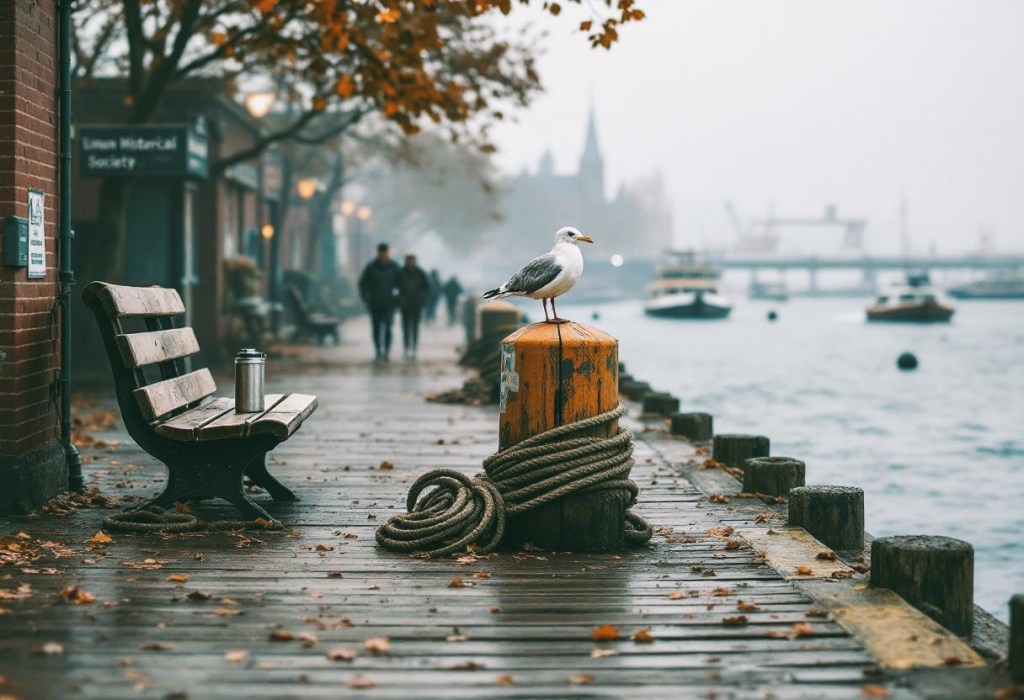
But this morning, walking the harbour with Father Walsh, I found myself thinking differently. He mentioned the Historical Society’s Civil War exhibition – Union shipyards, daguerreotypes of freed families arriving by river in 1863 – and said Maggie wants him to write about how a place holds its wars. I said what I know clinically and personally: we hold them in our bodies first, long before archives do.
History isn’t only what makes headlines. It’s also what settles in tissues, in families, in neighbourhoods – collective trauma that persists beyond direct survivors, reconstructing itself across generations.
The Consulting Room Testimony
My nine o’clock brought photographs in a shoebox: her father in Tuskegee Airman uniform, impossibly young; her mother at a church social, smile withheld. We’ve been working for eight months on inherited silence – that post-war stoicism that mistakes endurance for healing.
“The silences got passed down like recipes,” she said.
I recognised the pattern. My own mother arrived in New Corinth from Nevada in the late fifties, trading casino-floor neon for a bus driver’s steady devotion and a town itself mid-transformation. That private migration carried seismic shifts no history textbook records. My father’s stories of the 1978 shipyard closures – how you could watch a town’s confidence leak away like oil from a cracked hull. These events don’t make the century’s top-ten lists, but they reshape lives as surely as any war.
The man I saw at two spoke of the Challenger explosion as a strange touchstone – how that public disaster in 1986 made everything after feel like waiting for the next collapse. What helped him stand? Routine. Knowing the bus would come. His daughter’s school persisting. Small proofs of continuity.
My father again – Joseph Bennett on D.C. routes, then supervising New Corinth municipal transport, offering strangers the quiet dignity of reliable arrival. Steadiness as historical event, person by person.
Whose Memory Counts?
At Marcus’s, Jenny slid into the chair opposite with her conspiratorial grin, already knowing about the watercolours. But what stayed with me was something she mentioned almost in passing: her grandmother marched with textile workers in the 1930s, remembered Depression breadlines along the riverfront, used to say history isn’t what happened – it’s what we do with what happened.
I wrote that down. Clinical truth dressed as folk wisdom.
Walking to the Historical Society later, I passed streets that carry history like scent – the Italian social club turned yoga studio, the Polish bakery that survived three generations before closing last spring, the corner where buses used to terminate when my family arrived from Washington in 1971. Each closure, each arrival, each transformation: historical events in miniature, rarely commemorated but deeply felt.
Maggie surrounded by archival boxes, Civil War photographs spread like evidence. I asked the question forming all day: whose history gets archived, and whose gets dismissed as merely personal? She tapped a photograph of Black families disembarking in 1863 – faces solemn, exhausted, defiant. “That’s why we collect testimony, not just artefacts,” she said. “Every voice that names what happened is an act of historical correction.”
Collective memory is never neutral reconstruction – it’s social and psychological work, dedicated to meaning-making, to identity, to insisting one’s existence matters.
The Events That Mark Us
So what major historical events do I remember?
The public roll-call, certainly: World War II’s long shadow still cooling when I was born. Women granted suffrage – my grandmother’s generation finally permitted to vote. Civil Rights legislation that came too late and mattered profoundly. The Berlin Wall falling. The towers. The slow-motion disasters: climate shifts, opioid epidemics, pandemics that reveal exactly who we’ve decided matters and who we’ve agreed to sacrifice.
But also: desegregation fought street by street here in New Corinth. The ’78 shipyard closures that gutted whole neighbourhoods. Veterans carrying wars that ended on paper but never in the body. Children of Civil Rights still negotiating their parents’ strategic silences. Young people inheriting addiction like a bitter estate.
Personal memory and collective history blur – clinically sound, since they’re never truly separate.
Yesterday I took what felt, to me, like a historical risk: I said yes to vulnerability, signed up for watercolours at fifty-eight, invited someone to sit beside me at a concert without the protective frame of professional courtesy. These aren’t Challenger or 9/11. But they mark me. They reshape the landscape of what I thought possible.
That, too, is history – the kind we make rather than endure, the kind that unfolds in consulting rooms and cafés and harbour walks, person by person, courage by heartbeat.
The watercolour kit Dan set aside sits on my counter – small monument to intention. Tomorrow night: Bartók with David, the careful-handed man learning his own vocabulary of beginning again. These are my historical events now. They’ll never make the archives, but they’re already rewriting me.
History isn’t only what we witness collectively. It’s what we carry forward – the inherited courage and fractures both, the steadiness and the silences, the risks we finally take when competence no longer shelters us from being simply, ordinarily human.
The harbour keeps its autumn counsel. I’m learning to do the same, only speaking where silence has done enough damage.
Catherine
Bob Lynn | © 2025 Vox Meditantis. All rights reserved.


 Vox Meditantis
Leave a reply to Tony Cancel reply