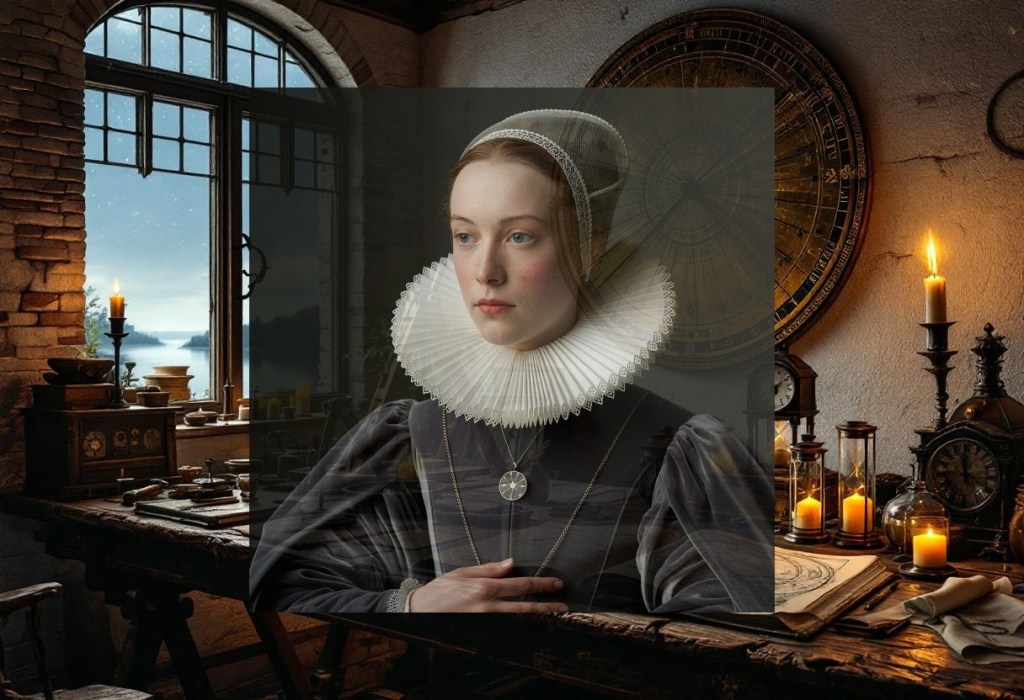
Sophia Brahe (1556-1643) assisted her brother Tycho in making astronomical observations that achieved unprecedented accuracy – to within one arcminute – creating the empirical foundation upon which Johannes Kepler derived his three laws of planetary motion. These meticulous measurements of Mars and other planets, conducted night after night over decades, ultimately enabled Newton’s theory of universal gravitation. Yet whilst her brother’s name became inseparable from the observations, and Kepler’s from the laws they revealed, Sophia’s contributions were absorbed into a narrative that credited men alone.
When we meet today, she appears as a woman who carries herself with quiet determination – the very animus invictus Tycho once praised. There is a weariness in her eyes, perhaps from years spent peering through sighting instruments in the cold Danish nights, or perhaps from something else entirely: the knowledge that history would remember the theories built upon her data whilst forgetting the hands that gathered it.
Welcome, Sophia. Thank you for joining us across the centuries. I want to begin by acknowledging something: your astronomical work with Tycho provided the data that reshaped our understanding of the cosmos. Those observations of Mars were accurate to one arcminute – roughly half the width of the moon as it appears to us. Without a telescope. How did you achieve such precision with only your eyes and instruments?
You speak of it as though it were mine alone. It was not. But I was there, night after night, and I held the instruments steady when my brother’s hands grew tired. The precision came not from any single observation, but from hundreds upon hundreds of measurements, each one recorded, each one compared. We used large instruments – quadrants taller than a man, sextants of brass and iron, mounted upon stone bases to prevent even the smallest tremor.
The sighting devices, the pinnacidia, were my particular concern. They required alignment more delicate than threading a needle in candlelight. One measured angles between celestial bodies, you understand, not the bodies themselves. A star, a planet – these are points of light. What we measured was the space between them, the geometry of the heavens. And geometry does not forgive error.
Walk us through a specific observation – say, recording the position of Mars on a November night. What were you actually doing, step by step?
Ah, Mars. The troublesome wanderer. Very well. First, one must wait for the sky to clear, which in Denmark means waiting a great deal. Then you ensure the instrument – let us say the great mural quadrant – is properly aligned to true north. This we did using Polaris, though we learned that Polaris itself is not perfectly fixed.
Once aligned, you sight Mars through the pinnacidium. This is two metal plates with tiny apertures, which you position such that the light of Mars passes through both holes. Your eye must be steady, your breathing shallow, for the slightest movement shifts everything. When aligned, you read the angle marked upon the graduated arc of the quadrant. These graduations were themselves a marvel – Tycho had them engraved to divisions of a single arcminute.
But one reading means nothing. You record the position, then return an hour later and record again. And again. Over months. Over years. Mars moves strangely, you see – backwards at times, or so it appears. Only by tracking its wanderings across many oppositions could we perceive the true shape of its path.
You’re describing what sounds like extraordinarily tedious work.
It was not tedious. It was necessary. Philosophers may sit in warm libraries and spin theories about the perfection of circular orbits, but the heavens care nothing for what we wish them to be. They are what they are. Observation is the only path to truth, and observation requires patience, discipline, and a refusal to bend what you see to what you expect.
Tycho understood this. He taught me that accuracy comes from repetition, from using multiple instruments to confirm each measurement, from recording everything – temperature, time, atmospheric conditions – so that errors might be understood and corrected later.
Tell us about the supernova you observed in November 1572. You were only thirteen years old.
Sixteen, I believe, though my birth year is recorded differently in various documents. I was at Herrevad Abbey with Tycho when he saw it first – a brilliant star in Cassiopeia where no star had been before. He was astonished, you understand. The heavens were supposed to be immutable, unchanging. Aristotle had said so, and who were we to question Aristotle?
Yet there it was, brighter than Venus, visible even in daylight for a time. Tycho set about measuring its position with obsessive care. I assisted – holding candles, recording numbers, fetching instruments. He was determined to prove it lay beyond the Moon, in the supposedly perfect realm of the stars.
And did you understand the significance at the time?
Not entirely. I understood that Tycho was excited, that something important was happening. But I was young, and still learning. It was only later, as I studied astronomy in earnest, that I understood what we had witnessed: evidence that the celestial realm could change, that superlunar and sublunar were not different orders of creation. It was the beginning of the end for the old cosmology.
Your brother initially discouraged you from studying astronomy, believing it “too complex for a woman”. How did you learn it anyway?
By refusing to accept his assessment. Tycho meant well, I think. He worried not that I lacked the intellect, but that I could not achieve what he called the “abstract understanding” required for astrology – for casting horoscopes, interpreting planetary influences. He believed this beyond me.
So I studied in German first, which I knew, and paid from my own purse to have Latin texts translated into Danish. I learned the mathematics of spherical geometry, the tables of planetary positions, the principles of parallax and refraction. When Tycho saw that I had mastered the basics without his help, he ceased his objections. He even wrote, with some surprise, that I had an animus invictus – a determined mind that would not yield to any man in intellectual matters.
That phrase – “animus invictus” – it’s one of the few times you’re quoted in the historical record.
Yes. And it is double-edged, is it not? He praises my determination, yet the praise itself suggests that such determination in a woman is remarkable, unexpected. As though intellectual persistence were a masculine quality I had somehow appropriated.
You also observed the lunar eclipse of 8th December 1573. What made lunar eclipses scientifically valuable?
Lunar eclipses occur when the Earth passes between the Sun and Moon, casting its shadow upon the lunar surface. By measuring the duration of the eclipse, the size and shape of Earth’s shadow, one can calculate the relative sizes and distances of the three bodies. This was geometry made visible in the sky.
Furthermore, eclipses provided a common reference point for astronomers across Europe. If one observes an eclipse in Copenhagen and another in Prague, comparing the precise times reveals information about longitude, about the size of the Earth itself. Tycho was meticulous about recording not just what we saw, but when we saw it, measured to the minute.
Let me ask about something technical: Tycho’s instruments were large – some quadrants stood two metres tall. Why did size matter?
Because a larger instrument allows finer divisions. Imagine trying to mark degrees on a circle the size of your hand versus a circle the size of a wagon wheel. On the wagon wheel, you have room to inscribe minutes and even fractions of minutes. The eye can distinguish smaller angles when the scale is larger.
But size brings its own problems. Large instruments are heavy, difficult to move, sensitive to wind and temperature changes. We mounted ours on solid masonry foundations and used brass fittings that would not warp. Even so, we had to calibrate constantly, checking our instruments against known stellar positions.
You mentioned Mars specifically was crucial for Kepler’s later work. Why Mars?
Because Mars is eccentric. Its orbit deviates more from a perfect circle than any other planet save Mercury, which is too close to the Sun for easy observation. When one assumes circular orbits, as all astronomers then did, Mars refuses to cooperate. The observations and the theory diverge by as much as eight arcminutes – four times our margin of error.
Tycho knew this. He gave Kepler the Mars data specifically because it was the most puzzling. And Kepler, brilliant and stubborn, spent years wrestling with those numbers until he abandoned circles entirely and proposed ellipses.
So your measurements were accurate enough to disprove the circular model. If they had been less precise – say, with errors of ten arcminutes instead of one – would Kepler have succeeded?
No. The difference between circles and ellipses, for Mars, is only a few arcminutes at crucial points in the orbit. With cruder data, one might attribute the discrepancy to observational error and cling to circles. Kepler himself said that he could not have derived his laws with measurements less accurate than ours.
This is what I mean about observation being foundational. The theory – the laws of planetary motion, the elliptical orbits – these are built upon data. Without precise data, the building collapses.
Yet when we speak of “Kepler’s laws,” we credit him alone. When we reference “Tycho’s observations,” we credit your brother. Where are you in this narrative?
I am nowhere. I am absorbed. The phrase “Tycho and his assistants” sometimes appears. I was an assistant, you see. Unpaid. My labour was familial duty, not professional contribution.
An assistant… not a collaborator?
There is a hierarchy in those words, is there not? An assistant serves. A collaborator creates jointly. Yet I did the same work as Tycho’s male assistants – sometimes more. I made observations, I recorded data, I performed calculations. But because I was his sister, because I was a woman, because I had no formal credentials, my work was seen as… supportive. Domestic, even.
Historian Margaret Rossiter termed this the “Matilda Effect” – the systematic denial of credit to women researchers. Your contributions were absorbed into Tycho’s legacy through what’s been called “familial attribution.” Can you speak to that experience?
It was not a single erasure, but a gradual disappearing. When Tycho published, he mentioned my assistance in passing, if at all. When others cited his work, they cited him alone. The observations became “Tycho Brahe’s observations,” though many eyes and many hands produced them.
And I had no recourse. Women could not publish independently in scientific academies. We could not hold university positions. Even had I wished to claim my share of credit, there was no institutional framework through which to do so. Science was a man’s world, and women entered it only as adjuncts to men – as sisters, wives, daughters.
You worked at Uraniborg, Tycho’s observatory on the island of Hven. What was that environment like?
Extraordinary and isolating in equal measure. Uraniborg was Tycho’s kingdom – observatories, workshops, alchemical laboratories, gardens, all built to his specifications. It was like nowhere else in Europe, a true research institute before such things existed.
But it was also removed from the world. We lived and worked in a small community, bound by Tycho’s vision and his rules. For me, it meant freedom to pursue astronomy away from the expectations of noble society. Yet it also meant my work remained invisible to the wider scholarly world. I was not corresponding with mathematicians in Prague or publishing treatises in Latin. I was measuring angles and recording numbers on a Danish island.
Beyond astronomy, you became accomplished in multiple fields – horticulture, chemistry, medicine, genealogy. Let’s discuss your work in botany and medicine. You created what were described as exceptional gardens at Eriksholm.
Yes, after my first husband’s death. I managed his estate and transformed the grounds. I was particularly interested in medicinal plants – following the principles of Paracelsus, who believed that nature provided remedies for every ailment if one knew how to prepare them.
Paracelsian medicine was controversial at the time. What drew you to it?
Paracelsus challenged the old Galenic medicine, which relied on balancing humours. He proposed instead that specific chemical remedies, properly prepared, could cure specific diseases. This required laboratory work – distillation, extraction, purification. It was alchemy in service of healing.
I established an alchemical laboratory at Eriksholm. There I prepared medicines – tinctures, elixirs, salves – and provided them to the local poor, who could not afford physicians. I was careful in my preparations, you understand. Paracelsus taught that the dose makes the poison; medicinal plants must be processed correctly or they become harmful.
But as a woman, you couldn’t be a licensed physician.
No. Women were barred from universities, thus from medical credentials. I could practice medicine, after a fashion – noblewoman’s charity, preparing remedies for the peasantry. But I could not be recognised as a physician, could not study anatomy at university, could not join a medical college. My knowledge was legitimate only as domestic accomplishment, not professional expertise.
You also introduced tulips to Denmark. That’s a horticultural achievement that’s measurable and documented.
Yes, I imported tulip bulbs and cultivated them successfully in Denmark’s climate. They were new to Northern Europe then, exotic and beautiful. My gardens became known for them, and for the variety of medicinal herbs I grew.
But again – what is remembered? Tycho’s observatory is commemorated. The supernova carries his name. My gardens have long since been replanted by others.
There’s an interesting parallel here: in horticulture, in medicine, in astronomy – you were doing what we’d now call “data collection” and “experimental work.” Infrastructure, in a sense. Yet history rewards the theories built upon infrastructure, not the infrastructure itself.
Yes. There is a pattern. Observation versus interpretation. Data versus theory. Process versus product. And these pairs map onto gender, do they not? Men theorise; women observe. Men think; women do.
But this division is false. There is as much intellect in designing an experiment, in building reliable instruments, in maintaining accuracy over years of tedious measurement, as there is in formulating the theory afterward. Perhaps more, for theory can be clever, but data must be true.
Let me push back: you were privileged. Aristocratic. Wealthy. You had resources most women – most people – would never have. Doesn’t that complicate the narrative of oppression?
Of course. I do not claim to have suffered as a peasant woman would suffer, or as one born into poverty. My status gave me access to education, to Tycho’s observatory, to books and instruments. Many brilliant women had no such opportunities and are lost to history entirely.
But even with every advantage – noble birth, family connections, education, Tycho’s support – the system still buried me. If a woman with my privileges could be erased, what hope had those with less? That, I think, is the measure of how deeply the structures were set against us.
You married twice. Your first husband, Otto Thott, died young. Your second marriage, to the alchemist Erik Lange, was by all accounts difficult.
Erik. Yes, Erik was brilliant and reckless in equal measure. An alchemist obsessed with transmutation, with turning base metals into gold. He spent his fortune – and nearly mine – on experiments that never succeeded. We were engaged for twelve years before we could marry, because he had fled Denmark to escape creditors.
Tycho wrote a poem about it, casting me as Urania, the muse of astronomy, pining for Erik. It was meant kindly, but there was condescension in it. The learned woman reduced to lovesick maiden.
Did you continue scientific work during your marriage to Lange?
Less than before. We travelled constantly, living in poverty much of the time. Erik died in 1613, and I returned to Denmark. By then I was in my fifties, and the world had changed. Tycho was long dead. Kepler had published his laws. The work we had done was foundational to a new astronomy, but I had no place in it.
So you turned to genealogy.
Yes. I produced a manuscript – 900 pages documenting the lineage of Danish noble families. It was meticulous work, tracing marriages and inheritances across centuries. That manuscript is still used by historians.
Another form of data collection. Another infrastructure.
Yes. I see the pattern you are drawing. And you are not wrong.
Late in life, do you think Tycho understood the full extent of your contribution?
He knew I was capable. He praised my animus invictus. But did he see me as his intellectual equal? I am not certain. He saw me as his sister, as a devoted assistant. Love and respect, yes – but also the blindness of his era. It would not have occurred to him to list me as a co-author, because such things were not done.
What should he have done differently?
Insisted that my name appear alongside his in publications. Described me as collaborator, not assistant. Ensured I was paid for my work as his male assistants were. These sound like small things, but credit is how one enters the historical record.
Let me ask about a specific methodological choice: why did Tycho refuse to use the telescope when it became available?
Tycho died in 1601, before Galileo turned the telescope skyward in 1609. But even had he lived, I think he would have been cautious. The telescope was new, unproven. How could one be certain it did not distort what it showed? Our naked-eye observations, refined over decades, were trustworthy precisely because we understood their limitations.
Looking back now – knowing that Kepler used your data to derive laws that Newton later explained with universal gravitation – do you feel differently about the work?
Pride and anger, in equal measure. Pride that the observations were true enough, precise enough, to bear the weight of such profound theories. Anger that my name is not spoken in the same breath.
When students learn about Kepler’s laws, they should learn first about the nights spent at Uraniborg, the cold metal of the quadrant, the squinting through apertures, the endless columns of numbers. They should know that science is built by many hands, not lone geniuses.
You mentioned mistakes earlier. What did you get wrong?
Oh, many things. We clung too long to the idea that planets must move uniformly, that variations in speed were illusions created by our perspective. We underestimated the effects of atmospheric refraction at low altitudes, though Tycho later corrected for this. And personally, I occasionally mis-recorded numbers – transposed digits, misread scales. Errors are inevitable. What matters is catching them, correcting them, being honest about uncertainty.
Were there theories you believed that we now know are false?
I believed the Earth was stationary at the centre of the cosmos, with the Sun and planets revolving around it. This was Tycho’s cosmological model – the “Tychonic system” – and I had no reason to doubt it. It fit the observations as well as the Copernican model, and it preserved the theological and philosophical comfort of an unmoving Earth.
We were wrong, of course. The Earth moves. But our observations were not wrong. They were accurate regardless of the cosmological interpretation we applied to them. This is an important distinction: data can survive the theories built upon it.
What would you say to a young woman today who wants to pursue science but faces institutional barriers or lack of recognition?
Do the work anyway. Not because you will certainly be recognised – you may not be – but because the work itself matters. Because truth is worth pursuing even when the pursuit brings no glory.
But also: demand credit. Insist on co-authorship. Name yourselves. I could not do this; you can. The structures are still tilted against you, but they are less immovable than they were.
And remember: someone, someday, will look back and see your contributions, even if your contemporaries do not. History is not fixed. It can be revised, corrected, expanded to include those who were erased.
Finally: if you could correct one thing about how you’re remembered – or not remembered – what would it be?
When people learn that Kepler’s laws were derived from “Tycho Brahe’s observations,” I would want them to pause and ask: whose observations? Who held the instruments? Who recorded the numbers? Who spent thirty years measuring the heavens?
And I would want the answer to include my name. Not instead of Tycho’s – his contributions were immense – but alongside it. Sophia Brahe. Astronomer. Observer. The woman whose eyes measured the cosmos that Newton explained.
That is all I ask. To be visible.
Letters and emails
Since our conversation with Sophia Brahe, we’ve received dozens of letters and emails from readers around the world eager to continue the dialogue. We’ve selected five thoughtful questions from our community – scientists, historians, students, and curious minds – who want to explore her life and work more deeply, and to hear what guidance she might offer those following similar paths today.
Meera Patel, 31, data scientist, Mumbai, India
Sophia, when you were calibrating your instruments for astronomical measurements, did you ever notice recurring sources of error that modern scientists might still face with data collection today, especially without digital tools? How did you mentally track uncertainty over long campaigns?
Ah, Meera, you ask a question that brings back memories of cold fingers and aching eyes. Yes, there were patterns of error that plagued us night after night, and I suspect they trouble your work still, though your tools differ from ours.
The greatest source of error was refraction – the bending of light as it passes through the Earth’s atmosphere. When a celestial body sits low on the horizon, its light travels through more air, more moisture, more perturbation, and thus appears higher than its true position. Tycho spent years measuring this effect, creating correction tables we applied to every observation. But the atmosphere is changeable. A humid night differs from a dry one. Winter air behaves differently than summer. We could correct for the general pattern, but not for every particular circumstance.
Temperature affected our instruments directly. Brass expands when warm, contracts when cold. A quadrant carefully graduated in summer reads differently in December. We learned to take measurements at similar temperatures when possible, or to note the conditions and apply judgement later. But judgement is imperfect – another source of uncertainty.
Then there is the human element. My eyes, Tycho’s eyes – they grew tired. After hours of observation, one begins to doubt what one sees. Is the star truly aligned with the crosshair, or am I merely wishing it so because my back aches and I long for bed? We addressed this through repetition and through using multiple observers. If three people independently record the same position, one gains confidence. If the readings diverge, one investigates why.
Tracking uncertainty over years required meticulous records. We did not merely write down positions; we recorded the date, the time, the instrument used, the observer’s name, the weather, the seeing conditions – was the air steady or turbulent? These annotations allowed us, years later, to assess which observations were most reliable. If Kepler found discrepancies in our Mars data, he could examine our notes and understand whether the error lay in the heavens or in our measurement.
Without your “digital tools,” as you call them, we relied on cross-checking and patience. Every important observation was repeated. Every instrument was calibrated against known star positions. Every calculation was performed twice, preferably by different hands. This was tedious beyond measure, but it was the only path to certainty.
I imagine you face similar challenges with your data, though at vastly different scales. The principles remain: know your instruments, understand their limitations, record your conditions, repeat your measurements, and never trust a single observation when you can have three. Uncertainty cannot be eliminated, only understood and accounted for. That is the work.
Kwame Boateng, 38, mechanical engineer, Accra, Ghana
If you had access to today’s telescopes and analytical software, what limitations of your era’s technology would you be most eager to overcome first, and which part of your traditional process would you still keep, even with all the new advances?
Kwame, you offer me a tempting prospect – access to instruments beyond imagining. Let me consider what I would seize upon first, and what I would preserve from our methods.
The first limitation I would overcome is atmospheric interference. You speak of telescopes that sit above the Earth’s air, in the void itself, observing without the distortion of refraction, without clouds, without the turbulence that makes stars twinkle and dance. This would be extraordinary. We spent countless nights waiting for clear skies, only to have fog roll in from the Sound at the crucial moment. And even on clear nights, the atmosphere bent and wavered the light, introducing errors we could minimise but never eliminate. To observe from beyond the air – that would transform everything.
Second, I would want instruments that could record positions automatically, without reliance on human eyes reading graduated scales by candlelight. The fatigue, the uncertainty of whether one has read the angle correctly – these plagued us. If your machines can note positions with absolute precision and store them for later analysis, that would free the observer to focus on what matters: selecting targets, planning campaigns, recognising patterns.
Yet here is what I would keep: the discipline of repeated observation over extended time. Your technology may capture a single image with clarity we could never achieve, but does it teach patience? Does it require you to return, night after night, season after season, year after year, watching Mars crawl across the sky? This long acquaintance with the heavens – this is how one develops intuition, how one notices the anomaly, the unexpected variation that demands explanation.
I would also preserve the practice of calibration through known references. We constantly checked our instruments against stars whose positions were well-established. I suspect your software and telescopes still require calibration, still need verification against standards. One must never trust the instrument blindly, no matter how sophisticated. The human mind must remain engaged, questioning, alert to error.
And finally, I would keep the habit of recording context – not merely the measurement, but the conditions under which it was made. Temperature, seeing conditions, instrument used, any irregularities noted. These annotations proved invaluable when Kepler questioned our Mars data. He could trace each observation back to its circumstances and judge its reliability. Raw numbers without context are dangerous; they appear authoritative while hiding their limitations.
So yes, give me your telescopes in the void, your automatic recorders. But let me bring with me the patience, the discipline, and the sceptical mind that our crude instruments demanded. Technology changes. The virtues of careful observation do not.
Tahlia Faumuina, 26, botanist, Wellington, New Zealand
Your gardens at Eriksholm mixed ornamental beauty with medicinal value. If you could choose one plant whose story best illustrates your approach to horticulture and healing, what would it be, and why did you value it both practically and symbolically?
Tahlia, you ask me to choose a single plant, and I find myself returning to wormwood – Artemisia absinthium. Not the most beautiful, certainly not as celebrated as my tulips, but it captures precisely how I understood the relationship between healing and cultivation.
Wormwood is bitter, almost offensively so. The first time I tasted a preparation of it, I nearly spat it out. Yet that bitterness is its virtue. Paracelsus taught that like cures like, that signatures in nature point toward use. Wormwood’s bitterness drives out the bitterness of fever, purges the stomach of corruption, expels worms from the bowels – hence its common name. The taste that repels is also the property that heals.
I grew extensive beds of wormwood at Eriksholm, harvested at midsummer when its potency was greatest. The leaves and flowering tops were dried carefully – not in direct sun, which diminishes their strength, but in shade with good air circulation. From these I prepared infusions for the poor folk who came to my door with complaints of the stomach, with fevers, with the lethargy that comes from intestinal parasites. The relief was often swift and visible.
But wormwood also taught me caution. In Paracelsian medicine, dose is everything. A small amount of wormwood cleanses and strengthens. Too much causes tremors, confusion, visions – the plant becomes poison rather than remedy. I learned to measure carefully, to adjust the strength based on the patient’s constitution, age, and affliction. A child required far less than a grown man. A pregnant woman should avoid it entirely.
Symbolically, wormwood represented what I valued most in my work: the recognition that nature provides remedies, but only to those who study carefully, who understand properties and preparations, who respect the boundary between medicine and poison. Beauty alone – like my tulips – brings joy but does not heal. Bitterness, properly prepared, saves lives.
There was also this: wormwood is hardy, persistent, unfussy about soil. It thrives where more delicate plants fail. It does not require ideal conditions to fulfill its purpose. I saw myself in that, I suppose. A woman working outside the formal structures of medicine, without university credentials or guild membership, yet still effective, still necessary. The official physicians might dismiss me as an amateur dabbling in simples, but the peasants who left my door without their fevers did not care about my lack of Latin certificates.
Wormwood: bitter, undervalued, resilient, healing. Yes, that plant tells my story well enough.
Andrés Cabrera, 23, undergraduate in physics, Bogotá, Colombia
If history had recognised your contributions equally with Tycho’s, and women in your time had enjoyed full academic access, how might the development of planetary science – or your own life’s work – have changed? What new possibilities do you think might have opened up?
Andrés, you ask me to imagine a world that never was – one where my contributions were acknowledged equally, where women held university chairs and published under their own names. It is a painful exercise, for it illuminates precisely what was lost.
Had I been recognised as Tycho’s collaborator rather than his assistant, I believe the most immediate change would have been financial independence. Payment for scientific work confers legitimacy. It transforms labour from familial duty into professional contribution. With my own income, I would not have been dependent on marriage for survival, would not have waited twelve years to wed Erik Lange while he fled his creditors. I might have established my own observatory, modest perhaps, but mine.
More significantly, recognition would have granted me access to the Republic of Letters – that network of correspondence through which natural philosophers exchanged ideas across Europe. Tycho corresponded with scholars in Prague, in England, in Italy. Had I been acknowledged as a serious astronomer, I too could have written to Kepler directly, to Galileo, to others pursuing celestial observations. Ideas would have flowed both ways. I would not have been isolated on Hven, my work visible only to those within Tycho’s household.
As for planetary science itself – here I must be careful not to overstate. The observations would have been the same; the data does not change based on who receives credit for gathering it. But the pace of discovery might have accelerated. If universities had admitted women, if academies had welcomed female members, you would have doubled the pool of potential astronomers, mathematicians, natural philosophers. How many brilliant women, lacking even my advantages, never pursued their interests because the door was barred? What questions went unasked, what observations unmade, because half of humanity was excluded?
I think particularly of my later work in chemistry and medicine. Had I been able to study at a university, to train formally in anatomy and pharmacology, what advances might I have made beyond folk remedies and Paracelsian experiments? I was intelligent, methodical, curious – precisely the qualities needed for natural philosophy. But I was forced to teach myself, to work in isolation, to remain amateur when I might have been professional.
The greatest loss, perhaps, is what I might have taught others. Had there been a place for me at a university, I could have trained younger women – and men – in observational astronomy, in botanical medicine, in the careful practices of empirical investigation. Instead, my knowledge died with me, recorded imperfectly in others’ accounts or not at all. That is the true cost of exclusion: not merely individual careers denied, but entire lineages of knowledge that never came to be.
Sofia Petrova, 46, historian of science, Sofia, Bulgaria
Looking across your work in genealogy, medicine, and observational astronomy, do you see a unifying principle or habit of mind that shaped how you approached problem-solving in such different areas? Would you encourage modern researchers to work across fields the way you did?
Sofia, you ask whether there exists a unifying thread connecting my work across such disparate fields. I have thought on this many years, and I believe the answer lies in a particular way of seeing: attention to what is actually present, rather than what ought to be present according to theory or tradition.
In astronomy, this meant recording what we observed in the heavens, even when it contradicted Aristotle. The supernova of 1572 should not have existed – the celestial realm was supposed to be immutable. Yet there it blazed, brighter than Venus. We could have dismissed it as atmospheric, as sublunary. Instead, we measured its parallax and proved it lay among the stars. The observation took precedence over the philosophy.
In horticulture, the same principle applied. I did not simply plant according to received wisdom about what would grow in Danish soil. I experimented. I brought tulip bulbs from warmer regions and observed how they responded to our colder climate, adjusting soil composition and drainage until they thrived. Each plant taught me its requirements through success or failure, not through what Dioscorides or Pliny claimed in their texts.
In medicine, Paracelsian practice demanded direct observation of how remedies affected actual patients, not deduction from abstract humoral theory. Does this preparation reduce fever? Does that tincture ease pain? One watches, records, adjusts the dose, tries again. The patient’s body, not ancient authority, provides the answer.
Even genealogy – which might seem merely archival – required the same sceptical attention. Family records often contained errors, wishful claims of noble connection, dates that did not align. I cross-referenced multiple sources, examined original documents where possible, noted contradictions rather than smoothing them over. Truth emerged from evidence, not from what families preferred to believe about their lineage.
So yes, there is a unifying habit of mind: empiricism, though we did not use that word precisely. A preference for observation over speculation, for what can be measured or documented over what sounds elegant in theory. And crucially, a willingness to be corrected by reality.
Would I encourage modern researchers to work across fields as I did? Yes, with a caution. Each discipline has its own rigour, its own demands. One must not dabble superficially, thinking that curiosity alone suffices. I spent years mastering astronomical calculation, years learning botanical properties, years studying genealogical methods. The connection between fields came not from shallow acquaintance with many things, but from applying the same demanding standards of evidence across different domains.
The danger in specialisation – which I understand has intensified in your era – is that one loses perspective, mistakes the methods of one’s own discipline for the only valid approach. Working across astronomy, medicine, and botany kept me humble. It reminded me that there are many ways to pursue truth, many forms of rigorous inquiry. That breadth, I believe, remains valuable.
Reflection
Sophia Brahe died in 1643, at approximately 87 years of age, having outlived both her brother Tycho and the astronomer Johannes Kepler, whose revolutionary laws rested upon the observations she helped create. She left behind no published astronomical papers bearing her name, yet her hands had measured the cosmos with a precision that would not be surpassed for generations.
Throughout our conversation, Sophia returned repeatedly to the tension between visibility and erasure – the paradox of producing foundational work that becomes infrastructure attributed to others. Her reflections illuminate what historian Margaret Rossiter termed the Matilda Effect: the absorption of women’s scientific contributions into male colleagues’ legacies. Sophia’s insistence that “data must be true” whilst theory “can be clever” challenges the gendered hierarchy that values interpretation over observation, insight over labour.
What emerges from this interview – and diverges somewhat from sparse historical accounts – is Sophia’s own understanding of her intellectual agency. Where records position her as Tycho’s “assistant,” she articulates a more complex reality: unpaid collaboration that required the same rigour, the same patience, the same mastery of spherical geometry and instrumental technique as her brother’s acknowledged work. Her description of the wormwood plant as emblematic of her position – bitter, undervalued, resilient, healing – offers a self-assessment absent from official genealogies.
The historical record remains frustratingly incomplete. We cannot verify every observation she made independently, cannot quantify her precise contribution to the decades of Mars data. Her 900-page genealogical manuscript survives, but her astronomical notebooks do not. This ambiguity itself tells a story about what gets preserved and what vanishes when women work within family structures rather than formal institutions.
Yet Sophia’s influence persists in unexpected ways. Contemporary movements auditing scientific credit – adding Rosalind Franklin to DNA discovery narratives, documenting the Harvard Observatory “computers” who mapped stellar spectra – echo her plea to ask “whose observations?” when history credits lone genius. Modern discussions of invisible labour in STEM, of data scientists whose infrastructure work goes unrecognised whilst theorists claim acclaim, replay the dynamics Sophia experienced four centuries ago.
Her legacy persists not in monuments or eponyms, but in the data itself. Those meticulous angular measurements, accurate to one arcminute, enabled Kepler’s ellipses and Newton’s gravitational law. Every spacecraft that navigates by celestial mechanics, every exoplanet discovered through precise positional astronomy, rests ultimately on foundations that include Sophia’s cold nights at Uraniborg, her steady hands aligning pinnacidia, her refusal to record anything but what the heavens actually revealed.
She asked only to be visible. Perhaps, finally, we are learning to look.
Who have we missed?
This series is all about recovering the voices history left behind – and I’d love your help finding the next one. If there’s a woman in STEM you think deserves to be interviewed in this way – whether a forgotten inventor, unsung technician, or overlooked researcher – please share her story.
Email me at voxmeditantis@gmail.com or leave a comment below with your suggestion – even just a name is a great start. Let’s keep uncovering the women who shaped science and innovation, one conversation at a time.
Editorial Note: This interview is a dramatised reconstruction created for educational and illustrative purposes. Whilst Sophia Brahe‘s biographical details, scientific contributions, and historical context are drawn from documented sources, the dialogue itself is fictional. Her voice, responses, and personal reflections have been imagined based on available historical evidence, period-appropriate language, and scholarly understanding of Renaissance women in science. Where the historical record remains incomplete or contested – as it often does for women whose work was absorbed into male relatives’ legacies – we have acknowledged these gaps explicitly. This creative approach aims to honour Sophia’s contributions whilst recognising the limitations of what can be definitively known across four centuries.
Bob Lynn | © 2025 Vox Meditantis. All rights reserved. | 🌐 Translate


 Vox Meditantis
Leave a reply to Bob Lynn Cancel reply