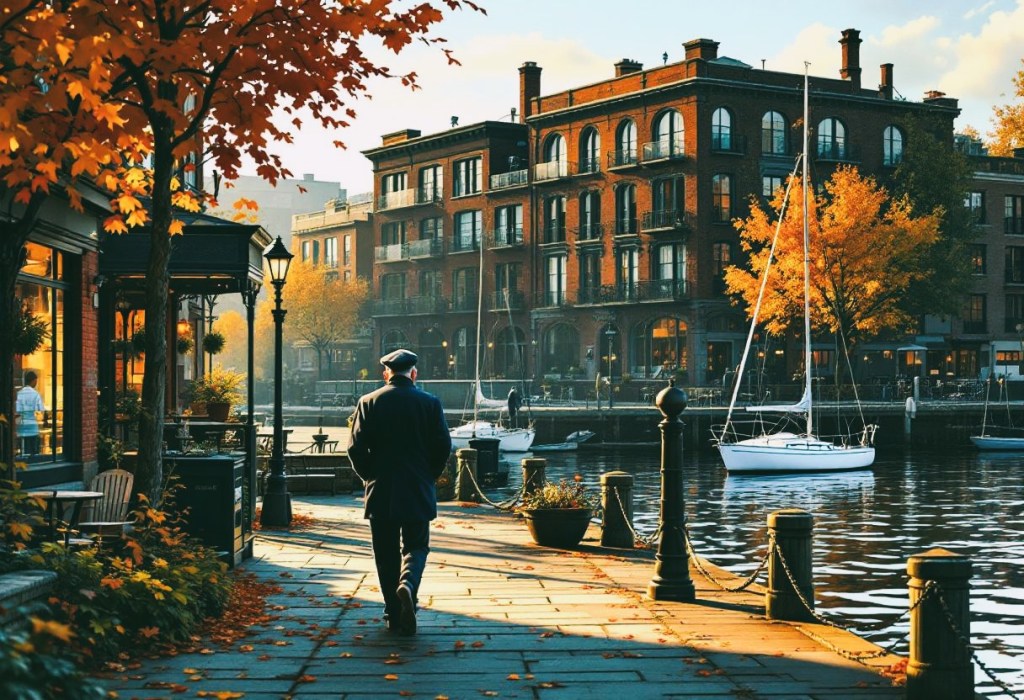
Do lazy days make you feel rested or unproductive?
Friday, 17th October 2025
The question arrived this morning like an uninvited guest – polite enough, but carrying assumptions I’m not sure I share.
Rest versus productivity. As if those are the only two options, the only axis along which a day might be measured. As if a day spent doing very little must produce either replenishment or guilt, restoration or waste, with nothing in between and no possibility of both at once.
I’ve been turning this over all day – between the young woman learning slowly that her worth isn’t determined by her output, between the older gentleman whose retirement has left him unmoored without the structure work provided, between the quiet moments when I stand at my office window watching the harbour light do its slow October dance across the water. The question follows me like a persistent ache, asking me to choose a side when what I actually feel is considerably more complicated.
Yesterday I wrote about Helen, about the patient accumulation of daily choices, about success measured not in spectacular achievement but in sustained, attentive presence over time. But what about the days when we don’t show up? What about the mornings when the steady discipline falters, when instead of the reliable rhythms we simply… stop?
What about lazy days?
The inheritance of industriousness
I come from people for whom idleness was nearly incomprehensible.
Father spent forty years driving buses and supervising municipal transport – shift work that demanded showing up regardless of weather, mood, or personal circumstance. Even on his days off, he was fixing something, organising something, helping a neighbour with something that needed doing. The idea of an entire day spent without tangible accomplishment would have struck him as vaguely shameful, a failure of character rather than a choice.
Mother, with her casino-girl exuberance transplanted to New Corinth, channelled her considerable energy into volunteering, organising, connecting. She couldn’t bear stillness – always another neighbour to visit, another cause to champion, another gathering to host. Her restlessness wasn’t anxiety exactly, more like a constitutional inability to simply be without also doing.
Between them, they modelled a life of relentless productivity dressed up as virtue. Hard work. Contribution. Making oneself useful. These weren’t just values in our household; they were the entire framework for understanding what made a life worthwhile.
And I absorbed all of it – the industriousness, the sense that time not spent productively was somehow time wasted, the vague guilt that accompanied any extended period of simply… being.
Even now, at fifty-eight, with a career that by any reasonable measure counts as successful, I struggle with unstructured time. Saturdays without patients feel oddly hollow until I fill them with errands or projects or volunteer commitments. Holiday weekends require strategic planning lest I find myself adrift, anxious, wondering whether I’m resting or merely squandering hours I’ll never reclaim.
The Protestant work ethic runs deep, apparently. Even in those of us who’ve spent decades studying the psyche, even in those of us who should know better.
What my patients teach me
Here’s the uncomfortable truth: much of my clinical work involves helping people unlearn exactly the messages I still carry.
The exhausted solicitor who can’t justify taking time off because there’s always another case, another client, another deadline. The mother of three who feels guilty reading a novel whilst her children are at school because shouldn’t she be doing something more useful? The recently retired engineer – my brother Michael, actually, who’s struggling with this precise question since finishing work this past spring – who keeps asking what he’s for now that he’s no longer building things.
I spend hours each week gently dismantling the notion that human worth equals human output. Encouraging people to rest without earning it through prior productivity. Suggesting that sometimes the most important thing we can do is nothing at all, that fallow periods serve a purpose even if that purpose isn’t immediately apparent.
And I believe this, professionally. The research supports it – rest isn’t laziness, it’s neurologically necessary. Recovery periods allow for memory consolidation, creative insight, emotional regulation. The body and mind require downtime to function optimally. This isn’t indulgence; it’s basic human maintenance.
But believing something intellectually and embodying it personally are rather different matters.
The anatomy of a lazy day
Last Saturday was one of those days. Entirely unplanned, which perhaps made it more unsettling.
I woke without my usual morning energy, that gentle urgency that typically propels me through dawn harbour walks and the day’s first preparations. Instead, I felt… heavy. Not depressed – I know depression intimately enough to recognise its signature. Just depleted, as if some essential resource had been drawn down to fumes.
I cancelled my morning walk. Made tea and sat in the armchair by the window, watching the harbour without any particular agenda. When I finally dressed, it was in comfortable clothes with no intention of going anywhere or seeing anyone. The day stretched ahead, empty of plans, and instead of relief I felt a low-grade panic.
What does one do with a day like this?
I tried reading, but couldn’t focus. Considered various household tasks – the filing that needed organising, the cupboard that wanted sorting – but couldn’t summon the will. Thought about calling my sister Susan, but didn’t have the energy for conversation. Eventually I simply sat, watching the light change, following the harbour’s small dramas – Tom on his morning rounds, Marcus opening the coffee shop, the Saturday sailors preparing their boats.
Nothing happened. I produced nothing, accomplished nothing, improved nothing. By any measure I’ve been taught to value, the day was entirely wasted.
And yet.
What rest actually feels like
Here’s what I noticed, once I stopped fighting the day’s essential emptiness and simply allowed it.
The quality of attention shifted. Without agenda or objective, I found myself noticing things usually lost in the purposeful momentum of daily life – the precise colour of October light on water, the way sound carries differently in autumn air, the small adjustments Tom makes to his gait now that his hip troubles him more. Observation without analysis, presence without productivity.
My body gradually unclenched. I hadn’t realised how much tension I carry until it began releasing – jaw, shoulders, the perpetual slight knot between my shoulder blades. Hours of simply sitting allowed muscles to remember they needn’t be perpetually braced.
And something else, harder to name. A quality of spaciousness, of permission to exist without justification. For those hours, I wasn’t Dr Bennett with patients relying on me, wasn’t the daughter of industrious parents proving their values weren’t wasted on me, wasn’t even particularly myself in any defined sense. Just a woman in a chair, watching light move across harbour water, requiring nothing of anyone including herself.
It felt – and this surprised me – rather like grace.
The paradox
But then evening arrived, and with it, the familiar anxiety. The day was ending and what did I have to show for it? No tasks completed, no correspondence answered, no reading accomplished, no relationships tended. Just hours of sitting, watching, being.
The guilt arrived right on schedule. Shouldn’t I have done something? Used the time better? At minimum responded to the emails accumulating, or prepared for Monday’s sessions, or attended to any of the dozen things perpetually waiting for my attention? What kind of person wastes an entire Saturday doing absolutely nothing?
And there it was – the word I’d been circling all day. Waste.
But was it? Was the day wasted, or was something else happening, something my inherited framework doesn’t have language for?
I think about my patients, the ones learning to rest, and what I tell them. That rest isn’t earned through prior productivity – it’s a basic requirement, like food or shelter. That the body signals its needs and ignoring those signals creates larger problems down the line. That sometimes doing nothing is precisely what’s needed, that fallow periods serve growth even when we can’t see the purpose immediately.
I believe this for them. Why is it so difficult to extend the same understanding to myself?
What unproductive days actually produce
Here’s what I know professionally, even if I struggle to accept it personally.
Rest isn’t the absence of productivity; it’s a different kind of work. The neurological processes that occur during downtime – memory consolidation, pattern recognition, creative synthesis – require mental space that constant activity precludes. We solve problems in the shower, have insights on walks, make connections whilst staring into middle distance precisely because we’ve stopped trying to force solutions.
Furthermore – and this matters particularly in my line of work – the capacity to be present with others’ suffering requires internal spaciousness. If I’m perpetually full, perpetually busy, perpetually producing, there’s no room to hold anyone else’s experience. The emptiness I resist might actually be the condition that allows me to do what I do.
Helen taught me this, though I don’t think I fully understood it at the time. Her office hours included built-in gaps – not for administrative work, but for what she called “metabolising”. Time to sit with what she’d heard, to allow the sessions’ emotional weight to settle, to return to herself before encountering the next student. She protected those spaces fiercely, understanding that presence requires periodic absence, that attention requires restoration.
I’ve tried to structure my own practice similarly – space between sessions, limits on patient load, evenings and weekends mostly protected. But I haven’t extended that same understanding to the spaces themselves, haven’t fully accepted that empty time serves a purpose even when it produces nothing tangible.
The cost of constant productivity
I see it in my patients constantly. The burnout cases, the anxiety disorders, the people who’ve driven themselves to collapse because they couldn’t justify stopping until their bodies made the choice for them.
The young architect who worked ninety-hour weeks until she developed panic attacks so severe she couldn’t enter her office building. The teacher who ignored her exhaustion until it metastasised into something darker, heavier, clinical. The executive who measured his worth entirely by his output until redundancy revealed the emptiness beneath.
We talk about balance, about self-care, about the importance of rest. But underneath, the same question pulses: isn’t rest something we earn? Don’t we need to justify it somehow, prove we’ve been productive enough to deserve the pause?
This is deeply American, I think, this notion that our value correlates directly with our utility. That time not spent producing is time wasted. That leisure must be earned through labour, that rest requires justification.
My parents embodied this completely. Their worth was demonstrated through their contributions – Father’s decades of reliable service, Mother’s endless volunteering and community building. They couldn’t have articulated it as ideology; it was simply how life worked, as natural and unquestioned as breathing.
And here I am, three decades into a career helping people question exactly these assumptions, still feeling vaguely guilty about an unproductive Saturday.
Learning from laziness
So what would it mean to truly embrace lazy days? Not as failures of discipline or shameful indulgences, but as necessary components of a sustainable life?
I think it would require several shifts I haven’t quite managed.
First, redefining productivity itself. Not everything valuable produces measurable output. The conversation that changes nothing but deepens connection. The walk that accomplishes nothing but shifts perspective. The afternoon that generates no product but allows essential recovery. If I could genuinely believe that these matter as much as the tangible achievements, perhaps the guilt would ease.
Second, trusting the process even when I can’t see results. Seeds germinate underground, invisible for weeks before anything emerges. Rest works similarly – we recover, integrate, restore in ways that don’t announce themselves, that only become apparent later when we discover we have reserves we thought were depleted.
Third, accepting that I’m not actually obligated to maximise every moment. That it’s genuinely acceptable – more than acceptable, necessary – to sometimes simply exist without justification or agenda. That my worth doesn’t depend on my productivity, even if every message I absorbed growing up suggested otherwise.
Father Walsh, my harbour-walking companion, would recognise this as essentially a spiritual question. He talks sometimes about Sabbath, about the radical notion of rest as commandment rather than reward, as something prescribed rather than earned. In his tradition, God rested not because the work was complete but because rest itself is holy, is part of the rhythm that makes existence sustainable.
I’m not religious in Father Walsh’s way, but I find something compelling in that framework. Rest as inherent need rather than grudging concession. Downtime as necessary component rather than shameful indulgence.
The both-and
So do lazy days make me feel rested or unproductive?
The honest answer: both. Simultaneously, contradictorily, without resolution.
They do restore me – I know this because I return to Monday’s sessions with more capacity, more patience, more genuine presence than I would have if I’d worked straight through the weekend. The space allows something to settle, to metabolise, to integrate. My body knows this, signals its needs clearly.
But they also trigger guilt, anxiety, that low-grade sense that I should be doing something, accomplishing something, justifying my existence through visible contribution. The messages run deep, encoded not just intellectually but in my nervous system, in automatic responses shaped by decades of industrious example.
Perhaps the work isn’t to eliminate one response in favour of the other, but to hold both with some compassion. To notice the guilt without letting it dictate behaviour. To appreciate the rest whilst acknowledging the discomfort it brings. To gradually, incrementally expand my capacity to simply be without constant justification.
Helen managed this, I think. That quality of settledness, of being entirely present without apparent effort. I don’t know whether she struggled with similar guilt or whether she’d long since made peace with rest as requirement. But I do know that her capacity to hold space for others grew directly from her capacity to hold space for herself, to honour her own need for metabolising time.
That’s the inheritance I want to claim – not my parents’ relentless industriousness, admirable as it was, but Helen’s understanding that sustainable presence requires periodic absence, that the work of being fully human includes the work of sometimes doing nothing at all.
What I’m learning
The harbour light is fading now, that particular October gold that makes everything briefly luminous before darkness arrives. Tomorrow I’ll walk with Father Walsh if the weather holds, attend the river clean-up that Kevin coordinates, perhaps stop by the Historical Society meeting that Maggie mentioned. Sunday will be full, productive, tangibly useful.
But tonight, I’m trying to sit with last Saturday’s emptiness without immediately filling it with justification or plan. Trying to believe that the day served a purpose even if I can’t articulate what that purpose was. Trying to extend to myself the same understanding I offer my patients: that rest isn’t earned, that human worth doesn’t require constant demonstration, that lazy days might not be laziness at all but rather a different form of labour, quieter and less visible but no less essential.
I’m not there yet. The guilt still arrives, the anxiety still pulses, the voice that sounds distressingly like Father’s steady pragmatism still asks what I have to show for myself. But I’m beginning to hear another voice beneath it, one that sounds like Helen, like the best clinical wisdom I know, like the self I’m still learning to become.
That voice says: Rest. The work will be there tomorrow. You will be there tomorrow, more capable because you allowed yourself this pause. Trust the rhythm. Trust the need. Trust that productivity and worth are not synonyms, that lazy days serve purposes visible only in retrospect, that sometimes the most courageous thing we can do is absolutely nothing at all.
I’m trying to listen. Some days I manage it better than others. But perhaps that’s the actual work – not achieving perfect rest, but slowly, persistently dismantling the notion that we must earn it, that we must justify our existence through constant contribution, that our worth depends on anything beyond our simple presence.
Helen taught me that success looks like showing up consistently across decades. Perhaps she also taught me – though I’m only now beginning to understand it – that sustainability requires knowing when not to show up, when to let the steady discipline rest, when to be gloriously, unapologetically lazy and trust that this too is part of the long game.
The harbour is dark now. Tomorrow will bring its tasks and its encounters, its small kindnesses and its steady work. But tonight, I’m practising the art of doing nothing, of being insufficient and incomplete and perfectly, humanly enough.
It’s harder than it sounds. But perhaps that’s precisely why it matters.
Catherine
Bob Lynn | © 2025 Vox Meditantis. All rights reserved. | 🌐 Translate


 Vox Meditantis
Leave a reply to artbychristinemallabandbrown Cancel reply