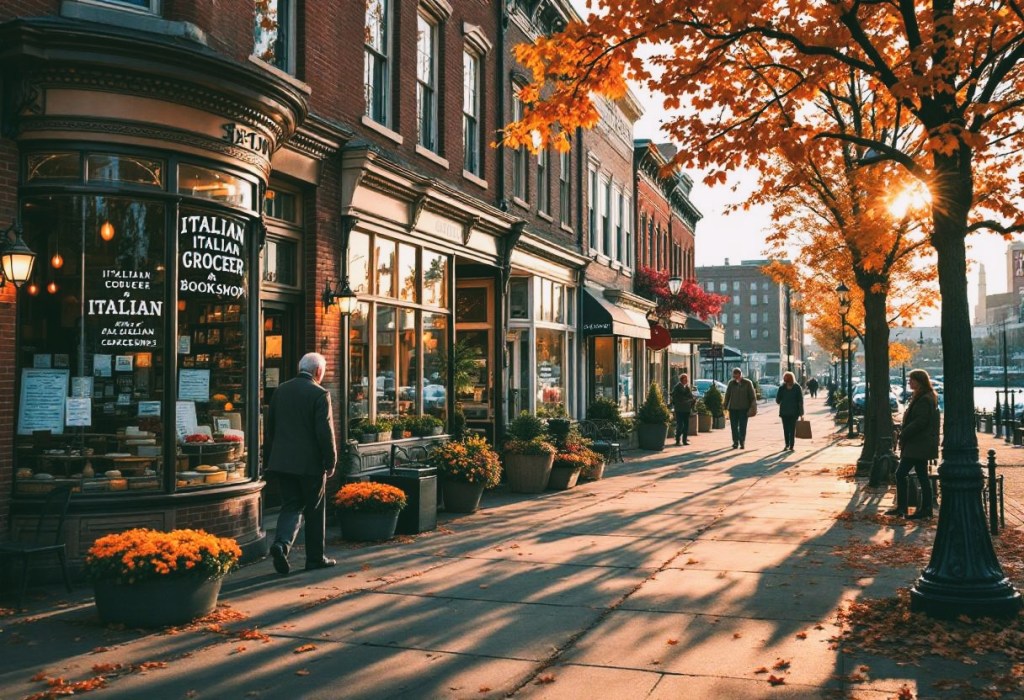
What makes a good neighbor?
Wednesday, 15th October 2025
The prompt arrived this morning with deceptive simplicity, the sort of question that sounds almost quaint until you begin unpacking what it actually asks.
I’ve been sitting with it all day between sessions, watching the harbour light shift across my office windows, thinking about Tom Callahan shuffling past at his usual hour with a wave and a weather report, about Marcus at the Harbourside knowing my coffee order before I reach the counter, about the particular texture of life lived in proximity to others – not quite intimacy, but something warmer and more sustaining than mere adjacency.
It’s rather ironic, I suppose, that yesterday I wrote about trying new things, about choosing adventure over the familiar rhythms of routine, when today’s question pulls me directly back to the dailiness of place, the accumulation of small gestures that constitute community. Perhaps they’re not opposites after all – perhaps being a good neighbour requires its own form of courage, its own willingness to show up consistently in ways that don’t announce themselves as particularly brave or bold.
What we inherit
My parents were good neighbours in fundamentally different ways. Father, with his bus driver’s attentiveness to routine and regularity, knew everyone on our street by name, remembered which elderly widow needed her bins brought in on collection day, noticed when the Hardy’s porch light stayed on past its usual hour and checked whether everything was alright. His neighbourliness was quiet, practical, expressed through steady presence rather than grand gestures. He understood that reliability itself can be a gift – that knowing someone will be there, will notice, will act if needed, creates a particular kind of safety.
Mother approached neighbouring with characteristic exuberance, forever organising street parties or volunteering to collect for various causes, appearing on doorsteps with borrowed cups of sugar and borrowed gossip in equal measure. Where Father noticed quietly, Mother engaged loudly, drawing people out, creating connections, ensuring that no one remained entirely unknown. She understood something essential about loneliness – that it thrives in the gaps between houses, that it requires active intervention rather than polite distance.
Together, they modelled a neighbourliness that balanced both impulses: the steady, watchful care and the warm, inclusive reach. I’ve tried, in my own rather more solitary way, to honour both inheritances, though I suspect I lean more naturally toward Father’s quieter approach.
The architecture of proximity
Living where I work – my consulting room occupying the ground floor of this Victorian near the harbour – means I inhabit the neighbourhood differently than I might otherwise. There’s no commute to separate professional Catherine from private self, no clear boundary between the person who holds space for others’ suffering and the woman who needs milk from Elena Moretti’s shop or who stops to admire Sylvia Nakamura’s autumn garden on her evening walk.
This permeability has its complications. I’ve learnt the delicate dance of encountering former patients at community events, maintaining appropriate boundaries whilst not pretending we’re strangers. Bill Patterson, whose daughter I treated a decade ago, now volunteers at the river clean-up days I attend – we exchange pleasantries, both of us carefully honouring what cannot be spoken whilst acknowledging what was. It’s a particular form of neighbourly discretion, this knowing when to see and when to look kindly past.
But the benefits far outweigh the awkwardness. Being woven into the actual fabric of daily life here – knowing which streets flood in heavy rain, which café has the best light for morning writing, where the harbour walk offers the most sheltered bench for difficult thinking – roots my clinical work in concrete reality rather than abstract theory. My patients aren’t disembodied symptoms arriving for fifty-minute sessions; they’re people who walk the same streets I do, facing the same rising rents and closing businesses, sustained by the same network of small kindnesses that hold all of us.
The disciplines of attention
What makes a good neighbour, I think, begins with a particular quality of attention – the willingness to notice without intruding, to register patterns without making assumptions. Tom, who’s lived three doors down since the shipyards were still running, has perfected this art. Our morning exchanges are brief – harbour conditions, whether the renovation project has recommenced, how the fishing was yesterday – but beneath the surface pleasantries runs a current of mutual regard. He notices when I’ve been working late, when I’ve missed my usual walk, when something in my posture suggests heaviness. He doesn’t pry, but his noticing itself offers a form of care, a reminder that one is seen even in one’s ordinary struggles.
I try to practice this same attentiveness, though it requires conscious effort not to slip into clinical assessment mode. When Priya, the architect who lives in the converted warehouse nearby, mentions her mother’s declining health in passing, I offer not therapy but simple acknowledgment, perhaps a recommendation for the excellent medical interpreter at the health centre – Lucia, who lives around the corner and who understands the particular complexities of healthcare across language and cultural barriers. Small informational gifts, offered without expectation of return or depth of disclosure.
This discipline of noticing extends beyond individuals to the neighbourhood itself. Good neighbours, I’ve observed, pay attention to the collective atmosphere, to shifts in the social weather that might signal trouble or opportunity. When the corner shop changed hands last year and suddenly felt less welcoming to the longtime Latino residents, it was Kevin from the river initiative who quietly organised a welcoming event, creating space for the new owners to meet their actual community rather than their imagined one. That kind of social architecture – building bridges before chasms open – seems to me essential to genuine neighbourliness.
The currency of small kindnesses
There’s an economy to neighbourhood life that operates outside conventional transactions, a circulation of small kindnesses that sustain community in ways more formal systems cannot. Marcus at the coffee shop knows that on difficult days — and somehow he can tell — I need my usual order brought to the corner table without my having to queue at the counter. Dan at Riverfront Books sets aside newly arrived titles he thinks might interest me, saving me the browsing time I rarely have. Elena saves the last of the good tomatoes when she knows I’m coming.
These gestures might seem trivial, barely worth naming. But in the aggregate, they create something profound: the felt experience of being known, of one’s patterns and preferences registered and accommodated, of mattering enough for others to extend themselves slightly beyond the minimum transaction requires.
I try to reciprocate in the ways available to me. When Amanda from the local paper needs background on mental health resources for a story, I make time despite my schedule. When Father Walsh mentions struggling with insomnia during one of our dawn harbour walks, I suggest a few non-pharmaceutical approaches – not as his psychiatrist, but as someone who shares his appreciation for the particular quality of early morning light on water. When Maggie at the Historical Society needs someone to interview elderly residents about the neighbourhood’s evolution, I volunteer, knowing my clinical training in listening might serve the project well.
This circulation of care, crucially, operates without strict accounting. Good neighbours don’t keep score, don’t measure their giving against others’ reciprocation. The gift is in the giving itself, in the maintenance of a social fabric where help flows naturally when needed because everyone has been both giver and receiver enough times that the roles feel fluid rather than fixed.
Holding boundaries with warmth
Here’s where my professional training and neighbourhood life intersect most productively: good neighbouring requires boundaries as surely as good therapy does. The warmth must be real, but it needn’t mean unlimited access or the collapse of all privacy. One can be genuinely present without being constantly available, can offer care without assuming responsibility for solving others’ problems.
I think of Dorothy Williams, the retired schoolteacher who’s been a neighbourhood elder since long before I arrived. She has mastered this balance – warmly interested in everyone’s lives, ready with practical help when genuinely needed, but also clear about her own limits, her own need for quiet, her right to decline requests that would overtax her energy. There’s no coldness in her boundaries, only a clarity that paradoxically allows for deeper connection. People trust her precisely because they know she won’t overextend herself and then resent them for it.
Learning this balance hasn’t come naturally to me. My training emphasises holding space, bearing witness, being available to others’ pain – disciplines that can blur into an unhealthy porousness if I’m not careful. I’ve had to learn, slowly, that saying no to a request from the community association or declining an invitation to yet another fundraiser doesn’t make me a bad neighbour. Sometimes the most neighbourly thing I can do is maintain my own wellbeing so I can continue offering what I do offer sustainably.
The courage of small talk
I’ve been thinking lately about something that might seem counterintuitive: that small talk, so often dismissed as superficial, might actually be a sophisticated social technology, a way of maintaining connection without demanding more intimacy than circumstances permit or people can offer.
My exchanges with the gentleman who takes his Saturday coffee at the harbour café – the one I mentioned yesterday, the chamber music concert, the conversation I haven’t yet had – these brief encounters matter not despite their lightness but because of it. We know each other slightly, pleasantly, without obligation. Should either of us need more – a word of sympathy in difficulty, a shared umbrella in sudden rain – the foundation exists. But neither of us is required to transform pleasantness into intimacy if that doesn’t serve us.
This seems to me increasingly valuable in an age that often mistakes intensity for authenticity, that suggests any relationship not plumbed to its depths is somehow false. Good neighbours create spaces where people can be lightly, easily social – where Tom can share his harbour wisdom without recounting his entire history, where I can admire Sylvia’s chrysanthemums without discussing my mother’s death, where Vinnie at the hardware store can tease me about my impractical tool choices without either of us needing to explain ourselves more fully.
There’s dignity in this lighter touch, a respect for the natural boundaries of acquaintanceship that allows community to include even the naturally solitary among us.
Witnessing transformation
One thing that strikes me about good neighbouring is its necessarily long view, its attention to the arc of lives and the neighbourhood itself over time. Because I’ve been here three decades now – first as a returning daughter of New Corinth, then as a young psychiatrist establishing her practice, now as something approaching an elder myself – I’ve witnessed the neighbourhood’s transformations: families arriving and departing, buildings changing hands, the slow dance between preservation and development that Priya the architect manages professionally and all of us negotiate daily.
Good neighbours, I think, hold this history gently, honouring what was whilst remaining open to what’s becoming. They resist both the nostalgic impulse to freeze everything in some imagined golden age and the dismissive erasure that treats the past as irrelevant obstacle to progress. They help newcomers understand what they’re joining whilst welcoming the changes new perspectives bring.
This requires a particular emotional flexibility, a capacity to grieve what’s lost – the family-owned shops replaced by chains, the affordable housing converted to luxury flats, the longtime residents priced out – whilst still extending genuine welcome to those who arrive. It’s easier said than done, this holding of both grief and welcome simultaneously, but I’ve watched people manage it with grace. James Zhang, the research scientist who immigrated from China a decade ago, speaks movingly about how certain longtime residents helped his family feel truly seen rather than merely tolerated, whilst also Tom, who remembers when the harbour was all working wharves, has learnt to appreciate what the revitalisation has brought even as he mourns what it’s cost.
The practice of showing up
Ultimately, I think good neighbouring comes down to something beautifully simple and maddeningly difficult: the practice of showing up, of being reliably present in the small, recurring rhythms that constitute community. Not heroically, not with fanfare, but steadily, across seasons and years, in ways that accumulate into something larger than their individual components.
It’s attending the river clean-up days even when I’d rather spend Saturday morning reading. It’s stopping to speak to Tom even when I’m running late. It’s shopping at Elena’s even though the supermarket would be more convenient. It’s participating in the historical society meetings even when I’m tired, offering what I can to the immigrant welcome programme even when my schedule feels impossible, pausing to appreciate Sylvia’s garden even when I’m preoccupied with case notes requiring my attention.
None of these acts feel particularly significant in the moment. But strung together across years, they constitute a life lived in genuine relationship to place and people, a rootedness that benefits both the neighbourhood and myself. I am held by the same web of care I help maintain – a thought that brings me comfort on difficult days when the consulting room feels heavy with others’ sorrows and I need reminding that I too am sustained by something larger than my solitary self.
The light is fading now over the harbour, that October golden hour when everything seems briefly held in amber. Soon Marcus will be closing the coffee shop, Elena pulling down the shutters at the grocers, Dan shelving the last books and locking up. We’ll all retreat to our separate dwellings, but the invisible threads that connect us remain, woven through years of small exchanges, ready to bear weight should any of us need it.
What makes a good neighbour? Perhaps simply this: the willingness to be woven in, to allow oneself to be known slightly and to know others the same way, to participate in the quiet, ongoing work of creating and maintaining the social fabric that holds us all. Not perfectly – none of us manages this perfectly – but persistently, with whatever combination of Father’s steadiness and Mother’s warmth we can muster, showing up for the beautiful, ordinary, essential work of being human together in a particular place.
I think tomorrow I might inquire about that watercolour class after all. It meets Tuesday evenings, which means I’d walk past Marcus closing up, past Elena’s shuttered shop, past all these familiar faces and spaces that constitute home. Perhaps part of trying new things is doing them here, in this neighbourhood that’s held me these thirty years, among these neighbours who’ve witnessed my becoming and whom I’ve been privileged to witness in turn.
That seems, somehow, the most neighbourly adventure of all.
Catherine
Bob Lynn | © 2025 Vox Meditantis. All rights reserved. | 🌐 Translate


 Vox Meditantis
Leave a reply to midwife.mother.me. Cancel reply