What could you try for the first time?
Tuesday, 14th October 2025
The prompt greeted me this morning alongside my coffee, a small challenge wrapped in an ordinary question: What could you try for the first time? It’s the kind of daily invitation that sounds easy enough until you sit with it and realise how much of yourself the answer might reveal.
I’ve been turning it over all day between appointments, the words catching at something tender, something I’ve been circling around since I wrote about Mother’s things on Sunday. It’s rather like pressing on a bruise to see if it still aches – and discovering, yes, it does, but perhaps not quite as fiercely as before.
The honest answer, the one that’s been forming in the quiet spaces of these autumn days, is that I could try being brave in the way Mother was brave. Not in grand gestures or dramatic pronouncements – that was never her style, despite the vivacity – but in the small, daily acts of choosing adventure over certainty, possibility over the known comfort of routine.
I’ve spent fifty-eight years building a life of careful deliberation. My practice thrives on it: the measured pace of therapy, the thoughtful silences, the patient accumulation of understanding that allows someone to finally articulate what they’ve been carrying wordlessly for years. This steadiness, inherited from Father and honed through decades of professional training, has served both my patients and myself remarkably well. Yet lately I find myself wondering what it might feel like to occasionally leap before looking, to follow curiosity without first mapping all possible consequences.
There’s a watercolour class that meets Tuesday evenings at the community centre on Harbour Street. I’ve walked past the lit windows dozens of times, seen the small clusters of easels and the intent faces bent over paper, heard the low murmur of conversation and occasional laughter filtering out into the October darkness. Each time, I’ve thought perhaps, and each time I’ve continued walking home to my Victorian office-cum-residence, to my evening cup of tea and the book waiting on my desk, to the familiar rhythms that ask nothing unexpected of me.
Mother would have signed up the first week. She’d have arrived with entirely the wrong supplies, charmed everyone into helping her sort it out, and probably left with three new friends and plans for weekend painting excursions along the riverfront. Her adventurousness wasn’t about expertise – she rarely excelled at the things she tried – but about the pure pleasure of novelty, the willingness to be a beginner, to look foolish, to discover whether something might bring joy.
I’ve been a beginner at very little since my residency thirty years ago. My life since returning to New Corinth in 1995 has been one of deepening expertise: knowing my patients’ histories intimately, understanding the subtle shifts in our small city’s collective mental health, building a reputation solid enough that I’m consulted on community matters that extend well beyond my consulting room. There’s profound satisfaction in that mastery, but also – I’m beginning to recognise – a certain calcification, a reluctance to venture beyond the territories I’ve mapped so thoroughly.
What could I try for the first time? I could try travelling alone. Mother and Father holidayed together, always, their contrasting temperaments balancing into something workable. Since their deaths, I’ve rarely ventured beyond the occasional conference in Philadelphia or Baltimore, practical trips with clear professional purpose. But there’s a small hotel in Québec I’ve read about, perched above the Saint Lawrence, with windows overlooking autumn forests that must be ablaze this time of year. I could go there for a long weekend, take my journal, walk unfamiliar streets where no one knows Dr. Bennett the psychiatrist, where I might simply be Catherine, middle-aged woman with a curiosity about French Canada and no particular agenda beyond seeing what unfolds.
The idea simultaneously thrills and terrifies me – which, I suppose, rather proves the point. I’ve spent my professional life encouraging others toward the edges of their comfort zones, gently supporting them as they risk vulnerability, try new patterns of relating, speak truths they’ve kept carefully hidden. Yet I’ve granted myself remarkably little of that same permission, content to remain within bounds I established decades ago.
Perhaps it’s being fifty-eight, this particular autumn of life when one begins calculating how many seasons remain, how many opportunities to choose differently. Or perhaps it’s the slow work of sorting through what Mother left behind – not just her silk scarves and Nevada postcards, but the example of her appetite for experience, her willingness to say yes before all the variables were known. She made plenty of mistakes, followed impulses that led nowhere in particular, but she was gloriously, messily alive in ways I’ve been too cautious to attempt.
I could also try – and this feels even more vulnerable to admit – opening myself to romantic possibility again. I’ve been alone for so long that solitude has become not just comfortable but seemingly essential, part of my identity as surely as my profession. The boundaries serve me well in my work; one cannot hold space for others’ emotional complexity whilst simultaneously navigating one’s own romantic turbulence. Yet this reasoning, sound though it may be, has also provided convenient shelter from the risk of intimacy, from the possibility that someone might see me fully – not Dr. Bennett, pillar of the community, but Catherine with all her contradictions and uncertainties.
There’s a gentleman who takes his morning coffee at the same harbour café I frequent on Saturdays. We’ve exchanged pleasantries for months now, small comments about the weather or the state of the riverfront renovation project. Last week, he mentioned a chamber music concert at the old Methodist church, said he’d heard the violinist was exceptional, wondered if I had plans to attend. I smiled, said I’d think about it, and went home to my familiar solitude. What if, instead, I’d said yes? What if I tried allowing someone past the careful professional persona, risked the discomfort of being known?
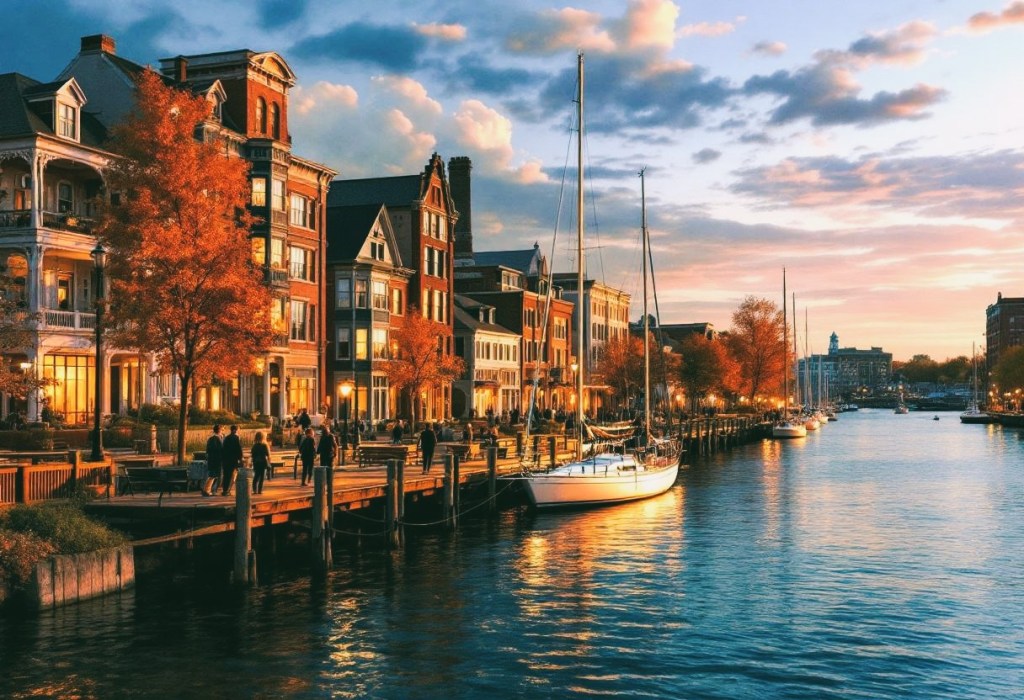
The light is fading now over the Delaware, that particular October golden hour when everything seems briefly precious and fleeting. I can see the harbour from my office window, the masts of the small boats bobbing gently, the last tourists strolling the boardwalk before dinner. Tomorrow I’ll see patients, listen carefully to their struggles and small triumphs, hold steady space for their becoming. But perhaps tomorrow evening, I’ll walk down Harbour Street and inquire about that watercolour class. Perhaps I’ll book that hotel in Québec. Perhaps I’ll attend the concert and look for a kind face in the crowd.
Mother used to say that the only adventures she truly regretted were the ones she didn’t take. At fifty-eight, I’m finally beginning to understand what she meant – not that every risk yields reward, but that the act of reaching beyond the known has its own intrinsic value, regardless of outcome. What could I try for the first time? I could try trusting that steadiness and adventure need not be opposites, that one can be both the careful holder of others’ stories and the protagonist of one’s own unfolding narrative. I could try being, just occasionally, gloriously uncertain about what comes next.
And perhaps that’s the greatest first thing of all.
Catherine
Bob Lynn | © 2025 Vox Meditantis. All rights reserved. | 🌐 Translate


 Vox Meditantis
Leave a reply to midwife.mother.me. Cancel reply