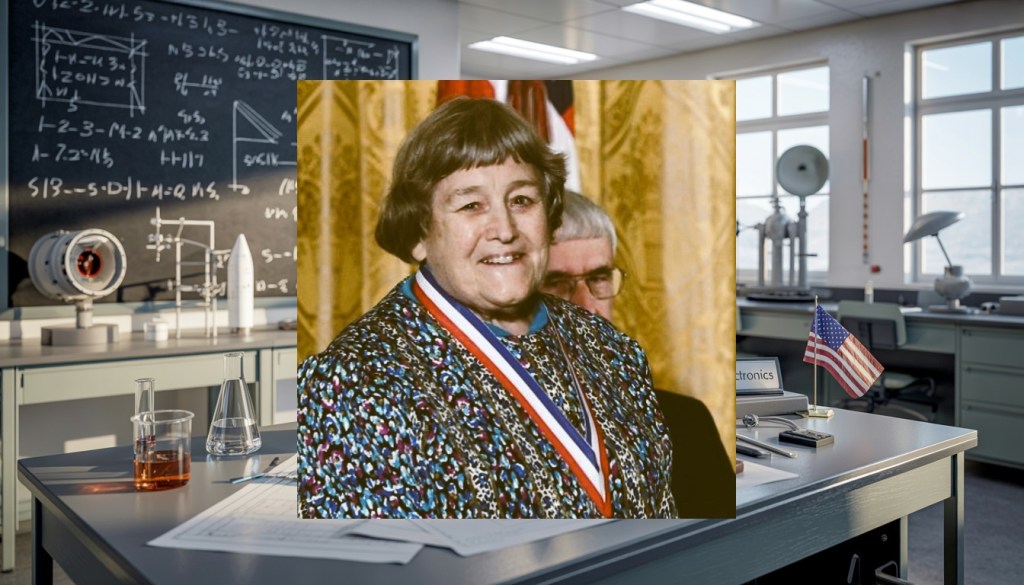
Yvonne Madelaine Brill (1924-2013) stands as one of the most influential rocket engineers of the twentieth century, whose electrothermal hydrazine thruster became the industry standard for keeping satellites in orbit. The Canadian-born engineer’s invention delivered a remarkable 50% improvement in fuel efficiency whilst allowing spacecraft to carry more equipment, fundamentally transforming satellite communication and space exploration. Despite her groundbreaking contributions to NASA’s TIROS weather satellites and Mars exploration missions, Brill faced systematic under-recognition, often credited secondarily to male colleagues in an era when women balancing career and family were viewed as anomalies rather than pioneers.
Today, as we confront the challenges of sustainable space travel and satellite debris, Brill’s legacy resonates powerfully. Her elegant engineering solution – using a single propellant system instead of multiple complex arrangements – anticipated the modern drive for efficiency that now guides reusable rocket development and orbital sustainability efforts. Her story illuminates not only the hidden contributions of women to national security technology during the Cold War but also the enduring need for diverse voices in addressing humanity’s greatest challenges.
Thank you for joining us, Mrs Brill. Looking back from 2025, we can see how profoundly your work shaped modern satellite technology. But let’s begin at the beginning – you arrived in America during the 1940s, just as the space age was dawning. What drew you from Manitoba to the heart of the aerospace revolution?
Well, I never set out to start a revolution, I can tell you that! I was just a young woman from Winnipeg who’d been told by her high school science teacher that women wouldn’t get anywhere in science. My father wanted me to open a little dress shop. But when you’re the first in your family to attend university, and you’ve got your sights set on something bigger, you don’t listen to that sort of nonsense.
The move to California in 1945 happened almost by accident. Douglas Aircraft offered me a position right after I graduated from the University of Manitoba – top of my class, I might add – and I thought, “Why not?” The war had just ended, and there was this tremendous energy around new technologies. I wanted to be part of it. I remember taking the train west, watching the landscape change, thinking I was heading toward something important. I just didn’t realise how important.
You mention it was “almost by accident,” but you ended up being the only woman working in rocket propulsion in the United States during the 1940s. That seems rather deliberate.
You’re quite right to call me on that. Perhaps “accident” isn’t the right word. I was fascinated by the engineering problems, but the university wouldn’t let me study engineering proper – claimed they couldn’t accommodate women at their summer camp. So I studied mathematics and chemistry instead, which turned out to be exactly what rocket science needed.
When I got to Douglas, they put me in the chemistry department working on rocket propellants and ramjets. Then came Project RAND in 1946 – the government’s request to put up an unmanned earth-orbiting satellite. It was highly classified then, of course. I was part of the proposal team, doing trajectory calculations with slide rules and those clunky Marchant calculating machines. I remember working for Dr Robert Kruger, and my calculations for getting to a 100-nautical-mile orbit came within two-hundredths of his estimates. That’s when I knew I belonged in this field.
That precision must have been crucial during the Cold War tensions. How did it feel to be working on what would become America’s first satellite project whilst the Soviets were developing their own capabilities?
The competitive atmosphere was palpable, absolutely electric. We knew the Soviets were working on something similar – there were rumours, intelligence reports. Every calculation mattered because whoever got there first would demonstrate technological superiority to the world. It wasn’t just about science; it was about proving that our way of doing things could outpace theirs.
I felt the weight of that responsibility, particularly as someone who’d immigrated from Canada. This was my adopted country, and I was contributing to its defence capabilities. When Sputnik went up in 1957, there was this collective intake of breath across the American aerospace community. We’d been beaten to the punch, and it hurt. But it also galvanised us.
Let’s talk about your family life during this period. You married within a year of arriving in California and followed your husband from job to job, as many women did then. How did you navigate that expectation whilst pursuing such demanding work?
Oh, that old chestnut. Yes, I followed Bill – my husband was a research chemist – from California to the East Coast. But I didn’t just tag along like luggage. I managed to find positions wherever we went, often part-time work when the children were small, but always in the field. I never stopped thinking like an engineer.
Those years when people say I “took time off” – that’s not entirely accurate. I continued consulting, kept my hand in the work. My brain didn’t switch off just because I was changing nappies. Some of my best ideas came during those supposedly quiet years. You’d be surprised how much problem-solving happens when you’re up at 2 AM with a teething baby and your mind starts wandering to propulsion systems.
In 1966, you joined RCA Astro Electronics, where you would develop your most famous invention. Can you walk us through the technical challenge that led to the electrothermal hydrazine thruster?
Ah, now we’re getting to the heart of it. By the mid-1960s, satellites were becoming more sophisticated, but they had a fundamental problem: staying in proper orbit required constant small adjustments, and the existing systems for doing this were terribly inefficient.
You see, most spacecraft used multiple propulsion systems – one type of thruster for large manoeuvres, another for fine positioning, different fuel tanks for each system. It was like having a toolbox where every tool required its own power source. Heavy, complex, prone to failure.
I kept thinking: why not use one propellant for everything? The breakthrough came with hydrazine – a combination of nitrogen and hydrogen that’s quite volatile but very energetic. The standard approach was to let hydrazine decompose over a catalyst bed, which worked well enough. But I reasoned that if we electrically heated the decomposition products before they left the nozzle, we could extract more energy from the same amount of fuel.
Could you explain the technical details of how this works? Our readers include many aerospace engineers who would appreciate the specifics.
Certainly. The system I patented – US Patent Number 3,807,657 – works on a fairly elegant principle. Liquid hydrazine enters through a series of perforated pipes into a cylindrical catalyst bed. The catalyst causes the hydrazine to decompose at extremely high temperatures, producing ammonia and nitrogen gas.
Here’s the crucial bit: instead of simply letting these hot gases expand through the nozzle, we apply electrical heating to raise their temperature even further before discharge. This additional thermal energy translates directly into higher exhaust velocity – and in rocketry, exhaust velocity is everything.
The result was a 30% increase in specific impulse compared to conventional hydrazine thrusters. More importantly, we could vary the thrust level by controlling the electrical heating. One set of thrusters could deliver high thrust – one pound or more – for major orbital corrections, whilst another set provided precise micro-thrust of 0.01 to 0.05 pounds for fine positioning. All using the same propellant supply.
That sounds almost too simple to be revolutionary. What made this approach superior to existing methods?
Simple is exactly right – that’s what made it revolutionary. Complexity is the enemy of reliability in space systems. Before my design, satellites needed separate propulsion systems with different propellants, different storage requirements, different control mechanisms. Each system added weight, complexity, and potential failure points.
My resistojet eliminated all that. One propellant, one storage system, one control mechanism. The weight savings alone were enormous – perhaps 20% of the spacecraft’s propulsion system mass. That meant more room for instruments, or longer mission life, or both.
But the real advantage was operational. Ground controllers could now make precise orbital adjustments using the same system that handled major manoeuvres. It was like replacing a garage full of specialised tools with one elegant multi-tool that worked better than any of the originals.
The efficiency improvement – 50% better fuel utilisation – meant satellites could stay in proper orbit for years longer than previously possible. For commercial communication satellites, that translated directly into millions of dollars of additional revenue.
When you first conceived this system in 1967, did you anticipate it would become the industry standard?
I hoped it would be useful, but “industry standard”? That seemed rather ambitious for a design that wouldn’t see its first flight test until 1983 – sixteen years later! The aerospace industry moves slowly, particularly when it comes to propulsion systems. Nobody wants to risk a multi-million-pound satellite on unproven technology.
But I did understand the implications. The commercial satellite industry was just beginning to emerge in the late 1960s, and I could see that efficiency would become crucial as missions became longer and more complex. What I didn’t fully grasp was how transformative this would be for satellite communications globally.
Looking back, that sixteen-year gap between conception and first flight seems extraordinary. What happened during those years?
Oh, that’s the reality of aerospace development – endless testing, refinement, more testing. My colleagues at RCA were methodical, which was proper given the stakes. We had to prove the system worked reliably under every conceivable condition: temperature extremes, radiation exposure, thermal cycling, vibration, you name it.
Meanwhile, I continued working on other projects. I contributed to the propulsion systems for the TIROS weather satellites – the first of their kind – and worked on Nova, the rocket series for the Apollo lunar missions. I even spent some time at NASA headquarters in the early 1980s, working on the Space Shuttle’s solid rocket program.
But I always kept an eye on my resistojet development. When it finally flew in 1983 on an RCA spacecraft, I felt tremendous satisfaction. Not vindication, exactly – I’d known it would work – but satisfaction that patience and persistence had paid off.
You mentioned the TIROS weather satellites. Those were groundbreaking in their own right, providing the first comprehensive view of Earth’s weather patterns from space. How did your propulsion work enable that capability?
TIROS – the Television Infrared Observation Satellite program – was absolutely crucial for understanding weather on a global scale. Before TIROS, meteorologists were essentially blind to weather patterns over the oceans, which cover most of our planet’s surface.
The propulsion challenge was keeping these satellites in precise sun-synchronous orbits so they could observe the same locations at consistent times each day. Weather prediction depends on regular, reliable data, and that requires satellites that stay exactly where they’re supposed to be.
My propulsion systems enabled TIROS satellites to maintain their orbits for much longer periods, providing years of continuous weather data instead of months. This was during the 1960s, remember – the height of the Cold War. Weather satellites weren’t just scientific instruments; they were strategic assets. Accurate weather forecasting affects everything from military operations to agricultural planning.
That brings us to another of your contributions: the Viking missions to Mars. How did your work enable humanity’s first successful landing on another planet?
Viking was an extraordinary challenge – two separate spacecraft, each consisting of an orbiter and a lander, flying to Mars in 1976. The journey took nearly a year, and once there, the orbiters needed to maintain precise positions to relay communications between the landers and Earth.
My hydrazine thrusters were perfect for this application. Mars operations required countless small orbital adjustments over months of operation, and fuel efficiency was absolutely critical. You can’t exactly send up a refuelling mission to Mars!
The Viking landers provided our first detailed look at the Martian surface, searching for signs of life and sending back thousands of photographs. The orbiters mapped the planet’s geology and atmosphere. None of that would have been possible without reliable, efficient propulsion systems to keep the spacecraft properly positioned.
There’s something poetic about your Canadian-developed, American-built technology helping humanity reach another world. Did you feel that sense of historical significance?
You know, when you’re deep in the technical work – calculating thrust vectors, designing catalyst beds, testing thermal properties – you don’t always step back to consider the poetry of it all. But yes, there were moments when the magnitude hit me.
I remember watching the first Viking images come back from Mars, thinking: “My little thruster helped make this possible.” Here was humanity’s first close look at another planet, enabled in part by a propulsion system I’d dreamed up in my office at RCA. That’s rather extraordinary when you put it that way.
And the international aspect wasn’t lost on me. Here I was, a Belgian-Canadian immigrant to America, developing technology that pushed the boundaries of human knowledge. It felt like the best of what immigration could accomplish – bringing diverse perspectives to tackle challenges no single nation could solve alone.
Let’s talk about recognition. Despite these groundbreaking contributions, you often found yourself credited secondarily to male colleagues. How did you handle that professional reality?
That’s the question everyone wants to ask, isn’t it? Look, I’m not bitter about it – bitterness doesn’t solve engineering problems. But the pattern was unmistakable. Technical papers would list male colleagues first, even when the core innovations were mine. Meeting minutes would attribute ideas to whoever spoke loudest, not whoever originated them.
The most galling example was often how my work was presented at conferences. I’d develop a propulsion system, write the technical specifications, oversee the testing – then watch a male colleague present “our” findings to the audience. “Our” work, but somehow I’d become invisible in the telling.
I learned to document everything meticulously. Patent applications, design memos, test results – all with my name clearly attached. That patent number I mentioned earlier, 3,807,657? That’s mine, full stop. Nobody can take that away.
Was there a particular moment when this pattern of erasure became impossible to ignore?
Oh, absolutely. It was during a major review meeting at RCA in the early 1970s. We were presenting the resistojet development to potential customers, and I’d prepared the entire technical briefing. I knew every specification, every test result, every design trade-off.
But when the meeting began, my supervisor introduced the project as if he’d conceived it himself. He presented my calculations, my test data, my design innovations – all as “his” work. I sat there, the only woman in the room, watching my professional achievements being claimed by someone else.
After that meeting, I made a decision. I would be more assertive about credit, more strategic about visibility. I started insisting on first authorship on papers where I’d done the primary work. I began presenting my own findings at conferences, even when colleagues suggested it might be “more appropriate” for a senior male engineer to speak.
Rockets don’t launch on praise alone, but careers sometimes do – and I wasn’t going to let my career be launched by someone else’s praise for my work.
That phrase – “rockets don’t launch on praise alone” – seems to capture your pragmatic approach. But surely the personal cost was significant?
Of course it was. There were times when standing up for proper recognition meant being labelled “difficult” or “uncooperative.” I lost opportunities because I wouldn’t quietly accept secondary credit for primary work. Some male colleagues found it easier to work with women who didn’t insist on their own visibility.
But here’s what I learned: accepting invisibility doesn’t actually make you more liked – it just makes you invisible. If I was going to be judged harshly anyway, I might as well be judged for work that was properly attributed to me.
The personal cost extended to my family as well. There were dinners missed, school events postponed, because I was traveling to conferences or working late to finish a crucial calculation. My children sometimes asked why Mummy’s work was so important that it took me away from home. How do you explain orbital mechanics to a six-year-old?
How did you explain it? What did you tell your children about the importance of your work?
I told them the truth, in language they could understand. “Mummy helps satellites talk to each other,” I’d say. “When Daddy calls Grandma in Toronto, the call might go through a satellite that uses Mummy’s rocket engine to stay in the right place.”
My daughter Naomi, who’s also an engineer now, later told me those conversations shaped her understanding of what was possible for women in technical fields. She saw that mothers could build things that mattered, could solve problems that helped people around the world communicate with each other.
But I also had to acknowledge the trade-offs. There were times when I chose work over family events, when I prioritised a crucial test over a school play. I tried to make up for it by bringing the children to my office sometimes, letting them see the hardware, the test facilities. They developed quite sophisticated vocabularies around propulsion systems!
Speaking of your daughter following you into engineering, how has the field changed for women since your early days?
The numbers have certainly improved – more women in engineering schools, more women in aerospace companies. But the fundamental challenges remain remarkably similar. Women still have to work harder to be taken seriously, still see their contributions overlooked or undervalued, still face questions about balancing career and family that their male colleagues never encounter.
What’s changed is the awareness. When I started out, discrimination was so normalised that people barely recognised it as discrimination. Now, at least, there’s acknowledgement that bias exists. That’s progress, even if it’s slower than I’d hoped.
Naomi tells me about her experiences in management positions, and whilst she faces different challenges than I did, the core issue remains: proving competence that’s assumed for male colleagues. The difference is that now there are support networks, professional organisations that advocate for women in engineering. I largely fought those battles alone.
Let’s turn to a more controversial aspect of your legacy. When you died in 2013, The New York Times obituary began with your beef stroganoff recipe and your role as a mother, rather than your scientific achievements. How would you have preferred to be remembered?
Oh, that obituary. “She made a mean beef stroganoff” – as if that were my greatest accomplishment! I did make excellent beef stroganoff, by the way, but I rather doubt that’s how we’d introduce a male rocket scientist’s obituary.
The irony is that the recipe wasn’t even particularly complicated – just good ingredients and careful attention to timing. Rather like engineering, actually. But nobody writes, “He made excellent scrambled eggs and also happened to design rockets.”
How would I prefer to be remembered? As someone who solved important problems elegantly. As an engineer who saw possibilities where others saw limitations. As someone who proved that the most efficient solution is often the simplest one, whether you’re designing rocket engines or organising a career around family responsibilities.
If you must mention the cooking, at least note that the same attention to detail that made my stroganoff excellent also made my propulsion systems reliable. Precision matters, whether you’re measuring paprika or calculating thrust vectors.
Looking at today’s space industry, with companies like SpaceX revolutionising rocket reusability and thousands of satellites creating orbital debris concerns, how do you see your work’s continuing relevance?
The principles remain absolutely relevant, perhaps more so than ever. Modern satellite constellations – thousands of spacecraft requiring precise positioning – depend on exactly the kind of efficient, reliable propulsion my resistojet provided. The environmental concerns about space debris make fuel efficiency even more critical, because efficient thrusters mean longer-lasting satellites that don’t need frequent replacement.
Reusable rockets are fascinating, but they still need efficient propulsion systems for final orbital insertion and station-keeping. SpaceX’s satellites use updated versions of the same monopropellant thruster concept I pioneered in the 1960s. The specific technology has evolved – better materials, more sophisticated control systems – but the fundamental insight remains: simple, efficient, reliable.
What troubles me about the current situation is how the rush to deploy satellite constellations sometimes overlooks long-term consequences. We’re creating orbital traffic jams that could persist for decades. Perhaps if more engineers thought like I did – considering the entire system lifecycle, not just initial deployment – we’d have better solutions for orbital sustainability.
Do you see parallels between the challenges you faced as a woman in aerospace and the current push for diversity in technology companies?
Absolutely. The fundamental issue hasn’t changed: homogeneous teams produce homogeneous solutions. When I was the only woman in meetings, I often asked different questions, approached problems from different angles. Not because women think differently than men in some essential way, but because different experiences lead to different insights.
Today’s technology challenges – climate change, sustainable energy, orbital debris – require the same kind of systems thinking that guided my work on satellite propulsion. These are complex, interconnected problems that need diverse perspectives to solve effectively.
The difference now is that there’s recognition of diversity as a strategic advantage, not just a nice gesture. Companies understand that innovation requires different viewpoints, different approaches to problem-solving. When I started out, I had to prove that women could do engineering work. Now the challenge is proving that diverse teams do better engineering work.
If you could address today’s generation of women entering STEM fields, what advice would you offer?
First, master your craft. Be so good at what you do that nobody can question your competence. But don’t make the mistake I sometimes made of thinking excellence alone would guarantee recognition. You must also advocate for yourself, document your contributions, and insist on proper credit.
Second, find allies – both men and women who recognise talent regardless of its packaging. Some of my greatest supporters were male engineers who judged work by its quality, not by the gender of the person presenting it. Cultivate those relationships, but don’t depend on others to fight your battles.
Third, remember that the problems you’re solving matter more than the recognition you receive. My resistojet enabled weather forecasting that saves lives, communications that connect families, and exploration that expands human knowledge. That work has value independent of whether history books spell my name correctly.
Finally, support other women coming up behind you. When I was promoted to positions where I could influence hiring and project assignments, I made sure qualified women got opportunities. Not because they were women, but because talent comes in many forms, and we needed all the talent we could find.
As we conclude, what do you hope your legacy represents for the future of aerospace engineering?
I hope it demonstrates that elegant solutions often emerge from careful observation of fundamental problems. My resistojet succeeded not because it was the most sophisticated approach, but because it was the most efficient. In an industry that sometimes prizes complexity, I showed that simplicity could be revolutionary.
I also hope it proves that innovation can come from unexpected sources. A Canadian-born mother working part-time at a corporate research lab isn’t the stereotypical image of a aerospace pioneer, but some of the best ideas come from people who think differently about familiar problems.
Most importantly, I hope my work reminds future engineers that technology exists to serve human needs. Satellites aren’t elegant engineering exercises – they’re tools for communication, navigation, weather prediction, scientific discovery. Every component, every system, every design decision should serve that larger purpose.
If young engineers remember me as someone who solved important problems efficiently and elegantly, who persisted despite obstacles, and who never lost sight of why the work mattered – well, that’s legacy enough for any engineer.
Thank you, Mrs Brill, for this remarkable conversation and for the contributions that continue to enable our exploration of space and understanding of our world.
It’s been my pleasure. Now, if you’ll excuse me, I have some calculations to review. There are always more problems to solve, more systems to improve. That’s the wonderful thing about engineering – the work is never really finished.
Letters and emails
Following our conversation with Yvonne Brill, we’ve received an overwhelming response from readers around the world who were captivated by her insights into Cold War-era aerospace engineering and the personal journey of a woman breaking barriers in rocket science. We’ve selected five particularly thoughtful letters and emails from our growing community – spanning five continents – whose authors want to explore deeper questions about her technical innovations, ethical considerations, and the advice she might offer to those following similar paths in STEM fields today.
Linh Pham, 34, Materials Scientist, Cape Town, South Africa:
Mrs Brill, I’m fascinated by your choice of hydrazine as the monopropellant for your resistojet system. Given that hydrazine is highly toxic and requires careful handling, were there alternative propellants you considered in the 1960s? How did the material science limitations of that era – particularly in catalyst bed design and thermal barrier coatings – influence your engineering decisions, and do you think modern green propellants like ADN could have changed your approach entirely?
Oh my, Linh, you’ve hit upon one of the thorniest engineering decisions I faced in the 1960s. You’re absolutely right about hydrazine being a nasty piece of work – we called it “devil’s brew” around the lab because of how it could burn right through your skin if you weren’t careful. But here’s the thing: in those days, our choices were rather limited compared to what you have now.
I did consider other monopropellants, certainly. There was hydrogen peroxide, which the Germans had used extensively during the war in their V-2 rockets. But hydrogen peroxide required silver screens as catalysts, and those degraded quickly under the thermal cycling we expected in space. The British had some interesting work with nitrous oxide systems, but the performance just wasn’t there for long-duration missions.
The real breakthrough with hydrazine came from understanding its decomposition chemistry. When it breaks down over an iridium catalyst – and we spent months testing different catalyst formulations – you get ammonia and nitrogen at temperatures around 1000°C. That’s hot enough to provide decent thrust, but not so hot that it destroys your chamber materials. The beauty was that this reaction was completely predictable and controllable.
Now, regarding the material science limitations you mentioned – goodness, that takes me back to some frustrating nights! Our thermal barrier coatings were primitive by today’s standards. We were working with basic ceramics and refractory metals, nothing like the advanced composites available now. The catalyst bed design was particularly challenging because we needed something that could withstand thousands of thermal cycles without degrading, but we were essentially using modified chemical reactor technology.
I had to design around these limitations rather than through them. The electrical heating element in my resistojet was positioned downstream of the catalyst bed precisely because our materials couldn’t handle direct electrical heating at the high pressures where decomposition occurred. It wasn’t the most elegant solution, but it worked with what we had.
As for modern green propellants like ADN – ammonium dinitramide, if I’m not mistaken – well, that’s fascinating stuff! If we’d had access to those in the 1960s, I might have approached the entire problem differently. The reduced toxicity alone would have simplified our ground handling procedures enormously. But you know, sometimes constraints force you toward better solutions. Working with hydrazine’s limitations taught me to think more carefully about system integration, which served me well throughout my career.
The key lesson I learned was this: don’t let perfect be the enemy of good enough to get the job done.
Adam Kowalski, 42, Technology Policy Analyst, Toronto, Canada:
You mentioned working on highly classified projects during the Cold War, including early satellite reconnaissance capabilities. Looking back, how do you reconcile the dual-use nature of space technology – where the same propulsion systems enabling weather forecasting also powered military surveillance satellites? Did you ever wrestle with the ethical implications of your innovations being used for purposes beyond their original scientific intent?
Adam, that’s a question that kept me awake more nights than I care to admit, particularly during the height of the Cold War. You have to understand the context we were working in – this wasn’t some abstract engineering exercise. The Soviets had beaten us with Sputnik, and there was genuine fear that American technological superiority was slipping away.
When I was working on the early reconnaissance satellite proposals at Douglas, we knew perfectly well that the same orbital mechanics enabling weather observation could guide spy satellites. The propulsion systems I developed didn’t discriminate between peaceful and military applications – physics doesn’t care about your intentions.
I wrestled with this constantly, especially after the Cuban Missile Crisis in 1962. Here I was, a Canadian immigrant, contributing to America’s military capabilities in space. But I came to see it this way: the alternative to American space dominance might well have been Soviet space dominance, and frankly, I preferred living in a world where democratic values shaped how space technology was developed and used.
The dual-use nature of our work was never hidden from us. During security briefings, they were quite explicit about potential military applications. But they also emphasised the peaceful benefits – weather forecasting that could save lives, communication satellites that could connect families across oceans, navigation systems that could guide ships safely to port.
What convinced me to continue was seeing how the same technology served both purposes simultaneously. The TIROS weather satellites I helped propel weren’t just gathering intelligence – they were providing crucial data for hurricane prediction, agricultural planning, and disaster response. My resistojet enabled longer missions that benefited everyone who depended on satellite services.
I also realised that stepping away wouldn’t change anything – someone else would develop these systems, possibly with less consideration for their broader implications. At least by staying involved, I could advocate for designs that prioritised reliability and efficiency over purely military specifications.
The ethical line I drew was this: I would work on propulsion systems and orbital mechanics, but I wouldn’t contribute directly to weapons development. When opportunities arose to work on missile guidance systems, I declined. Propulsion for peaceful space exploration and communication felt different from propulsion designed specifically to deliver warheads.
Looking back, I think the peaceful applications ultimately outweighed the military ones. The Global Positioning System started as a military project, but now it guides ambulances to hospitals and helps farmers optimise their crops. Technology has a way of serving humanity’s broader needs, regardless of its original intent.
Amara Diallo, 28, Aerospace Engineering Student, Seoul, South Korea:
I’m impressed by how you maintained your technical edge during those years when you worked part-time whilst raising children. Could you walk us through your process for staying current with rapidly evolving aerospace literature and emerging technologies? Did you develop any particular strategies for efficient learning or maintaining professional networks when traditional conferences and industry gatherings weren’t always accessible to women with family responsibilities?
Amara, you’ve asked about something I rarely discussed openly, but it was absolutely crucial to my survival in this field. When you’re working part-time with three children at home, you can’t afford to waste a single moment on inefficient learning.
First, subscriptions were my lifeline. I maintained personal subscriptions to the Journal of the American Rocket Society, Astronautics & Aeronautics, and several technical reports from NASA and the Air Force. These weren’t cheap on a part-time salary, but I considered them essential tools, like a carpenter’s saw. I’d read them during my lunch breaks, sometimes while the children napped, often late at night after everyone was asleep.
I developed what I called my “index card system.” Whenever I read something significant – a new propulsion concept, test results, material properties – I’d write the key points on index cards with the source citation. I organised these by topic: catalyst chemistry, thermal management, orbital mechanics. This way, I could quickly review developments in any area before a meeting or project discussion.
Professional networks were trickier. The informal conversations at conferences – you know, those after-hours discussions where real information gets exchanged – weren’t accessible when you’re rushing home to relieve the babysitter. So I cultivated relationships through correspondence. I’d write thoughtful letters to authors of papers that interested me, asking technical questions or sharing observations from my own work. Many engineers were quite generous with their time and insights through the mail.
I also learned to maximise every professional interaction. When colleagues visited RCA, I’d prepare specific questions in advance. Instead of general chit-chat, I’d ask: “What’s your experience with iridium catalyst degradation at high cycling rates?” or “Have you seen the latest thermal coating work from Bell Labs?” This approach earned me a reputation for being direct and well-prepared, which actually helped my credibility.
The children inadvertently helped too. Teaching them simplified versions of orbital mechanics – “Why does the satellite stay up there, Mummy?” – forced me to understand concepts more clearly myself. Sometimes their innocent questions revealed assumptions I hadn’t examined.
My biggest innovation was what I called “productive multitasking.” While cooking dinner, I’d mentally review technical problems. During children’s bath time, I’d work through calculations in my head. I kept a small notebook in my handbag for jotting down ideas during mundane activities.
The key was treating professional development as seriously as any other engineering problem: define the requirements, optimise for efficiency, and never stop iterating on your approach.
Christopher Hayes, 31, Space Industry Entrepreneur, São Paulo, Brazil:
Imagine if budget constraints had forced NASA to choose between funding your hydrazine thruster development and investing in early reusable rocket technology during the 1970s. Which path do you think would have ultimately advanced space exploration more significantly? And given today’s focus on rapid reusability versus long-duration orbital operations, how might that decision have shaped our current approach to space commercialisation?
Christopher, that’s a fascinating hypothetical that gets to the heart of how we prioritise technological development. You’ve really made me think about the path not taken, haven’t you?
If I’m being completely honest, I would have argued for continued development of my hydrazine thruster system, but not for the reasons you might expect. In the 1970s, reusable rockets were still largely theoretical – wonderful on paper, but riddled with unsolved engineering problems. The Space Shuttle program was already consuming enormous resources trying to make reusability work, and frankly, we were learning that it was far more complex than anyone had anticipated.
My resistojet, on the other hand, was solving immediate, practical problems. Every satellite launched needed reliable station-keeping propulsion, whether it was riding a reusable rocket or an expendable one. You see, reusability addresses the launch problem, but once you’re in orbit, you still need efficient propulsion for years of operation. These are complementary technologies, not competing ones.
But here’s where your question becomes really intriguing: if budget constraints had forced that choice, I think investing in reusable rocket technology might have been the correct long-term decision, even though it would have pained me personally. The launch costs in the 1970s were astronomical – pardon the pun – and anything that could reduce them would open space access to more missions, more experiments, more commercial applications.
However, I suspect we would have paid a steep price in satellite reliability and mission duration. Without efficient station-keeping propulsion, we might have ended up with shorter-lived satellites requiring more frequent replacement launches. That could have actually increased overall mission costs, even with cheaper rockets.
Looking at today’s space commercialisation, I think both paths were necessary. Your modern companies like SpaceX have finally cracked the reusability puzzle that bedeviled us in the 1970s, but they’re still using derivatives of my monopropellant thruster concepts for satellite operations. The real breakthrough came from pursuing both approaches simultaneously, rather than choosing one or the other.
What fascinates me about current space commerce is how it validates something I believed back then: reliable, efficient systems eventually matter more than flashy innovations. Reusable rockets grab headlines, but the unglamorous propulsion systems that keep satellites operational for decades are what make the business model work.
The lesson, I think, is that revolutionary technologies often require evolutionary support systems to reach their full potential. Sometimes the quiet innovations enable the dramatic ones.
Natalia Rojas, 39, Science Communications Director, Barcelona, Spain:
Your story resonates deeply with many of us who’ve had to choose between being visible advocates for other women or keeping our heads down to advance our own work. If you could redesign the institutional structures of aerospace companies in the 1960s and 70s – knowing what you know now about organisational psychology and inclusive leadership – what specific changes would have made the biggest difference in supporting technical women like yourself?
Natalia, you’ve put your finger on the central dilemma I faced throughout my career. There were times when I chose to keep my head down and focus on the work, and times when I felt compelled to speak up for other women. Looking back, I’m not sure I always made the right choice, but I learned some hard lessons about institutional change.
If I could redesign those aerospace companies from scratch, the first thing I’d change would be the promotion and project assignment processes. In the 1960s and 70s, these decisions happened in informal conversations – over lunch, at the golf course, during after-work drinks. Women were rarely present for these discussions, so we were essentially invisible when opportunities arose.
I’d mandate that all significant assignments be posted internally with clear qualification criteria. No more of this “I know just the man for the job” nonsense. Every qualified engineer should have the chance to apply and be evaluated on merit alone.
Second, I’d restructure performance evaluations to focus on measurable contributions rather than subjective assessments of “leadership potential” or “team fit.” Too often, these vague criteria became excuses for bias. When my supervisors could point to specific patent applications, successful test results, or cost savings I’d generated, it was harder for them to overlook my contributions.
The meeting culture needed complete overhaul too. I’d institute rotating meeting leadership – not just letting the loudest voice dominate the discussion. Some of my best ideas were dismissed simply because I didn’t interrupt forcefully enough to be heard. A more structured approach to gathering input would have surfaced contributions from quieter team members, many of whom happened to be women.
But the most important change would have been creating what I’d call “diagonal mentorship” – pairing technical women with senior engineers from different departments. This would have provided advocacy and visibility without the political complications that arose when women competed directly with their immediate supervisors for recognition.
I also would have tracked and published promotion rates by gender and department. Transparency has a wonderful way of encouraging fairer treatment. When biases are invisible, they persist. When they’re documented, people become accountable for addressing them.
The truth is, Natalia, I spent too many years believing that excellent work would speak for itself. It doesn’t – it needs advocates. If I’d understood that earlier, I might have been more strategic about building alliances and creating opportunities for other women, rather than just hoping the system would eventually recognise our contributions.
Change requires both individual excellence and institutional reform. Neither alone is sufficient.
Reflection
Yvonne Brill passed away on 27th March 2013 at the age of 88, her remarkable contributions to aerospace engineering finally receiving broader recognition only in her final years. Through this conversation, we’ve glimpsed the mind of a woman whose quiet persistence and elegant engineering solutions transformed an entire industry, yet whose story was nearly lost to the selective memory of institutional history.
The themes that emerged – her pragmatic approach to balancing excellence with advocacy, her ability to find ingenious solutions within severe constraints, and her philosophical acceptance of dual-use technology – paint a more nuanced portrait than the simplified narratives often told about pioneering women in STEM. Her voice here reveals someone who was simultaneously more strategic and more conflicted than historical accounts suggest: a woman who chose her battles carefully, sometimes sacrificing personal recognition for professional effectiveness.
The historical record remains frustratingly incomplete regarding Brill’s inner life and decision-making process. Her oral history interviews with the IEEE reveal glimpses of her technical thinking, but little about how she navigated the emotional toll of erasure. Her family’s accounts provide personal details, yet the full scope of her professional frustrations remains largely undocumented.
Today, as private companies revolutionise space access and satellite constellations multiply exponentially, Brill’s foundational work becomes even more relevant. Modern ion thrusters and electric propulsion systems represent evolutionary advances from her hydrazine resistojet concept, whilst companies like Planet Labs and SpaceX rely on derivatives of her station-keeping principles for constellation management.
Her technical legacy lives on in every commercial satellite maintaining orbit today. The National Academy of Engineering inducted her posthumously in 2017, and NASA’s Office of Diversity and Inclusion regularly cites her story in recruitment efforts. But perhaps her greatest influence lies in the countless women engineers who, knowingly or not, benefit from the paths she carved through institutional resistance.
Brill’s story reminds us that progress often comes not from dramatic breakthroughs, but from patient individuals who refuse to accept that elegant solutions are impossible, even when the world seems determined to overlook their contributions entirely.
Who have we missed?
This series is all about recovering the voices history left behind – and I’d love your help finding the next one. If there’s a woman in STEM you think deserves to be interviewed in this way – whether a forgotten inventor, unsung technician, or overlooked researcher – please share her story.
Email me at voxmeditantis@gmail.com or leave a comment below with your suggestion – even just a name is a great start. Let’s keep uncovering the women who shaped science and innovation, one conversation at a time.
Editorial Note: This interview represents a dramatised reconstruction based on extensive historical research, including Yvonne Brill‘s IEEE oral history interviews, technical papers, patent documentation, family accounts, and contemporary aerospace industry records. While her technical achievements and career trajectory are accurately represented, the specific conversations and personal reflections presented here are imaginatively constructed to illuminate her experiences and perspectives within their proper historical context. This approach allows us to explore the human dimension of her groundbreaking engineering work whilst acknowledging the limitations of the documentary record. All technical details regarding her propulsion systems and their applications have been verified through multiple sources to ensure accuracy and respect for her remarkable contributions to aerospace engineering.
Bob Lynn | © 2025 Vox Meditantis. All rights reserved. | 🌐 Translate


Leave a comment