2nd October 1868
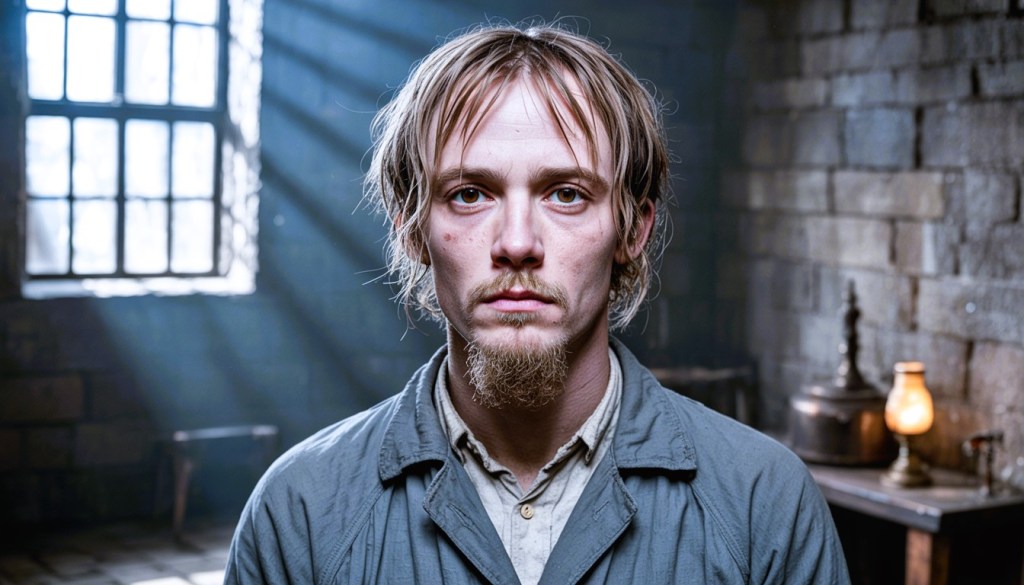
The autumn light falls thin and cold through the high window – a shaft no wider than my hand, traversing the stone floor in its slow arc from morning until it fades utterly. I mark the hours by its passage, as one marks the stations of the Cross. Each day it grows weaker, as though the sun itself had wearied of illuminating this place.
The warder brought news this morning of Japan, where an Emperor has taken up the reins of power from the military lords who held them these centuries past. Such transformations seem the province of distant worlds whilst I remain fixed in this narrow cell, where even the shadows are familiar as old companions. They gather in the corners at dusk, and I have learnt to read their shapes as though they were scripture – each one an echo of the life I knew before these walls enclosed me.
I think often upon beauty, and what becomes of it when denied the eye that might perceive it. Does a flower bloom unseen in a forest glade possess less perfection for want of a witness? The philosophers would say its beauty exists entire, independent of human regard. Yet I find this cold comfort. Art requires the communion of souls – the maker and the beholder bound in silent covenant. Here, I am severed from both offices.
Last night, in that suspended hour between waking and sleep, a curious riddle came unbidden to my thoughts, as though whispered by some unseen visitant. What would thy life resemble, stripped of all mechanical reckoning, all engines of calculation? A strange formulation, yet it seized my mind with peculiar force.
I puzzled over this through the watches of the night. We possess, in this modern age, machines that perform arithmetic – Babbage’s great unfinished engine, which the newspapers describe as capable of computation beyond human capacity. But what manner of existence would we know without such mechanical aids? Without the abacus, the counting-frame, the ledger and the tally?
Then understanding came, as dawn breaks through mist. The riddle speaks not of brass and cogs, but of the soul’s dependence upon external apparatus – upon all those systems and structures we have built to order our days, to measure our worth, to calculate our position in the scheme of things. It asks: what remains when these scaffoldings fall away?
I see now that I inhabit precisely such an existence. The great computing engine of society – with its hierarchies, its appointments, its ceaseless tabulation of merit and station – grinds on beyond these walls, whilst I am cast out from its workings. My life no longer figures in any ledger save the prison register. I have become a shadow, an echo of the man I was.
Yet in this subtraction, I discover an unexpected remainder. Without the machinery of social commerce, without the endless reckoning of wealth and reputation, I am thrown back upon those faculties which cannot be calculated. The mind’s eye still conjures images of surpassing loveliness. Memory still delivers up whole galleries of beauty witnessed in freer days – the play of light upon water, the curve of a woman’s throat, the particular green of beech leaves in spring. These require no apparatus save consciousness itself.
The warder thinks me half-mad, finding me thus at times, staring at the wall where the lamp-light creates its nightly pageant of forms. But I have learnt to see in these poor shadows something of that divine artistry which fashioned all creation. Is it not written that we are made in the image of God? Then surely this capacity to perceive beauty, to be moved by form and line and light, partakes of the sacred.
The gruel tonight was watery, the bread harder than yesterday’s. My body weakens, but I find I care less for its complaints than formerly. Perhaps this is what the riddle meant to teach – that when the calculating engines of flesh and circumstance are stilled, we discover what irreducible element persists. For some, it might be faith or duty. For me, it is this strange, fierce hunger for beauty, which neither iron bars nor the Crown’s justice can extinguish.
I heard the chapel bell this evening, its sound reaching me as though from across vast distances. An echo of an echo. Yet even such attenuated music stirred something in my breast. Tomorrow I shall petition again for writing materials beyond this stub of pencil and these scraps. If I might render in line and shade some portion of what I see – these shadows, these geometries of confinement – it would be labour more sustaining than the oakum-picking they set us to.
The lamp gutters low. Soon the darkness will be complete, save for such light as filters from the corridor. In this absence of illumination, I shall close my eyes and reconstruct from memory the great paintings I once studied – their colours, their compositions. A poor substitute for the originals, yet better than staring at blank stone.
I wonder if the Emperor in Japan understands what it means to trade the shadow of power for its substance. There is a kind of authority that comes from renunciation, from the stripping away of all machinery and pretence. In losing everything, one learns what cannot be lost. This is the arithmetic of the spirit, and no engine yet devised can perform its calculations.
The shadow on the wall has taken the form of a bird tonight, cast by some irregularity in the lamp-flame. I shall watch it until sleep comes, and dream of flight.
Victorian Britain in 1868 saw the aftermath of the Second Reform Act (1867), which expanded the urban male franchise but left many disenfranchised and social tensions unresolved. Prisons operated under the separate and silent systems instituted earlier in the century, emphasising moral reform through isolation, meagre diets, and hard labour, while public discussion turned toward gradual penal moderation and inspection. Abroad, reports of Japan’s Meiji Restoration (1868) reached British readers, signalling rapid modernisation and altered diplomatic horizons. Subsequent decades brought further franchise reforms (1884), evolving prison regulations, and advances in public health after recurrent cholera outbreaks declined with sanitary improvements, reshaping civic life and state responsibility.
Bob Lynn | © 2025 Vox Meditantis. All rights reserved. | 🌐 Translate


 Vox Meditantis
Leave a reply to Bob Lynn Cancel reply