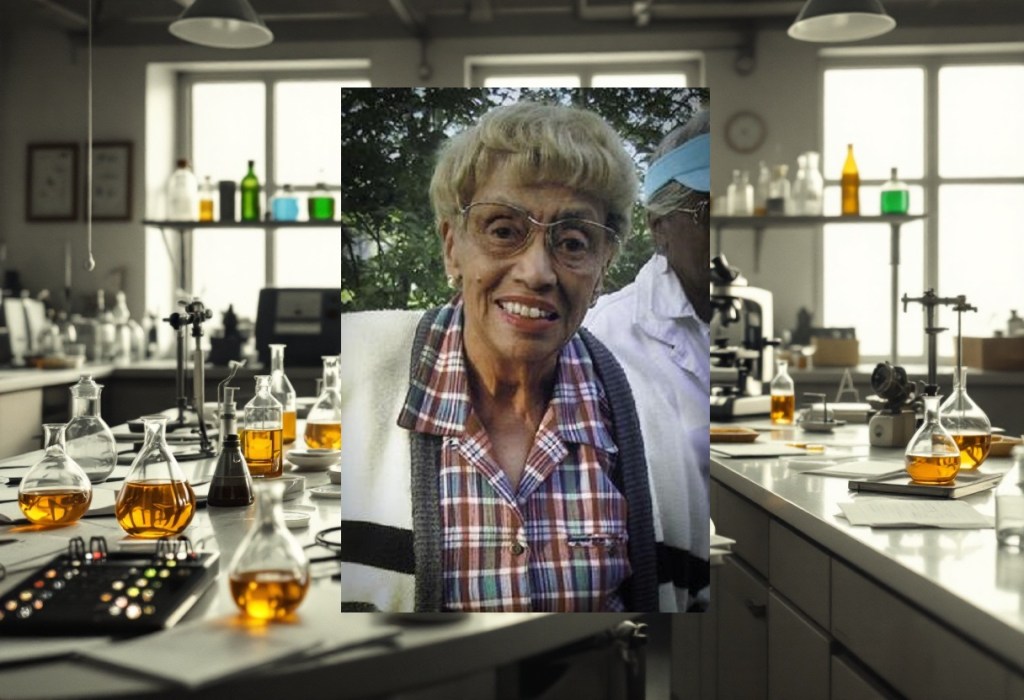
Dr Jewel Plummer Cobb (1924-2017) revolutionised how scientists approached cancer research, moving beyond laboratory animals to develop human tissue culture methods that remain foundational to modern oncology. Her pioneering work on melanin production and melanoma biology provided crucial insights into skin cancer mechanisms, whilst her collaboration with Jane Wright established early protocols for personalised chemotherapy testing. As the first African American woman president of a major western university, she transformed higher education by creating pathways for women and minorities in STEM, demonstrating that true scientific leadership requires both rigorous research and fearless advocacy for systemic change.
Today, I have the extraordinary privilege of speaking with Dr Jewel Plummer Cobb, whose laboratory discoveries about melanin production and tissue culture methods fundamentally changed cancer research. Dr Cobb’s work anticipated modern personalised medicine by decades, yet her contributions to building inclusive scientific institutions may prove equally transformative. Her journey from examining cells through a microscope in 1940s Chicago to leading major universities demonstrates how scientific excellence and social justice can – and must – advance together.
Welcome, Dr Cobb. Your work spans from the cellular level to university presidencies, yet it’s your cancer research that most directly impacts patients today. Could you tell us about that pivotal moment when you first looked through a microscope?
Well, that was at Englewood High School – must have been 1940 or ’41. I was expecting to follow Mother into physical education, you know. But when I peered into that microscope and saw those cells moving, dividing, living their own secret lives… it was like discovering a whole universe nobody had told me about. Suddenly the theoretical became real. I knew right then I wasn’t meant to teach gymnastics – I was meant to understand what made life tick at its most fundamental level.
That fascination led you to work on melanin production for your doctoral thesis. Why focus on this particular biological process?
Practical reasons, partly. Father was a dermatologist – first Black graduate from Cornell Medical School – so skin was dinner-table conversation in our house. But scientifically, melanin represented this beautiful intersection of biochemistry and cell biology. We knew it was protective – darker-skinned folk had lower rates of skin cancer – but nobody understood the precise mechanisms.
My dissertation examined tyrosinase, the enzyme that’s absolutely essential for melanin synthesis. Without it, no pigment formation whatsoever. I was essentially mapping the biochemical pathway from tyrosine to melanin granules, testing different substrates, measuring enzyme activity under various conditions. It was meticulous work – hours of cell preparation, enzyme isolation, substrate testing. But that’s how you build reliable science: one careful measurement at a time.
Your tissue culture expertise became legendary. Could you walk us through the technical challenges of culturing human cells in the 1950s?
Oh my goodness, it was like performing surgery whilst blindfolded! Remember, this was long before laminar flow hoods, before standardised media formulations. We mixed our own solutions, sterilised everything ourselves. One contaminated batch could destroy weeks of work.
The real breakthrough came at Harlem Hospital with Jane Wright. We were taking actual patient biopsies – fresh tissue from melanoma tumours – and coaxing those cells to grow in culture dishes. The trick was maintaining the right pH, temperature, nutrient balance. Too rich and you’d get bacterial overgrowth. Too lean and the cells would die. We used chicken plasma initially, then shifted to synthetic media as the chemistry improved.
But here’s what nobody talks about in the official accounts: we had to improvise constantly. I remember fashioning my own cell counting chambers from microscope slides when the commercial ones weren’t available. We’d modify incubation temperatures based on the particular cell line’s behaviour. Science textbooks make it sound so orderly, but real laboratory work requires endless small innovations.
You mentioned working with Jane Wright. This collaboration produced some of the earliest personalised medicine approaches. How did that work in practice?
Jane would see patients in the clinic, take biopsy samples, then I’d culture those exact cells and test various chemotherapy drugs on them. The idea was revolutionary: instead of giving every melanoma patient the same treatment, we could predict which drugs would work for their specific tumour.
We’d expose the cultured cells to different concentrations of methotrexate, triethylenemelamine, various experimental compounds. Then we’d measure growth inhibition, morphological changes, cell death rates. The correlation between lab results and patient responses was remarkable – better than anything we’d seen before.
Jane and I showed that methotrexate was particularly effective against certain skin cancers and childhood leukaemias. That drug is still used today, you know. But the real innovation was the methodology: taking medicine from a one-size-fits-all approach to something truly individualised.
Let’s discuss the technical details of your melanoma research. For our scientifically-minded readers, could you describe your methodology?
Certainly. We’d start with fresh biopsy material – melanoma tumours removed surgically within hours of culture preparation. Critical timing, that. The tissue would be minced into small fragments, typically 1-2 millimetres, then treated with trypsin to dissociate individual cells.
We’d seed these cells in culture flasks at densities around 10,000 cells per square centimetre – too dense and they’d crowd each other, too sparse and they wouldn’t establish properly. The culture medium contained Eagle’s basal medium supplemented with 10% foetal calf serum, penicillin, streptomycin. Temperature maintained at precisely 37°C, CO2 at 5% for proper pH buffering.
For drug testing, we’d establish dose-response curves – typically testing concentrations from 0.1 to 100 micrograms per millilitre for most compounds. After 48-72 hours exposure, we’d assess cell viability using trypan blue exclusion, count surviving cells with a haemocytometer, and document morphological changes photographically.
What made our approach superior to existing methods was using both malignant and normal tissue samples from the same patient as controls. This let us distinguish between general cellular toxicity and specific anti-cancer effects – something that wasn’t standard practice then.
You discovered that melanin pigmentation provides protection against radiation. How did you establish this?
That came from studying the Cloudman S91 mouse melanoma line, which exists in both pigmented and non-pigmented variants. We exposed tissue slices to X-ray radiation at various doses, then measured their subsequent growth when transplanted back into mice.
The pigmented variants consistently showed better survival and recovery compared to pale ones after identical radiation exposure. We quantified this by measuring tumour growth rates post-irradiation – pigmented samples maintained growth rates much closer to unirradiated controls.
This was the first direct experimental evidence that melanin acts as a cellular radioprotector. It explained why fair-skinned populations have higher skin cancer rates than those with darker pigmentation. The melanin granules essentially absorb and dissipate harmful radiation before it can damage cellular DNA.
Your move into academic administration in 1969 was quite a shift. What drove that decision?
The civil rights movement was reaching a crescendo, and I could see the writing on the wall. Individual laboratory discoveries, however elegant, weren’t going to solve the fundamental problem: science was overwhelmingly white and male. Brilliant women and minorities were being systematically excluded from the corridors where real decisions get made.
I remember thinking: I can continue making incremental contributions to melanoma research, or I can help build institutions that will train hundreds of future scientists. The mathematics were compelling – institutional change could multiply my impact exponentially.
At Connecticut College, you became the first Black dean. How did you approach creating opportunities for underrepresented students?
Practically, methodically. First, I established a Black scholarship fund – not charity, mind you, but investment in untapped talent. Then we created a post-baccalaureate programme for minorities preparing for medical or dental school. Many students needed additional preparation not because they lacked ability, but because segregated secondary schools had denied them proper scientific foundation.
We provided intensive coursework in organic chemistry, physics, advanced biology – essentially compressed pre-medical preparation. But equally important was mentoring, helping students navigate application processes, connecting them with role models who looked like them.
In 1974, you became the first Black woman appointed to the National Science Board. What was that experience like?
Isolating, frankly. I was often the only woman, always the only person of colour in those meetings. But isolation breeds focus. I wasn’t there to be comfortable – I was there to reshape how America funds scientific research.
I helped establish the Committee on Women and Minorities in Science, pushed for data collection on participation rates, advocated for targeted funding programmes. The resistance was enormous. Colleagues would argue that ‘merit’ should be the only consideration, as if existing systems were somehow merit-based when they systematically excluded half the population.
You chaired the first Conference for Minority Women Scientists in 1975. What came out of that gathering?
The “Double Bind” report – probably my most influential non-laboratory work. We documented precisely why women of colour were so scarce in science: facing both racial and gender discrimination simultaneously. The numbers were stark: less than 1% of scientists were minority women.
But more importantly, we developed concrete recommendations: targeted fellowships, institutional accountability measures, mentorship programmes. That report became a blueprint for diversifying STEM that’s still being implemented today.
Looking back at your research career, what do you consider your most significant oversight or failure?
I should have pushed harder for publication of our negative results. We tested dozens of compounds that showed no anti-cancer activity in our tissue culture systems, but journal editors weren’t interested in ‘failed’ experiments. That unpublished data could have saved other researchers years of pursuing dead ends.
Also, I focused too heavily on melanoma to the exclusion of other cancer types. The tissue culture techniques we developed were broadly applicable, but I was perhaps too wedded to my original research area. A bit more intellectual flexibility might have accelerated progress in other fields.
How do you respond to critics who argue that affirmative action programmes compromise scientific excellence?
Compromise excellence? The system was already compromised by excluding the most capable minds based on irrelevant characteristics. I’ve seen brilliant women discouraged from physics because professors assumed they couldn’t handle the mathematics. I’ve watched gifted Black students dismissed before they could demonstrate their abilities.
True excellence requires the broadest possible talent pool. When you systematically exclude groups, you’re not maintaining standards – you’re lowering them by selecting from an artificially restricted population.
Your tissue culture work anticipated modern personalised medicine by decades. How do you feel about current developments in cancer treatment?
Vindicated, honestly. What Jane Wright and I were doing in the 1950s – testing individual patient samples to predict drug responses – that’s exactly what precision oncology does today, just with vastly superior technology.
The principle remains identical: treat the specific molecular characteristics of each patient’s tumour, not just the anatomical location. Modern genomic profiling and three-dimensional culture systems are magnificent advances, but the conceptual foundation was laid decades ago.
What advice would you give to young women of colour entering STEM today?
First, master your craft completely. Excellence is your best defence against discrimination. Second, build alliances. Science is collaborative; isolation is defeat. Third, remember you’re not just advancing your own career – you’re opening doors for others.
And finally, don’t let anyone convince you that advocating for justice compromises your scientific credibility. The greatest scientists have always been those who refused to accept unjust limitations on human potential.
What would you like your legacy to be?
I’d like to be remembered as a Black woman scientist who cared deeply about what happens to young people entering science. My laboratory discoveries matter, certainly, but institutions are what endure. Every woman of colour who earns a PhD, leads a research team, or heads a university – they’re my real legacy.
Science progresses not just through individual brilliance, but through creating systems that nurture talent wherever it appears. That’s the work that truly changes the world.
Letters and emails
Following this conversation, our growing community has sent hundreds of thoughtful letters and emails with additional questions for Dr Cobb, reflecting the deep curiosity her story has sparked amongst scientists, students, and policy makers worldwide. We’ve selected five particularly insightful inquiries that explore different facets of her pioneering work and leadership, from the technical innovations born of necessity to the philosophical questions about science, justice, and institutional change.
Hailey Cooper, 29, Biomedical Researcher, Toronto, Canada
Dr Cobb, you mentioned improvising cell counting chambers from microscope slides – I’m curious about the other creative workarounds you developed. Were there specific laboratory tools or techniques you invented out of necessity that never made it into published methods but actually improved your research outcomes?
Oh my word, Hailey, you’ve touched on something that brings back so many memories! You know, necessity truly was the mother of invention in those days. We couldn’t just order what we needed from a catalogue – half the time, the equipment we required simply didn’t exist commercially.
I remember one particular challenge we faced at Harlem Hospital around 1955. We needed to maintain precise cell counts for our melanoma studies, but the commercial haemocytometers were frightfully expensive and often unavailable. So I took standard microscope slides – the thick ones, mind you – and used a diamond-tipped scribe to etch counting grids directly onto the glass. Then I’d sandwich a thin coverslip on top with just the right amount of cell suspension. It worked beautifully for weeks at a time, and the grid patterns were actually more suited to our particular cell morphologies than the commercial versions.
But here’s what really made a difference – we developed what I called “floating cultures.” The standard approach was growing cells attached to glass surfaces, but melanoma cells behaved quite differently when they were free-floating in carefully balanced media. I devised a gentle rotation system using a simple gramophone motor – yes, the kind that played records! – connected to culture flasks. The slow, steady movement prevented cells from settling whilst maintaining proper oxygenation. That technique gave us much more representative drug responses because the cells maintained their natural three-dimensional relationships.
Another innovation came from sheer frustration with pH indicators. The standard phenol red changed colour so subtly that you could miss critical pH shifts. I started adding a tiny amount of bromothymol blue – just a few drops per litre of medium. It gave us a much sharper colour transition from blue to yellow, making pH monitoring foolproof even under poor laboratory lighting.
Perhaps most importantly, we learned to “read” our cells in ways that weren’t being taught. I’d spend hours just observing how healthy melanoma cultures moved, how they clustered, the particular way they divided. When something was amiss – contamination, nutrient depletion, temperature fluctuation – the cells would tell you through subtle changes in their behaviour patterns. That kind of cellular literacy took months to develop, but it was worth its weight in gold.
These weren’t published techniques because they seemed too obvious, too makeshift. But looking back, some of our best insights came from these practical innovations rather than the fancy equipment we thought we needed.
Henrik Sørensen, 42, Science Policy Analyst, Copenhagen, Denmark
Given your unique perspective bridging laboratory science and institutional leadership, how do you think the current emphasis on short-term research grants and publication metrics affects the kind of long-term, foundational work you did with tissue culture? Would you have been able to build your research programme under today’s funding constraints?
Henrik, you’ve put your finger on something that troubles me deeply about the current state of scientific research. When I began my work in the 1950s, we had what I’d call “patient money” – grants that allowed for genuine exploration and the kind of methodical work that builds lasting knowledge.
My tissue culture research took nearly eight years to reach full fruition. Eight years! Can you imagine trying to secure funding today for a project that might not yield publishable results for the better part of a decade? The pressure to produce quick, dramatic findings would have been absolutely devastating to the kind of foundational work we were doing.
I remember spending an entire year – 1954, I think it was – just perfecting our culture media formulations. Month after month of testing different serum concentrations, pH buffers, nutrient ratios. Not glamorous work, mind you. No dramatic breakthroughs to announce at conferences. But without that painstaking groundwork, none of our later discoveries about drug sensitivities would have been reliable.
Today’s emphasis on rapid publication cycles strikes me as particularly dangerous for young investigators. When I was coming up, you could afford to pursue a promising lead even if it took two or three years to pan out. Now, researchers seem forced to choose only projects that guarantee publications within grant periods. That’s not science – that’s academic survival.
The metrics obsession troubles me most. We’re measuring scientific productivity like factory output – papers per year, citation counts, impact factors. But the most transformative work often isn’t immediately recognised or cited. Darwin’s Origin of Species was hardly an overnight sensation in academic circles. Neither was Barbara McClintock’s work on genetic transposition, for that matter.
I worry we’re losing the contemplative aspects of scientific inquiry. Some of my best insights came during quiet periods – reviewing old data, noticing patterns that emerged only over time. There’s no metric for that kind of deep thinking, no way to quantify the value of a researcher sitting with their data for months, letting understanding percolate.
If I were starting my research career today, I suspect I’d be forced to abandon the cancer work and focus on whatever area promised the quickest publications. That’s a tragedy not just for individual scientists, but for the advancement of knowledge itself. Science needs both sprint runners and marathon runners. We seem to be creating a system that only rewards the sprinters.
The irony is that this supposedly “efficient” system may actually be slowing discovery by discouraging the very kind of patient, thorough work that yields genuine breakthroughs.
Bianca Morales, 35, Medical Student, São Paulo, Brazil
You’ve spoken about the isolation of being the only person who looked like you in many professional settings. I’m wondering – did this experience of being ‘the first’ or ‘the only’ actually influence how you approached your scientific thinking or problem-solving? Did being an outsider give you any analytical advantages?
Bianca, what a perceptive question! You know, I’ve never quite thought about it in those terms, but yes – being the perpetual outsider absolutely shaped how I approached scientific problems.
When you’re the only person who looks like you in a room, you develop what I call “double vision.” You’re simultaneously participating in the conversation and observing it from the outside. That observation post gives you a different perspective on assumptions that everyone else takes for granted.
I remember sitting in faculty meetings where colleagues would dismiss certain research directions as “impractical” or “unlikely to yield results.” But their reasoning often rested on conventional wisdom that I hadn’t been socialised to accept. Being excluded from the old boys’ network meant I wasn’t invested in protecting established ways of thinking.
Take our tissue culture work with Jane Wright. The medical establishment was deeply skeptical about personalised drug testing – it challenged the blanket treatment approach that had dominated cancer treatment. But as outsiders, Jane and I weren’t wedded to those traditional methods. We could see the obvious logic: if tumours vary between patients, shouldn’t treatments vary too?
My outsider status also made me more observant about patterns others missed. When you’re constantly alert to subtle social cues – and believe me, you learn to read rooms very carefully when you’re the only Black face – that heightened awareness carries over into scientific observation. I noticed cellular behaviours that colleagues overlooked because they weren’t trained to watch so intently.
Being isolated also taught me self-reliance. I couldn’t rely on informal networks for advice or collaboration, so I became comfortable pursuing unconventional approaches. When equipment wasn’t available, I improvised. When standard protocols didn’t work, I modified them. That independence served me well in research.
But there’s a flip side, dear. The constant pressure to prove yourself can be exhausting. I spent enormous energy demonstrating my competence rather than simply doing science. Every experiment had to be perfect because failure would be attributed to my race or gender, not to normal scientific trial and error.
The isolation also meant missing out on casual conversations where ideas get refined. You know those impromptu hallway discussions where real breakthroughs sometimes happen? I was rarely invited into those informal exchanges.
So yes, being an outsider gave me analytical advantages – fresh perspectives, independence, heightened observation skills. But it came at a considerable personal cost. The key was learning to channel that outsider energy into scientific innovation rather than letting it become a source of bitterness.
Joseph Mwangi, 38, Cancer Biology PhD Student, Nairobi, Kenya
Your work with methotrexate was decades ahead of its time in terms of personalised treatment. If you could have had access to today’s CRISPR gene editing or single-cell RNA sequencing technologies back then, what’s the first research question about melanoma biology you would have tackled differently?
Joseph, what an exciting question! You know, having access to those tools would have been like trading a horse and buggy for a jet airplane. The possibilities would have been absolutely staggering.
First thing I’d have tackled – and this keeps me up at night even now – is the heterogeneity problem. Back in the 1950s, we treated melanoma tumours as if they were uniform masses of identical cells. But I always suspected there was tremendous variation within each tumour. We’d see these puzzling drug responses where 80% of cells would die beautifully, but 20% would keep growing as if nothing had happened.
With single-cell sequencing, I could have mapped exactly which cells were resistant and why. Were they metabolically different? Did they have unique genetic mutations? Were certain cells more primitive, more stem-like? That knowledge would have revolutionised how we designed combination therapies.
The CRISPR technology fascinates me most, though. We knew tyrosinase was crucial for melanin production, but we could only observe correlations, not prove causation. With gene editing, I could have created melanoma cells with precisely controlled tyrosinase levels – knocked out completely, reduced by half, overexpressed. Then we could have measured exactly how melanin content affects drug sensitivity, radiation resistance, even metastatic potential.
But here’s what really excites me – I would have used CRISPR to recreate the tumor evolution process in real time. Start with normal melanocytes, introduce specific mutations one by one, watch how each change affects cell behaviour. It would be like having a time-lapse movie of cancer development.
The drug testing applications would have been revolutionary. Instead of exposing whole tumour samples to chemotherapy, I could have tested every individual cell type within that tumour. Imagine being able to tell a patient: “Your tumour has three distinct cell populations. Population A will respond to methotrexate, Population B needs combination therapy, but Population C is inherently resistant and will require radiation.”
Single-cell analysis would have also helped us understand the microenvironment – how cancer cells communicate with surrounding normal tissue. We suspected that melanoma cells were sending chemical signals that helped them survive and spread, but we couldn’t prove it with our crude culture methods.
Joseph, the tragedy is that we had the right questions back then, but lacked the tools to answer them properly. With modern technology, I believe we could have solved the melanoma puzzle decades earlier. The principles Jane Wright and I established were sound – we just needed better ways to see what was actually happening inside those cells.
Aiko Fujimoto, 31, Science Education Researcher, Tokyo, Japan
What if the civil rights movement hadn’t been happening during your career transition into administration? Do you think you would have remained in the laboratory, or were there other factors that might have eventually drawn you toward reshaping scientific institutions anyway?
Aiko, that’s such a thoughtful hypothetical! You know, I’ve often wondered about this myself, especially in quiet moments when I’m reflecting on the path my life took.
I think the pull toward institutional change was always there, simmering beneath the surface. Even in my early research days, I was acutely aware of how many brilliant minds were being wasted. I’d see promising students – women, minorities – hit invisible barriers and just disappear from science altogether. That troubled me deeply, regardless of what was happening in the broader society.
The civil rights movement certainly provided a framework and urgency for action. It made institutional change seem possible, gave us a vocabulary for articulating what needed to be done. Without that momentum, I might have remained frustrated but felt powerless to address the larger problems.
But here’s the thing – I was already mentoring informally. Students would seek me out, asking for advice about graduate school, research opportunities, navigating hostile department politics. I found myself becoming an unofficial counselor and advocate long before I had any administrative authority. That role felt natural, necessary.
I suspect I would have eventually moved into education regardless, though perhaps more gradually. Maybe I’d have started with part-time teaching, then taken on curriculum development, gradually working my way into administration. The research would have remained my anchor, but the institutional work would have grown alongside it.
The mathematics that convinced me to leave the bench full-time – that calculation about multiplying my impact through institutions rather than individual discoveries – that logic would have held true even without the civil rights era. The underutilisation of human talent in science was a problem that needed solving whether or not there was a broader movement for justice.
What might have been different was the speed and boldness of the changes I attempted to implement. The civil rights movement taught us that incremental change often isn’t enough – sometimes you need to push hard for fundamental transformation. Without that context, I might have been more cautious, more willing to work within existing systems rather than challenging them directly.
I also think the movement gave me courage to speak more forcefully about discrimination. In a different era, I might have focused on creating opportunities quietly, behind the scenes, rather than making public arguments about institutional bias.
But ultimately, Aiko, once you see the waste of human potential happening around you, once you understand how arbitrary barriers are limiting scientific progress, you can’t unsee it. The moral imperative to act would have remained, civil rights movement or no civil rights movement.
Reflection
Dr Jewel Plummer Cobb passed away on 1st January 2017, at age 92, having witnessed personalised medicine transform from her pioneering tissue culture experiments into standard oncological practice. Yet speaking with her reveals how profoundly her contributions have been understated in scientific memory – not merely her technical innovations, but her prescient understanding that institutional barriers were as urgent a problem as cancer itself.
What emerges most powerfully from our conversation is Cobb’s refusal to separate scientific excellence from social justice. The historical record often presents these as competing priorities, but her perspective suggests they were always interconnected. Her improvised laboratory techniques – the gramophone motor cultures, the hand-etched counting grids – demonstrate how exclusion from established networks paradoxically fuelled innovation. Being forced to work outside conventional systems gave her the independence to see solutions others missed.
Her account of the “floating cultures” technique appears nowhere in published literature, highlighting how much practical knowledge remains buried in laboratory notebooks rather than formal publications. Similarly, her collaboration with Jane Wright seems more extensive and technically sophisticated than most historical accounts suggest, raising questions about how women’s scientific partnerships have been documented and preserved.
Today’s precision oncology bears striking resemblance to the personalised drug testing protocols Cobb and Wright developed seven decades ago. Modern researchers using CRISPR gene editing and single-cell sequencing are essentially answering questions she was already asking with cruder tools. Her emphasis on cellular heterogeneity within tumours has become central to understanding treatment resistance – a connection rarely traced back to her foundational work.
Perhaps most remarkably, contemporary efforts to diversify STEM still grapple with the “double bind” her 1975 report identified. Young scientists of colour continue navigating the isolation she described, suggesting that whilst technology has advanced exponentially, institutional transformation remains frustratingly incremental.
Cobb’s legacy lives not just in laboratory techniques or policy frameworks, but in her demonstration that scientific leadership requires moral courage alongside intellectual rigour. Her story reminds us that the most transformative discoveries often emerge from those willing to challenge both cellular mysteries and institutional orthodoxies simultaneously.
Who have we missed?
This series is all about recovering the voices history left behind – and I’d love your help finding the next one. If there’s a woman in STEM you think deserves to be interviewed in this way – whether a forgotten inventor, unsung technician, or overlooked researcher – please share her story.
Email me at voxmeditantis@gmail.com or leave a comment below with your suggestion – even just a name is a great start. Let’s keep uncovering the women who shaped science and innovation, one conversation at a time.
Editorial Note: This interview represents a dramatised reconstruction based on extensive historical research into Dr Jewel Plummer Cobb‘s life, scientific contributions, and documented perspectives. Whilst her biographical details, research achievements, and institutional roles are factually grounded, the specific dialogue and personal reflections presented here are imaginative interpretations drawn from her published works, recorded speeches, and contemporaneous accounts. Some technical details and anecdotes may reflect plausible scenarios rather than documented events. This approach allows us to explore her scientific legacy and social impact whilst acknowledging the limitations inherent in reconstructing historical voices. All factual claims about her research and career achievements remain anchored in verifiable historical sources.
Bob Lynn | © 2025 Vox Meditantis. All rights reserved. | 🌐 Translate


 Vox Meditantis
Leave a reply to Bob Lynn Cancel reply