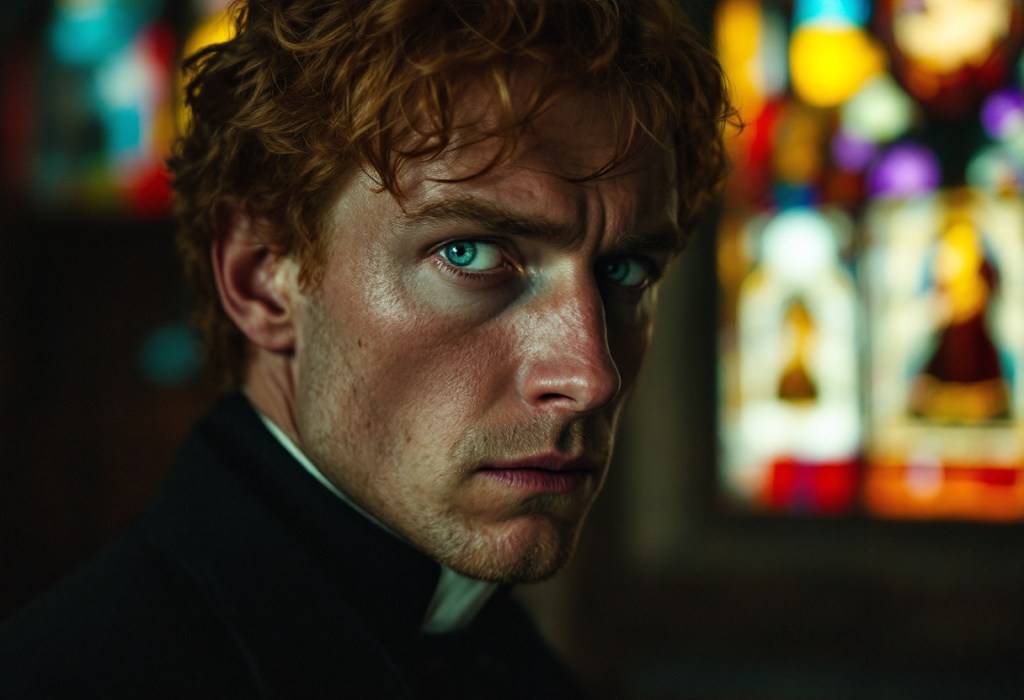
10th September 1897
The evening shadows lengthen across the nave as I sit in contemplation within these hallowed walls, my pen hesitant upon the page. How strange it is that in this sacred place, where truth ought to shine forth as clearly as the setting sun through our stained glass, I find myself most conscious of the masks we all wear – myself chief amongst the guilty.
Today brought another letter from my dear sister Mary, who writes with her customary directness: “Edward, what are you doing this evening? Surely you cannot spend every night amongst your books and prayers when there are perfectly suitable young ladies in the parish who would welcome the attention of so distinguished a gentleman as yourself.” How like her to pierce straight to the heart of my disquiet! What am I doing this evening, indeed? I sit here amongst the wooden pews, wrestling with thoughts most unseemly for one in my position.
The faces that fill these benches each Sunday morning haunt me now in their absence. There is young Miss Pritchett, whose countenance speaks of such earnest devotion during the morning service, yet I have observed her casting glances towards young Thackeray with unmistakable warmth. And Mrs. Aitken, whose grief for her departed husband she wears like a veil, though I suspect beneath that sorrowful mask lies a heart ready once more for affection, if only she would permit it.
But it is my own countenance that troubles me most profoundly. When I stand before my congregation, expounding upon the virtues of spiritual love and Christian charity, what mask do I present? The learned divine? The pastoral shepherd? Yet beneath this clerical facade, I confess to feelings that would scandalise the very souls I shepherd. The Queen’s jubilee celebrations this summer brought visitors from London, and amongst them… but no, I shall not commit such thoughts to paper.
The newspapers speak much of the situation in Greece, where war has lately concluded, and of the great discoveries of gold in the distant Klondike. How fitting that men should dig so desperately in frozen earth for that which glitters, when the true treasures of the heart remain buried beneath layers of propriety and station. I think of our Lord’s words about the Kingdom of Heaven being like treasure hidden in a field, yet how are we to recognise such treasure when we ourselves are so practised in concealment?
Mrs. Tunstall approached me after evening prayer yesterday, her widow’s weeds rustling like autumn leaves, to seek counsel regarding her late husband’s business partner, who has shown her marked attention. “Rector,” she said, “how does one know when affection is genuine and when it is merely the counterfeit of true feeling?” I spoke to her of prayer and patience, of seeking divine guidance in all matters of the heart, yet even as I counselled her, I felt the weight of my own hypocrisy.
The very stones of this church seem to mock my uncertainty. These walls have witnessed countless unions blessed, countless vows spoken before the altar, yet here sits their shepherd, as uncertain in matters of the heart as any untried youth. The Good Book speaks of putting away childish things, yet in this regard I remain as confounded as ever I was.
The gas lamps flicker now, casting dancing shadows that remind me how we all move through this world half-illuminated, our true selves glimpsed only in moments when we forget to maintain our careful composure. Perhaps that is why I find myself drawn here in the evening hours, where the familiar surroundings offer some solace, even as they amplify my inner turmoil.
What am I doing this evening, Mary asks? I am learning, perhaps, that even those called to guide others in matters of faith and morality are not immune to the tender confusions that beset all of Adam’s children. Whether this knowledge brings wisdom or merely deeper uncertainty, only time – and the Almighty’s grace – shall reveal.
Late Victorian Britain saw the 1897 Diamond Jubilee and recent end of the Greco–Turkish War (1897), alongside reports of the Klondike Gold Rush. Queen Victoria’s Jubilee marked sixty years on the throne, celebrated with imperial pageantry that reinforced Britain’s global reach and Anglican public life. The brief Greco–Turkish War ended with Greek defeat and international mediation imposing reforms in Crete, foreshadowing Balkan tensions that would erupt in the early twentieth century. News of Klondike discoveries (1896–1899) spurred mass migration and speculation, emblematic of fin‑de‑siècle ambition and risk. In Britain, ecclesiastical debates over ritual, social reform, and moral authority continued, shaping parish life and the Church’s role into the Edwardian era.
Bob Lynn | © 2025 Vox Meditantis. All rights reserved. | 🌐 Translate

 Vox Meditantis
Leave a comment