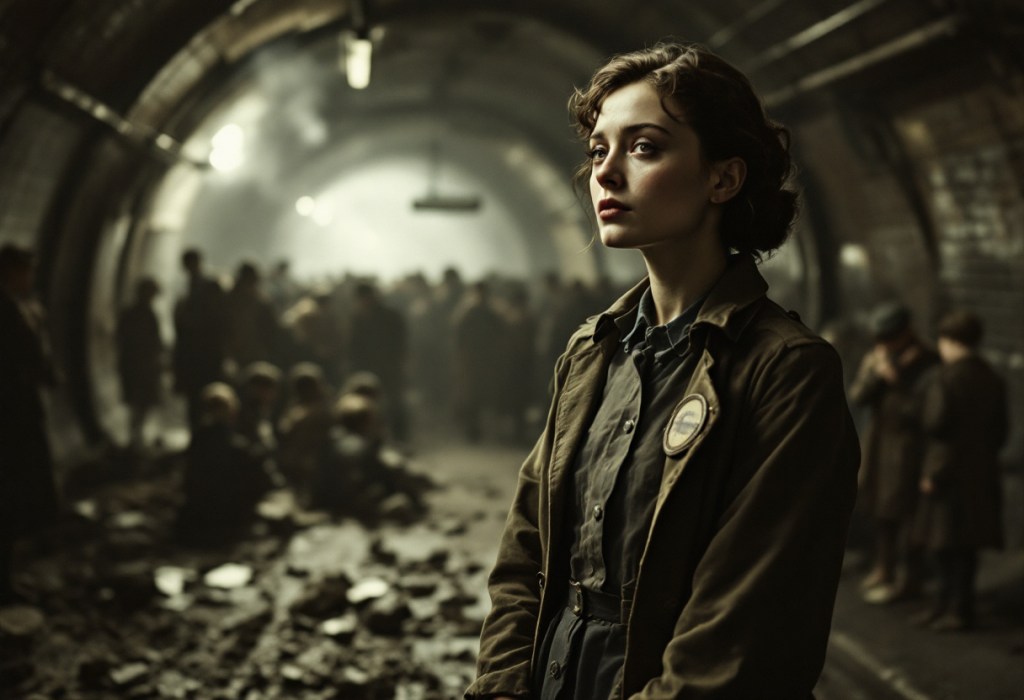
Aldgate East Underground Station, London – 7th September 1940
I had the four-to-six shift on the barriers at Aldgate East, and the platform air already prickled with that metallic tang you only get when the trains grind their brakes a bit too hard. Half-past four, Saturday, 7th September 1940. A warm, windless afternoon – so warm the posters for Lyon’s Tea were peeling at the corners like sunburnt skin.
Ernie Finch, my fellow clerk, leaned on the mahogany ticket window and fanned himself with a dog-eared Evening News.
“Reckon we’ll still get our tea break, Gracie?”
“With your luck, Finch, you’ll have three,” I said. “Some of us have to earn the King’s shilling.”
He grinned, all big teeth and Brylcreem. “Fancy yourself, don’t you?”
The tannoy crackled. Air-raid warning red. Take cover immediately.
Ernie’s smile slipped. “Here we go again.”
I shrugged for show, but my stomach folded in half. The siren outside yowled its two-tone lament – a sound that turned the very air brittle.
Commuters poured down the escalators, shoes clacking like hailstones. Women shepherded children still in Saturday best; an elderly tailor clutched his sample-case as if it were a lifebelt.
“Easy now,” I called, slipping into my practiced calm. “Mind the step, luv. Plenty of room down below.”
Ida Rosenthal appeared, white coat flapping over her navy day dress, a St John’s armband snug round her sleeve. She’d popped in before but we’d never properly spoken.
“Ticket clerk, yes?” she said, accent lilting East-End Yiddish. “Any spare stretchers?”
“We’ve two in the first-aid cupboard.”
“G-d willing we won’t need them, but better safe, nu?”
I liked the set of her jaw: determined, no fuss.
Then – an unnatural lull. The siren still blared, but footsteps slowed; even the flicker of the electric bulbs seemed to hold its breath. A distant hum, like a swarm of hornets magnified by a wireless set, grew until it filled the tunnel mouth.
Ernie peered up the escalator. “Look at the sky, Grace.”
I climbed a few steps, just high enough to see through the street-level grilles. The western horizon was a sheet of hammered copper, studded with silver specks: 348 bombers escorted by 617 fighters, we’d learn later. In that moment the numbers meant nothing – only the scale, the terrible, gorgeous sweep of wings catching the late sun.
“Back inside!” I shouted, voice cracking.
The first stick of high explosives landed somewhere along Commercial Road. The ground shuddered like a rug whipped clean. Dust sifted from the vaulted ceiling; the electric light flickered once, twice, then steadied. People screamed, prayed, or froze mute.
I forced myself to the ticket hall, heart pounding. Plaster flakes danced in the air. A second detonation – closer – hurled me against the oak barrier. Glass shattered; the Evening News spun across the floor like a wounded bird.
Silence, then a terrible ringing in my ears. My eyes watered from cordite and brick dust.
“Ernie?” I croaked. No answer. I scrambled over the debris. He lay half-behind the broken barrier, face turned oddly peaceful, a crimson flower blooming across his shirtfront. A near miss, the psychologists would call it – close enough for carnage, not close enough to claim me.
My knees buckled, but Ida’s voice sliced through the fog. “Ticket clerk! Help me, please.”
She knelt over a boy of about eight, trousers shredded, shrapnel lodged in a milk-pale calf. I fetched the stretcher, hands shaking so hard the canvas rattled.
“Hold him,” she said. I gripped the child’s shoulders while she slipped a tourniquet round the leg, humming under her breath – some lullaby older than Whitechapel itself.
Another rumble overhead; ceiling dust rained down. The boy whimpered.
“All right, son,” I whispered, East-End vowels softening. “Mum’ll be along directly.”
The all-clear was a lifetime coming, though the clock above the barrier showed scarcely twenty minutes had passed. When the siren wound down, the quiet felt obscene.
Street-level was a vision of Dante: smoke coils, broken glass glittering like frost, a black taxi on its roof. Fire crews were already hosing a blazing warehouse by the docks. One of them – a tall chap in the Auxiliary Fire Service’s tan overalls – spotted me.
“Station staff?” he called, voice clipped, almost Eton.
“That’s right.”
He jogged over, lowering his tin helmet. “Alec Montgomery.” He offered a soot-streaked hand. I took it out of reflex.
“Grace Baker.”
“Well, Miss Baker, the roof at the north entrance looks dodgy. Get your people farther down the platform.”
“I’ve one lad dead, a boy half-bled, and a crowd shaking like leaves. You’ll forgive me if I’m already doing my best.”
A ghost of a smile. “Quite. Point taken.”
He was about to move off when something bright caught my eye near Ernie’s shattered window: a ration book, green cover spattered with dust. I stooped, slipped it into my apron pocket without thinking. Why? Heaven knows. Perhaps I meant to find the owner; perhaps I just wanted one scrap of order in the chaos.
Mrs Kenning bustled up in her ARP warden’s helmet, cheeks smudged with soot, pince-nez perched defiantly.
“Any incendiaries inside?”
“Not yet,” I said.
“Right you are. Keep folk calm, love. And mind that north roof – looks like a dog’s dinner.”
Even in catastrophe her voice carried the sing-song of Bethnal Green.
Back on the platform, we settled the injured on benches. Word spread that 150,000 souls were expected to sleep in the Underground this night alone. I stared at the soot-streaked faces – clerks, costermongers, a few sailors on leave – united by terror and something fiercer: the will to endure.
Alec returned with a flask. “Tea?”
I accepted, hands still trembling. The liquid tasted of smoke and pennies, but it was hot and it was real.
“First raid on the capital in daylight of this scale,” he said, almost to himself. “Herr Göring thinks he’ll break us.”
“He’ll have to queue up with the rest,” I muttered. He laughed – an incongruous, bright sound in that ruined hall.
Above, the fading daylight turned the smoke a bruised violet. Sirens wailed in distant boroughs, a reminder that the night would not be merciful.
I felt the ration book’s sharp corner against my hip and flinched. Ernie’s blood still spotted my sleeve; the boy whimpered in his sleep; Ida sang softly in a language I did not know.
And somewhere beyond the river, fires raged unchecked, painting the low clouds a hellish orange.
The first night of the Blitz had begun, and we were already changed.
***
The nights blended into each other like spilled ink. Thirty-seven straight raids by the middle of October, and the city had taken on the rhythm of the hunted – scurrying underground at dusk, emerging grey-faced at dawn to survey the fresh damage.
I’d taken to arriving early for my shifts, partly from duty, mostly because my lodgings above the milliner’s shop felt too exposed, too quiet. The Underground had become its own small nation, with rules I was still learning to navigate.
“Grace, luv, you’ve got that pinched look again,” Mrs Kenning said, adjusting her warden’s armband. She’d started checking on our station regularly, her rounds taking in the whole district. “When did you last have a proper meal?”
“Yesterday. I think.” The days had grown slippery things, measured now in alerts and all-clears rather than clock hands.
“Bollocks. Come on.”
She led me to the makeshift canteen where Ida was ladling something that might generously be called soup into tin mugs. The nurse had taken up semi-permanent residence on our platform, treating everything from shrapnel wounds to nervous exhaustion.
“Ah, the ticket clerk,” Ida smiled, passing me a steaming cup. “You look terrible, shayna.”
“Charming as ever.” But I accepted the soup gratefully. It tasted of turnips and hope.
Alec appeared from the tunnel mouth, soot-blackened and reeking of cordite. He’d grown reckless these past weeks, volunteering for the most dangerous fire-watching duties.
“Warehouse on Wapping High Street’s gone,” he announced, accepting water from Ida to wash the worst grime from his hands. “Took three buildings with it.”
“Anyone hurt?” Mrs Kenning asked.
“Seven pulled out so far. Two didn’t make it.”
The numbers had stopped shocking us. That was the most frightening change – how quickly horror became routine.
“There’s talk the Jerry’s running low on targets,” Alec continued, his posh accent roughened by exhaustion. “Docks are mostly rubble, railways disrupted. Perhaps they’ll move on to Manchester, Birmingham.”
“Don’t tempt fate,” Ida murmured, fingers instinctively touching the Star of David beneath her collar.
We’d settled into an uneasy intimacy, the four of us. Shared terror had a way of stripping pretence. Mrs Kenning had lost her husband in the last war and her only son to consumption two winters past. Ida’s family had fled Poland in ’38, leaving everything. Alec never spoke of his people, but I’d noticed he wore no wedding ring and received no letters.
The siren began its nightly keen at half-past six. Platform space filled rapidly – the same faces mostly, though some disappeared and weren’t replaced. White lines painted along the platform edge kept the shelterers clear of the passenger routes. Trains would run until half-past ten, then the electricity would be cut and people could spread onto the tracks themselves.
I’d given up my bedsit key to a bombed-out family from Stepney. These nights I slept on a camp-bed behind the ticket office, the stolen ration book hidden beneath my spare uniform. Each time I glimpsed it, my stomach clenched with shame.
“You’re brooding again,” Alec observed. We were sharing his flask during the early hours – tea laced with something stronger.
“Just tired.”
“No. Something’s eating at you.” His grey eyes were shrewd despite the drink. “Want to tell Uncle Alec?”
The casual kindness nearly undid me. Instead, I shook my head and passed the flask back.
That was the night everything changed.
The 14th of October. Balham station took a direct hit just after eight o’clock – a 1,400-pound bomb that pierced the road and ruptured both the station and the sewer mains below. Word came through on the emergency telephone: passengers and shelterers trapped, water rising, no word from platform level.
“All available hands,” the district supervisor’s voice crackled. “Evacuation train departing from Aldgate East in ten minutes.”
Ida grabbed her medical kit. Mrs Kenning checked her torch batteries. Alec shouldered a coil of rope.
“You should stay here,” he told me.
“Like hell.”
The evacuation train felt like a funeral cortege, crawling through the tunnels with makeshift lighting. At London Bridge we transferred to a rescue train that could get closer to Balham. The tunnel ahead was flooded, black water reflecting our torch beams like oil.
“Christ,” someone whispered.
We waded in, water reaching our thighs, then our chests. The smell hit us first – sewage, gas, and something worse. Bodies floated past, mostly elderly folks who couldn’t swim. A child’s shoe bobbed by my elbow.
“Here!” Ida called from ahead. A group of survivors clung to a partially submerged platform bench. I helped pull them through the water whilst she checked for injuries.
An old man in a drenched overcoat gripped my arm. “My missus,” he gasped. “She were right behind me when the water came.”
I played my torch across the debris. A woman’s handbag floated nearby, contents spilling out. Among them, waterlogged and splitting, was a green ration book. The same shade as the one in my pocket.
My breath caught. Mrs Dorothy Palmer, aged 63, of Balham High Road. I’d seen the name dozens of times, each glance a small knife-twist of guilt.
She was gone. The woman whose rationed butter and tea I might have claimed was drowned ten feet away, and I’d never even tried to find her.
“Grace?” Ida’s voice seemed to come from underwater. “Grace, help me with this stretcher.”
I forced myself to move, to lift, to rescue who we could. But Mrs Palmer’s ration book felt like lead in my pocket, heavier than all the water in the tunnel.
When we finally emerged at dawn, sixty-four people were confirmed dead. Alec’s uniform was torn, Ida’s face streaked with mud and tears. Mrs Kenning sat on the pavement, helmet in her hands, looking older than time.
“Fancy a cup of tea?” Alec asked quietly.
We found a mobile canteen by the river. The Thames reflected the sunrise, deceptively peaceful after the night’s horror. Barrage balloons hung overhead like grey whales in a pale sky.
“Funny thing,” Alec said, stirring his tea. “Met a chap at the warehouse fire yesterday. Offered me a case of petrol coupons, no questions asked. Black market, obviously.”
“You didn’t take them,” Ida said. It wasn’t a question.
“No. But I thought about it. Thought about what my car could do with proper fuel, how many more people I could reach.” He looked directly at me. “Sometimes doing the right thing feels like cowardice.”
The ration book seemed to burn against my ribs. Mrs Palmer was beyond help now, beyond justice. But the weight of what I’d done – or failed to do – pressed down like the flooded tunnel water.
“Sometimes,” I said carefully, “we tell ourselves stories to make the wrong thing feel necessary.”
“And sometimes,” Mrs Kenning added, “we’re just scared, and we make mistakes we can’t unmake.”
Alec nodded slowly. “The trick, I suppose, is what we do next.”
Above us, the all-clear sounded. Another night survived. Another morning to face the consequences of who we’d become in the darkness below.
***
The moon hung full and silver on the night of 10th May 1941, what the forecasters called a “bomber’s moon.” The Thames ran low at the ebb, exposing mudbanks that gleamed like bone in the pale light. I should have known it would be a bad night.
Alec had been missing for three days, off on some fire-watching assignment near the British Museum. Mrs Kenning fretted like a mother hen, checking the casualty lists twice daily. Ida worked herself to exhaustion, treating an endless stream of walking wounded from the smaller raids that had peppered April.
“You’re wearing yourself thin, shayna,” she told me as we prepared the platform for another night’s shelter. “When did you last see proper daylight?”
“Can’t remember.” It was true. The world had narrowed to these tunnels, these faces, this eternal twilight of sirens and bombs.
The siren wailed at 11:02 p.m. precisely. Within minutes, the first stick of high explosives landed somewhere near Westminster. The ground trembled, and dust rained from the ceiling tiles.
“Bloody hell,” Mrs Kenning muttered, adjusting her helmet. “That’s close.”
Then came the incendiaries – thousands of them, dropping like bright rain across the city. From the street-level grilles, we could see the sky turning orange, then red, then a hellish white that hurt to look upon.
“Grace!” A young ARP messenger clattered down the escalator, face streaked with soot. “Hospital at St Bartholomew’s is ablaze – they need all medical personnel immediately.”
Ida grabbed her kit without hesitation. “I’ll go.”
“Not alone you won’t,” Mrs Kenning said. “Grace, mind the station. I’ll see she gets there safe.”
Before I could protest, they were gone, leaving me with two hundred terrified souls and bombs falling like judgment itself.
The raid intensified beyond anything we’d endured. Five hundred and seventy-one German sorties, someone would calculate later. Seven hundred and eleven tons of high explosive. The platform shook with each impact; the lights flickered and died, leaving us in the ghostly glow of emergency lanterns.
A child began to cry – the same lad Ida had treated that first night, now eight months older and hollow-eyed with too much terror. I knelt beside him, offering what comfort I could.
“Will the nasty men go away soon?” he whispered.
“Soon, love. Very soon.”
But privately, I wondered if this was the night London finally broke.
At 3.30 a.m., another messenger arrived, this one from the Fire Brigade. “Need someone who knows the tunnels,” he gasped. “Gentleman trapped near Russell Square – building collapsed on him. Says he’s from Aldgate East station.”
My blood turned to ice. Alec.
I left my post to a volunteer warden and followed the messenger through passages I’d never seen, maintenance tunnels that ran between the main lines. We emerged into chaos – half of Bloomsbury seemed to be burning, the fires casting mad shadows on the smoke-filled streets.
“There,” the fireman pointed to a heap of rubble that had once been a Georgian terrace. “Been calling for help the last hour.”
I could hear him before I saw him – Alec’s voice, hoarse but determined, coming from beneath a tangle of beams and masonry. “Grace? Is that you?”
“It’s me, you bloody fool. What were you doing up there?”
“Incendiaries on the roof of the Museum. Had to – ” His voice broke off in a cough.
The rescue crew worked with desperate efficiency, shifting debris piece by piece. When they finally pulled him clear, his left leg hung at an unnatural angle and blood matted his fair hair.
“Hello, beautiful,” he managed, trying for his usual grin. “Fancy meeting you here.”
“Don’t you dare joke. Not now.”
As the ambulance men loaded him onto a stretcher, he gripped my hand with surprising strength. “Grace, listen to me. There’s something I need to tell you – about those petrol coupons. I took them. Sold them yesterday to buy medical supplies for the shelter.”
I stared at him. In the firelight, his face was drawn with pain and something else – shame.
“It wasn’t much money,” he continued. “But I told myself it was for the greater good, that rules didn’t matter when people were dying. I’ve been lying to myself for weeks.”
The weight of Mrs Palmer’s ration book seemed to double. Here was Alec, confessing his small sin while I carried a larger one.
“Alec – “
“Let me finish. I need you to know – whatever happens tonight – that we’re none of us saints. But that doesn’t mean we stop trying to be decent.”
The ambulance bell clanged as they loaded him inside. Through the rear window, I watched his pale face disappear into the smoke-filled night.
I made my way back through streets that looked like the surface of the moon. Fires burned everywhere – more than two thousand of them, the reports would say. The very air shimmered with heat. When I reached our station, Mrs Kenning was waiting on the platform, her face grim.
“Ida?” I asked.
“Safe. Hospital evacuated before the roof came down. She’s treating casualties at the emergency station in Christ Church.” Mrs Kenning studied my expression. “And our Mr Montgomery?”
“Alive. Broken leg, cuts, but alive.”
“Thank God for small mercies.”
The all-clear didn’t sound until nearly six in the morning. As the shelterers began to emerge, blinking in the dusty dawn light, I walked with Mrs Kenning to street level. The scene that greeted us defied comprehension.
Seven hundred acres of London lay in ruins. Smoke rose from a thousand fires. But there, through the haze, stood the dome of St Paul’s Cathedral – blackened, scarred, but intact. A miracle in stone and lead.
“Look at that,” Mrs Kenning breathed. “Still standing.”
I thought of Mrs Palmer, drowned in the tunnels below Balham. Of Ernie Finch, killed on the first night by flying glass. Of all the small moral compromises we’d made in the name of survival.
But also of Ida, rushing toward danger to heal the wounded. Of Mrs Kenning, patrolling the dark streets to keep us safe. Of Alec, confessing his sins even as his blood seeped through the stretcher blankets.
“Mrs Kenning,” I said quietly. “I’ve done something I’m not proud of.”
I told her about the ration book – the theft, the weeks of guilt, the discovery of Mrs Palmer’s body. When I finished, she was quiet for a long moment.
“Right then,” she said finally. “Do you know her address?”
We found the house in Balham High Road – or what remained of it. The building had taken a direct hit sometime during the autumn raids. But next door lived Mrs Palmer’s sister, a bent old woman named Rose.
“Dorothy always spoke of you underground folks,” Rose said when I explained. “Said you were angels in the darkness.”
I placed the waterlogged ration book in her trembling hands. “I’m sorry I couldn’t return it sooner. Your sister – she seemed a good woman.”
“She was that. Raised three children alone after her husband passed. Always thinking of others first.” Rose looked at me with eyes that had seen too much sorrow. “Thank you for bringing this home, dear. It means more than you know.”
Walking back through the ruined streets, Mrs Kenning touched my arm. “Feel better?”
“A bit. Not entirely.”
“Good. You shouldn’t feel entirely better. The trick is carrying the weight without letting it crush you.”
That afternoon, I sat in the empty ticket hall with a composition book I’d bought from a stationer’s shop that had somehow survived the bombing. On the first page, I wrote: “We endured, yes, but we also erred. Let the record show both.”
Then I began setting down the stories – not the heroic myths already forming in the newspapers, but the smaller truths. Ida’s lullabies in the dark. Alec’s reckless courage and human weakness. Mrs Kenning’s fierce maternal protection of strangers. The child who cried every night but always asked if I was all right. The man who shared his last biscuit with a pregnant woman. The woman who stole blankets from the dead.
All of it. The nobility and the shame, the terror and the tenderness, the way extraordinary circumstances revealed both the best and worst of what we carried inside.
When Ida returned that evening, exhausted from treating casualties, I handed her the first page.
She read it slowly, then looked up with something like approval. “This is good work, Grace. Someone should remember how it really was.”
Outside, the sirens stayed silent. Hitler had turned his attention eastward to Russia, though we wouldn’t know that for weeks. The Blitz was over, but its echoes would ring in our dreams for decades.
I thought of Alec, recovering in hospital, already planning his return to the fire service. Of Mrs Kenning, who would continue her rounds long after the last bomb fell. Of all the small acts of courage and compromise that had carried us through those fifty-seven nights.
We had not been heroes in the storybook sense. We had been human – flawed, frightened, and somehow magnificent in our stubborn refusal to surrender either our lives or our essential decency.
That would have to be enough. That would have to be everything.
The End
On the night of 10th–11th May 1941, London suffered the final and most devastating raid of the Blitz. More than 500 German aircraft dropped over 700 tons of high explosives along with tens of thousands of incendiaries, killing about 1,436 people, seriously injuring around 1,800, and devastating roughly 700 acres of the city. The Blitz had begun on 7th September 1940, with London bombed for 57 consecutive nights before air raids spread across Britain. In total, the campaign killed about 40,000 civilians, wounded some 139,000, and damaged or destroyed around two million homes – 60 percent of them in London. After the May 1941 raid, the Luftwaffe largely redirected its efforts eastward in preparation for the invasion of the Soviet Union, though later attacks – including the Baedeker raids and the V-weapon campaign – would follow. The Blitz remains one of the defining examples of sustained aerial assault on civilians, shaping modern approaches to civil defence, heritage preservation, and collective memory.
Story inspired by Tony @ Ingliando
Bob Lynn | © 2025 Vox Meditantis. All rights reserved. | 🌐 Translate


 Vox Meditantis
Leave a reply to obajiezinne04 Cancel reply