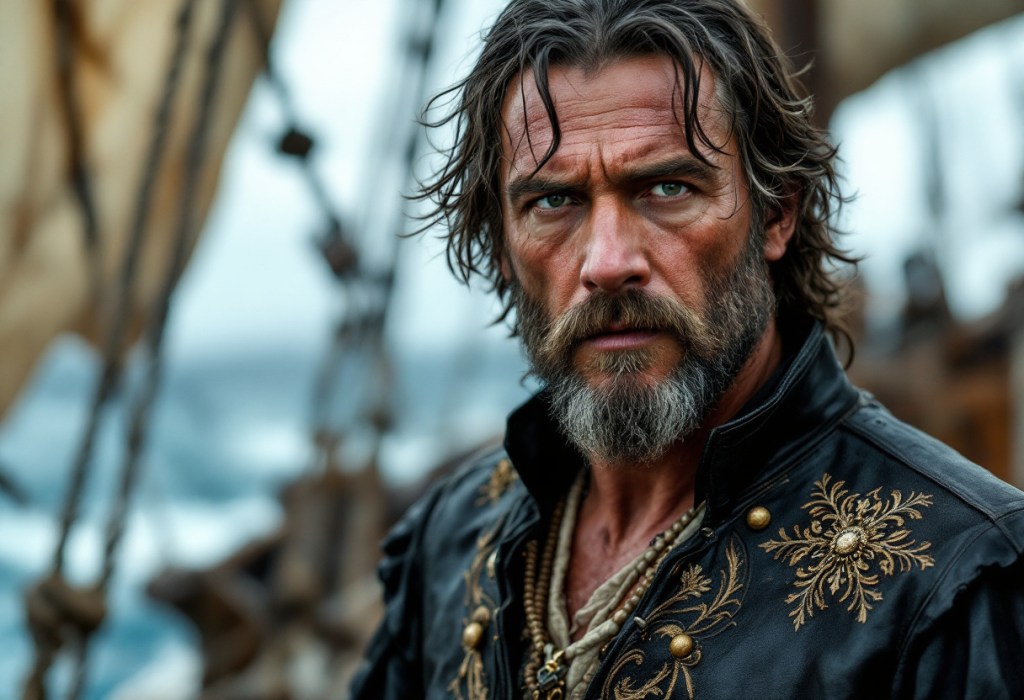
Havana Harbour, Cuba – September 1622
In the pre-dawn darkness of the Caribbean’s most dangerous month, twenty-eight treasure-laden ships prepared to carry the wealth of an empire across waters that had already begun to whisper of storm.
The harbour of San Cristóbal de la Habana lay shrouded in the grey half-light before dawn, its waters black as the sacred oil that anointed kings. From the quarterdeck of the Nuestra Señora de Atocha, Don Rodrigo Vázquez de Coronado watched the final chests of Bolivian silver being hauled aboard with the methodical precision of men who understood that haste might mean death – either from a dropped fortune or an overseer’s lash.
“¡Cuidado con esa plata, malditos!” The harsh voice of the cargador mayor cracked across the water like a whip. “Mind that silver, you cursed dogs!”
Rodrigo winced as he observed an indigenous porter stumble beneath the weight of a chest that could purchase a dozen Extremaduran farms. The man’s knees buckled against the wet planking, and the overseer’s staff found his ribs with practised cruelty. Such was the cost of empire – blood and silver flowing in equal measure, both destined for the coffers of His Catholic Majesty.
“The burden grows heavy upon you, Don Rodrigo.”
The voice belonged to Captain Bartolomé García de Nodal, whose weathered face bore the marks of a man who had gazed upon the uttermost ends of the earth. The famous explorer moved with the careful gait of one whose bones remembered Cape Horn’s bitter winds.
“Sí, mi Capitán,” Rodrigo replied, his hand unconsciously moving to the rosary at his belt. “Near fifty tons of treasure she carries now. The Atocha grows fat with the wealth of Peru whilst her sisters sail light as gulls.”
García de Nodal’s grey eyes followed the procession of wealth ascending from the harbour. “Strange providence, is it not? That we who guard the rear should bear the greatest burden. As if God Himself conspires to test our mettle.”
“Or our consciences,” Rodrigo murmured, too quietly for the captain to hear clearly.
The sound of sandalled feet upon the deck heralded the approach of Fray Miguel de Cervantes, the ship’s chaplain. The Franciscan’s brown robes seemed to absorb the morning’s pale light, rendering him a shadow amongst the bustling sailors.
“Buenos días, Don Rodrigo, Captain García de Nodal.” The friar’s voice carried the musical cadence of Old Castile. “I have completed the morning prayers for our cargo. Though I confess, each blessing weighs more heavily upon my soul.”
“How so, Padre?” García de Nodal inquired, though his tone suggested he already suspected the answer.
“Each real de a ocho blessed represents a life spent in the mines of Potosí, each emerald the tears of Colombia’s children. We carry not merely treasure, but the crystallised suffering of the Indies.” The friar’s fingers worried at his wooden cross. “Tell me, Captain, what manner of blessing sanctifies such wealth?”
Before García de Nodal could respond, the gruff voice of Mateo Sánchez interrupted their philosophical discourse. The weathered sailor from Cádiz had served under Rodrigo for seven years, and his scarred hands knew every rope and sail of the great galleon.
“Perdón, Don Rodrigo, but the wind…” Mateo’s words trailed off as he gestured toward the harbour mouth. “She blows contrary this morning. The old-timers amongst the dock workers, they cross themselves when they speak of it.”
“¿Qué dicen?” Rodrigo demanded. “What do they say?”
“That the ceiba trees along the Malecón shed their leaves unseasonably. That the santeros refuse to bless any vessel departing this tide.” Mateo’s voice dropped to barely above a whisper. “They say the sea herself grows hungry, and treasures call to her from the deep.”
“Superstitious nonsense,” García de Nodal declared, though his hand moved instinctively to his sword hilt. “We serve God and King, not the primitive fears of the native folk.”
“Con su permiso, Captain,” interrupted a new voice, cultured and feminine despite its tremor of grief. Doña Isabella de Mendoza approached their gathering with the measured grace of Castilian nobility, though her widow’s black seemed to drain colour from the brightening sky. “Might I speak privately with the segundo contramaestre?”
Rodrigo inclined his head respectfully. At perhaps five-and-twenty, the young widow possessed the refined beauty of Toledo’s finest houses, yet her dark eyes held depths that spoke of recent tragedy.
“Certainly, Doña Isabella. Captain, Padre, if you would excuse us?”
As the others withdrew, Isabella moved closer to the rail, her gloved hands gripping the wood with unconscious intensity.
“Don Rodrigo, I must confess a disquiet that haunts my prayers. My late husband…” She paused, composing herself. “Don Carlos died securing the emeralds now in our hold. He wrote to me of dreams – terrible dreams of green fire beneath black waters.”
“Señora, grief can conjure phantoms from thin air. Your husband died nobly in service to the Crown.”
“Did he?” Her voice carried a note of desperate questioning. “Or did he die feeding an empire’s endless hunger? These emeralds I carry – they cost not merely his life, but the lives of countless indigenous souls who dug them from Colombia’s mountains. What blessing can God place upon such stones?”
The question hung between them like storm clouds, heavy with implication. Rodrigo studied the young woman’s face, recognising his own doubts reflected in her anguished features.
“Señora, we are but servants of a greater design. His Catholic Majesty requires these resources to defend the Faith against Protestant heresy. The Thirty Years’ War – “
“Consumes gold and lives in equal measure,” Isabella finished bitterly. “Yet here we stand, Don Rodrigo, about to commit fifty tons of treasure and near three hundred souls to the mercy of winds and waves. For what? So that German princes might slaughter each other more efficiently?”
Before Rodrigo could formulate a response, a commotion near the ship’s waist drew their attention. The final chest of treasure – containing, according to the manifest, pearls from the waters of Venezuela – had been secured in the hold. The cargador mayor approached with his ledger, his face bearing the satisfied expression of a man whose accounting balanced perfectly.
“Don Rodrigo,” the man called, his voice thick with the accent of Seville’s docks. “The cargo stands complete. Forty-seven tons, three hundredweight, precisely as ordered by His Excellency the Viceroy.”
“Muy bien. Signal the fleet that Atocha stands ready for departure.”
As the cargo master departed, Rodrigo found himself alone again with Isabella. The sun had risen fully now, painting Havana’s limestone buildings the colour of old bone. In the harbour, twenty-eight vessels prepared for the voyage that would carry Spain’s colonial wealth across the Atlantic’s vast expanse.
“The burden you spoke of,” Isabella said quietly, “it is not merely the treasure, is it, Don Rodrigo?”
“No, señora. It is the weight of choice. Each decision we make – to serve, to sail, to carry this cargo – implicates us in a design larger than ourselves. Whether that design serves God’s will or man’s avarice…” He shrugged with the fatalism of a soldier. “Perhaps we shall know when we stand before the throne of judgment.”
From the harbour mouth came the distant cry: “¡Leva anclas!” The tide was turning, and with it, the fate of the Tierra Firme treasure fleet. As the crew prepared to weigh anchor, Rodrigo offered a silent prayer to the Virgin whose name graced their vessel.
He could not know that within forty-eight hours, both prayer and ship would lie beneath the unforgiving waters of the Florida Keys.
***
The dawn of the fifth brought an unnatural stillness that made Rodrigo’s skin crawl like a penitent’s hair shirt. No breath of wind stirred the Atocha‘s pennants, yet the sea itself seemed to pulse with malevolent life. The barometer – that curious Dutch invention he’d learned to read during his service in Flanders – had fallen precipitously during the night watches.
“Santísima Virgen,” Mateo breathed, crossing himself as he approached the quarterdeck. “The very air tastes of copper and fear. My grandmother in Cádiz, she always said when the sea grows still as a church before dawn, the devil himself walks upon the waters.”
“Your grandmother never sailed beyond Seville, hermano,” Rodrigo replied, though his voice lacked conviction. The strange calm had infected the entire fleet; twenty-eight vessels drifted like painted ships upon a canvas sea, their sails hanging limp as burial shrouds.
García de Nodal emerged from his cabin, his grey hair dishevelled from troubled sleep. “The glass continues to fall, Don Rodrigo. In all my years – from the Strait of Magallanes to these cursed Caribbean waters – I have never witnessed such ominous signs.”
“¿Qué hacemos, Capitán?” Rodrigo asked. “The fleet awaits our signal.”
“We continue north. What choice have we? To return to Havana would mean facing the Viceroy’s wrath, and winter approaches in Spain. His Catholic Majesty’s armies require this treasure before the next campaign season.”
The philosophical weight of García de Nodal’s words hung heavy between them. How many men would die so that Habsburg cannons might thunder across German fields? How many souls would feed the depths so that Philip IV might purchase another year of war?
By midday, the sea had begun to show her true temperament. Great swells rolled beneath the fleet like the breathing of some vast leviathan, lifting the treasure ships high before dropping them into valleys of green water. The wind, when it finally came, arrived not as a gentle blessing but as the angry breath of an avenging angel.
“¡Madre de Dios!” cried a voice from the rigging. “¡Las nubes!“
Rodrigo followed the sailor’s terrified gaze westward. The sky had transformed into something from the Apocalipsis of San Juan – black clouds swirled in patterns that hurt the eye to contemplate, shot through with veins of sickly yellow light. Lightning flickered within those roiling masses, not the clean fire of summer storms but something malevolent and hungry.
“All hands!” Rodrigo bellowed, his voice carrying the authority of fifteen years at sea. “Strike the topsails! Secure the treasure chests with double lashings!”
The crew moved with the desperate efficiency of men who understood their mortality. In the ship’s belly, fifty tons of silver and gold – the crystallised suffering of a continent – shifted ominously with each roll. What had once been their pride now threatened to become their tomb.
Doña Isabella appeared at the companionway, her face pale as Carrara marble. “Don Rodrigo, the passengers…” Her voice caught as a particularly violent swell sent her stumbling against the mizzen shrouds. “The children cry ceaselessly, and the men speak of writing final confessions.”
“Where is Fray Miguel?”
“Below, offering what comfort he can. Though I fear his own faith wavers. He spoke strangely of thirty pieces of silver and the weight of Judas’s purse.”
The storm struck with the fury of God’s own judgment just as the church bells of distant Havana would have been ringing Vísperas. The wind shrieked through the rigging like the souls of the damned, while waves tall as cathedral spires crashed over the Atocha‘s bow. The great galleon, built to withstand the cannons of Dutch pirates and English sea-wolves, groaned like a dying beast beneath nature’s assault.
“¡Por todos los santos!” Mateo shouted over the howling gale. “The San Pedro founders!”
Through the wall of rain and spray, Rodrigo glimpsed the sickening sight of one of the fleet’s smaller vessels listing heavily to starboard. Her mainmast had gone by the board, taking with it half her crew. As they watched in helpless horror, the sea claimed her entirely, leaving only floating debris and the screams of drowning men that the wind mercifully snatched away.
García de Nodal appeared beside him, lashed to the rigging by a rope about his waist. Rain streamed from his bearded face like tears. “Seven ships lost already,” he shouted. “The Consolación, the Santo Cristo… all gone to the depths with their treasures and souls.”
“¿Y nosotros, Capitán?” Rodrigo had to scream to be heard above the storm’s fury. “What of us?”
“We face a choice, old friend. Attempt to weather the storm in deep water, or seek shelter among the Florida Keys. Both paths lead through the valley of death.”
Below them, the treasure shifted again with a sound like thunder. The Atocha‘s hull, stout oak from the forests of Cantabria, began to work loose from its joints. Water seeped through gaps that had widened under the tremendous strain, and the ship’s pumps could barely keep pace with the rising bilge.
In the passenger quarters, the rigid hierarchies of colonial society had begun to crumble like sand castles before the tide. Noble and commoner huddled together in the darkness, united by terror and the democratic nature of approaching death. Rodrigo glimpsed Don Alonso de Vargas, the wealthy merchant from Lima, sharing his final flask of wine with a common sailor’s wife. Class distinctions seemed absurd when measured against eternity.
“The coral reefs,” García de Nodal announced, his voice heavy with fatalism. “We must attempt to clear the Marquesas Keys. In deep water, we die slowly. Among the reefs, we die quickly – but some few might reach the shallows alive.”
Rodrigo felt the weight of command settle upon his shoulders like a lead cope. Three hundred souls depended upon his seamanship, his ability to read wind and wave, his knowledge of these treacherous waters. Yet what was human skill against the hurricane’s primal fury?
“Que sea la voluntad de Dios,” he whispered, then raised his voice to a roar. “All hands prepare to come about! We make for the shallows!”
As the crew struggled to bring the great ship’s head around, Rodrigo offered a final prayer to the Virgin whose name graced their vessel. The treasure in her belly – enough to purchase kingdoms – would mean nothing if they could not survive the next six hours. The Nuestra Señora de Atocha turned her bow toward the coral teeth of the Florida Keys, carrying with her the wealth of an empire and the hopes of men who had forgotten that the sea acknowledges no earthly authority save death itself.
***
The jagged limestone spires of the Marquesas Keys rose from the churning waters like the ribs of some primordial beast, white bone gleaming through the storm’s fury. Rodrigo felt the Atocha‘s hull shudder as she scraped across the first reef, the sound of splintering oak audible even above the hurricane’s howl.
“¡Dios nos ampare!” Mateo screamed from the bow. “The forecastle takes water!”
García de Nodal appeared beside Rodrigo, his face a mask of grim acceptance. “How deep?” he demanded.
“Three fathoms and falling fast, mi Capitán. The pumps cannot keep pace.”
The great galleon lurched sickeningly as another wave lifted her stern and drove her deeper onto the coral. Somewhere below, fifty tons of treasure shifted like the vengeful dead, and the sound of snapping timber echoed through the ship’s bones. The proud vessel that had weathered storms from Seville to Cartagena was dying beneath their feet.
“All souls to the upper deck!” García de Nodal commanded. “Abandon the lower quarters!”
Through the chaos, Rodrigo glimpsed passengers struggling up from the flooded compartments – nobles and commoners alike reduced to the same desperate scramble for survival. Don Alonso de Vargas, the wealthy Lima merchant, clawed his way up the companionway beside a barefoot ship’s boy, both men equal in their terror.
Doña Isabella emerged from the passenger quarters supporting an elderly Franciscan monk, her widow’s black sodden with seawater and blood from a gash on her forehead. “Don Rodrigo!” she called above the din. “The children – can we not lower a boat?”
“Imposible, señora. No boat could survive these seas.” Even as he spoke, they watched the ship’s longboat torn from its davits and smashed against the mizzenmast like kindling.
The mainmast went with a crack like cannon fire, taking half the rigging and three screaming sailors into the foam. The Atocha listed heavily to starboard, her death throes beginning in earnest. In the ship’s belly, centuries of colonial wealth – silver reales from Potosí, emeralds from Nueva Granada, Peruvian gold that had once adorned Inca temples – tumbled toward the coral that would become its eternal grave.
Fray Miguel appeared at Rodrigo’s shoulder, his brown robes plastered to his skeletal frame. “¿Es éste el juicio de Dios?” the chaplain whispered. “Is this God’s judgment upon our enterprise?”
Before Rodrigo could answer, another massive wave swept the deck. When the water receded, García de Nodal was gone – simply vanished as if the sea had claimed its tribute. Only his sword remained, wedged between two deck planks.
“¡Al palo de mesana!” Rodrigo roared, pointing toward the mizzen mast. “To the mizzen! It stands higher than the waves!”
Perhaps thirty souls heard his command above the storm’s fury. They struggled through knee-deep water as the Atocha‘s deck tilted at an impossible angle. Don Alonso slipped and would have been swept overboard, but one of the African slaves – a man whose name Rodrigo had never bothered to learn – caught his arm and hauled him upright.
“Gracias, hermano,” the merchant gasped, and in that moment, the rigid hierarchies of New Spain meant nothing.
The mizzen mast rose like a cross against the storm-black sky, its rigging a ladder to uncertain salvation. Rodrigo helped Isabella secure herself to the ratlines, then turned to assist others. Children first – the ship’s boys, a young mestizo girl travelling with her grandmother. Then the women, the elderly, the wounded.
As the Atocha‘s hull finally cracked apart, the treasure that had drawn them to this fate scattered across the seafloor like silver tears. Rodrigo felt a strange lightness, as if a burden he had carried for fifteen years suddenly lifted from his soul. All that wealth, all that suffering crystallised into coin and jewel – it mattered nothing now.
“Padre,” he called to Fray Miguel, who clung to the rigging a few feet below. “Grant us absolution!”
The chaplain’s voice rose thin but clear above the wind: “Ego vos absolvo a peccatis vestris…” The Latin words of forgiveness carried across the water, blessing the living and the soon-to-be-dead alike.
By dawn, only five remained clinging to the mizzenmast’s stump. Rodrigo, his hands raw and bleeding from the rope. Mateo, unconscious but breathing. Two of the African slaves whose Spanish names had been Pablo and Domingo, whose real names would die with them in these waters. And miraculously, impossibly, Doña Isabella – her face corpse-pale but her dark eyes still fierce with the will to live.
The others had slipped away during the endless night. García de Nodal, who had chosen to go down with his ship. Fray Miguel, who had given his place on the mast to a drowning sailor and disappeared beneath the foam with a prayer on his lips. Don Alonso, whose merchant’s calculations had proven useless against the sea’s awful arithmetic.
When the carrack Santa Cruz appeared through the morning mist, her crew found five souls more dead than alive, surrounded by floating debris and the corpses of their companions. The rescue felt not like salvation but like a stay of execution – a chance to bear witness to disaster rather than escape its weight entirely.
Standing on the Santa Cruz‘s deck wrapped in rough sailcloth, Rodrigo stared back toward the reef where the Atocha‘s treasure lay scattered like stars across the ocean floor. Fifty tons of wealth that might have prolonged Spain’s wars, purchased victories, bought another decade of imperial glory – all of it surrendered to the depths.
“¿En qué piensa, Don Rodrigo?” Isabella asked softly, her voice hoarse from salt water and screaming.
“That perhaps the sea has rendered the only verdict that matters, señora. All our wealth, all our grand designs – what are they against the judgment of wind and wave?”
She nodded slowly. “My husband’s emeralds lie beneath twenty fathoms of water, beyond any man’s greed. Perhaps that is where they belonged all along.”
Three weeks later, in the Audiencia Real at Havana, Rodrigo delivered his testimony to the colonial magistrates. His words were recorded in careful script, but the bureaucrats cared more for the cargo manifest than the moral weight of what had transpired. How much silver lost? How many chests of reales? Could the treasure be recovered?
The questions felt obscene. He thought of García de Nodal’s philosophical acceptance, of Fray Miguel’s final blessing, of the unnamed African who had died saving a Spanish merchant who had never seen him as fully human. The true treasure of the Atocha was not silver or gold but the moments when disaster stripped away pretense and revealed the soul beneath.
When the questioning ended, Rodrigo walked to Havana’s harbour one final time. The sea stretched blue and innocent to the horizon, giving no sign of the fortune in treasure and lives it had claimed. Somewhere beneath those placid waters, the Nuestra Señora de Atocha rested in the coral embrace of the Florida Keys, her cargo transformed from imperial wealth into maritime sepulchre.
He turned his back on the sea and walked toward the Franciscan monastery beyond the city walls. There would be no more treasure fleets for Don Rodrigo Vázquez de Coronado, no more voyages in service of empire’s endless hunger. The survivor’s burden was heavier than any cargo of silver – the weight of witnessing judgment, of carrying truth back to a world that preferred comfortable lies.
Behind him, the Caribbean lapped gently at Havana’s stones, keeping its secrets for centuries to come.
The End
On 6th September 1622, the Spanish galleon Nuestra Señora de Atocha sank in a hurricane off the Florida Keys, leaving only five survivors from roughly 265 aboard and scattering nearly 50 tons of treasure across reefs from the Marquesas to the Dry Tortugas within two days of departing Havana in a 28‑ship convoy. Spain’s urgent salvage – hampered by a second storm on 5 October and depths of about 17 metres – failed to find the main wreck, even as the crown, financing the Thirty Years’ War, sank deeper into debt compared with other hurricane‑lost fleets of the era. Rediscovered on 20th July 1985 by Mel Fisher, the “Atocha Motherlode” (c. $450 million) reshaped maritime law, museum practice, and public interest in underwater archaeology.
Story inspired by Tony @ Ingliando
Bob Lynn | © 2025 Vox Meditantis. All rights reserved. | 🌐 Translate


Leave a comment