Hunger Haunts Yorkshire’s Travelling Storyteller

Hunger Haunts Yorkshire’s Travelling Storyteller

4th September, 1861

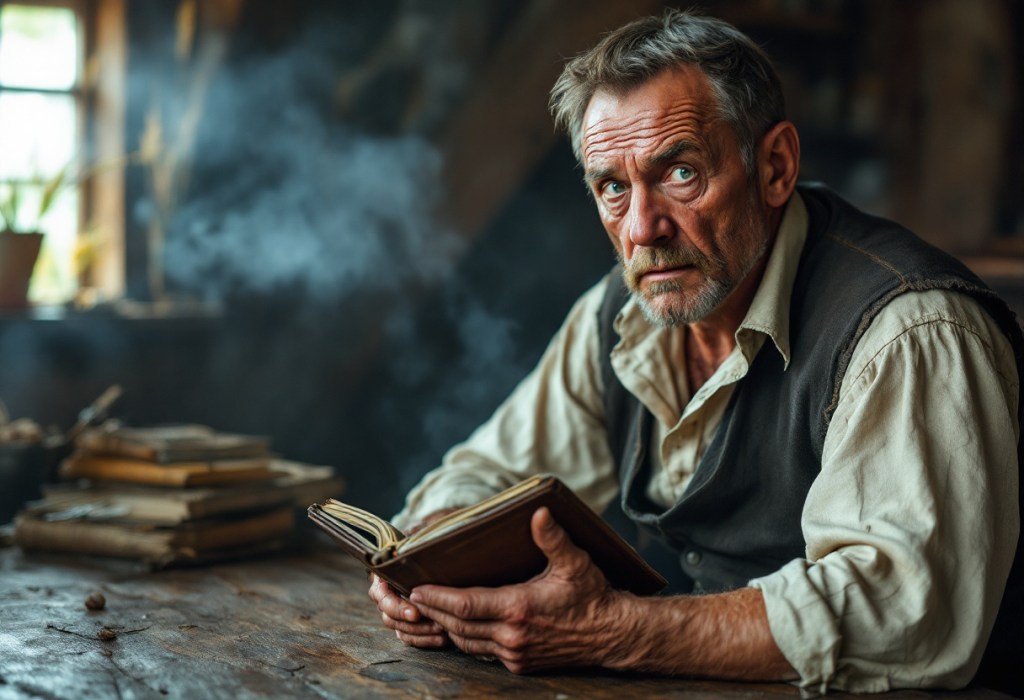
The smoky warmth of The George Inn provides scant comfort this evening, though I am grateful for its shelter from the autumn chill that creeps through these Yorkshire dales like a harbinger of harder times to come. I sit in the corner with my worn leather portfolio, nursing a half-pint that must last until some patron might take pity upon a travelling storyteller and commission a tale or portrait.

The potato harvest this year has been poor again – the landlord speaks in hushed tones of blight returning to the land like a Biblical curse. The very earth seems to rebel against our sustenance, and I cannot help but see Divine Providence in this suffering. Even here in the tavern, men speak of little else but the price of bread and the scarcity of good grain. My own stomach gnaws at me like a persistent hound, though I have managed to secure a heel of bread and a morsel of cheese that I shall ration carefully.

The conversation tonight turns, as it has these past months, to the terrible war across the Atlantic. Young Mr. Crowther, whose brother sailed to Boston these five years past, reads aloud from a letter describing the carnage at Bull Run. The very thought that Christian men should turn upon one another with such violence fills me with dread. Yet I confess there is a selfish fear that grips me more tightly – that this American calamity shall strangle the cotton trade entirely, and with it the prosperity of our mill towns. Already I find fewer commissions amongst the merchant classes, and the working folk have no coin to spare for stories or sketches.

I watch the barley shoots in the landlord’s small garden through the grimy window, how they strain towards what little light the shortened days provide. Like them, I feel myself reaching desperately for whatever sustenance I might find, be it coin or crust. There is something both pitiful and noble in this struggle – how all God’s creatures bend themselves towards survival, towards growth, even when the soil grows thin and the seasons grow harsh.

Are you holding a grudge? The question came to me as I observed old Mrs. Sutcliffe refuse to speak to the miller’s wife over some slight regarding the weighing of flour. Indeed, I find myself harbouring bitter feelings towards those who commission my work only to haggle over payment like merchants in a bazaar. Last month, the squire’s eldest son demanded I complete a portrait of his spaniel, then claimed the likeness insufficient and paid me barely half the agreed sum.

Yet what manner of Christian am I to nurture such resentment when Providence may be testing my humility? Perhaps these trials are meant to prune away my pride as a gardener cuts back the rose to encourage new growth. Still, when hunger gnaws and winter approaches, forgiveness becomes as scarce as grain in a poor harvest. I struggle to remember Our Lord’s teaching about turning the other cheek when each slight might mean the difference between shelter and the workhouse.

The fire burns low now, and the other patrons take their leave. I shall soon be forced to seek lodging, though my purse grows ever lighter. Tomorrow I shall walk to the next village, hoping to find some merchant in need of a sign painted or a farmer’s wife who might trade a meal for a story to tell her children.

Lord grant me strength to endure what trials may come, and help me to remember that even in the darkest soil, seeds of hope may yet take root and flourish.

E.M.


The mid-Victorian era and the early months of the American Civil War frame this entry, when the Union’s July 1861 defeat at First Bull Run shocked observers and foreshadowed a long, attritional conflict that disrupted global trade. Britain’s textile industry depended on Southern cotton; as hostilities deepened and the Union blockade tightened, raw cotton supplies dwindled, driving up prices and producing uncertainty by late 1861 that would culminate in the Lancashire Cotton Famine (1861–65). The crisis brought unemployment and relief schemes across northern England, while the war’s later Union victories and emancipation reshaped international perceptions and restored commerce only gradually after 1865.

Bob Lynn | © 2025 Vox Meditantis. All rights reserved. | 🌐 Translate

4 responses to “Hunger Haunts Yorkshire’s Travelling Storyteller”

  1. @1942dicle avatar

    Following your post’s narrative, ‘grudge’ comes to mind remembering the captivating story in Martha Mitchell’s ‘Gone with the Wind’ . Dee TEzelli, author on Amazon Books.

    Liked by 1 person

    1. Bob Lynn avatar

      Thank you for drawing that connection – it’s fascinating how stories separated by decades can speak to the same fundamental human struggles. Though I believe you meant Margaret Mitchell’s “Gone with the Wind” rather than Martha, the parallel you’ve identified cuts straight to the heart of something profound.

      Both narratives address how we respond when the ground shifts beneath our feet – whether through economic collapse, war, or simply the grinding persistence of want. E.M.’s reflection on grudges in that Yorkshire tavern mirrors what Mitchell explored through Scarlett O’Hara: do we allow bitterness to consume us, or do we channel our pain into something that might yet nourish us?

      What strikes me most powerfully is how both stories refuse to romanticise suffering whilst acknowledging its capacity to reveal who we truly are. E.M. recognises his own resentment toward those who’ve cheated him, just as Scarlett never pretends to be noble in her desperation. There’s an honesty in that admission – a refusal to perform sainthood when survival itself demands every ounce of energy.

      The question of forgiveness becomes particularly complex when we’re hungry, doesn’t it? It’s easy to speak of turning the other cheek when our bellies are full and our futures secure. But when each slight might mean the difference between shelter and the workhouse, as E.M. puts it, grace becomes a luxury we can barely afford.

      Perhaps that’s what makes both stories endure – they understand that moral choices are never clean when they emerge from genuine desperation.

      Like

  2. @1942dicle avatar

    Just wondering if E.M. Forster in his last (posthumous) novel Maurice was still wrestling with ‘love’ and heartbreak and effects of grudge? I didn’t read it yet. But I will. Dee Tezelli

    Liked by 1 person

    1. Bob Lynn avatar

      You’ve spotted something quite intriguing there, though I should clarify that the “E.M.” initials are pure coincidence – I was thinking more along the lines of Ezra Micklethwaite or Edmund Moorcock, those robust Yorkshire names that would have been common in the dales during the 1860s. Nothing so deliberately literary as a nod to Forster, I’m afraid.

      But your instinct to connect these narratives reveals something profound about how literature explores the psychology of wounded pride. You’re absolutely right that Maurice struggles with love and heartbreak, but more specifically with what happens when society refuses to acknowledge your fundamental worth as a human being. Forster understood that when you’re forced to conceal essential parts of yourself – whether your desires, your needs, or simply your right to fair treatment – the resulting isolation can transform justified anger into something that devours you from within.

      Our Yorkshire storyteller faces economic rather than sexual marginalisation, yet there’s a parallel process at work. Both men must manage that treacherous space between legitimate grievance and corrosive resentment. Neither narrative offers easy consolation or simple moral prescriptions about forgiveness.

      What’s particularly compelling is how both works refuse to romanticise their protagonists’ struggles. The diarist admits his bitter feelings even as he questions their Christian propriety. Forster’s Maurice, similarly, doesn’t present his protagonist as a noble sufferer but as someone genuinely coping with how to love authentically in a world that criminalises his very nature.

      Both stories understand that when survival itself feels precarious – whether economically or socially – grace becomes something we can barely afford to extend. Yet somehow, in acknowledging this difficulty, they illuminate what genuine forgiveness might actually cost and why it matters.

      You should indeed read Maurice when you have the chance – it’s a brave and necessary book.

      Liked by 1 person

Leave a comment