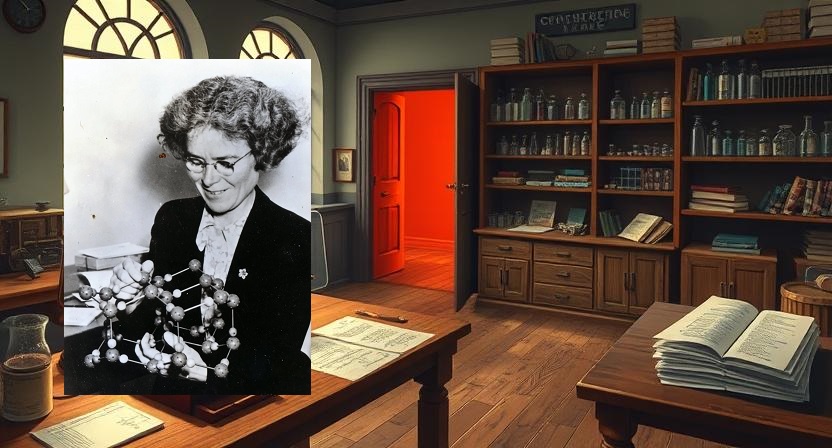
Dame Kathleen Lonsdale (1903-1971) proved that the benzene ring is flat using X-ray crystallography, settled one of chemistry’s fundamental debates, and became one of the first women elected to the Royal Society. Her principled commitment to scientific truth was matched only by her resolute stance as a Quaker pacifist, leading her to spend time in Holloway Prison rather than compromise her beliefs. Today, her work underpins all organic chemistry and pharmaceutical development, whilst her approach to balancing motherhood with cutting-edge research anticipates modern discussions about supporting women in STEM careers.
Good afternoon, Professor Lonsdale. It’s remarkable to have you here with us today. Your work on benzene fundamentally changed how we understand organic chemistry.
How do you do! Please, call me Kathleen – I’ve never been one for too much ceremony. Though I must say, it’s rather extraordinary to be speaking with someone from 2025. You say my work changed organic chemistry? I suppose it did settle that old argument about whether benzene was flat or puckered, didn’t it?
Indeed it did. Before we discuss the technical details, could you tell us about your path into science? It wasn’t exactly conventional for a woman born in 1903.
Quite right – it was anything but conventional! I was born in Ireland, the youngest of ten children. When I was five, my mother brought us to England after my father’s drinking became too much to bear. We settled in Seven Kings, in Essex. Money was terribly tight – my older siblings had to leave school early to help support the family.
I was fortunate to show some aptitude for mathematics early on. The girls’ school I attended didn’t teach proper maths or science, so I had to transfer to the boys’ school for those subjects. Can you imagine? A young girl sitting amongst all those boys, learning physics and higher mathematics. Some thought it most unseemly.
What drew you specifically to crystallography?
Well, I’d intended to read mathematics at Bedford College for Women, but after my first year I switched to physics. I was fascinated by the idea that we could use invisible rays to see the invisible – the very structure of matter itself. When Professor Bragg examined me for my degree in 1922, he invited me to join his X-ray crystallography group at University College London. The following year, he moved to the Royal Institution and I went with him.
You must understand, X-ray crystallography was barely twenty years old then. We were pioneers, really, working out how to make these mysterious rays reveal the secrets of crystal structures. It was like learning to read an entirely new language.
Let’s talk about your breakthrough with hexamethylbenzene. Can you walk us through exactly how you proved the benzene ring was flat?
Ah, now we’re getting to the meat of it! Christopher Ingold at Leeds University had given me crystals of hexamethylbenzene to study. This was tremendously important because chemists had been arguing for decades about benzene’s structure. Some thought it was flat, others believed it must be puckered like a boat.
The problem was devilishly difficult. I had to work out the arrangement of atoms in three-dimensional space using only the spots and intensities on my X-ray photographs. No computers, mind you – just mathematics, patience, and a good deal of intuition.
Can you explain the technical process for our readers who understand crystallography?
Certainly. I started with crystals that belonged to the triclinic system – the lowest symmetry, which makes analysis particularly challenging. However, I noticed the diffraction pattern showed pseudo-hexagonal symmetry, which was the key insight.
I measured the unit cell dimensions: a = 8.90 Ångström, b = 9.11 Ångström, c = 8.52 Ångström, with angles α = 109°28′, β = 113°37′, γ = 109°28′. With one molecule per unit cell, I could calculate the density and begin to work out where each atom must be positioned.
The crucial breakthrough came when I plotted electron density maps. By comparing the observed structure factor amplitudes with calculated ones for different possible arrangements, I could determine that all six carbon atoms in the central ring lay in the same plane, forming a perfect hexagon with carbon-carbon bond lengths of 1.42 Ångström.
What made this measurement so definitive compared to previous attempts?
The precision was unprecedented for its time. I could determine bond lengths to within 0.02 Ångström – extraordinary accuracy for 1929. But more importantly, this was the first time anyone had determined atomic positions without making prior assumptions about the molecular structure. Previous chemical evidence suggested benzene might be flat, but my work provided “definite proof, from an X-ray point of view”.
You mention this was done without computers. How labour-intensive was the calculation process?
Oh my word, it was absolutely back-breaking work! Every structure factor had to be calculated by hand using logarithm tables. I’d spend entire days doing nothing but arithmetic – calculating, checking, recalculating. One small error could invalidate weeks of work.
When I moved on to hexachlorobenzene in 1931, I was the first to use Fourier synthesis methods for structure determination. That was even more computationally intensive. Professor Bragg was marvellous – he arranged for me to have domestic help so I could focus on the calculations. Without that support, managing three small children and such demanding work would have been impossible.
Speaking of children, how did you balance motherhood with research during the 1930s?
It was a constant juggling act, I won’t lie. Between 1929 and 1934, I had three children – Jane, Nancy, and Stephen. During those years, I largely worked from home, doing calculations whilst the children napped or after they’d gone to bed.
My husband Thomas was wonderfully supportive. He’d do his own PhD experiments in the kitchen in the evenings whilst I worked on my structure factor calculations in the sitting room. We made quite a pair – him testing the torsional strength of metals, me mapping the atomic architecture of crystals!
The grant Professor Bragg arranged for domestic help was absolutely crucial. It allowed me to return to experimental work at the Royal Institution. More countries should recognise that if they want married women to contribute their scientific talents, they must make special arrangements to support them.
Your work extended beyond benzene. Tell us about your divergent beam X-ray technique.
Ah yes, that was rather different from the usual highly collimated beams everyone else was using. I borrowed a special X-ray tube from my colleague Alex Müller that produced copper radiation divergent through about 180 degrees.
The beauty of this technique was its sensitivity. I could place crystals very close to the source and obtain excellent photographs with exposure times of just three seconds. The resulting patterns showed series of arcs and circles whose positions were so precise I could calculate lattice dimensions – and hence carbon-carbon bond lengths in diamond – to extraordinary accuracy.
Did you encounter any unexpected challenges or make mistakes you can now acknowledge?
Oh, certainly! One learns far more from failures than successes, though we don’t often discuss them in our published papers.
Early on, I made several errors in my calculations for hexamethylbenzene. I remember spending weeks convinced I’d found evidence for a slightly puckered ring, which would have supported Bragg’s theory. It was only when I triple-checked my arithmetic that I realised I’d made an error in my structure factor calculations.
There’s also the matter of lonsdaleite – that rare form of diamond named after me. Recent work suggests what we thought was a distinct hexagonal form of diamond is actually ordinary diamond riddled with structural defects. Rather embarrassing, really, though the mineral still bears my name!
You famously spent time in Holloway Prison during World War II. How did that experience shape your subsequent work in prison reform?
That month in Holloway was a turning point in my life. I’d refused to register for civil defence duties – not because I didn’t support Britain’s cause, but because my Quaker faith demanded I stand against war as a method of fighting evil, regardless of personal consequences.
Prison was an education. I cleaned floors and did other menial tasks, but they allowed me books and papers, so I managed seven hours of scientific work each day. More importantly, I saw how the system failed the women there. Many were there for poverty-related crimes, trapped in cycles they couldn’t escape.
After the war, I became a regular prison visitor and campaigned for reform. Science teaches us to look for root causes, not just surface symptoms. The same analytical approach that revealed benzene’s structure could illuminate society’s problems.
You’ve been described as combining scientific objectivity with moral conviction. How do you reconcile faith and science?
People often assume they’re incompatible, but I’ve never found them so. Science reveals the elegant mathematical relationships underlying creation – how could that not inspire wonder and humility?
My Quaker faith emphasises the experimental approach to spiritual life. We believe in testing spiritual insights against experience, much as we test scientific hypotheses against evidence. Both require intellectual honesty and willingness to admit when we’re wrong.
During the war, reason told me I was being foolish – I was exempt due to my three children, my isolated protest would accomplish nothing. But I’d “wrestled in prayer” and knew I must refuse to register. Sometimes moral clarity requires the same intuitive leap that guides scientific discovery.
Looking back, do you think your work received the recognition it deserved during your lifetime?
Well, I was hardly ignored! I became one of the first women Fellows of the Royal Society in 1945, the first female professor at University College London, first woman president of the International Union of Crystallography. They even named a building after me at UCL – rather more recognition than many scientists receive.
But you’re quite right that fundamental discoveries often become so taken for granted that people forget someone had to prove them originally. Every student now learns that benzene is flat, but few know someone had to demonstrate that experimentally. My work became part of the foundation upon which modern organic chemistry was built – perhaps that’s the highest form of recognition.
What would you tell young women entering STEM fields today?
Don’t let anyone convince you that marriage and motherhood are incompatible with scientific achievement. They present challenges, certainly, but they also bring perspectives that enrich your work. My experience managing a household taught me organisational skills that proved invaluable in the laboratory.
Be prepared to work twice as hard for half the recognition – that’s unfortunately still true, isn’t it? But persist. Science needs diverse minds asking different questions. Some of my most important insights came from approaching problems differently than my male colleagues might have.
And remember: fundamental research matters. I spent years studying the arrangement of atoms in crystals – work that seemed utterly abstract to many people. Yet that work now underpins pharmaceutical design, materials science, even the development of new forms of diamond harder than any natural stone.
Any final thoughts on how you’d like to be remembered?
As someone who was “generally rather mixed up” but tried to do some good whilst she was here! That’s what I wrote when they named lonsdaleite after me.
Seriously, I hope I’m remembered as someone who asked difficult questions and wasn’t satisfied with easy answers – whether about the structure of benzene or the structure of society. Science and social justice both require the courage to challenge accepted wisdom.
If my work helped establish that women could contribute meaningfully to fundamental research, and if my activism helped create a more just society, then I shall consider my time well spent. After all, as I used to say: “In God’s world there is always a right course of immediate action.” Finding that course, whether in the laboratory or in life, is the great adventure.
Letters and emails
We’ve selected five letters and emails from our growing community who are eager to ask Professor Lonsdale more about her life, her pioneering work, and the advice she might offer to those following in her footsteps. Below are their thoughtful and varied questions, each reflecting unique perspectives on her scientific methods, personal journey, and the impact of her legacy.
Isabella Quiroga, 34, Materials Engineer, São Paulo, Brazil:
Professor Lonsdale, I’m fascinated by your divergent beam technique using copper radiation. How did the wavelength characteristics of copper K-alpha radiation specifically advantage your measurements of carbon-carbon bond lengths in diamond? Could this approach have worked equally well with molybdenum or tungsten sources available in your era?
My dear Isabella, you pose a most stimulating question about the use of copper Kα radiation in my measurements of carbon–carbon bond lengths in diamond. When I first began my investigations in the late 1920s, copper Kα rays, with a wavelength of 1.5418 Å, struck a fine balance between penetrating power and scattering strength for organic and light-element crystals. The somewhat longer wavelength compared with molybdenum (0.7107 Å) produced stronger diffraction intensities from carbon atoms, which scatter X-rays rather weakly, and reduced absorption by the crystal. In practical terms, this meant I could mount very small diamond crystals close to the tube and obtain clear, well-defined diffraction spots without unduly long exposure times.
Had I employed molybdenum Kα radiation, the shorter wavelength might have yielded higher angular resolution, but the diffraction intensities would have been considerably weaker for carbon, leading to fainter spots and much lengthier exposures – surely no small inconvenience when one is hand-calculating structure factors by candle-light and logarithm tables! Furthermore, the increased absorption of Mo rays by the glass capillary and mounting apparatus would have introduced further corrections that risked compounding arithmetic errors.
Tungsten sources, on the other hand, were not widely used in our field for crystal work. Tungsten Lα radiation has a characteristic wavelength of about 0.211 Å, which is admirably short, but its production required enormous tube currents and special filters. These tubes tended to overheat, and their emission lines often mingled with less useful satellite lines. The result was a muddled diffraction pattern – a most unwelcome complication when one seeks to place six carbon atoms in a precise plane to within a few hundredths of an angström.
I must also acknowledge the practical support of my colleagues at the Royal Institution. Sir Lawrence Bragg, ever generous with advice, encouraged me to experiment with various anode materials. Yet it soon became clear that copper anodes provided the most reliable and intense Kα radiation for my purposes. This choice was confirmed when I compared diffraction patterns from hexamethylbenzene and hexachlorobenzene: copper produced crisp ring patterns that were far easier to interpret in the Fourier syntheses I undertook.
In sum, while molybdenum and tungsten might seem tempting for their shorter wavelengths and theoretical resolution gains, the modest absorption and robust scattering of copper Kα rays made them the pragmatic champion in my work. They allowed me to marry experimental clarity with computational manageability – a union without which I doubt I could have proved the flatness of the benzene ring with the precision required in those early days of crystallography.
Andreas Schneider, 41, Philosophy of Science Professor, Munich, Germany:
You mentioned ‘wrestling in prayer’ before making your wartime decision about civil defence registration. This suggests a deeply personal process for resolving conflicts between institutional expectations and individual conscience. How do you think this same reflective approach influenced your willingness to challenge established chemical theories when your crystallographic evidence contradicted prevailing wisdom?
My dear Andreas, your question strikes at the very heart of how I approached both moral and scientific quandaries. When I spoke of “wrestling in prayer” before refusing to register for civil defence duties, it described a genuine struggle of conscience. Quakers are taught that every individual has the Inner Light, a guiding spirit that demands honesty and courage. In the weeks preceding my decision, I spent many quiet mornings in our modest garden behind University College London, reading Thomas Kelly’s writings on nonviolence and praying for clarity. I would kneel beside my rock garden – my children playing nearby – and whisper my fears: that I might be seen as ungrateful to my country, that my refusal could cause hardship for my family, that perhaps I misunderstood God’s will.
It was only after repeating that prayerful exercise day by day until I felt a deep, unshakeable calm that I understood I must follow my convictions, regardless of the professional cost. I explained my reasons to Ronald Greaves at Holloway Prison – another Quaker who guided conscientious objectors – and he helped me prepare the statement I would present to the authorities.
Now, you ask how this quiet, inward process shaped my willingness to challenge established chemical theories. In truth, I see these as two sides of the same coin. Science, like faith, demands rigorous self-examination. When I first calculated the electron density map for hexamethylbenzene, I found my results at odds with the prevailing belief that the benzene ring might pucker. I spent a fortnight retracing every logarithm-table calculation to ensure I had not misled myself, much as a Quaker might reread a spiritual reflection to test its truth against one’s Inner Light.
Few realise how often I sat into the small hours before my daughters’ nursery nurse arrived, working by the glow of an oil lamp to confirm each structure factor. I felt no shame in admitting that I did not know the answer outright; instead, I welcomed the uncertainty, trusting that careful analysis and honest questioning would lead to the correct conclusion. Sir William Bragg himself remarked on my perseverance, saying that scientific discovery often calls for a kind of spiritual patience – I rather took that as high praise.
Thus, the same resolve that guided me to accept the penalties of a prison cell also steeled me to question long-held assumptions in crystallography. Both required me to trust quieter forms of authority – whether divine or empirical – over the louder voices of tradition. In every experiment, as in every act of conscience, I sought to let neither fear nor convenience sway my judgement. I can only hope that today’s scientists will recognise the value of such inward discipline, for it is by testing our convictions against reality – spiritual or physical – that we arrive at genuine insight.
Min-Ji Park, 28, Computational Chemistry PhD Student, Seoul, South Korea:
Given that you pioneered Fourier synthesis methods for crystal structure determination in 1931, I’m curious about your mathematical intuition. When you were hand-calculating those structure factors without any computational aids, what mental strategies or mathematical shortcuts did you develop? Did you ever envision machines that could perform these calculations automatically?
My dear Min-Ji, what an intriguing question you pose about the art of calculation in our early days of crystallography. In the years around 1931, when I first embarked on Fourier syntheses for hexachlorobenzene, I confess I spent many an evening poring over logarithm tables by the flicker of an oil lamp. Our tools were simple: slide rules, four-figure logs, pencil and paper. Yet necessity breeds invention, as they say, and I developed a few personal techniques to ease the burden on my weary eyes and aching fingers.
Firstly, I grouped similar terms whenever possible. Structure factors often came in series that differed only by a sign or by a small angular step. I would write out one full set of calculations, then copy it by hand for subsequent reflections, changing only the figures that required adjustment. This cut down errors, too, for I knew that if the first column was sound, the rest would follow more swiftly.
Secondly, I learned to recognise symmetry-related reflections at a glance. Although our triclinic crystals lacked the higher symmetries of cubic systems, hexachlorobenzene displayed pseudo-hexagonal motifs in its pattern. By acquainting myself intimately with those repeating arcs on my photographic films, I could predict many of the sine and cosine values needed for the Fourier sums. A great many terms could then be borrowed from earlier sheets, rather than recalculated from scratch.
As for mathematical “shortcuts,” I became adept at spotting when a term was negligible. If a reflection’s intensity was so faint as to risk vanishing under background noise, I would still note its phase possibility but omit the minute amplitude from my sums. This saved hours without sacrificing the accuracy needed to place those chlorine atoms securely in three-dimensional space.
Did I ever dream of machines to do this work? Ah, indeed! I recall reading of Hewlett and Packard’s early experiments with electronic calculators in the late 1940s, though those machines were still crude by our standards. My heart would beat faster imagining a device that could crunch logs at the press of a few keys. Yet I also feared that too much reliance on such contraptions might sever one’s intimate understanding of the mathematics beneath. There is a kind of profound satisfaction in seeing a crystal’s structure emerge from your own hand-worked sums – a communion of mind and material, if you will.
Still, I welcomed any aid that lightened our toil. When Professor Bragg arranged for my laboratory to acquire one of those bulky mechanical desk calculators – able to multiply and divide at the turn of a handle – it was like being handed a magic wand. Calculations that once took hours could be reduced to minutes, allowing me more time by the microscope and at the X-ray tube itself.
So, while I treasured the discipline of manual computation, I never resisted progress. I encouraged younger colleagues to embrace emerging machines, but not to forget the rigor and insight born of pencil, paper, and persistence. In that balance, I believe, lies the true spirit of crystallographic discovery.
Caleb Richardson, 39, Science Journalist, Toronto, Canada:
Here’s a hypothetical: imagine you had access to modern synchrotron radiation sources and computer modelling from the very beginning of your career. Do you think having such powerful tools might have actually hindered your development as a crystallographer? Would the necessity of doing everything by hand have given you insights that automation might have obscured?
My dear Caleb, what a delightful “what if” you propose – modern synchrotron beams and computer modelling at the outset of my career! I can almost hear Beryl Cockcroft’s exclamation in the lab: “Kathleen, you’ll be spoilt for choice!” Yet I often wonder whether having such powerful tools from the start might have robbed me of some hard-won insights.
Consider synchrotron radiation: its brilliance and tunable wavelengths would have been miraculous for detecting faint reflections from light atoms like carbon. Exposure times counted in seconds rather than hours! But in 1928, I learned to coax clear patterns from a humble copper-anode tube, adjusting slit sizes and distances by trial and error. Those long hours wrestling with capillary mounts taught me to “read” diffraction films – to discern subtle spots and arcs that, at first glance, seemed mere smudges. If I’d had synchrotron beams, I suspect I would have leaned heavily on the equipment’s sensitivity and perhaps overlooked the telltale quirks of experimental artefacts.
And what of computer modelling? In principle, one could run a least-squares refinement overnight and awaken to perfection – but perfection can be a trap. In my first Fourier syntheses for hexachlorobenzene, I recall noticing a faint electron-density bulge that did not align with any chlorine site. My hand calculations allowed me to trace that bulge to a small impurity inclusion, likely a trace of bromine from the reagent. A computer routine might have swept that anomaly into the residuals and called it “noise,” whereas I saw it as truth demanding explanation.
Furthermore, the discipline of manual computation forged an intimate bond with the data. When I spent hours at the desk calculator, turning its crank until my arms ached, I memorised angular relationships and structure-factor symmetries. This mental map saved me countless trips to the darkroom. A generation reliant on automated fitting might miss that inner choreography of numbers and geometry.
Yet I would not wish to deny modern scientists these marvels. I cannot imagine the speed with which one might now characterise novel materials or explore transient phases under high pressure. Nor the joy of watching real-time diffraction movies. It warms my heart that crystallographers today stand on shoulders both of Braggs and of synchrotron pioneers alike.
In the end, perhaps every era needs its trials by fire – hours of solitary calculation, evenings in poor light, the thrill of spotting a rogue reflection, and the satisfaction of knowing every figure by heart. That forge of experience shapes not only the scientist’s skill but also her judgement and intuition. So, would modern tools hinder my growth? Possibly. But they also promise discoveries I could scarcely dream. I like to think that, armed with both the hard-earned wisdom of hand-worked sums and the might of modern apparatus, today’s crystallographers carry forward a legacy richer than mine alone.
Thandiwe Khumalo, 45, Science Policy Advisor, Cape Town, South Africa:
Your experience balancing scientific research with raising three children seems remarkably progressive for the 1930s. Beyond the domestic help Professor Bragg arranged, what institutional or cultural changes could have better supported women like yourself? How might different support structures have accelerated scientific discovery more broadly?
My dear Thandiwe, your question about institutional and cultural support for women in our field strikes a powerful chord. In those days, support beyond a hired cook or a charwoman was scarcely imagined. Yet I often thought that a fellowship explicitly for married women scientists – offered with sabbatical leave and childcare subsidies – would have been revolutionary. Imagine a grant from the Royal Society or the Medical Research Council that covered nursery fees and allowed mothers to spend term-time in the laboratory rather than worrying over unpaid bills.
At University College London, I was fortunate to have Sir William Bragg’s backing, but his patronage depended on personal goodwill rather than formal policy. Too many female colleagues found their careers ebbing once they wed or bore children. If colleges had provided on-site nurseries and flexible working hours – perhaps even job-sharing posts – we could have retained brilliant minds who otherwise left research altogether.
Culturally, the notion that a lady’s proper place was in the home discouraged many talented women from even applying for scientific posts. To combat that, I believe professional societies ought to have established women’s sections – annual symposia where women crystallographers and chemists presented their work without fear of condescension. Such gatherings could foster mentorship, exposing young researchers to role models and networks that were then largely male preserves.
In my own experience, an early-career luncheon hosted by the Chemical Society in 1930 opened my eyes to how few women occupied chairs or editorial boards. Had they instituted quotas – small as they might have seemed – it would have signalled that female scholarship was valued, not merely tolerated. Even a single seat reserved for a woman on the council would have had symbolic weight, accelerating cultural change.
Another measure would be allowing part-time or term-time laboratory access without penalty. I recall having to choose between full-time posts and staying at home with the children; a half-time lectureship could have offered both scholarly continuity and maternal presence. Scandinavian universities pioneered such posts in the 1950s, and I envied their foresight.
Finally, improved funding for technical assistants would have freed many women from manual drudgery. In my laboratory in the 1940s, I often found myself cleaning capillary mounts and winding goniometer heads when, frankly, my talents were wasted on such tasks. A corps of skilled technicians – employed on secure contracts – could have handled routine work, leaving scientists to think, teach, and innovate.
I am convinced that these structural reforms – combining childcare support, flexible appointments, women’s networks, and dedicated technical staff – would not only have retained gifted women in research but accelerated discovery for all. When you free a scientist’s mind from domestic burdens, you unleash creativity that benefits the entire community.
Reflection
On 1st April 1971, Dame Kathleen Lonsdale died at the age of 68, leaving behind a legacy etched into every crystallographer’s mind. Throughout our conversation, themes of perseverance and ingenuity emerged again and again: her hand-calculated Fourier syntheses, her fierce defence of conscience as a Quaker pacifist, and her juggling of microscopy and motherhood in an age that rarely made space for both. Yet Kathleen’s own recollections sometimes differ from the tidy narratives found in textbooks. She confessed to calculation errors that almost led her astray, and to spotting a bromine impurity by eye – details rarely recorded in official accounts.
Historians debate the true nature of lonsdaleite and the extent to which her work on divergent-beam photography pioneered modern methods. These uncertainties remind us that the historical record is often incomplete, shaped by archivists’ choices and the biases of the era.
Today’s crystallographers build on her foundations: from Hodgkin’s protein structures to synchrotron-driven time-resolved diffraction; from machine-learning analyses of electron density to pharmaceutical design informed by her benzene maps. Researchers routinely cite her 1929 hexamethylbenzene paper, and students still study her hand-drawn electron-density contours.
Her story challenges us now: How many contributions go unthanked because they form part of our accepted fabric? As we push the frontiers of nanomaterials and drug discovery, Kathleen Lonsdale’s quiet courage and exacting methods beckon us to embrace both rigour and conscience. May her example spark in each of us a relentless curiosity, and a resolve to give credit where credit is due.
Who have we missed?
This series is all about recovering the voices history left behind – and I’d love your help finding the next one. If there’s a woman in STEM you think deserves to be interviewed in this way – whether a forgotten inventor, unsung technician, or overlooked researcher – please share her story.
Email me at voxmeditantis@gmail.com or leave a comment below with your suggestion – even just a name is a great start. Let’s keep uncovering the women who shaped science and innovation, one conversation at a time.
Editorial Note: This interview is a dramatised reconstruction grounded in historical records, letters, and published papers from Dame Kathleen Lonsdale’s life and work. While dialogue and details evoke her era and documented achievements – such as her 1929 benzene study, Quaker witness, and prison reform efforts – creative liberties have been taken to imagine her voice and personal reflections. Readers should view this as a thoughtful homage rather than a verbatim transcript, intended to honour her pioneering spirit and illuminate her enduring influence on crystallography and chemistry.
Bob Lynn | © 2025 Vox Meditantis. All rights reserved. | 🌐 Translate


 Vox Meditantis
Leave a comment