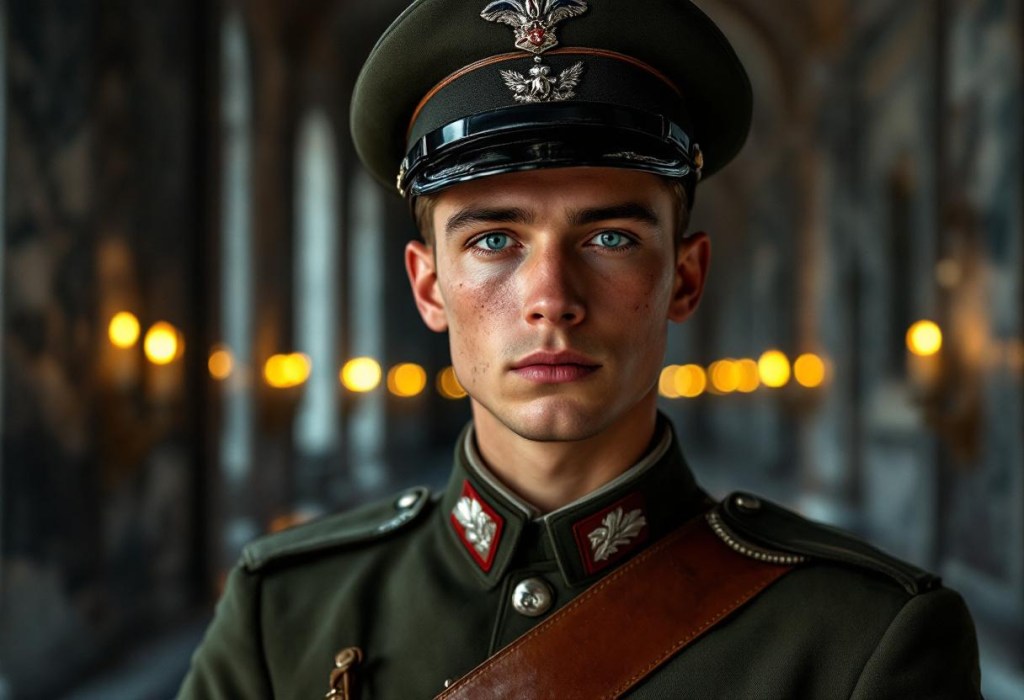
The Romanian Royal Palace, Bucharest, Romania – 23rd August 1944
The evening air through the palace windows carries the scent of lime trees and distant gunpowder. I stand at my post outside the Blue Salon, watching shadows lengthen across the marble floors of the Cotroceni Palace, and wonder how many more sunsets I shall see as Captain Alexandru Rădescu of His Majesty’s Royal Guard. The clock in the corridor has just chimed eight, and with each passing minute, the weight of what we are about to attempt presses more heavily upon my chest.
Four years. Four years since Marshal Antonescu dragged our beloved Romania into this devil’s pact with Hitler, and tonight – God willing – it shall end. My hand rests instinctively upon the Luger concealed beneath my dress uniform, its cold metal a reminder that some secrets are worth dying for. Through the tall windows, I can see the last traces of daylight fading over Bucharest, and somewhere beyond the city’s edge, the sound of Soviet artillery grows ever closer. The Wehrmacht retreats, and with them, perhaps, our chance at redemption.
Domnule Căpitan, I tell myself, using the formal address my father drilled into me as a boy, tonight you cease to be merely a soldier. Tonight, you become something your ancestors might yet be proud of.
The irony is not lost on me. My family has served Romanian royalty for three generations. My grandfather fell at Mărășești in the Great War, defending this very kingdom against the Kaiser’s armies. My father spent his career ensuring King Carol’s safety, only to watch that same monarch flee into exile when the pressures of this war became too great. And now I stand here, about to betray everything I was raised to revere – the chain of command, military discipline, unquestioning loyalty – in service of something higher.
The marble beneath my boots is the same marble my father once policed as a young lieutenant. These corridors echo with the footsteps of generals and ministers who shaped our nation’s fate, and tonight they shall witness its transformation. I think of those bronze lions flanking the palace entrance, their proud faces turned towards the city, and wonder what they have seen these past four years. What would they make of Romanian boys dying in the frozen hell of Stalingrad? Of cattle cars rolling east from our railway stations, packed with our Jewish neighbours?
Focus, Alexandru. The familiar voice of my conscience, tinged now with the accent of my old philosophy professor at the University of Bucharest – Professor Weinberg, whose lectures on Kant’s moral philosophy seem a lifetime ago. Before they came for him. Before I learned the true meaning of complicity through silence.
A footfall echoes from the grand staircase, and my spine straightens automatically. But it is only Colonel Gheorghe Ionescu, another of our conspirators, making his evening rounds with studied casualness. Our eyes meet briefly as he passes – the slightest nod confirming that our friends in the courtyard remain in position. Emil Bodnăraș and his communist associates are already within the palace walls, masquerading as minor functionaries whilst they arrange the final details of this most audacious gamble.
Strange bedfellows we make – royalists and communists, career officers and underground fighters. Yet here we are, united by a common recognition: that some evils are so profound they transcend political differences. When the Antonescu regime began shipping Jews to Transnistria by the thousands, when Romanian divisions were ground to nothing in Hitler’s mad crusade against Moscow, when our very sovereignty became a commodity traded between Berlin and Budapest – that was when men like us discovered that loyalty to an abstract ideal of order matters less than loyalty to basic human decency.
The salon doors remain closed, but I know what lies beyond. King Michael, barely twenty-two years old, reviewing the proclamation that will announce Romania’s break with the Axis powers. How must he feel, this young man who inherited a throne his father abandoned, knowing that within hours he must risk everything on a single desperate throw of the dice? There is something deeply Romanian about this moment – our eternal pattern of dramatic reversals, of snatching transformation from the jaws of catastrophe.
My pocket watch shows twenty past eight. Marshal Antonescu’s motorcar should arrive within the quarter-hour, bringing with it the architect of our national shame. I have seen him twice before – once at a military parade in 1941, when his alliance with Hitler still seemed like pragmatic statecraft, and once last autumn, when the reality of defeat had begun to etch lines into his weathered face. Tonight, when he walks through these palace doors expecting another routine conference with his puppet king, he will instead find himself under arrest by the very guards he trusts to protect his regime.
The contradiction would be almost comic if the stakes were not so absolute. We are soldiers trained to follow orders, executing the ultimate act of disobedience. We are guardians of tradition, perpetrating the most radical revolution in our nation’s modern history. We are Romanians, finally choosing to be Romanian rather than German satellites or Soviet vassals.
Through the windows, I can see the gardens where I played as a child when my father brought me to official functions. The rose beds my mother once admired, now brown and neglected in the wartime austerity. The fountain where I first kissed Maria Popescu during the summer of 1938, when the world still seemed rational and war was merely a diplomat’s nightmare. She married a lawyer from Craiova the following year, just before the borders began changing and young men started disappearing into uniform.
Such memories feel simultaneously ancient and immediate tonight – fragments of a Romania that existed before we learned to measure moral compromise in trainloads of deportees and regiments of frozen corpses. Perhaps that is what we are truly fighting for: not merely to change governments, but to reclaim some essential part of ourselves that four years of fascist alliance have nearly extinguished.
The palace settles around me with the familiar creaks of old stone and seasoned wood. In forty minutes, perhaps less, these same corridors will witness either our triumph or our execution for high treason. There will be no middle ground, no graceful retreat. Marshal Antonescu will either submit to arrest, or blood will be spilled upon these marble floors that have known three centuries of more dignified royal ceremonies.
Ave, Caesar, morituri te salutant. The Latin phrase comes unbidden to mind – one of the few things I remember from my classical education. We who are about to die salute you. Except tonight, it is not Caesar we salute, but something far more fragile and precious: the possibility that courage, however belated, might yet redeem a nation’s honour.
***
The distant rumble of engines grows louder, echoing off the palace’s stone facades. My pocket watch shows half past eight – Marshal Antonescu’s motorcade, precisely on schedule as always. Through the tall windows, I glimpse the black Mercedes staff cars sweeping up the circular drive, their headlamps cutting pale beams through the evening gloom. Four years of this same ritual: the dictator arriving for his weekly briefing with King Michael, confident in his puppet master’s control.
Tonight shall be different.
I straighten to attention as the sound of heavy boots approaches through the palace’s marble corridors. Colonel Ionescu appears first, his face a mask of professional neutrality that betrays nothing of the conspiracy brewing within these walls. Behind him, two of Antonescu’s personal guards – Corporal Munteanu and Sergeant Major Vasile – men I’ve shared cigarettes with during previous visits, now unknowing escorts to their master’s arrest.
“Bună seara, Căpitane Rădescu,” Munteanu nods as they pass. “Another long evening ahead, eh?”
“Indeed, Corporal. Să ne dea Dumnezeu putere – may God give us strength.” The traditional blessing carries new weight tonight.
Then comes Marshal Antonescu himself, resplendent in his dress uniform, medals catching the light from the crystal chandeliers. At sixty-two, he still carries himself with the bearing of the cavalry officer he once was, though the lines around his eyes speak of the burden these war years have brought. He pauses briefly at the salon doors, exchanging pleasantries with Colonel Ionescu about the evening’s agenda – routine military matters, supply reports from the Eastern Front, nothing to suggest the earth-shattering reversal that awaits him within.
“His Majesty is prepared to receive you, Domnule Mareșal,” Colonel Ionescu announces with perfect military courtesy.
The salon doors close with a soft click that seems to echo through eternity. I resume my post, acutely aware that somewhere in the palace’s shadows, Emil Bodnăraș and his communist associates are moving into their final positions. The weight of my concealed Luger feels enormous against my ribs.
It is then that Sergeant Gheorghe Popescu approaches – my oldest friend in the Royal Guard, the man who stood beside me through officer training at the Military Academy, who shared my doubts as Romania slipped deeper into Hitler’s embrace. Gheorghe comes from good Moldovan peasant stock, the sort of hardy, uncomplicated soldier who forms the backbone of any army worth the name. His weathered hands speak of childhood summers working his family’s small farm before duty called him to Bucharest.
“Ce faci, Alexandru?” he asks quietly, using the familiar form reserved for old friends. “You look as though you’ve seen a ghost.”
“Perhaps I have, prietene. Perhaps we all have.”
Gheorghe studies my face with the shrewd perception that makes him such an excellent sergeant despite his humble origins. In the distance, we can hear the murmur of voices from within the salon – King Michael’s young tenor contrasting with Antonescu’s gravelled bass, discussing matters that shall soon become utterly irrelevant.
“Do you remember,” Gheorghe says suddenly, leaning against the marble pillar beside my post, “how we used to talk about what we’d do after the war? Back when we thought it would be over by Christmas of ’41?”
“I remember many things, Gheorghe. Too many.”
He pulls out his worn tobacco pouch – a gift from his wife Ileana before her death in the bombing of Ploiești last year – and begins rolling a cigarette with practiced efficiency. The familiar ritual seems almost obscene against the magnitude of what’s about to unfold.
“Spune-mi,” he says, not looking up from his tobacco, “tell us about the last thing you got excited about.”
The question hangs in the air between us like smoke. Such a simple inquiry, the sort of casual conversation that passes between soldiers during long watches. Yet in this moment, with history pivoting on decisions made in secret chambers, it strikes me as profound as any philosophical treatise.
What was the last thing that truly excited me?
My mind races backwards through the grey months of doubt and growing conviction. Was it three weeks ago, when I first learned of tonight’s plan through whispered conversations in the palace chapel? The moment when Major Bodnăraș approached me after evening prayers, his communist credentials seeming less important than his shared revulsion at what our country had become?
Or perhaps it was earlier – that night in June when I listened to the BBC through the static of my hidden wireless, hearing Churchill announce that the tide was turning, that the Anglo-American forces had secured their foothold in Normandy. The realisation that Hitler’s Reich was finally, inexorably crumbling, and that Romania might yet escape total destruction if we possessed the courage to act.
“Gheorghe,” I begin, then stop. How does one explain the excitement of moral awakening to a man whose own conscience never needed such dramatic resurrection? How do I tell him that what excited me most was not any grand political revelation, but something far more personal – the discovery that I was still capable of feeling shame?
The voices from the salon grow suddenly louder, more heated. Through the heavy oak doors, I catch fragments: “Majestatea Sa does not understand the strategic implications…” Antonescu’s voice, carrying the sharp edge it takes when his authority is questioned.
“It was a letter,” I say finally, my voice barely above a whisper. “A letter from Professor Weinberg – you remember him from the University? They released him from the camp at Târgu Jiu last month, before he could be… before the deportations reached him.”
Gheorghe’s hands still on his cigarette. He knows, as we all know, what happens to those who reach the end of that particular journey.
“He wrote to thank me,” I continue, “for the food parcels Mama sent while he was imprisoned. Such a small thing – a few tins of meat, some bread, winter clothing. But in his letter, he said something that pierced me like a blade: ‘Dragă Alexandru, your family’s kindness reminded me that not all Romanians have forgotten how to be Romanian.‘”
The words hang between us, carrying the weight of four years’ accumulated shame. Four years of standing silent while our Jewish neighbours disappeared. Four years of saluting a flag that marched beside the swastika. Four years of telling ourselves that survival required compromise, that honour was a luxury we could not afford.
“That excited me, Gheorghe. The possibility that we might still deserve such faith. That we might yet prove ourselves worthy of it.”
Before my friend can respond, the salon doors burst open with such violence that the crystal chandelier overhead trembles. King Michael emerges, his young face set in lines of determination that seem to age him by decades. Behind him come two palace guards escorting a stunned Marshal Antonescu, the dictator’s face cycling through disbelief, rage, and the dawning recognition of catastrophe.
“Ce naiba…?” Gheorghe breathes, his unfinished cigarette tumbling to the marble floor.
The coup has succeeded. Romania has chosen its side at last. And as I watch Marshal Antonescu being led away – the man who delivered our nation to Hitler’s altar – I finally understand what true excitement feels like. Not the cheap thrill of conspiracy, but the profound relief of a people rediscovering their souls.
The last thing I got excited about was hope itself – the possibility that redemption might come to those brave enough to seize it.
***
The palace corridors that moments before had been thick with conspiracy now thrummed with controlled urgency. Marshal Antonescu’s footsteps – once the drumbeat of Romanian fascism – fade into the distance as his escorts lead him towards the chamber that shall serve as his prison cell. I watch through the tall windows as his personal guards, still bewildered by the swiftness of events, are quietly disarmed by our men. The changing of an epoch, accomplished in less than an hour.
“Sfinte Dumnezeule,” Gheorghe breathes beside me, crossing himself with hands that tremble slightly. “Holy God, Alexandru – we’ve actually done it.”
Indeed we have. Yet even as the reality settles upon us, I find myself thinking not of triumph, but of the profound weight of what comes next. Through the palace’s ancient walls, I can hear the distant sound of church bells beginning to ring across Bucharest – not in celebration, not yet, but in the regular tolling of evening prayers. By tomorrow’s dawn, those same bells shall ring for an entirely different Romania.
King Michael emerges from the salon, his young face bearing the gravity of a man who has just altered the course of history. At twenty-two, he possesses a composure that puts men twice his age to shame. Colonel Ionescu approaches him with a crisp salute.
“Majestatea Sa, the German Ambassador is requesting an immediate audience. Baron Killinger seems… agitated by reports from the city.”
“Let him wait,” His Majesty replies with quiet authority. “Romania has waited four years to speak truthfully to Berlin. They can wait a few hours to hear what we have to say.”
How different this young king sounds from the uncertain boy who inherited his father’s abandoned throne just four years ago. War has a way of tempering men, and tonight Michael speaks with the voice of someone who has found his purpose in the crucible of moral crisis.
Emil Bodnăraș emerges from the shadows of the corridor, his communist credentials forgotten in this moment of shared national purpose. Strange how revolution makes allies of the most unlikely companions – a royalist captain, a Moldovan peasant-soldier, a Marxist intellectual, and a young king united by nothing more complex than the recognition that some betrayals are acts of patriotism.
“The radio station is secure,” Bodnăraș reports in his measured tones. “We await Your Majesty’s pleasure for the announcement.”
The announcement. The words that shall tell the world that Romania chooses conscience over convenience, that we reject the path of comfortable collaboration for the uncertain road of moral awakening. I think of the millions of Romanians – farmers in Moldavia, workers in the Prahova oil fields, students in Cluj – who shall wake tomorrow morning in a fundamentally different country from the one in which they fell asleep.
Gheorghe nudges my elbow, his weathered face creased with concern. “You never answered my question, prietene. About the last thing that got you excited.”
The last thing. How do I explain that what excited me was not any single moment, but the gradual recognition that redemption remained possible even for a nation that had lost its way so completely? That a people could choose to remember who they were beneath the accumulated compromise and fear?
“Do you remember,” I begin, my voice low enough that only he can hear, “that night last month when we heard the BBC report about the Allied landings in Normandy?”
“Bineînțeles – of course. You looked as though you’d seen the Archangel Michael himself.”
“In a way, perhaps I had.” I pause, gathering my thoughts like a man preparing for confession. “What excited me was not merely the news that Germany was losing – any fool could see that by then. What excited me was the realisation that we might yet deserve to survive this war with our souls intact.”
Through the windows, I can see people beginning to gather in the palace gardens – word travels swiftly in wartime, and already rumours of change are spreading through the city like wildfire through summer wheat. Ordinary Romanians, emerging from their houses despite the blackout restrictions, drawn by some instinct that history is pivoting on this August evening.
“For four years,” I continue, “I have watched our nation become something unrecognisable. We sent our Jewish neighbours to die in cattle cars. We fed our young men into Hitler’s meat grinder at Stalingrad. We allowed ourselves to become accomplices to horrors that would have appalled our grandfathers. And all the while, we told ourselves it was necessary – that survival required such compromises.”
The clock in the corridor chimes half past nine. Thirty minutes until King Michael addresses the nation, thirty minutes until Romania officially rejoins the family of civilised peoples. In the distance, I can hear the rumble of vehicles as German forces begin their hurried withdrawal from Bucharest – the occupier becoming the occupied with startling suddenness.
“But that night,” I say, “listening to Churchill’s voice through the static of my hidden wireless, hearing him speak of democracy and justice and the hope of better days – I felt something I hadn’t experienced in years. Not excitement at Germany’s coming defeat, but excitement at the possibility that we might yet prove worthy of such words ourselves.”
Gheorghe nods slowly, understanding passing between us like the recognition of shared faith. We have both seen too much these past four years – too much cruelty dressed as necessity, too much evil justified as pragmatism. The excitement I felt was not political but spiritual: the possibility of moral resurrection for a people who had nearly forgotten how to distinguish between survival and honour.
At five minutes before ten, King Michael takes his place at the palace’s broadcasting equipment. The technicians, sworn to secrecy just hours before, now prepare to transmit the words that shall echo through history. I catch a glimpse of His Majesty’s prepared text – phrases about “accepting the armistice offered by the United Nations” and “declaring war on Germany” – words that will transform us from Axis satellite to Allied partner with the simple act of speaking them aloud.
“Citizens of Romania,” King Michael begins, his young voice carrying across the airwaves to reach every corner of our ancient land, “Marshal Antonescu’s government has been dismissed. Romania accepts the armistice offered by the Soviet Union, Britain, and the United States. Romania has joined the United Nations against Nazi Germany.”
The words ring through the palace corridors like cathedral bells announcing Easter. Through the windows, I watch as people in the gardens embrace one another, tears streaming down faces that have forgotten how to weep for joy rather than sorrow. Church bells across Bucharest take up the celebration, their bronze voices proclaiming to heaven and earth that Romania has chosen to remember who she truly is.
“Dragoste de țară,” Gheorghe murmurs – love of country. Such a simple phrase, yet how complex it has become during these years when loving Romania seemed to require hating so much else.
What truly excited me was not the thrill of conspiracy or the satisfaction of successful rebellion. It was something far more profound: the recognition that even a nation can experience conversion, that even a people who have lost their way can choose to walk back towards the light. Tonight, Romania has chosen courage over comfort, justice over mere survival. Tonight, we have chosen to be Romanian rather than simply to exist under Romanian skies.
The bells continue ringing as midnight approaches, proclaiming to a war-weary continent that one more nation has found its conscience. By dawn, the Red Army will be welcomed as liberators rather than conquerors, and Romania will begin the long journey towards redemption. It is estimated that our decision tonight shall shorten this terrible war by six months, sparing hundreds of thousands of lives across Europe.
That is what excited me – not the drama of the moment, but the possibility that moral courage, however long delayed, might yet change the world. Tonight, as I stand in these ancient palace corridors where my father once served and my grandfather before him, I understand that sometimes the greatest act of loyalty is the willingness to betray what we have become in order to reclaim what we once were.
The last thing I got excited about was hope itself – the discovery that redemption remains possible even for those who thought they had fallen too far to rise again.
The End
On 23rd August 1944, King Michael I orchestrated a coup d’état that removed Marshal Ion Antonescu from power and ended Romania’s alliance with Nazi Germany, leading to an armistice with the Allies within hours. More than 500,000 Romanian soldiers had previously fought alongside Axis forces on the Eastern Front, and Romania’s sudden switch is credited with shortening World War II by an estimated six months, saving tens of thousands of lives. Before the coup, Romania had been allied with the Axis since 1940 and had suffered Allied bombing of its oil fields; afterward, Soviet troops entered Bucharest by 31st August, initiating nearly four decades of communist rule. This decisive moment reshaped postwar borders and alliances, and its legacy continues to influence contemporary debates on national sovereignty and historical redemption.
Bob Lynn | © 2025 Vox Meditantis. All rights reserved. | 🌐 Translate


 Vox Meditantis
Leave a reply to Bob Lynn Cancel reply