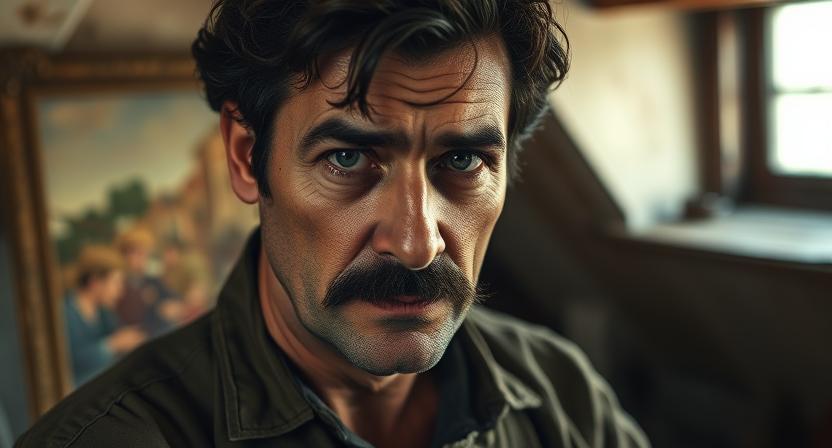
Paris, France – 21st August 1911
I: Canvas and Conscience
The grey light of dawn crept through the grimy dormer window like an unwelcome confession, illuminating what I had done. Madonna mia, what I had done.
She leaned against my washstand – La Gioconda – wrapped in my work apron like some sacred relic rescued from heretics. The rough canvas of my smock couldn’t hide her entirely; one corner of that immortal face peeked through, Leonardo’s masterwork reduced to contraband in a workman’s hovel. My hands trembled as I reached for her, then stopped. Even now, hours after walking from the Louvre with history tucked beneath my coat, I could scarce believe the audacity of it.
The bells of Sacré-Cœur tolled six times across the rooftops of Montmartre, each chime hammering against my skull like an accusation. Ladro, they seemed to cry. Thief. But no – I was no common thief. I was Vincenzo Peruggia, son of Giuseppe, grandson of old Matteo who remembered when the French devils came marching through our valleys with their stolen treasures.
I unwrapped her with the reverence due a Madonna, my calloused fingers – stained permanent brown from years of sizing canvases and mixing glazes – careful not to touch the painted surface. There she was, in all her enigmatic glory, regarding me with that smile that had haunted kings and emperors. But now, in this cramped chamber beneath the eaves where the ceiling sloped so low I could not stand upright at the window, that smile seemed… different. Mocking, perhaps. As though she questioned not my deed, but my worthiness to have performed it.
“Basta così,” I whispered to her in the dialect of home. Enough now. But was it enough? Had I honoured the blood of my fathers, or had I merely proven myself the common criminal these Parisians believed all Italians to be?
The weight of her – not the physical weight, which was nothing to one who had carried far heavier frames through the corridors of the Louvre – but the spiritual weight pressed upon my chest like the stones they piled upon heretics. She was worth more than I would earn in fifty lifetimes of honest labour, more than the entire wretched district where I dwelt amongst the other stranieri – the foreigners who came to Paris seeking work and found only suspicion.
My grandfather’s voice echoed from the grave, as clear as if old Matteo sat beside me on my narrow bed: “Remember, ragazzo, we are people of the mountains. The French, they came with their armies and their empty promises of liberty, but what they took from Italia – Madonna mia! – they took our treasures, our saints, our very soul. What Napoleon could not steal with his cannons, his soldiers carried away in their packs.”
I was perhaps seven when Nonno first told me of Bonaparte’s thievery, his gnarled hands gesturing wildly as he described the systematic rape of Italian culture. We sat in the kitchen of our stone house in Dumenza, the smell of my grandmother’s polenta filling the air, whilst outside the November wind howled down from the Alps like the ghosts of conquered peoples.
“They promised to liberate us from the Austrians,” Nonno had spat into the fire, making it hiss. “Liberation! Pah! They liberated our gold, our paintings, our sculptures. Every church, every palace – stripped bare and sent north to fill their Louvre with our magnificence.”
It was my father who explained our name to me, some years later, when I had grown old enough to understand such things. We walked the terraced hillsides above our village, tending the vines that had fed our family for generations, when Papa stopped and pointed southward toward the distant hills.
“See there, Vincenzo? Beyond those mountains lies Perugia, the ancient city of our people. Our name – Peruggia – it tells the world we belong to that noble place, that our roots run deep in Italian soil. Never forget this, figlio mio. A man’s name is his history, his dignity. Whatever else they may steal from you in this world, they cannot steal the blood in your veins or the honour it carries.”
But when I came to Paris five years past, seeking work in the great museums and galleries, what honour did my name carry? None that the French recognised. To them, I was simply another Italian seeking employment, another pair of hands to glaze their windows and mend their frames for wages a Frenchman would scorn. They mangled my name in their throats – “Per-oo-zhia” instead of the musical “Pe-roo-ja” that rolled off Italian tongues like a prayer.
The irony was not lost on me that it was precisely this dismissive attitude which had enabled my deed. Who notices a workman? Who questions the Italian glazier when he arrives at the museum in his white smock, carrying his tools? I had installed the very glass cases that were meant to protect the masterpieces from theft, had worked within touching distance of La Gioconda for months whilst the guards and curators discussed the paintings as though I possessed no eyes to see, no mind to understand their significance.
“Monsieur Peruggia,” the head curator had once said, not bothering to look at me as he supervised my work on a Raphael, “mind you don’t leave fingerprints on the glass. These Italians painted beautiful things, but one must be careful with them.”
Beautiful things. As though Leonardo and Raphael and Michelangelo were merely decorative objects, not the beating heart of la patria. As though Italy itself were nothing more than a museum for French tourists to visit and admire before returning to their superior civilisation.
The injustice of it burned in my throat like cheap wine. But now, studying her face in the growing light, doubt crept into my soul like rising damp. Had I saved her, or damned myself? Had I struck a blow for Italian pride, or merely proven their contempt justified?
A gentle rap at my door froze the blood in my veins. Three soft knocks, then a voice I recognised – Madame Dubois, my landlady, with the morning coffee she brought each day to her tenants who paid their rent faithfully.
“Monsieur Vincenzo?” she called through the thin wood, her voice warm with genuine concern. “I have your café, and such dreadful news from the papers. There has been a terrible theft at the Louvre!”
I stared at La Gioconda, and she stared back, that immortal smile now seeming to whisper: Now, Vincenzo Peruggia, son of Giuseppe, grandson of Matteo, let us see what manner of man you truly are.
II: The Interrogation of Identity
“Un moment, Madame Dubois!” I called through the door, my voice cracking like a boy’s. Swiftly, I draped my heaviest blanket over La Gioconda, transforming her into what might pass for a mirror or canvas awaiting paint. My heart hammered against my ribs as I unlatched the door.
Madame Dubois stood in the narrow corridor, her grey hair pinned beneath a black lace cap, holding a chipped porcelain cup that steamed with coffee and chicory. Her weathered face bore the concerned expression of a woman who had mothered half the struggling artists and workmen in Montmartre.
“Ah, mon pauvre Vincenzo, you look quite pale this morning. Are you taking ill?” She pressed the cup into my hands, her fingers warm against mine. “Such terrible excitement in the city! Some villain has stolen the most precious painting from the Louvre – La Joconde herself! Can you imagine such wickedness?”
The coffee scalded my throat, but I welcomed the pain. It grounded me, kept me from floating away on wings of panic. “Stolen, Madame? But surely… surely the guards, the security…”
“Gone without a trace! The newspapers say it is an international incident. The Prefect himself has taken charge.” She shook her head, clucking like a worried hen. “Mark my words, it will be some foreign devil behind this. These criminals, they come to our beautiful Paris and…” She stopped herself, colour rising in her cheeks. “Forgive me, Vincenzo. I do not mean to suggest… that is, you are a good man, an honest worker.”
“Oui, Madame,” I managed. “Honest work, honest pay.”
After she departed, I sat motionless for what seemed like hours, though the shadows on the wall suggested it was perhaps twenty minutes. Finally, I could bear the confinement no longer. I must venture forth, must learn what the authorities knew, what suspicions they harboured. To remain shuttered in my room would itself appear suspicious.
I dressed with particular care – my best trousers, my cleanest shirt, my Sunday waistcoat. If I were to walk amongst the citizens of Paris whilst harbouring their greatest treasure, I must appear beyond reproach. The irony was not lost on me that I dressed like a gentleman to disguise the fact that I had become a thief.
The streets buzzed with excitement. At every corner, newsboys cried their headlines: “Vol au Louvre! La Joconde a disparu!” I purchased a copy of Le Figaro with trembling fingers, studying the reporter’s breathless account of the discovery. A painter – Dieu merci, not one I recognised – had arrived to sketch the masterpiece only to find bare wall and empty hooks. The theft had gone undetected for nearly twenty-four hours.
My steps led me, as if by their own volition, toward the 9th arrondissement and the Café de la Paix. Perhaps I sought the anonymity of crowds, or perhaps some masochistic impulse drove me to witness the city’s reaction to my deed. The grand café near the Opéra attracted a mixture of bourgeois Parisians and foreign visitors – precisely the sort of establishment where an Italian workman might sit unnoticed in a corner.
I ordered a petit noir and spread the newspaper before me, though the words swam like tadpoles in my vision. Around me, animated conversations dissected the crime from every angle. A portly banker declared it the work of anarchists; his companion insisted upon German spies. Two ladies in elaborate hats speculated about international art smugglers, their voices thrilling with delicious horror.
“Monsieur?”
I looked up to find a gentleman of perhaps forty years standing beside my table. He was well-dressed but not ostentatious – a government man, unmistakably. His dark hair was pomaded back from a high forehead, and his grey eyes missed nothing.
“Inspector Henri Beaumont, Prefecture of Police.” He produced a leather wallet containing his credentials. “I wonder if I might join you for a moment? I am speaking with various citizens about yesterday’s regrettable incident.”
My throat constricted, but I managed to nod. He settled into the chair opposite mine with the fluid grace of a predator, signalling the waiter for coffee.
“You work at the Louvre, I believe? I recognise you from the employees’ files.” His tone was conversational, almost friendly. “Glazier, is that correct?”
“Sì – yes, Inspector. Vincenzo Peruggia. I maintain the glass cases, the window glazing.”
“Ah.” He stirred sugar into his coffee with deliberate slowness. “Peruggia – that is Italian, certainly. Tell me, Monsieur Peruggia, where did your name come from? We are attempting to understand whether this theft might have… shall we say, nationalistic motivations.”
The question struck me like a physical blow. Here was the moment I had both dreaded and, perhaps, unconsciously courted. The blood of my fathers rose in my throat like wine.
“My name?” The words poured forth before prudence could stop them. “Inspector, my name comes from Perugia, from the very heart of Italia! From a people whose culture, whose art, whose sacred treasures have been scattered across Europe by conquering armies!” I leaned forward, my voice dropping to an urgent whisper. “Do you know what Napoleon took from my country? Do you comprehend the systematic pillaging of Italian genius that filled your precious Louvre?”
Inspector Beaumont’s eyebrows rose slightly, but his expression remained neutral. “I see you feel quite strongly about these historical… grievances.”
“Grievances?” The word exploded from me. “When a man’s heritage is stolen, when the masterworks of his ancestors are displayed as trophies of conquest, you call this a grievance? Inspector, there are Italians who would give their lives to see justice done, to see Italy’s treasures returned to Italian soil where they belong!”
The moment the words left my lips, I knew I had revealed too much. The inspector’s fingers, which had been idly tracing the rim of his coffee cup, grew still. His grey eyes sharpened with sudden interest.
“Indeed? And you know such men personally, Monsieur Peruggia?”
My blood turned to ice water. “I… I speak only of what any patriotic Italian might feel, Inspector. I am a simple workman, not a… not a criminal.”
But even as I spoke, my treacherous memory conjured the moment when I first beheld La Gioconda in her place of honour. It was my second day at the Louvre, installing protective glass around a series of Renaissance works. I had rounded the corner into the Grande Galerie and there she was – my countrywoman, my sister in Italian genius, trapped behind French glass in a French palace, gazed upon by French tourists as though she were some exotic curiosity rather than the crowning achievement of Italian art.
In that instant, I had heard my grandfather’s voice as clearly as if old Matteo stood beside me: “Bring her home, ragazzo. Bring our Madonna home to Italia.”
“Monsieur Peruggia?” The inspector’s voice cut through my reverie. “You appear quite… affected by these thoughts.”
I pushed back my chair with a scrape that seemed thunderous in the suddenly quiet café. “Forgive me, Inspector, but I must return to work. The Louvre, it will need much attention after… after this terrible crime.”
As I fled the café, my heart pounding like a rabbit’s, I caught a glimpse of Inspector Beaumont drawing a small notebook from his waistcoat pocket. But I could not see what he wrote, could not know that his careful script recorded: “Peruggia – passionate about Italian heritage but appears genuine working-class patriot rather than sophisticated criminal. Emotional, not calculating. Low priority for further investigation.”
If I had known this, perhaps the next hours would have passed more peacefully. Instead, I stumbled through the streets of Paris convinced that the net was already closing around me, that my passionate words had marked me as surely as if I had confessed outright to the crime of the century.
La Gioconda waited in my chamber, wrapped in her workman’s shroud, whilst I walked the streets a marked man – or so I believed.
III: The Reckoning of Righteousness
Darkness fell over Paris like a shroud, and with it came the weight of what I had done. The candle I had lit upon returning to my chamber cast dancing shadows on the sloping walls, transforming my humble lodgings into a sanctuary of guilt and uncertainty. La Gioconda sat propped against my washstand, no longer hidden beneath the blanket. In the flickering light, her smile seemed to pulse with life, as though she breathed the same close air that filled my lungs with increasing difficulty.
From the street below came the voices of news-sellers, their cries cutting through the evening like knives: “Edition spéciale! La Joconde toujours introuvable! Incident international!” The words hammered against my skull – still missing, international incident. Each syllable was an accusation, each headline a reminder that I had set something in motion far greater than myself.
I sat before her like a penitent before the altar, my hands clasped so tightly the knuckles showed white in the candlelight. “What have I done, Madonna mia?” I whispered in the dialect of home. “What have I done to you, to myself, to the world?”
The doubt that had begun as a whisper in the café now roared like an Alpine wind through my conscience. Inspector Beaumont’s questions echoed endlessly: Where did your name come from? Nationalistic motivations? But it was not the inspector’s voice that tormented me now – it was my own, asking questions I feared to answer.
Three gentle raps interrupted my torment. “Vincenzo?” Madame Dubois’ voice, softer now, concerned. “I have brought you some soup, mon pauvre. You missed your dinner entirely.”
I rose on unsteady legs to admit her. She entered bearing a steaming bowl that smelled of leeks and herbs, her face creased with worry.
“You have been pacing, I think? The floorboards, they creak terribly in this old building.” She set the soup upon my small table, then noticed my pallor. “Mon Dieu, Vincenzo, you are quite grey! This terrible business at the Louvre, it has affected everyone so deeply. Even my poor Henri – my late husband, you understand – even he would have wept to see such a thing.”
“Your husband, Madame? He was… he worked with art?”
“Ah, oui.” Her weathered face softened with memory. “Henri was a restorer, you see. Not grand like the masters at the Louvre, but he understood the sacred trust of caring for beautiful things. He always said…” She paused, settling herself on my only chair as though the weight of remembrance required rest. “He always said that great art belongs not to one nation, but to all humanity. ‘These painters, ma chérie,’ he would tell me, ‘they painted not for kings or countries, but for the human soul itself.’”
The words struck me like blows from a mason’s hammer. “But surely… surely a people have the right to their own heritage? Their own treasures?”
“Ah, mon petit,” she said, reaching across to pat my hand with her worn fingers, “Henri used to ask: ‘Does the sunrise belong only to the land where it first appears? Does music belong only to the throat that first sang it?’ These questions, they tormented him too, especially during the war with Prussia. But always he returned to the same truth – beauty transcends borders, Vincenzo. It transcends the small hatreds that divide us.”
After she departed, leaving me with soup I could not taste and wisdom I could not digest, I found myself alone with questions that multiplied like shadows in my chamber. I pulled my one chair close to La Gioconda and studied that immortal face by candlelight.
“Where did your name come from, Vincenzo?” I asked aloud, my voice cracking in the close air. “From thieves or from honest men?”
The painting seemed to shimmer in the unsteady light, and for a mad moment I imagined she might answer. But the only voice I heard was my own conscience, relentless as a prosecutor.
Had my grandfather’s stories been truth or legend? Had Napoleon truly stolen her, or had she come to France through legitimate means? The certainty that had driven me to commit this deed now crumbled like ancient mortar. What if – Madonna santissima – what if I had built my righteous theft upon a foundation of lies?
I rose and began to pace the narrow confines of my chamber, three steps to the window, three steps back, like a caged animal. The floorboards creaked beneath my feet, no doubt disturbing the tenant below, but I could not be still. The magnitude of my ignorance crashed over me in waves of nausea.
“I am a fool,” I whispered to the painting. “A fool who acted on children’s stories and old men’s grievances.”
But even as I spoke these words, another voice rose within me – the voice of pride, of generations of Peruggias who had bent their backs to Italian soil, who had withstood conquest and occupation with dignity intact. Was it folly to love one’s homeland? Was it criminal to wish for the restoration of stolen glory?
Yet Madame Dubois’ words haunted me: Beauty transcends borders. And Inspector Beaumont’s questions cut deeper still: Where did your name come from?
I knelt before my battered trunk and withdrew paper, pen, and ink. My hands shook as I dipped the nib, but my resolve grew stronger with each word I scratched upon the page:
Papà carissimo,
I write to you from Paris with questions that burn in my soul like fever. You have told me many times of our family’s honour, of the meaning of our name, of the treasures stolen from Italia by Napoleon’s armies. But I must know – and you must tell me the truth, not the stories that comfort old men – did the French truly steal La Gioconda from our homeland? Or have I… have I believed in legends?
I am a man now, no longer the boy who sat at Nonno’s knee drinking tales of conquest and resistance. I need facts, Papà, not fables. My very soul depends upon the truth of what you tell me.
Your son,
Vincenzo
As I wrote, a strange peace descended upon me. The fevered certainty that had driven me to theft gave way to something more complex – a willingness to confront uncomfortable truths about my motivations, my heritage, perhaps even my crime.
I folded the letter carefully and turned once more to La Gioconda. But now, as I rewrapped her in my work apron, something had changed. I no longer saw myself as her liberator, returning stolen goods to their rightful home. Nor did I see myself as a common thief, driven by greed or madness.
I was something more complicated – a custodian, perhaps. A man who had acted from love, however misguided, and who now bore the responsibility of discovering the truth before deciding what justice demanded.
“Forgive me, Madonna,” I whispered as I secured the final fold of cloth around her frame. “I took you believing I served honour. Now I keep you whilst I learn whether honour requires your return.”
The candle guttered in its holder, casting wild shadows that danced across the walls like the ghosts of my ancestors. In the growing darkness, La Gioconda’s smile seemed less mocking than understanding – as though she had witnessed this struggle between love and duty, between heritage and truth, countless times in her five centuries of existence.
Tomorrow I would post my letter to Dumenza. Tomorrow I would begin the research that might damn my actions or vindicate them. Tonight, I would guard the world’s most famous painting whilst confronting the most fundamental question of identity: not where my name had come from, but what kind of man I wished it to represent.
Outside my window, Paris slept fitfully, unaware that history’s most audacious art thief lay wakeful three floors above the cobblestones, transformed by doubt from crusader into scholar, from liberator into seeker of inconvenient truths.
The End
On 21st August 1911, Vincenzo Peruggia, an Italian handyman employed at the Louvre, stole Leonardo da Vinci’s Mona Lisa in what became the most famous art theft in history. The painting remained missing for 28 months until December 1913, when Peruggia was arrested after attempting to sell it to an art dealer in Florence for 500,000 lire.
Prior to the theft, the Mona Lisa was little known outside artistic circles, but the international media frenzy surrounding its disappearance transformed it into a global icon. More than 120,000 visitors came to the Louvre in the first two days after the painting’s return.
Peruggia’s motive stemmed from the mistaken belief that Napoleon had looted the painting from Italy. In fact, Leonardo himself had brought it to France in 1516, when King Francis I invited him to court, and it was legitimately acquired by the French crown.
The theft marked the first major property crime to receive worldwide media coverage, with newspapers across Europe and America running front-page stories. Today, around 10.2 million people visit the Louvre each year, with an estimated 80% coming specifically to see the Mona Lisa – a status directly shaped by its dramatic history as a stolen masterpiece.
Bob Lynn | © 2025 Vox Meditantis. All rights reserved. | 🌐 Translate


 Vox Meditantis
Leave a reply to Bob Lynn Cancel reply