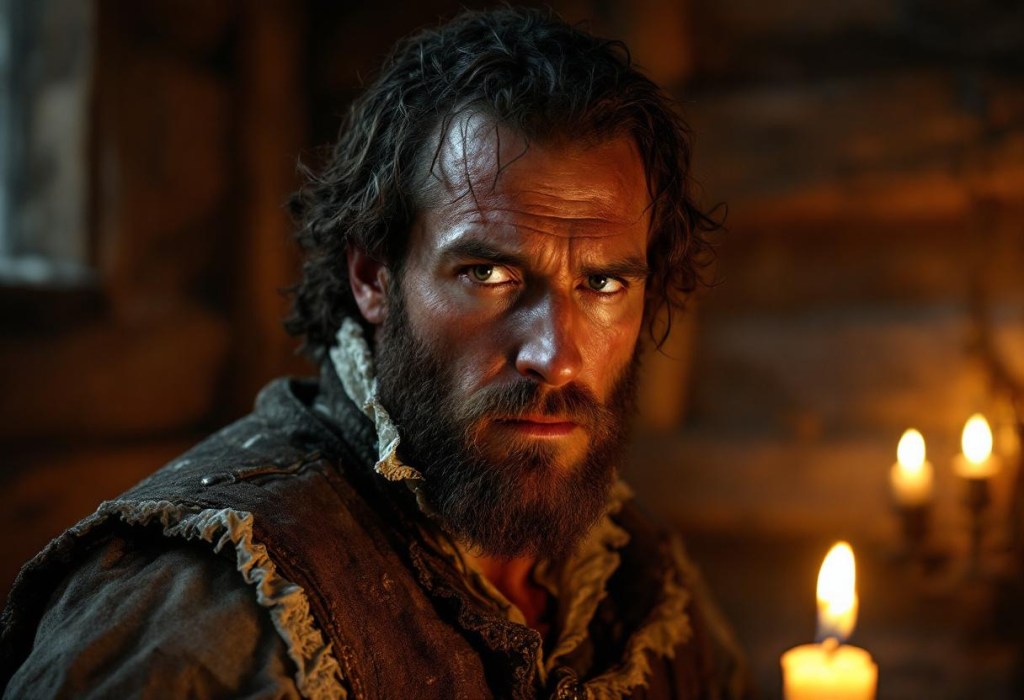
Roanoke Island, North Carolina – 18th August 1587
I: Breath of the New World
I never knew a night could hold so many voices.
The sea murmured beyond the palisade, fretful as a child denied rest; the pines answered with their own rough whisper, and somewhere in the marsh a heron cried, a thin silver note that shivered the darkness. Yet within our half-finished cottage another music rose – Eleanor’s quickened breathing, the muted encouragement of Mistress Lawson, and the heartbeat of an infant not yet born. All these threads wove together until the very air trembled, as though Roanoke itself leaned close to hear the first English cry upon its soil.
I walked the length of the porch for the hundredth time, lantern in hand, counting every board beneath my boots. The timbers still smelled of resin; they had been felled only a fortnight past, and sap glistened along the grain like tears that refused to fall. It was fitting, I supposed, for my own eyes had known no dryness since Eleanor’s pains began at sundown. Governor they called me, yet I stood useless beneath the indifferent stars, my authority worth less than the dull clasp-knife at my belt.
The door creaked open. Ananias Dare filled the threshold, shoulders stooped, hair plastered to his brow with sweat not his own. Lantern-light caught the freckles across his cheeks; he looked half a boy and half a knight errant, a young London tiler suddenly charged with defending two fragile lives against wilderness and ocean alike.
“Father White,” he said, voice hushed, “Mistress Lawson bids thee fetch more boiled water, if there be any left.” He swallowed hard, as though the very request tasted of despair.
“Aye,” I answered, forcing steadiness. “There is a kettle by the hearth in the common house. I shall return in a breath.” But I did not move. My hand drifted instead to the satchel at my hip, where quills and rough-bound folios lay in uneasy slumber. What do you enjoy most about writing? The question had haunted me throughout the voyage, and now it surfaced again, insistent as the tide. To capture truth? To fashion memory? Or merely to keep madness at bay when flesh and timber prove so fragile?
Ananias mistook my silence for reluctance. “Sir, forgive me – ’tis only that Eleanor grows weary beyond telling. She clutches my hand as if I might keep her soul from forsaking her body.”
“Hold her the tighter, then,” I said, finding my feet at last. “I shall bring the water, and God willing it will suffice.”
I crossed the clearing, lantern swinging. Around me the settlement dozed fitfully: a scatter of cabins, their roofs still patched with sail-cloth; the fort’s earthwork walls, already sagging; the single brass cannon that glinted like a prayer none dared utter. Within the common house, embers glowed. I coaxed flame enough to set the kettle hissing, then filled a wooden bowl and hurried back, sloshing warmth over my cuffs.
Inside the cottage the air was thick with rosemary smoke, meant to ward infection though it could not banish fear. Eleanor lay upon a pallet of woven reeds and blankets, her hair a dark halo against sweat-damp linen. Mistress Lawson knelt beside her – a wiry woman whose experience of childbirth outweighed the doctoring of any London surgeon. Ananias knelt on the other side, murmuring words I might have spoken once to Eleanor’s mother in another life.
Eleanor’s eyes found me through the half-gloom. “Father,” she breathed. It was not a plea, nor even a greeting, but an acknowledgement of shared wonder and terror. She had crossed an ocean in her husband’s embrace, but in this hour she clung to childhood memories: evenings in our Thames-side garden, the smell of crushed mint on her palms, my sketchbook open to receive her laughter.
I knelt, offering the bowl. Mistress Lawson wrung cloths and pressed them to Eleanor’s brow, then shifted to her task with brisk competence. “Head crowns now,” she muttered. “You’ll see your babe afore the next psalm is sung.”
“Let it be Psalm Eight,” I whispered, quoting, ‘Out of the mouths of babes and sucklings hast thou ordained strength.’ Ananias swallowed a tremor of gratitude.
Minutes stretched, collapsed, stretched again. Eleanor’s cries rose and fell like waves upon Hatteras shoals. With each, the settlers outside stirred – hushed voices, prayers half-remembered, the colony holding its breath as though one infant could redeem every hardship we had borne: the sweltering decks of the Hopewell, the spiteful shoals that tore at her hull, the Spanish rumours that shadowed our sails.
At last a thin wail sliced the candle-lit air. The sound was raw, astonished, unashamed of its need. Mistress Lawson lifted a blood-slicked infant, severed the cord with her knife, swaddled the tiny form in linen that once served as Eleanor’s petticoat. “A maid,” she declared, half triumphant, half awed.
Eleanor’s head fell back; tears coursed unchecked yet her smile shone like dawn over emerald marsh. Ananias pressed his lips to her temple, himself weeping freely. I reached for my satchel with trembling fingers. Ink, quill, sketchbook – I spread them on a crate that served as table. The lantern’s glow fluttered across the page.
I began to draw before thought could still my hand: the curve of a newborn brow, the damp wisps of dark hair, the fist no larger than a shilling curled most ferociously around nothing at all. Each stroke felt inadequate, yet I chased the likeness with near-desperate haste, for I knew a truth deeper than any Atlantic trench: memory, unpinned by ink, drifts like smoke upon the wind.
As I worked, Eleanor’s voice drifted toward me, soft but clear. “Father, thou hast asked often what joy thou findest in writing. In this hour I would know as well.” Her words trembled, yet they bore no weakness – only curiosity born of pain and love intermingled.
Quill paused above parchment. I stared at the child, at the fragile flutter in her throat. “If joy there be,” I answered, “’tis the power to grant our moments a life beyond our own. Ink may one day carry her story across seas even I may never sail.”
Mistress Lawson placed the infant – Virginia, we had agreed – upon Eleanor’s breast. The child latched with surprising strength. Light pooled around them: mother and daughter bound in primordial covenant, husband kneeling in reverent silence. I felt myself outside the scene and within it, both recorder and participant – observer bound by blood to his subject.
Outside, the heron cried again, but this time the note rang less lonely. Beyond the palisade, forests pressed close, secrets unguessed. Yet within these humble walls something older than empire had taken root.
I dipped the quill once more. The page waited – white as promise, hungry as the sea.
II: Ink in the Gathering Shadow
The dawn that followed Virginia’s birth broke pale and tremulous, as though the very sun were hesitant to look upon our fragile foothold. I stood upon the rampart of the earthen fort, catalogue in hand, trying to coax colour from the low sky with ochre and lead-white. No sooner had I sketched the faintest blush than Fletcher, our lean-bodied chaplain, climbed the ladder and growled, “We’re near out o’ meal, Governor. The men mutter that the babe suckles richer fare than they.”
“Let them come see my ledger,” I answered. “Words will prove there’s naught to hoard.” Yet I knew hunger breeds disbelief as surely as damp breeds mould, and both had begun to creep beneath every door-sill.
That afternoon I walked to the tide-marsh with Manteo. The Croatoan lord moved with a hunter’s patience, each footfall a conversation with ground and reed. He carried no musket, only a shell-inlaid knife tucked neat at his hip. I, by contrast, wore a rapier that knocked clumsily against my knee and proclaimed far more menace than I could wield.
“Your daughter strong?” he asked in his lilting English, taught by Lane’s soldiers two summers past.
“Aye, stronger than sense would counsel,” I said, though my smile faltered. “I thank you for the deer hide your folk sent. It keeps her sleep warm.”
He paused, eyes following a kingfisher’s dive. “Hide is gift, yet remembrance stronger. Your writings, your drawings – these stay after storms eat roofs. Speak kindly of my people, John White, and the wind itself may bear you safe.”
I felt the weight of the quill behind my ear. “That is my vow, friend. But there are those among us whose tongues run faster than my pen.”
He understood. News had reached him of men grumbling that if the Croatoan withheld maize the English would simply take it by shot and steel. Justice, some called it – Christian men rationalising theft. Compassion, I reminded them, would serve us better, but compassion seldom fills a stomach.
That night we convened in the open square beneath a half-moon. Lanterns swung from pikes, throwing wild shadows over our assembly. Mistress Harvie, whose eldest boy had died of flux, spoke first. “We have crosses carved upon three doors now,” she said, voice hoarse. “If no ship arrives, who shall carve the fourth?”
“We must send for aid,” insisted George Howe, fists red with pitch from mending the palisade. “Governor, take the pinnace. Sail to England afore autumn gales trap ye here.”
I looked to Eleanor, standing near the fire with Virginia tucked beneath her cloak. Heat flushed her cheeks, yet her gaze was steadfast. She, who had braved the Atlantic at six months swell, would not beg me stay, nor urge me go; she would merely bear the consequence.
Thomas Humfrey, our blunt-jawed watchman, spat into the dust. “Or better – strike south and seize Spanish stores at San Augustín. A victory’s worth a thousand pleas to London.”
I measured my breath. “Plunder brings Spain’s wrath upon us, and perhaps upon England herself. I will not damn my granddaughter’s cradle for the sake of quick bread.” Murmurs rose – some assent, more frustration. I lifted my journal, its spine already fraying. “This book records we sought peace, traded fair, and honoured God in this place. Let it not turn liar because fear numbs our wits.”
Eleanor stepped forward then, voice clear as the lantern glass. “Gentlemen, consider: if my father sail, I and my child remain. Will you guard us, or will you quarrel while wilderness closes in?” Silence answered; shame often speaks so. She met each pair of eyes until heads bowed like barley beneath gust.
Later, inside our cottage, she laid Virginia in her willow cradle – a crude thing Ananias had shaped with more faith than skill. The infant slept, lashes dark as river silt against her cheeks. Ananias adjusted the hide about her and whispered, “If we scarce have bread, shall the babe know milk enough?”
“We shall barter with Manteo for maize,” I said, though I had no notion what we could trade save rusted tools and fragile promises.
Eleanor sat upon the pallet, fingers tracing the grain of the cedar board that served as cradle stand. “Father, I read the new pages of your chronicle. Your lines grow grim.”
“My hand obeys the eye,” I confessed, “and the eye sees want.” I opened the folio so candlelight revealed yesterday’s ink: gaunt faces, ribs like cask hoops, the fort’s gates sagging under their own doubt. Yet at the centre, bright as a church window, I had drawn Virginia, swathed in deer hide, gaze fixed upward as if charting stars yet unnamed. “I fear,” I said, “that by the time aid returns, this likeness may be all that endures of her.”
Eleanor’s jaw clenched. “Then draw her again – draw her tomorrow and the morrow after – so that if naught but pages remain, the world shall at least know she lived, and was loved.”
Ananias reached to squeeze my shoulder. “Master White, thou hast always held faith that art could bend time. Now we must trust that it can bend fate.”
I tried to answer, but the lantern guttered, and for a breath the room lay bathed only in ember-glow. Through the thin wall came the hiss of wind among palmetto fronds, carrying perhaps the distant crack of a musket – real or imagined, I could not tell.
The next days blurred in salt heat and fretful labour. We scoured the island for mussels, set snares for rabbit we rarely caught, patched sails upon the pinnace. I traded a pewter inkwell for two baskets of beans from a Croatoan woman whose children marvelled at Virginia’s pale curls. Each evening I added a new sketch: a bent-back labourer coughing blood into his palm; Eleanor by the shore washing swaddling cloths, the sea foaming about her calves; Manteo guiding me through cypress swamp where ghost-lights flickered and he warned me never to speak my name aloud.
On the eighth night after the birth, smoke smudged the southern horizon – too distant for camp-fire, too sable for cloud. Rumour claimed a Spanish galleon cruised the Outer Banks, seeking revenge for Sir Francis Drake’s mischief. Panic rippled. Muskets were primed, though half had flints too dull to spark. I spent that vigil atop the fort, brush in hand, capturing the ominous smear. Fletcher found me at dawn, beard sparkling with dew. “Why paint doom, Governor?”
“Because,” I said, “a man must look upon his fear ere he can master it.”
He shook his head. “Ink will not feed babes, nor drive Spaniards hence.”
“Yet it might remind a father why he fights,” I countered, closing the sketchbook against the moist air.
That evening, as cicadas shrilled above the pine treetops, the council met once more. Torches crackled; faces gleamed with sweat and resolve. George Howe spoke bluntly: “Governor, the pinnace is rigged. You must depart on the morrow whilst wind holds fair. Delay, and neither you nor any help shall return ’til spring – too late for us.”
Murmurs of assent rolled like surf. I felt the verdict settle upon my shoulders: nine stone of doubt and duty. My gaze sought Eleanor. She lifted Virginia, now nine days old, and placed the child in my arms. That tiny body offset the council’s weight, yet somehow made it heavier still.
“Go, Father,” she murmured, voice steady yet eyes glistening. “Take word of our plight. Write of us so truly that no heart in London can ignore our need.”
I pressed my lips to Virginia’s brow. The warmth of her skin, the milk-sweet scent – both branded themselves upon memory. I looked at the circle of faces – some hardened by toil, others lit by fledgling hope – and spoke the only words that felt honest:
“I shall go, but not to beg. I shall go to bear witness. Let my quill be your covenant, my sketches your plea. If England forget her children here, history itself shall shame her.”
A hush fell, deeper than the night beyond our torches. For an instant I believed even the pines leaned nearer to listen.
So it was settled. At dawn we would load the pinnace with dwindling rations and the weightless cargo of expectation. I returned to the cottage to pack paints and folios, yet found myself unable to close the final book. I added one last note beneath Virginia’s newest portrait:
This child, born in the wild 18th August 1587, knows naught of fear. Let ink keep her thus until my sail bears me home.
Quill laid down, I watched the fresh stroke dry, thinking: What do I enjoy most about writing? Tonight the answer seemed both balm and curse – that I may carry my loves upon the page when I cannot carry them in my arms.
III: Legacy upon Water and Wind
The dawn that carried me from Roanoke rose burnished and sullen, as though the heavens themselves begrudged our parting. All night the wind had prowled round the cabins, rattling loose shutters and thrumming the raw-hide hinges of the fort gate. By first light the air tasted metallic, full of storm-promise and the smell of unseen lightning. I thought it a fitting choir to bless – or curse – the voyage I must undertake.
We gathered on the strand below the stockade, where the pinnace sat half in water, half in sand, her patched sails furled like weary wings. The settlers formed two uneven ranks, faces pinched with cold resolve. Some clasped Bibles or knives; most cradled nothing but the hollow ache of uncertainty. Lanterns, snuffed in the growing light, swung from pikes behind them, glass panes still misted from long vigil.
Eleanor stood foremost, Virginia in her arms, Ananias at her shoulder. She had braided her hair with a scrap of crimson ribbon – the last remnant, she claimed, of the gown she wore upon our arrival. The colour struck my eye like a foxglove blooming amid frost. Virginia slept despite the wind, lips pursed in dreamless abandon. I ached to believe it an omen of peace, yet my stomach roiled like the bar in ebb tide.
Manteo approached from the tree-line, feathered cloak billowing. Behind him came two Croatoan youths bearing woven baskets of dried maize and smoked shad – more food than our own larder held. He beckoned me aside, away from English ears.
“Storm will run with you south-east,” he said, English words slow but sure. “Best to skirt shallow shoals and seek the open sea. Trust the gulls: their flight shows where sand lies hidden.”
“I shall heed them,” I promised, “and lay thanks for your counsel in my log.”
He fixed me with that quiet gaze which always felt older than the island itself. “Logs burn. Bring truth instead.” He tapped the rolled folio at my belt, then pressed a slender reed flute into my palm. “Play this when sky grows black. Spirits follow music home.”
“Home is a far shore,” I answered.
“Still, song can find it.” He gripped my wrist once, firm and warm, then stepped back to join the watching throng.
A hush fell. Even the surf seemed to draw breath. Fletcher opened his prayer-book and intoned the 107th Psalm – travellers upon the great waters, tempest lifting waves on high. The words floated over us, thin but steady. When he closed the leather cover, I turned to face my daughter.
Eleanor crossed to me. The ribboned braid trembled against her cloak, but her voice held fast. “I would have thy blessing, Father, ere the sea takes thee from our sight.”
“’Tis I who seek thine,” I said, and cupped her cheek. How much strength could pass through a single touch? Enough, I prayed, to last until my return. I kissed Virginia’s brow; the downy skin smelled of smoke and milk and cedar. Her eyes fluttered, almost opened, then settled back into the hush of infancy.
Ananias offered his hand. “Bring back powder, seed, and hope in equal measure,” he said, forcing a half-smile. “We’ll keep the hearth alight.”
“You must do more,” I replied, gripping tight. “Guard compassion as fiercely as the muskets. Remember Manteo’s trust.”
He nodded, though worry flickered in his gaze – worry that compassion had little purchase against starvation.
With that, there remained only the sea. I handed Eleanor a slim volume – the smallest of my sketchbooks, bound in calf. “For Virginia, when she can grasp more than my finger. Each page a likeness of her first days. Fill the blank leaves with what joys follow.”
She took it carefully, as if the parchment might crumble in salt air. “Return soon, or I shall fill them with grievances.”
“Then I have great incentive.” I forced levity; my throat tasted of iron.
The crew – five souls stout of limb if not of spirit – pushed the pinnace to deeper water. I waded after, surf soaking hose and jerkin. When the keel floated free, I hauled myself aboard, joints protesting. Phillip Stevens, my mate, loosed the mainsail; it snapped open, catching a gust that smelled of rain-soaked copper. The vessel heeled, then steadied on a north-east tack to clear the headland before turning for England’s far shore.
From the rail I saw Eleanor raise Virginia, tiny arms splayed like fledgling wings. Wind tugged the ribbon free; it streamed crimson above her head, a solitary pennon against pewter sky. I lifted my sketchbook, traced the scene with a charcoal nub, speed warring with swell. The image smeared, yet the motion itself etched memory deeper than any neat line.
Soon the shore diminished – rows of cabins blending to ochre smudge, palisade shrinking to toothpick silhouette. The fort’s flag hung limp, still damp from night mist, its red cross dulled. When land finally slid beneath the horizon, a cold resolve settled in its stead.
We beat north-east for three hours before the storm found us. Clouds stacked black upon black; wind howled through shrouds like lamenting choirs. Rain arrived in spears, dousing lamps and drumming the deck hollow. Waves rose cobalt and cruel, green eyes foaming as they lunged. Stevens bawled orders unheard, his beard plastered like kelp. Two men lurched to secure the fore-mast, another clung white-knuckled to the tiller.
In the chaos I remembered Manteo’s flute. I wedged myself beneath the gunwale and pressed reed to lip, breath ragged. A thin, reedy note faltered, caught the gale, then lifted clearer, surer. I played the folk air Eleanor favoured in childhood, “Greensleeves,” though the tune wavered like a candle in gale. The crew eyed me as if I had lost wits, yet their terror eased by inches; rhythm gave their movements unity. When lightning split the sky, I caught a glimpse of Stevens mouthing the refrain.
The squall passed with evening, leaving the vessel battered but afloat. Stars clawed through ragged cloud; the moon, a broken coin, cast pallid light on deck. We set about patching lines, baling water, murmuring thanks to whatever guardians watched sailors and fools alike.
At the first lull I opened my great ledger, pages spotted with brine. My hand shook from cold and fatigue, yet words spilled swift:
27th August 1587, lat. unknown, sea rough. Departed Roanoke at God’s behest and man’s pleading. Leave behind one hundred and seventeen souls, amongst them mine own blood, trusting Providence and pen to keep them safe. Storm assailed us; music held us. Thus I write: what joy I find in writing is neither fame nor posterity but mercy – the mercy of bearing faithful witness when distance forbids my arms their rightful office.
I paused, quill hovering. The sentence felt both judgement and absolution. Ink pooled, then I continued, sketching a small fist curled about an imagined quill, the fist I had left behind.
Exhaustion claimed my crew by pairs; they slumped against coils, breath rasping in rough unison. I alone remained wakeful, keeper of course, conscience and candle. Overhead the mast creaked like old bone, yet the sails billowed smooth and full. The ship, it seemed, remembered purpose even when her captain doubted his own.
I thought of Roanoke sleeping under foreign stars – of Eleanor kneeling beside the cradle, of Ananias pacing the palisade, musket across shoulder yet heart bent toward prayer. I thought of Manteo listening for songs on ocean wind, trusting me to carry truth beyond the reach of tide.
Storm-washed air tasted sharp; it cleared my mind like frost upon fields. I dipped the quill anew and closed my entry:
Let this log stand witness: should I fail to return, those I leave in the New World lived not as interlopers but as dreamers; asked not for conquest but for a patch of earth to cradle their children. May justice remember, and compassion answer, long after my ink lies faded.
I blew on the page until the final word dried. Then I folded the ledger against my chest, feeling its heartbeat echo my own. The night stretched empty ahead, the ocean vast, the wind at last a steady friend. Yet within that immensity I carried a cargo no storm could drown: the scent of cedar and milk, the weight of a newborn’s gaze, and a single scarlet ribbon, now tied round the flute’s middle, fluttering in obedient time to the deck’s slow roll.
So I kept watch, and wrote, and prayed – that ink might indeed bend fate, and that some future reader, finding these pages salt-stained in a London study, would understand that hope once breathed upon a lonely Carolina shore, and bore the name Virginia Dare.
The End
On the 18th August 1587, Virginia Dare became the first English child born in North America, at the Roanoke Colony on Roanoke Island, in present-day North Carolina. The colony, led by Governor John White, included 117 settlers who had arrived only weeks earlier, seeking to establish England’s first permanent foothold on the continent. Soon after Virginia’s birth, White returned to England for supplies but was delayed by war with Spain. When he finally made it back in 1590, the settlement had disappeared without a trace, leaving behind only the cryptic word “Croatoan” carved into a post. The fate of Virginia Dare and the so-called Lost Colony remains one of history’s enduring mysteries, continuing to shape America’s fascination with its earliest European roots.
Bob Lynn | © 2025 Vox Meditantis. All rights reserved. | 🌐 Translate


 Vox Meditantis
Leave a reply to Bob Lynn Cancel reply