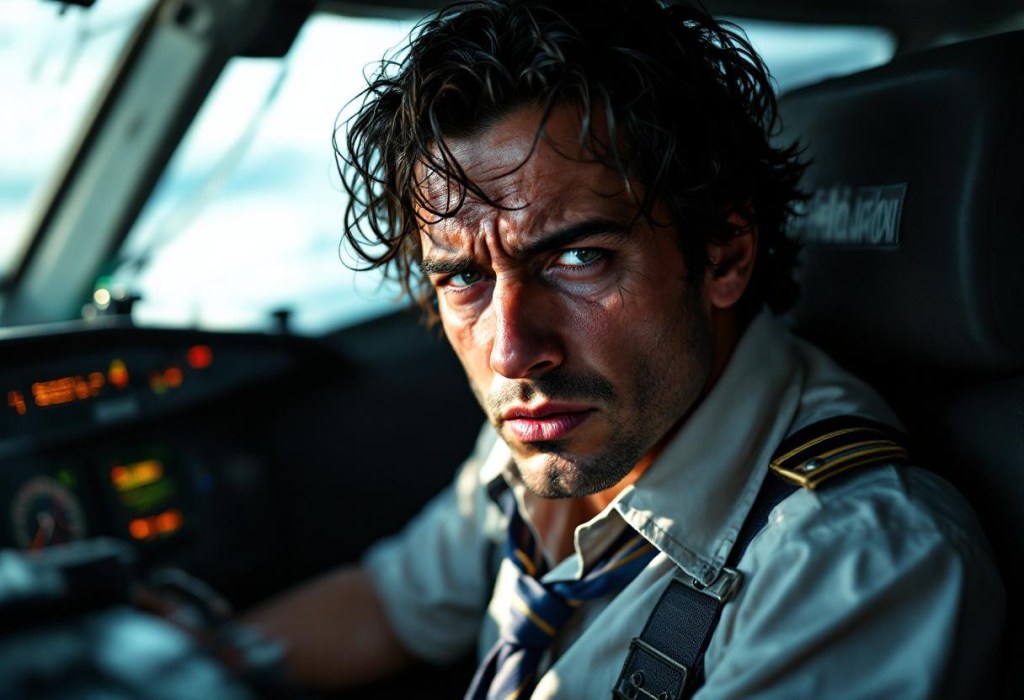
Helios Airways Flight 522, Eastern Mediterranean Sea – 14th August 2005
Morning Departure
The Mediterranean sun climbed steadily over Larnaca’s tarmac, casting long shadows beneath the wings of our Boeing 737-300. I pressed my palm against the cabin window, feeling the warmth seep through the aluminium skin of Helios Airways Flight 522, and wondered if this would be the day that changed everything.
Haris laughing in my tiny Limassol flat three nights ago, her dark hair catching the lamplight as she held up her grandmother’s ring. “When we get back from Athens,” she’d whispered, “we’ll set a date.”
The memory dissolved as I straightened my tie and checked my watch: 08:45. Twenty-two minutes until departure, and I was still adjusting to being here at all. The call had come at dawn – Stavros had phoned in sick, leaving them short-staffed. As a qualified flight attendant with pilot training, I was the natural choice for the emergency roster. What I hadn’t expected was to find Haris already aboard, her own replacement shift having been arranged days earlier.
“Andreas!” Louisa Vouteri’s voice carried across the cabin as she supervised the final pre-flight preparations. Our chief purser moved with practiced efficiency, though I caught the slight tension around her eyes that suggested she, too, was working an unexpected shift. “Could you assist with the rear galley checks?”
I nodded, stealing a glance towards the forward cabin where Haris was demonstrating the safety equipment to early-boarding passengers. Even in the regulation uniform, she possessed an elegance that made mundane procedures seem graceful. Her voice carried the melodic cadence of educated Greek-Cypriot English as she explained the location of life jackets.
“Emergency preparedness,” she’d said over coffee last week, “it’s all about routine until it isn’t.” We’d been discussing my pilot training, the endless checklists and procedures that become second nature. “The scary thing is when the routine itself becomes the problem.”
The cockpit door stood ajar, offering glimpses of Captain Hans-Jürgen Merten and First Officer Pampos Charalambous running through their pre-flight sequence. Merten, at fifty-nine, carried himself with the quiet authority of a pilot who’d logged thousands of hours across European routes. His methodical approach to the checklist was reassuring – each item marked off with Germanic precision. Charalambous, younger by eight years but equally experienced, provided the local knowledge that made their partnership effective on these Cyprus-Athens routes.
I’d flown with both men before, trusted their competence implicitly. Yet something nagged at me as I moved through the cabin, checking seat belts and overhead compartments. Perhaps it was the maintenance log I’d glimpsed earlier – something about a pressurisation leak check completed yesterday evening. Routine work, the sort of thing that happened weekly on commercial aircraft.
My instructor’s voice from flight school: “Andreas, the most dangerous word in aviation is ‘routine.’ The moment you stop questioning the routine is the moment routine starts questioning you.”
The passengers were settling in now – a mixture of Cypriot families heading to Athens for holidays, Greek nationals returning home, and the usual complement of business travellers. Children chattered excitedly in Greek and English, their voices creating that particular symphony of anticipation that fills every departure lounge. An elderly woman clutched her handbag tightly, whispering what sounded like a prayer. A young couple shared earphones, heads bent over a guidebook.
“Beautiful morning for flying,” Haris said, appearing beside me as I completed the safety equipment check. Her smile held that private warmth reserved for moments when duty and affection intersected.
“Gorgeous,” I agreed, though I was looking at her rather than the crystalline sky beyond the windows. “Strange to think we’re both working this flight.”
“Fate,” she said lightly, but her fingers brushed mine as she passed – a touch that would have been invisible to passengers but spoke volumes about the life we were building together.
The announcement crackled through the cabin speakers: boarding complete, doors secured, pushback authorised. I took my position near the rear galley as Louisa began the safety demonstration. The familiar ritual unfolded – oxygen masks, life jackets, emergency exits – words I could recite in my sleep yet which carried weight I’d never fully considered.
How do you prepare for the unprepared? My flight instructor again, his weathered face serious as he explained hypoxia symptoms during high-altitude emergencies. “The insidious thing about oxygen deprivation is that you don’t know it’s happening. Your judgement fails before your body does.”
At 09:07 precisely, Flight 522 began its taxi to runway 04. Through the porthole, I watched Larnaca’s terminal building slide past, then the familiar landmarks of the coastal road where Haris and I had walked just last Sunday, planning our future with the careless confidence of people who believe tomorrow will be much like today.
The engines spooled up, that deep rumble that never failed to stir something primal in my pilot-trained bones. We lifted off into a perfect Mediterranean morning, climbing steadily through the crystalline air above Cyprus. The island fell away beneath us, a brown and green patchwork bordered by the infinite blue of the sea.
Everything was routine. Everything was normal.
At 12,000 feet, the first warning chime sounded in the cockpit.
I was adjusting a passenger’s overhead reading light when I heard it – a sound that shouldn’t have been there, cutting through the steady drone of the engines like a knife through silk. Through the partially open cockpit door, I glimpsed Captain Merten’s head turn towards his instrument panel, saw the flash of amber warning lights reflecting off the windscreen.
The routine was questioning us now.
Into Hypoxia and Silence
The warning chime had stopped, but something else was wrong now. Wrong in a way that felt… distant. Like watching through thick glass.
Captain Merten’s voice drifted back from the cockpit, discussing what sounded like an air conditioning malfunction with First Officer Charalambous. The German-accented English mixed with technical jargon I recognised from my pilot training, but the words seemed to float rather than land with their usual precision. Pressurisation. Manual override. System check.
Haris and I walking along Finikoudes Beach last month, her hand warm in mine as we debated wedding venues. “Something small,” she’d said, “just family. Nothing complicated.” The salt air had tasted of possibility then.
I blinked hard, trying to focus. The cabin felt… different. Quieter somehow, though I couldn’t pinpoint exactly when the change had begun. The excited chatter of children had faded to murmurs. The elderly woman with her handbag had stopped her whispered prayers and was staring vacantly ahead.
At 18,000 feet, the oxygen masks dropped.
Yellow plastic cups swayed from the ceiling like obscene party decorations, their rubber tubing dancing in the pressurised air. The familiar recorded announcement began playing – “Please secure your own mask before assisting others” – but the words sounded hollow, mechanical. Unreal.
I moved through the cabin on autopilot, helping passengers who seemed strangely docile, their movements sluggish as though they were underwater. A businessman fumbled with his mask, his usually sharp eyes now unfocused. A mother helped her daughter but forgot to don her own, her face growing pale beneath the harsh cabin lighting.
“Andreas.” Haris’s voice came from somewhere far away, though she stood barely two metres from me. Her own mask dangled unused around her neck, and I noticed – with the detached interest of someone observing a mildly curious phenomenon – that her lips were taking on a faintly blue tinge.
“You need to…” I started to say, but the words felt thick in my mouth. Heavy. Like trying to speak through treacle.
My flight instructor demonstrating hypoxia in the altitude chamber: “Notice how your thinking becomes impaired before you realise anything’s wrong. You feel euphoric, confident. Right up until you pass out.”
The memory was crystal clear, more vivid than the present moment. That was wrong, wasn’t it? The present should be… present. Should be sharp and immediate and…
The aircraft levelled off. Through the porthole, I glimpsed the Mediterranean far below, but we seemed to be circling rather than progressing towards Athens. The coastline that should have been Greek looked suspiciously like… Cyprus again?
Louisa appeared beside me, moving with the determined purpose of someone fighting against an invisible weight. Her professional composure was cracking at the edges, and I saw her press the intercom button repeatedly, trying to raise the cockpit.
“Captain Merten? Captain?” Her voice carried an edge of desperation that cut through my growing detachment. “We have a situation in the cabin. Please respond.”
Silence from the cockpit. Not even the crackle of radio static.
The aircraft continued its steady, purposeless flight. Thirty-four thousand feet, according to the altitude display visible through the open cockpit door. The autopilot light glowed green and steady. Everything was functioning perfectly, except for the fact that no one was flying the plane.
Sunday afternoon in my flat, Haris reading while I practiced flight procedures on my computer simulator. “You’re obsessed with emergencies,” she’d laughed. “What are the odds of actually needing all those procedures?” I’d kissed her forehead, tasting the faint sweetness of her shampoo. “Better to know and not need than need and not know.”
Time became… elastic. Minutes or hours passed – I couldn’t tell which. The sun’s angle through the windows seemed wrong, as though we’d been airborne for much longer than the scheduled ninety-minute flight to Athens. Some passengers had slumped forward in their seats. Others stared at nothing with glassy eyes.
The young couple who’d shared earphones earlier were still alive, still conscious, but they moved like sleepwalkers. The man kept trying to adjust his mask, forgetting each time that he’d already done so. His girlfriend had her head tilted back, mouth slightly open, breathing shallow and rapid.
I found myself thinking with unusual clarity about emergency procedures. Oxygen. That was the key. The cabin crew emergency bottles would last longer than the passenger masks. I should fetch one. I should help Haris. I should…
But my feet felt leaden, my thoughts scattered like leaves in a gale.
“Andreas!” Louisa’s voice was sharper now, cutting through the fog in my brain. She was standing near the cockpit door, her face flushed with effort and fear. “I can’t raise them. The pilots… I think they’re…”
She didn’t finish the sentence. Didn’t need to.
Through the cockpit doorway, I could see Captain Merten slumped forward over his controls, his carefully maintained Germanic posture finally abandoned. First Officer Charalambous hung slack in his harness, his head tilted at an unnatural angle.
We were flying a ghost ship.
The realisation hit me with surprising calm. Perhaps that should have worried me more – this unnatural serenity in the face of catastrophe. But my training kicked in, muscle memory overriding the growing numbness in my thoughts.
Emergency oxygen. Portable bottles in the forward galley.
I moved towards the supply compartment, my vision tunneling slightly at the edges. Each step required conscious effort, as though I were walking through deep sand. Behind me, I heard Louisa speaking urgently into the passenger address system, though her words seemed to come from very far away.
Outside the windows, I glimpsed something that shouldn’t have been there. Aircraft. Military aircraft, flying in formation with us. F-16s, their angular profiles unmistakable even through the haze that seemed to be creeping into my peripheral vision.
The Greek Air Force. They’d scrambled fighters to intercept us.
The thought carried implications that my increasingly sluggish mind struggled to process. If they’d sent interceptors, it meant we were off course. Unresponsive. A potential threat.
It meant we were already dead, from their perspective. A flying tomb carrying 121 souls into the Mediterranean afternoon.
I reached for the emergency oxygen bottle with hands that no longer felt entirely like my own.
Time to see if my training meant anything at all.
The Final Descent
The portable oxygen bottle felt impossibly heavy in my hands. Strange how something meant to save your life could weigh so much when you barely had strength to lift it. The mask fitted over my face with a soft hiss, and suddenly – clarity. Sharp, brutal clarity that made the previous hour seem like a half-remembered dream.
Haris.
I turned towards where I’d last seen her, but she was motionless now, slumped in her crew seat with that peaceful expression people wear when they’ve simply… gone to sleep. Her hand still reached towards an oxygen bottle she’d never quite managed to grasp.
Our first date, three years ago. Coffee in Nicosia, her laugh bright as silver bells when I spilled sugar across the table. “You’re nervous,” she’d observed with that gentle perceptiveness that made me love her. “It’s rather endearing.”
The memory cut deeper than any physical pain. I forced myself to look away.
Louisa lay near the cockpit door, her final position telling the story of her last conscious moments – reaching for something, trying to help. The chief purser who’d worked an unexpected shift, just as we all had. Just as we’d all paid for.
Focus. The cockpit.
I dragged myself forward, each step requiring enormous will. The portable oxygen gave me perhaps thirty minutes of clear thinking. Maybe less at this altitude. Had to use it wisely.
Captain Merten hadn’t moved. Neither had Charalambous. Both men who’d trusted their instruments, followed their training, done everything correctly except for one small switch left in the wrong position during maintenance. One tiny human error that had murdered us all by degrees.
The control panel swam into focus as I settled into the captain’s seat. Training kicked in – muscle memory from countless simulator hours. Autopilot engaged. Altitude 34,000 feet. Heading… we were circling. Had been circling for… Christ, how long?
Radio first. Mayday calls.
“Mayday, mayday, this is Helios 522.” My voice sounded strange through the oxygen mask, muffled and desperate. “We have… cabin pressurisation failure. Crew incapacitated. I am… flight attendant with pilot licence. Please advise.”
Static. Then I realised – still tuned to Larnaca approach. They couldn’t hear me from here.
Fingers clumsy on the radio dials. Athens control. Emergency frequency. 121.5.
“Mayday, mayday, Helios 522. Emergency. Please respond.”
Nothing. Or maybe they were responding and I couldn’t hear properly. Hard to tell with the ringing in my ears.
Movement outside caught my eye. The F-16s. Two of them, flying formation with our aircraft. Sleek grey shapes against the impossible blue of the Mediterranean sky. The nearest pilot was looking directly at me through his canopy, and I realised what he was seeing – a commercial airliner full of the dead, with one man desperately trying to fly an aircraft he wasn’t qualified for.
I raised my hand. A pathetic gesture, really. What was I trying to communicate? Help? Acknowledgement? Goodbye?
My instructor’s voice, patient and clear: “Emergency procedures aren’t about panic, Andreas. They’re about prioritising. What can you control? What can’t you? Focus on what you can.”
What could I control?
The aircraft’s heading. Maybe. If I could work out how to disengage the autopilot without sending us into a death spiral.
Fuel. I checked the gauges with growing horror. We’d been airborne for… three hours? Four? Flying in circles while everyone aboard slowly suffocated. The fuel was nearly gone.
Athens sprawled below us now, a vast spread of white buildings catching the afternoon sun. Millions of people going about their ordinary Thursday lives, unaware that a flying tomb circled overhead.
The engine warning light came on. Port engine first, the subtle change in vibration as it flamed out from fuel starvation. Then the starboard followed, leaving us with nothing but the whistle of wind over aluminium and the rapidly decreasing hum of electrical systems.
We were gliding now. A 737 with no power, following the inexorable mathematics of gravity and aerodynamics towards the earth below.
Haris making breakfast last Sunday, humming some old Greek song while eggs sizzled in the pan. Sunlight streaming through our kitchen window, turning her hair to spun gold. “What shall we do today?” she’d asked, and I’d suggested the beach, the mountains, anything that would keep us together in the ordinary miracle of being alive.
The aircraft wanted to dive, nose-heavy without engine thrust. I fought the controls, trying to maintain a shallow glide slope that might – might – carry us clear of the city. The hills northeast of Athens were coming up fast, brown and green and mercifully empty of the dense housing that surrounded the capital.
My vision was tunnelling again despite the oxygen. The mask wasn’t enough anymore. Nothing was enough.
The stick felt… strange in my hands. Heavy. Like trying to steer through deep water. Was I still flying the plane, or was it flying itself towards the inevitable impact?
“What good is an emergency plan,” I thought with crystalline clarity, “when the very people meant to execute it can’t stay conscious?”
The ground rushed up with sickening speed. Hills covered in scrubland and olive groves. A small village – Grammatiko – passed below our starboard wing. Empty fields beyond.
I remember thinking, quite distinctly, that we’d missed the populated areas. That however this ended, we wouldn’t take anyone else with us.
Then the earth reached up with rocky fingers, and everything became… quiet.
In the final moment, through the haze of dying consciousness, I felt Haris’s hand in mine again. Warm and real and infinite. “See you soon, my love,” I whispered, though whether aloud or only in my mind, I’ll never know.
The hills of Grammatiko embraced Flight 522 at 12:04, taking all 121 souls aboard into silence.
But Athens slept safely that night, and somewhere in the wreckage, investigators would find two bodies near the cockpit controls – Andreas Prodromou and his beloved Haris, together at the end.
Some emergencies, it turned out, were prepared for by love itself.
The End
On 14th August 2005, Helios Airways Flight 522 crashed near Grammatiko, Greece, killing all 121 people on board in the country’s deadliest aviation disaster. The Boeing 737-300 was operating from Larnaca to Prague with a stop in Athens when it suffered a gradual loss of cabin pressure. Ground engineers had left the pressurisation system in manual mode after maintenance checks, and the crew failed to detect the problem. As oxygen levels fell, passengers and crew became incapacitated by hypoxia, leaving the aircraft to fly on autopilot for nearly three hours.
Flight attendant Andreas Prodromou, who had pilot training, briefly regained consciousness and attempted to take control, but both engines flamed out after the aircraft ran out of fuel. The crash prompted sweeping safety reforms, including mandatory installation of distinctive cabin-pressure warning lights on Boeing 737s to prevent confusion with take-off configuration alarms, enhanced crew training, and stricter European Union airline inspection standards. These changes significantly strengthened global aviation safety, reducing the risk that pressurisation emergencies would be misinterpreted again.
Bob Lynn | © 2025 Vox Meditantis. All rights reserved. | 🌐 Translate


 Vox Meditantis
Leave a reply to Bob Lynn Cancel reply