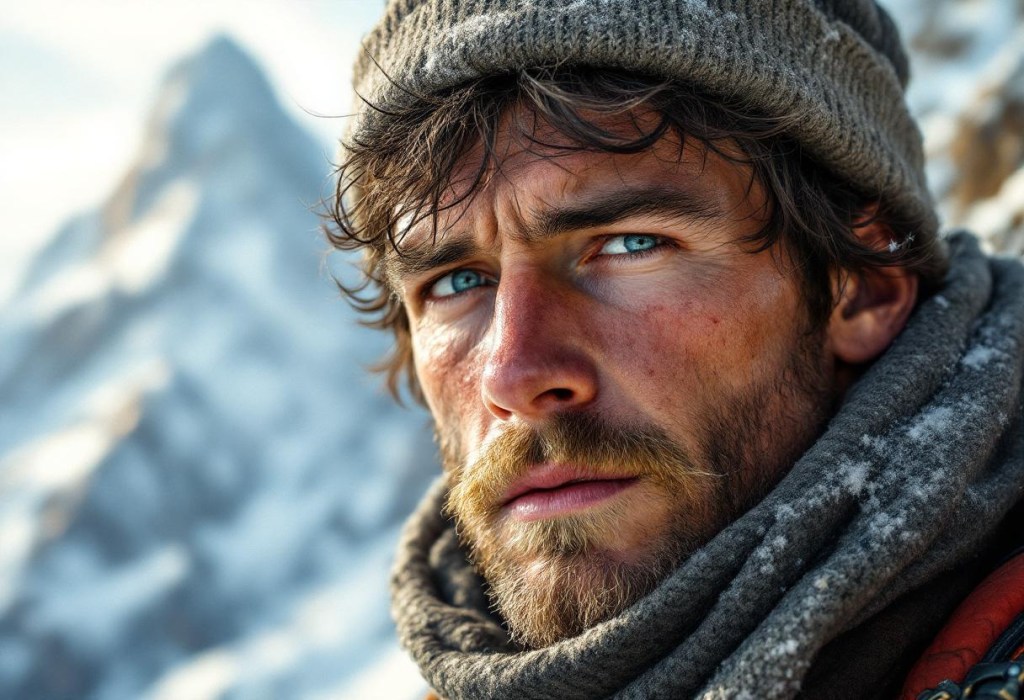
The Eiger, Swiss Bernese Alps – 11th August 1858
Part I: The Measure of a Man
Charles Barrington stirred in the thin darkness of his lodgings, the wooden beams of the Grindelwald inn creaking softly above his head as the Alpine wind whispered secrets through the valley. Sleep had been elusive, his mind turning restlessly over what lay ahead – a prospect that no gentleman, indeed no man, had ever contemplated with reasonable expectation of success. The Eiger loomed somewhere beyond the shuttered windows, its presence felt rather than seen in the pre-dawn gloom, a brooding mass of limestone and ice that had claimed the ambitions of lesser peaks for millennia.
He rose quietly, his movements careful not to disturb the profound silence that settled over mountain villages before cockcrow. The floorboards, worn smooth by generations of Alpine boots, felt cold beneath his stockinged feet as he moved to the window. Drawing back the heavy wooden shutters, he peered into the darkness where the great mountain waited, invisible yet unmistakably present, like a sleeping giant whose breathing one might feel upon the air.
The sound of voices from the courtyard below drew his attention – low, measured tones speaking the local dialect with the easy familiarity of men who had known each other through countless dawns such as this. Christian Almer and Peter Bohren moved through their preparations with a methodical precision that spoke of rituals refined by necessity. Barrington watched, transfixed, as the two guides laid out their equipment in the pale light of a storm lantern, each piece examined with the reverence a surgeon might show his instruments.
Almer, the elder of the two, possessed hands that seemed to read the very soul of rope and iron. His fingers traced along hemp fibres with an intimacy that suggested conversations held in a language Barrington could never hope to understand. The Irishman had thought himself well-prepared, his gentleman’s education having furnished him with theoretical knowledge of mountaineering, yet watching these men, he felt the inadequacy of his learning as keenly as a physical ache.
Peter Bohren moved with the fluid economy of a man whose every gesture had been honed by the mountain’s harsh tutoring. He selected ice axes with the same care a musician might choose his instrument, weighing each tool in his palm, testing the balance, the keenness of the cutting edge. There was poetry in their movements, Barrington realised – a profound understanding of the marriage between human skill and the tools that extended it into realms where flesh alone could not venture.
“Herr Barrington,” Almer called softly, his voice carrying the particular quality of men accustomed to making themselves heard above the wind’s howl. “The morning grows no younger whilst we tarry.”
Barrington dressed quickly, his fingers fumbling slightly with the unfamiliar fastenings of his Alpine attire. The heavy woollen garments felt cumbersome after the fine-tailored clothes of Dublin society, yet he understood instinctively that fashion held no currency where they were bound. As he descended to the courtyard, he caught Bohren casting a practised eye towards the eastern horizon, where the faintest suggestion of dawn touched the peaks with silver.
“The weather?” Barrington enquired, following the guide’s gaze.
“She will hold,” Almer replied, though his expression remained thoughtful. “But the mountain keeps her own counsel. We must listen carefully to what she tells us.”
The simplicity of the statement masked depths that Barrington was only beginning to fathom. These men read signs invisible to him – the particular quality of cloud formation, the behaviour of wind patterns, the subtle messages written in snow conditions and rock stability. Their very survival depended upon an intimacy with natural forces that his urban existence had never required him to develop.
They set off through the village as darkness still held sway, their boots creating a steady rhythm against the cobbled streets. The guides moved with sure-footed confidence even in the gloom, their bodies adjusted to terrain that would have challenged Barrington’s navigation in broad daylight. He found himself following the sound of their movement as much as their visible forms, trusting in their guidance with a faith that both humbled and alarmed him.
As they left the last of the village buildings behind, the character of their undertaking began to assert itself. The path – if such a generous term could be applied to the barely discernible track they followed – wound upwards through terrain that grew increasingly hostile with each step. What had seemed like romantic adventure in the comfort of his Dublin study now revealed itself as something far more serious: a test of human capability against forces that regarded their ambitions with complete indifference.
The first grey light of dawn found them already well above the treeline, moving across slopes where the morning wind carried the sharp scent of snow and stone. Barrington’s breath came harder now, the thin air reminding him that they had entered the mountain’s domain proper. Yet his guides showed no such distress, their breathing steady and controlled, their pace unwavering despite the increasing gradient.
It was then that the mountain chose to demonstrate its power. A rumble began somewhere high above them, a sound that seemed to emerge from the very bones of the earth itself. Almer’s hand shot out, grasping Barrington’s arm with iron strength, pulling him against a rock face as a river of snow and ice thundered past them into the valley below. The avalanche lasted perhaps thirty seconds, yet in that brief span, Barrington experienced his first true understanding of the forces they sought to challenge.
“Close,” Bohren observed with characteristic understatement, his voice carrying no trace of alarm.
Barrington’s heart hammered against his ribs as he watched the guides calmly assess the changed conditions, their professional composure absolute despite having witnessed destruction that could have ended their enterprise – and their lives – in an instant. In that moment, watching these men evaluate danger with the same measured consideration they might give to selecting breakfast, he began to comprehend the true nature of their calling.
The morning light strengthened around them as they continued their ascent, and with it came Barrington’s growing awareness that he was witnessing something extraordinary: men whose profession demanded not merely skill or courage, but a complete integration of knowledge, instinct, and judgement that few callings could claim to require.
Part II: The Testing Ground
The morning had progressed with deceptive ease, the mountain allowing them passage through terrain that would have seemed impossible from below. Barrington found himself developing a rhythm with his guides, their movements creating a kind of alpine ballet across slopes where a single misstep would write the final chapter of their story. The sun climbed higher, casting the snow fields in brilliant relief against the blue-black shadows of the north face, yet with each step upward, the Eiger seemed to regard their progress with increasing scrutiny.
It was past mid-morning when the mountain chose to test them properly. They had traversed a particularly exposed section where the west ridge narrowed to little more than a knife-edge of limestone and snow, when Barrington felt his footing give way beneath him. The verglas – that treacherous skin of ice that formed overnight on the rocks – had remained hidden beneath a deceptive dusting of fresh snow. One moment he was following Almer’s steady progress across what appeared to be secure ground; the next, he was sliding helplessly towards the void, his gentleman’s boots finding no purchase on the polished stone.
The sensation was unlike anything his Dublin existence had prepared him for – not the controlled fear of a difficult horse or the managed risk of a business venture, but the absolute terror of gravity asserting its dominion over human ambition. Below him yawned the north face proper, a vertical wilderness of ice and stone that fell away into blue-black infinity. His hands clawed desperately at the rock, seeking any irregularity that might arrest his descent, but the mountain offered no such mercy.
Then, with a violence that drove the breath from his lungs, the rope connecting him to his guides snapped taut. The hemp fibres – those same strands he had watched Almer examine with such reverence in the pre-dawn darkness – held fast against forces that should have torn them asunder. Above him, he heard Bohren’s sharp command in the local dialect, followed by the immediate response of men whose lives had been spent in partnership with such moments.
Suspended over the abyss, Barrington experienced a profound revelation about the nature of trust. Every thread of the rope that held him represented not merely craftsmanship, but the accumulated wisdom of generations of mountain men who had learned to read the language of hemp and iron. The knots that secured him had been tied by hands that understood viscerally how human life might depend upon the placement of each twist and turn of fibre.
“Herr Barrington,” Almer’s voice came from above, steady as granite despite the circumstances. “You must listen carefully now. We shall bring you back, but you must do exactly as we say.”
The calm authority in the guide’s tone penetrated Barrington’s panic more effectively than any shout or dramatic gesture might have done. This was not bravado or false reassurance, but the voice of a professional addressing a crisis within his area of expertise. Watching from below as the two guides began their rescue manoeuvre, Barrington witnessed something approaching artistry in their movements.
Bohren anchored himself with an economy of motion that spoke of countless similar situations, his body positioned to provide maximum security whilst allowing Almer the freedom to work. The elder guide began a complex dance with rope and iron, each placement calculated with the precision of a surgeon, each decision weighted against consequences that would tolerate no error. There was poetry in their collaboration – wordless communication born of shared experience in circumstances where miscommunication meant death.
As they hauled him back to safety, Barrington found himself studying his rescuers with entirely new eyes. The physical strength required was considerable, but it was the mental discipline that truly impressed him – their ability to remain methodical whilst adrenaline coursed through their veins, to think clearly whilst staring into the face of potential catastrophe. This was professional competence of a kind his commercial world rarely demanded or produced.
“The mountain tests all men equally,” Almer observed once Barrington had regained solid footing, his breathing gradually returning to normal. “Rank and education mean nothing to her. Only preparation and respect.”
The simplicity of the statement carried depths that Barrington was only beginning to fathom. These men possessed something that his gentleman’s education had never taught him to recognise: expertise that had been earned through direct confrontation with forces that killed without malice or favour. Every skill they demonstrated had been purchased through experience that lesser men would not have survived to learn from.
As they continued their ascent, Barrington’s awareness sharpened to encompass details he had previously overlooked. The way Bohren read the subtle signs of unstable snow conditions, adjusting their route with minute corrections that avoided dangers invisible to the untrained eye. The manner in which Almer tested each handhold before committing his weight, his fingers seeming to interrogate the very molecular structure of the rock. Their equipment, which had appeared so simple in the inn’s courtyard, revealed itself as the product of generations of refinement, each tool evolved through bitter experience to serve its purpose with absolute reliability.
Most remarkably, they performed these demonstrations of expertise without ostentation or self-consciousness. There was no sense that they were showing off for their gentleman client, no awareness that they were displaying skills worthy of profound admiration. For them, this was simply work – the daily exercise of capabilities that their profession demanded they possess.
During a brief rest on a narrow ledge carved into the mountain’s flank, Barrington found himself contemplating a question that had been building throughout the morning’s drama. What manner of professional calling demanded such complete integration of physical skill, mental discipline, and moral courage? In his Dublin circle, men prided themselves on their expertise in law or commerce, their mastery of social conventions or political manoeuvring, yet none of these accomplishments required their practitioners to stake their lives upon their competence with such regularity.
The guides tended to their equipment with ritualistic care, coiling rope with the same reverence a priest might show sacred vestments, examining iron points with the focused attention of men who understood that their survival depended upon the smallest details. Watching them, Barrington began to understand that he was witnessing something extraordinary – men whose profession had transformed them into instruments of precision, whose expertise had been refined in the crucible of mortal consequence until it achieved a kind of perfection rarely found in human endeavour.
Above them, the summit beckoned through thinning air, but Barrington’s thoughts had turned inward. A question was forming in his mind, one that seemed to capture something essential about what he had witnessed this day – something about the nature of professional excellence and the particular kind of admiration it deserved.
Part III: The Summit of Understanding
The afternoon sun had begun its westward journey when they encountered the mountain’s final test. The last approach to the Eiger’s virgin summit demanded passage through terrain that seemed designed to humble human ambition. Here, where the mountain’s architecture narrowed to its ultimate point, every step required a negotiation between flesh and stone that pushed the boundaries of what mortal men might reasonably attempt.
Barrington’s legs trembled with exhaustion as he followed his guides across a traverse that would have defeated him utterly without their guidance. The thin air burned his lungs with each breath, whilst the altitude played tricks with his vision that no amount of gentleman’s conditioning had prepared him to endure. Yet ahead of him, Almer and Bohren moved with the same measured precision they had displayed at dawn, their bodies adapted through years of such punishment to function where lesser constitutions would simply surrender.
The irony was not lost upon him – here, where his education and social standing counted for nothing, where his carefully cultivated accomplishments proved as useful as morning mist against granite, these mountain men demonstrated mastery that dwarfed any expertise he had previously encountered. Every placement of axe and rope represented knowledge earned through direct communion with forces that killed without conscience or consideration.
“Mein Gott,” Bohren muttered as they gained a precarious foothold on a ledge barely wide enough to accommodate their forms. Above them, the summit pyramid rose in a final challenge that seemed to mock their presumption.
Almer studied the route ahead with the concentrated attention of a scholar examining ancient texts, his weathered features revealing nothing of the calculations taking place behind his eyes. When he finally moved, it was with the fluid certainty of a man whose expertise had been distilled through countless similar moments into something approaching instinct.
They climbed in silence now, the mountain’s thin air making conversation a luxury they could ill afford. Barrington found himself entering a state of consciousness he had never before experienced – a heightened awareness born of exhaustion and danger that stripped away the comfortable assumptions of civilised existence. In this rarified atmosphere, only essential truths survived.
As they paused on a narrow shelf of rock, perhaps fifty feet below the summit that no human eye had ever gazed upon from above, Barrington felt compelled to voice the question that had been building throughout their extraordinary day. The words came without premeditation, emerging from depths of gratitude and wonder he had not known he possessed.
“What profession do you admire most,” he asked quietly, his voice barely audible above the wind’s whispered commentary, “and why?”
Both guides turned to regard him with surprise, their expressions suggesting that philosophical discourse was not customary at such altitudes. Yet something in Barrington’s tone – perhaps the genuine reverence it carried – prompted Almer to consider the query with his characteristic thoughtfulness.
“Herr Barrington,” the elder guide began, his accent lending gravity to the English words he chose carefully, “this is a question I have not before considered.” He paused, his gaze moving across the vast panorama that spread below them, peaks and valleys arranged in magnificent disorder as far as the eye could encompass. “Yet perhaps it is one worth pondering.”
The Swiss guide’s weathered hands adjusted his grip on the rope that connected their lives as he continued. “I think of my father’s father, who was a shepherd in these valleys. He could read weather in the movement of clouds, predict storms by the behaviour of his flock days before they arrived. His hands knew the temperament of every animal in his care, and he moved through these mountains as though they were his parlour.”
Bohren nodded in silent agreement, understanding the direction of his companion’s thoughts.
“I think also,” Almer continued, “of the midwife in our village. Frau Weber. When other women panic at the moment of birth, she becomes calm as still water. Her expertise has brought life safely into the world when death seemed certain. She needs no instruments but her knowledge, no assistants but her experience.”
The simplicity of his examples carried profound weight in the thin air. Barrington realised that Almer was speaking of something he himself had only begun to understand – the particular nobility that belonged to those whose mastery had been earned through direct engagement with elemental forces.
“There is the blacksmith too,” Almer added, warming to his theme. “His hands know the soul of iron, can coax metal to forms that serve man’s needs. Watch him work, and you see conversation between craftsman and material that no book can teach.”
A pause fell between them, filled only by the mountain’s eternal song. Then Almer fixed Barrington with eyes that held depths carved by decades of such moments.
“But perhaps,” the guide concluded, “the profession I admire most is any calling that requires a man to stake his life upon his knowledge. Where error means not embarrassment or financial loss, but death. For such work demands not merely skill, but complete integration of body and mind and spirit. It transforms the practitioner into something approaching perfection.”
As they resumed their final approach to the summit, Barrington felt the profound truth of those words settling into his consciousness. Here, in the company of men whose profession demanded such absolute competence, he had witnessed excellence of a kind his comfortable world rarely produced or rewarded.
The summit itself, when they finally gained it as the afternoon sun began its descent towards the western peaks, proved to be a modest affair – a pointed crown of stone and ice that had waited through geological ages for this moment of human witness. Yet standing there, three small figures on ground that had never known human presence, Barrington experienced something approaching transcendence.
This was not conquest, he understood with sudden clarity, but harmony. The mountain had not been defeated but rather had chosen to permit their passage, and that permission had been earned through the extraordinary competence of men who understood their proper relationship with forces infinitely greater than themselves.
As they began their careful descent, the shadows lengthening around them like fingers of approaching night, Barrington found his thoughts turning towards Ireland and the life that awaited his return. Yet he knew with absolute certainty that this day had established a standard by which all future professional encounters would be measured – not by social position or financial reward, but by the depth of expertise demonstrated when circumstances permitted no margin for error.
The mountain guides had shown him something precious: the particular dignity that belonged to those whose mastery had been refined in the crucible of genuine consequence. It was a revelation that would shape his understanding long after the summit had become memory, a measure of professional excellence that transcended any single calling to encompass the highest achievements of human capability.
In the gathering twilight, as they picked their careful way down paths known only to themselves, Barrington carried with him the answer to his own question – professional admiration properly belonged to those who had earned their expertise through direct engagement with forces that demanded nothing less than perfection, where competence was not merely desirable but absolutely essential for survival itself.
The End
On 11th August 1858, Charles Barrington, an Irish merchant with little mountaineering experience, made the first successful ascent of the Eiger via its western flank, accompanied by Swiss guides Christian Almer and Peter Bohren. The team set out from the Wengernalp hotel at 3:30 a.m., reached the 3,970-metre summit at noon, stayed for ten minutes, and descended in about four hours. This achievement was a landmark in Alpine climbing history, cementing the Eiger’s reputation as one of the premier challenges in the Bernese Alps.
The mountain’s infamous north face – nicknamed the Mordwand (“murder wall”) in German – would go on to claim at least sixty-four lives between 1935 and the present, remaining unclimbed until 1938, when a German-Austrian team completed the first ascent of the face. Remarkably, Barrington never returned to the Alps after his sole expedition, instead devoting himself to training his racehorse Sir Robert Peel, which won Ireland’s first Grand National in 1870.
Today, the Eiger continues to draw climbers from around the globe. A railway tunnel built through the mountain in the early 20th century offers access to viewing platforms carved into the rock face, helping make the Eiger one of Switzerland’s most photographed and visited peaks.
Bob Lynn | © 2025 Vox Meditantis. All rights reserved. | 🌐 Translate


Leave a comment