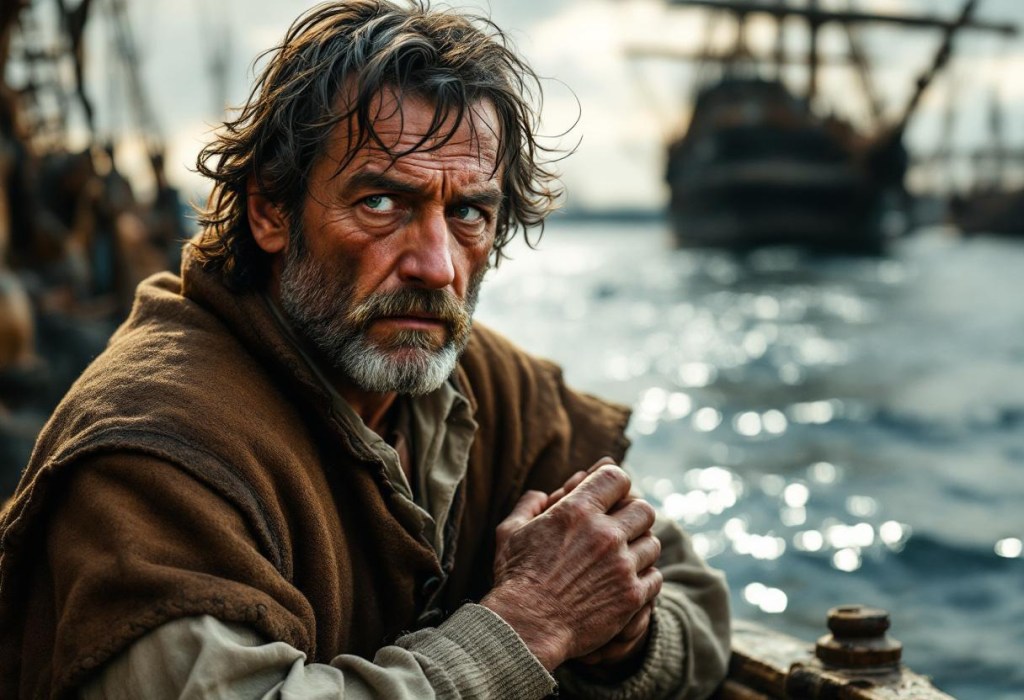
Stockholm, Sweden – 10th August, 1628
Part I: The Pride
The August dawn hovered over Stockholm’s harbour like a hesitant witness, casting long, faint shadows between the forest of masts that bristled against the chilled, slate-coloured sky. Nils Andersson’s boots struck the cobblestones in deliberate, hollow cadence as he moved through the morning mist, pulled forward by an unease he could neither name nor ignore. Before him, dwarfing all other vessels, the Vasa loomed – a hulk of timber and ambition carved from the shadows into the light of the new day.
Even in the half-light, she was magnificent. Sixty-nine metres of carved oak and ambition, her hull gleaming with fresh paint and gilded ornament. Lions and cherubs cavorted across her stern castle, their golden faces catching the first weak rays of sun. The royal coat of arms blazed forth in azure and gold, whilst hundreds of sculptures proclaimed the might of King Gustavus Adolphus to any who might dare challenge Sweden’s dominion over the Baltic. Nils had spent three years of his life breathing sawdust and bleeding splinters for this moment, yet as he gazed upon his handiwork, a familiar weight settled in his chest like a stone dropped into still water.
The memory struck him like a physical blow – three months past, in the timber yard behind the royal dock. Admiral Fleming had arrived unannounced, his jewelled fingers drumming impatiently against his sword hilt as he surveyed the Vasa’s emerging hull.
“The beam is too narrow for her height, Admiral,” Nils had said, stepping forward despite his apprentice’s warning glance. “With the bronze cannons and the upper works – “
“Master Andersson.” Fleming’s voice cut like a blade through seasoned oak. “His Majesty desires a ship that will cow the Danish fleet at first sight. Are you suggesting we disappoint our sovereign?”
“I’m suggesting we build a ship that won’t disappoint him by sinking.” The words had escaped before Nils could check them.
Fleming’s pale eyes had narrowed to slits. “You speak of sinking when we speak of glory. Perhaps your grandfather’s fishing boats have limited your vision.” He stepped closer, close enough that Nils could smell the wine on his breath. “The King’s enemies will see sixty-four bronze cannons and two hundred carved warriors. They will not see your… calculations.”
“But the sea will see them,” Nils had replied quietly.
“The sea,” Fleming had said with contempt, “serves Sweden as all things must serve Sweden.”
Now, watching the crowds gather for the maiden voyage, Nils felt that same cold certainty settling in his chest. The sea served no king.
Nils pulled his woollen cloak tighter against the morning chill. The harbour was beginning to stir with the purposeful movement of those who made their living from the sea. Fishermen prepared their nets whilst stevedores hefted cargo with practised efficiency. Yet all eyes turned inevitably towards the Vasa, as if drawn by some invisible tide. She dominated the water like a floating cathedral, a testament to Swedish craftsmanship and royal ambition that would soon carry the kingdom’s aspirations across the northern seas.
The shipwright’s calloused hands traced the rail of a smaller vessel as he walked, feeling the honest grain of pine beneath his fingertips. His grandfather had built boats like this – simple, seaworthy craft that had carried fishermen safely through Baltic storms for decades. There was no gilt upon their humble bows, no carved lions to proclaim their grandeur, yet they had never failed their masters. They understood the fundamental covenant between wood and water, between human ambition and natural law.
As the morning progressed, Stockholm’s citizenry began to gather along the waterfront. Noble ladies in their finest silks positioned themselves upon specially erected platforms, whilst merchants and craftsmen jostled for position among the common viewing areas. Children darted between the adults’ legs, their excited chatter rising like smoke above the crowd. This was to be a day of celebration, a moment when Sweden’s naval supremacy would be proclaimed to the world.
Nils recognised many faces in the growing throng. There was Henrik the carpenter, who had carved the elaborate stern decorations with such loving care. Master Eriksson the sailmaker stood with his apprentices, pride evident in his weathered features as he gazed upon the vast expanse of canvas that would soon catch the Baltic winds. Yet beneath the excitement, Nils detected something else – a tension that seemed to emanate from those who, like himself, had intimate knowledge of the great ship’s construction.
Near the merchant quarter, he spotted Captain Erik Jonsson examining the Vasa with the calculating gaze of one who had spent his life reading the subtle language of ships and weather. The captain’s face bore the permanent squint of a man accustomed to scanning distant horizons, his hands scarred by rope and salt spray. There was something reassuring about his presence – a reminder that beneath all the ceremony and spectacle, the sea remained the final arbiter of any vessel’s worth.
The morning sun climbed higher, burning away the mist to reveal the Vasa in her full glory. Every detail proclaimed the wealth and power of the Swedish crown: the intricate carvings that spoke of mythological triumph, the pristine rigging that seemed to web the sky itself, the gleaming brass fittings that reflected the light like captured stars. She was beautiful beyond measure, a masterpiece of the shipwright’s art that represented years of labour and immeasurable expense.
Yet as Nils watched the final preparations for departure, his unease deepened. The ship listed slightly to port even whilst at anchor, her heavy gun deck pressing down upon the waterline with ominous persistence. The afternoon breeze, when it came, would fill those massive sails and heel her further still. Physics and pride were about to meet in a contest that could have only one victor, and Nils Andersson knew which force would prove the stronger.
The weight of royal expectations pressed down upon the harbour like the heavy air before a storm, and somewhere in the depths of his craftsman’s soul, Nils Andersson began to pray.
Part II: The Fall
The afternoon sun hung low over Stockholm’s harbour as the church bells chimed four o’clock. Captain Söfring Hansson’s voice carried across the water, sharp with authority as he ordered the final preparations for departure. Nils Andersson stood amongst the swelling crowd, his craftsman’s hands gripping the harbour rail until his knuckles showed white beneath the grime of honest labour. The Vasa lay magnificent in the golden light, her bronze cannons gleaming like captured sunfire, yet something cold and prescient twisted in his belly as he watched the warping begin.
The great ship moved slowly along the waterfront, hauled by anchors and the muscle of her crew. Hundreds of Stockholmers had gathered to witness this moment of national pride – merchants in their finest doublets, fishermen’s wives clutching excited children, foreign ambassadors whose presence spoke of international interest in Sweden’s maritime ambitions. The very air seemed to vibrate with expectation, yet Nils found himself studying the Vasa’s behaviour in the water with growing unease. Even under tow, she listed slightly to port, her ornate hull riding lower than his experienced eye deemed prudent.
As the ship reached Slussen and caught the harbour current, four of her ten sails unfurled like the wings of some magnificent but doomed creature. The white canvas billowed against the azure sky, and a thunderous salute echoed across the water as her bronze guns proclaimed Swedish might to all who would hear. The crowd erupted in cheers, their voices carrying across the harbour like a tide of joy and patriotic fervour.
But Nils saw what others could not – or would not – see. The slight southwesterly breeze, so gentle it barely stirred the pennants along the shore, caught those towering sails with inexorable force. The Vasa heeled to port under the pressure, her gun ports – open wide to display her armament in ceremonial splendour – dipping perilously close to the waterline. For a heart-stopping moment, the great ship seemed to hang suspended between triumph and disaster, her ornate stern castle swaying like a drunkard’s dance.
“She’s too tender,” Nils whispered, the words torn from his throat like a prayer. Around him, the crowd maintained their festive mood, but he could see other mariners in the throng beginning to frown, their weathered faces reflecting his own growing alarm.
The sheets were cast off as the gust passed, and slowly – so slowly – the Vasa righted herself. A collective sigh of relief seemed to ripple through the spectators, and the cheering resumed with renewed vigour. Children pointed at the magnificent vessel as she continued her stately progress eastward, whilst their parents spoke in hushed tones of Swedish naval supremacy and the glory that would follow this mighty ship across the Baltic seas.
Yet Nils’s relief proved tragically short-lived. As the Vasa approached Tegelviken, where the southern bluffs gave way to open water, a stronger gust of wind found her exposed sails. This time, there was no gentle listing, no graceful recovery. The great ship heeled violently to port, her elaborate superstructure acting like a giant lever that drove her gun ports beneath the grey surface of the harbour.
The sound that followed would haunt Nils Andersson’s dreams for the remainder of his days – the rush of water pouring through bronze-framed apertures that had been designed to project Swedish power, not to admit the very element that should have borne the ship to victory. The lower gun deck flooded with terrifying speed, the weight of water exceeding the Vasa’s minimal ability to right herself.
“Dear God in Heaven,” someone gasped nearby, but Nils could not tear his gaze away from the unfolding catastrophe. His craftsman’s knowledge made the disaster even more horrifying, for he understood precisely what was happening beneath those ornate planks. The water was cascading down into the hold, overwhelming pumps that had never been designed for such an influx, creating a deadly spiral from which there could be no recovery.
The crowd’s cheers died like candles in a gale. Children began to cry as they sensed their parents’ sudden terror. Women screamed as they realised that the pride of the Swedish navy was not performing some elaborate manoeuvre – she was dying before their very eyes.
The Vasa’s death throes lasted mere minutes, but to Nils they seemed to stretch into eternity. He watched men scrambling up the rigging as the deck canted at impossible angles, saw figures leaping into the harbour waters, witnessed the magnificent stern castle – adorned with lions and cherubs that had taken months to carve – disappear beneath the surface like a sinking dream. The great ship settled into thirty-two metres of grey water, only a cable’s length from the shore, her masts protruding above the surface like the fingers of a drowning giant.
Boats rushed from every corner of the harbour – fishing smacks, merchant vessels, even the royal barge – their crews hauling survivors from the cold embrace of the Baltic. Yet for all their efforts, thirty souls would not answer the evening’s muster. Thirty lives sacrificed to royal ambition and the hubris of those who believed themselves wiser than the immutable laws of physics.
As the immediate rescue efforts continued, Nils became aware of someone standing beside him – a weathered figure whose calm presence seemed to anchor him in a world suddenly turned mad. Captain Erik Jonsson’s lined face bore the expression of a man who had seen the sea claim too many vessels, too many dreams, too many lives.
They stood together in the gathering dusk, surrounded by the debris of Sweden’s greatest maritime ambition, whilst the cries of the bereaved echoed across waters that had swallowed more than timber and bronze – they had swallowed the very soul of a nation’s pride.
Part III: The Reckoning
The silence between them stretched like the lengthening shadows across Stockholm’s harbour, broken only by the distant splash of oars and the muffled sobs of those who mourned. Nils Andersson stood transfixed by the sight of the Vasa’s mainmast, still visible above the grey waters like a monument to folly, its royal pennant now sodden and lifeless. Around them, the detritus of Sweden’s greatest maritime disaster drifted with the current – carved wooden angels whose golden faces now bore the tarnish of salt water, fragments of rigging that had once sung with Baltic winds, splinters of oak that had been shaped by his own hands into something magnificent and doomed.
Captain Erik Jonsson cleared his throat, the sound cutting through Nils’s reverie like the scrape of an anchor chain. When the shipwright turned to face him, he found the older man’s weathered features etched with a compassion that seemed born of long acquaintance with the sea’s capacity for both wonder and cruelty. Erik’s pale blue eyes, faded by years of scanning distant horizons, held no accusation – only the quiet understanding of one craftsman recognising another’s anguish.
“Thirty-two years I’ve been sailing these waters,” Erik said, his voice carrying the measured cadence of a man accustomed to speaking truth in the face of hard realities. “Seen storms that could tear a ship apart like parchment, pirates who’d slit your throat for a handful of copper coins, ice that could crush a hull like an eggshell.” He gestured towards the protruding mast with a calloused hand. “But this… this is something else entirely.”
Nils felt the weight of unspoken guilt pressing down upon his shoulders like a millstone. “I knew,” he whispered, the confession torn from his throat like splinters from green wood. “God help me, I knew she was too tender, too heavily laden. The calculations were there in every timber joint, every gun port, every ornate carving that Fleming demanded for His Majesty’s glory.”
The captain nodded slowly, his gaze drifting across the rescue boats that still plied the waters in search of survivors. “Aye, I thought as much. Takes a builder’s eye to read a ship’s soul, and yours has been dark with worry all afternoon.” He paused, watching as a fishing smack pulled another sodden figure from the harbour’s embrace. “Question is, what does a man do with such knowledge when authority refuses to listen?”
Before Nils could respond, Erik turned to face him fully, and in that weathered countenance the shipwright saw something unexpected – not condemnation, but curiosity tinged with what might have been hope. The question, when it came, struck with the force of a physical blow.
“If you were going to open up a shop, what would you sell?”
The words hung in the evening air like smoke from a dying fire. Nils stared at the captain, his craftsman’s mind reeling from the apparent callousness of the inquiry. Here, surrounded by the wreckage of lives and dreams, with the cries of the bereaved still echoing across the water, this stranger asked about commerce? About profit and trade as if nothing of consequence had occurred?
Yet as the moments passed, Nils began to perceive the deeper currents beneath Erik’s seemingly casual question. This was not mockery, nor insensitive curiosity about his future prospects. This was something far more profound – an invitation to examine the very foundations upon which he had built his understanding of craft, purpose, and service.
“Coffins,” Nils said bitterly, his voice rough with suppressed emotion. “Perhaps I should sell coffins, for I seem to have mastered the art of building tombs disguised as ships.”
Erik’s expression did not change, but something in his pale eyes suggested he had expected such an answer. “Coffins serve their purpose, true enough. But they’re the end of stories, not the beginning.” He nodded towards a small fishing boat that bobbed near the disaster site, its crew still searching for survivors despite the growing darkness. “What about boats like that one? Simple craft that bring men home to their families each evening, that put bread upon humble tables without need for royal fanfare?”
The suggestion struck Nils like a revelation. He found himself studying the little vessel with new eyes, seeing past its weathered planks and patched sails to the honest craftsmanship beneath. Here was a boat built not for glory but for purpose, designed to work in harmony with wind and wave rather than to dominate them through brute force and ornament. Its builder had understood something that the Vasa’s architects had forgotten – that the sea demands respect, not defiance.
“My grandfather built such boats,” Nils said slowly, memory stirring like sediment in still water. “Thirty years he spent crafting vessels for the fishermen of Gotland. Never lost a single one to storm or structural failure.” He paused, his craftsman’s hands unconsciously sketching proportions in the air. “They called his work common, unremarkable. No gilt upon their bows, no carved lions to proclaim their builder’s skill.”
“Yet they served,” Erik observed quietly. “They carried honest men through honest work, season after season, year after year. Is that not a form of glory in itself?”
As if drawn by invisible threads, Nils found himself walking towards the water’s edge, where the harbour mud gleamed black in the dying light. Without conscious thought, he knelt beside the lapping waves and began to trace lines in the soft earth with his finger – the clean, purposeful lines of a fishing boat’s hull, proportioned for stability rather than spectacle. The design emerged beneath his touch like something long suppressed finally finding voice.
“Beam of five metres, perhaps,” he murmured, more to himself than to Erik, who had followed and now stood watching with growing interest. “Draft shallow enough for coastal work, but deep enough to handle Baltic swells. Single mast, manageable by a crew of three or four.” His finger carved deeper furrows as the vision solidified. “No bronze cannons to weigh her down, no carved cherubs to catch the wind. Just honest oak and iron, built to last a lifetime of honest service.”
Erik crouched beside him, studying the muddy sketch with the attention of a mariner reading a chart. “She’d be beautiful in her own way,” he said approvingly. “The kind of beauty that comes from knowing exactly what you are and fulfilling that purpose without apology.”
As full darkness settled over Stockholm’s harbour, Nils continued to refine his design in the yielding mud. With each line, each carefully considered proportion, he felt something shifting within his craftsman’s soul – a rebalancing of priorities that had been knocked askew by years of serving royal ambition rather than human need. The Vasa’s masts still jutted from the water like accusations, but their power to wound was diminishing with each stroke of his finger in the harbour earth.
“I would sell boats,” Nils said finally, his voice carrying a conviction that surprised him with its strength. “Simple boats for simple men who trust their lives to my craft. No admiral would commission them, no king would claim them for his navy. But they would serve, Captain Jonsson. They would serve, and they would bring their crews safely home.”
Erik Jonsson smiled – the first genuine expression of joy that had graced the harbour since the Vasa’s final plunge. “Aye,” he said, rising and extending a hand to help Nils to his feet. “I believe they would. And I know fishermen who would pay honest coin for such vessels, built by a craftsman who has learned the difference between pride and vanity.”
As they walked back towards the lights of Stockholm, leaving the muddy sketch to be claimed by the rising tide, Nils felt the weight of failure beginning to transform into something else entirely – the foundation upon which true craftsmanship might finally be built.
The End
On 10th August 1628, the Swedish warship Vasa capsized and sank in Stockholm harbour just minutes into her maiden voyage, claiming an estimated 30 to 50 lives from the roughly 150–200 people on board. Built between 1626 and 1628 as the flagship of King Gustavus Adolphus’s fleet during Sweden’s war with Poland–Lithuania, the Vasa was one of the most costly undertakings in Swedish history, consuming over 200,000 riksdaler – around 5% of the nation’s gross national product. Measuring 69 metres in length, armed with 64 bronze cannons, and lavishly decorated to project Swedish naval power, she nonetheless suffered from fatal design flaws that left her dangerously top-heavy and unstable. A royal inquiry found no one personally accountable, and the ship lay forgotten on the harbour floor for 333 years until marine archaeologist Anders Franzén located her in 1956. Raised intact in 1961, the Vasa is now preserved to 98% of her original timber and stands as the centrepiece of Stockholm’s Vasa Museum. Since opening in 1990, the museum has drawn over 45 million visitors, making it Scandinavia’s most popular museum and a striking reminder of the perils of ambition outpacing engineering wisdom.
Bob Lynn | © 2025 Vox Meditantis. All rights reserved. | 🌐 Translate


 Vox Meditantis
Leave a comment