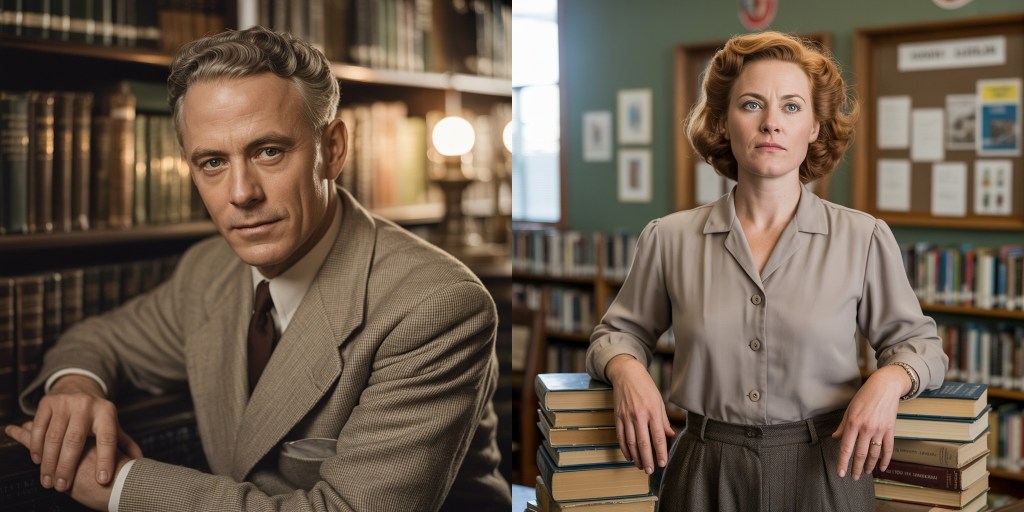
67 Beacon Street, Boston, Massachusetts
15th November, 1944
My Dearest Sarah,
The lamplight flickers against these November-darkened windows as I take up my pen this evening, and I find myself thinking of Wordsworth’s lines: “The best portion of a good man’s life, his little, nameless, unremembered acts of kindness and of love.” How those words have echoed through my thoughts these past weeks, Sarah, as I have wrestled with the weight of my recent silence and the inadequacy of any explanation I might offer.
I must begin with what should have been my first words to you—I am profoundly sorry. My retreat into that familiar refuge of books and solitude following our disagreement about the post-war world was not born of indifference to your views, but rather from my own cowardice in facing how deeply they challenge the comfortable certainties I have carried these forty-five years. When you wrote so passionately about the opportunities this terrible war might create for women’s advancement, about the possibility that Sarah Harris need not return to the constraints that bound her mother’s generation, I felt the ground shift beneath assumptions I had never thought to examine.
Your forgiveness, expressed in that remarkable letter of 3rd November—written, I suspect, on that practical blue stationery whilst you waited for me to find courage enough to respond—has humbled me entirely. That you could see past my wounded pride to the frightened man beneath speaks to a generosity of spirit I scarcely deserve. You wrote that my silence suggested not dismissal of your ideas but rather “the careful consideration of a mind too honest to offer easy agreement,” and in those words, I glimpsed the extraordinary woman who has somehow chosen to love this cautious New England professor.
How can I adequately express my gratitude for such grace? In the weeks since receiving your letter, I have walked the familiar paths of Cambridge with new eyes, seeing everywhere the evidence of changes I had been too blind to acknowledge. The women welding at the shipyard in nearby Charlestown, the female students who now comprise nearly half my literature courses, the quiet revolution occurring beneath the surface of our war-torn world—all of it suddenly visible because you had the courage to name what I could not see.
I am grateful, too, for the way you have awakened in me appetites I thought long buried beneath years of academic routine. Before your letters began arriving like small miracles in my daily post, I had convinced myself that passion was the province of the young poets I teach rather than the middle-aged man who merely interpreted their words. Yet your correspondence has revealed that the capacity for wonder—for that breathless anticipation when I recognise your handwriting upon an envelope—remains as vital at forty-five as it was at twenty-five.
Your recent description of the Nebraska sunset, painted in words that would make Cather herself envious, reminded me that the Midwest possesses its own profound poetry—one written not in carefully crafted verses but in the daily acts of survival and hope performed by people like your Norwegian grandparents, like you yourself. I think often of your grandmother’s hands, as you described them, “map-lined with the geography of seasons survived,” and I understand now why you found my initial romanticising of hardship so naïve. Experience has taught you what books could never teach me—that true strength lies not in enduring suffering but in transforming it into wisdom.
The war that has aged us both prematurely has also granted us this unexpected gift: the discovery that love need not be the exclusive territory of youth. In your letters, I find the rare companion who can match my passion for ideas whilst grounding those ideas in lived experience. When you challenge my interpretation of Frost’s rural imagery with your own memories of harvest time, when you question my assumptions about Steinbeck’s migrant workers with stories from your library’s community programmes, you remind me that literature lives not in ivory towers but in the daily lives of people like those you serve.
I close this letter with a confession: I have begun drafting what I dare to hope might become a book about the evolution of American correspondence during wartime, inspired entirely by our own exchange of letters. Your voice—direct, challenging, yet achingly tender—has shown me that the most profound love letters are not those that merely profess devotion, but those that risk honesty in service of deeper connection.
With all my love and boundless gratitude for your patience with a man still learning to match his heart’s capacity with his courage to express it,
Arthur
P.S. I have been re-reading your letter of October whilst preparing tomorrow’s lecture on epistolary literature, and I find myself marvelling at how your words demonstrate truths about the form that centuries of scholarly analysis have failed to capture. Perhaps the most profound correspondence has always emerged not from peace, but from the crucible of separation and longing.
Bob Lynn | © 2025 Vox Meditantis. All rights reserved. | 🌐 Translate

 Vox Meditantis
Leave a comment